


“The Beatles of the avant-garde.” That’s just one of the epithets hurled at the willfully obscure musical collective known only as The Residents. Since the early ’70s—though they had been at work for years at that point—the group, waggishly billed as North Louisiana’s Phenomenal Pop Combo, has been turning out some of the weirdest and most intriguing music known to humankind. Multimedia pioneers, The Residents have long made music and videos that satirize popular (and unpopular) culture, while defying convention and engaging in subtle social commentary.
They’ve also poked the bear countless times, creating deeply transgressive works that focus on the macabre, violent, and simply outré. The Residents have only rarely cracked the album charts, but their albums—more than 100 and counting—are often critical smashes, and their influence is considerable.
One of The Residents’ earliest recorded and released works was the narrative/conceptual Eskimo. Ostensibly based on Inuit folk tales collected by the group’s (almost certainly fictitious) mentor/collaborator N. Senada, the work features conventional ingredients—vocals, guitars, percussion, and synthesizers—put to some decidedly unconventional uses. A studio album was released in 1979 to critical praise (and commercial indifference), and over the coming years The Residents would make several attempts to stage it as a performance piece. Always busy, the group became involved in countless other projects, leaving Eskimo’s promise unfulfilled.
Recent interest created conditions that the always-anonymous group found favorable, so as spokesman Homer Flynn (more on him in a moment) explains, The Residents are mounting a tour, performing the original Eskimo material with newly added music. The group’s 2026 tour was originally planned to commence with a January 9 date in Vancouver, followed by 12 more North American dates that month. But in very early January, the group’s website announced that the tour was postponed due to “unexpected and serious health-related matter within the band’s camp.” Then last June, the group released a new set of North American dates for the Eskimo tour, starting October 7 in Chicago. According to that update, “The shows will bring the entire 1979 classic Eskimo to the stage for the first time. In addition, they have added five new pieces based on authentic Eskimo folk tales from the late 1800s.”
One of the group’s earliest tenets was the belief that an artist does his or her best work when it’s done in obscurity. They’ve credited that Theory of Obscurity to the mysterious N. Senada. In line with that philosophy, The Residents—whose most recognized visual image is four top-hatted, tuxedoed figures with giant eyeballs in place of heads—don’t do interviews. They never have. Instead, they employ spokesmen authorized to speak on the group’s behalf. Some cynics have suggested that those spokespeople—including Hardy Fox (who died in 2018) and Flynn, the latter of whom I spoke with in December 2025—are in reality Residents themselves. But nobody knows for sure.
The transcript has been edited for length, flow, and clarity.Bill Kopp: The Residents have often used their work as a means of commentary on society, popular culture, and the like. They seem to do so on Eskimo by referencing Coca-Cola ads. I’m not someone who believes that anything ends up on a Residents recording if it’s not by intention; nothing happens by accident. What do you think they were trying to communicate by inserting the Coke jingle?
Homer Flynn: My interpretation is that they felt that Eskimo culture—Inuit culture—was an isolated and somewhat pure thing 100, 150 years ago. And they felt that it was ultimately corrupted by Western culture. So you get polar bears drinking Coke.
Bill: I understand that the original storyline and concept for Eskimo were inspired by N. Senada’s expedition to the Arctic. From the beginning, was Eskimo conceived as a multimedia work, or was that an idea that came later?
Homer: I think they saw it as a multimedia work from the beginning. They played little [performances of Eskimo] here and there, but basically they’ve never really toured it or taken it out because their ambition was to do a stage production with it; more than a band on tour.
But things change over time. And they were approached almost two years ago to play an event called A Night of Ideas. The French consulate in San Francisco produced it in conjunction with another French agency in Paris. One intriguing thing about this performance is that they were asked to headline the show, but the organizers wanted only 20 minutes. The Residents went, “Well, yeah, 20 minutes is not that hard to do.”
Bill: But that’s not how long Eskimo is!
Homer: No, it’s not. So ultimately, they did an abbreviated version. But they felt like the fact that they only wanted 20 minutes begged for experimentation, for trying things that they hadn’t done before. So they thought, “Why not try to do more of a band version of it as opposed to a whole stage production?” That came together incredibly effortlessly, and from that point one thing led to another.
Bill: With that in mind, is this run of dates going to come down completely on the band side of things, or is it going to bridge the gap between band and stage production?
Homer: I think it’ll be a little bit of both. There are limitations as to what you can do with a band on tour. Everybody’s got to go on a bus. Whatever you’re carrying has to go on that bus or in a trailer behind it. But The Residents have never been shy about stretching their limitations.
I think it’s a really interesting show myself. They were invited to play a festival in L.A. called Exotikon, and that was in June [2025]. Once again, that came together fairly effortlessly. So they kind of feel, “Okay, this is what this wants to be; let’s go with it.”
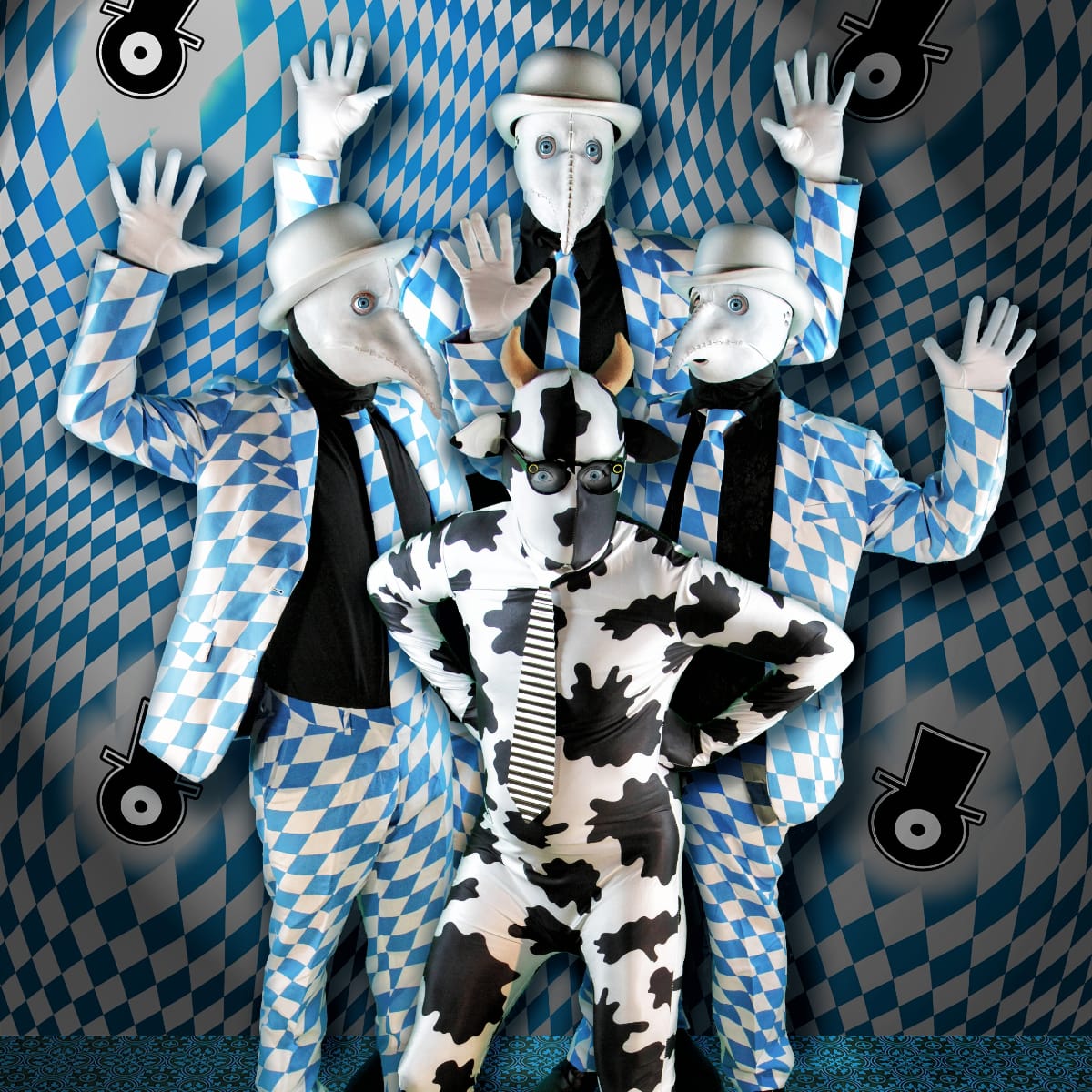
Bill: Was The Residents’ performance at that tiki event—Exotikon—an abbreviated version of Eskimo, or was it the full work?
Homer: Some of the Eskimo songs were abbreviated. They felt it needed to be abbreviated a little, but then expanded at the same time. So they also added several new songs because they realized that, doing the album live, it wasn’t long enough. And (laughs) there are places in Eskimo when we don’t hear anything but wind . . . for a long time. So they started doing research, and they found these Eskimo folk tales from the late 1800s, early 1900s. They couldn’t believe they hadn’t found those when they did the original research. But they found several books—50 or 60 of these folk tales—and picked out ones that were particularly appealing to them. So they’ve added four or five new songs to the set.
Bill: When The Residents conceive of a live performance—whether it’s a one-off like A Night of Ideas or a tour—are things set in stone? Or do they do a postmortem after a performance and think, “Okay, how can we tinker with this and change it to improve it going forward?”
Homer: They certainly have tinkered with it and changed things from A Night of Ideas to Exotikon, and from Exotikon to now. But usually once they’re touring—once they have a show together—they don’t really change things a whole lot. If they did an American tour and then a European tour, things may get shifted around between those because you have a big gap of time. But when they’re doing 14, 15 shows in three weeks, they’re not changing things very much.
Bill: Is there any chance at all for additional Eskimo dates in the U.S. at some point?
Homer: I think that everybody—agents, promoters, whatever—is looking to see how this one does. I expect there will probably be more U.S. dates, but nobody knows at this point.
Bill: I first interviewed Hardy Fox back in 2006, and I know that Jay Clem had done select interviews long before then. But in ’06, I was still surprised that a spokesman for The Residents and/or The Cryptic Corporation decided to do press. In recent years, you in particular have made yourself much more available to journalists; in fact, this conversation is the third time I’ve interviewed you. And you’re even doing a meet-and-greet at the upcoming shows, which I found really surprising. What led to the change in the approach over the years, and does it represent any kind of a rethinking of the Theory of Obscurity?
Homer: It’s my own personal point of view that the media pretty much controls things. When somebody—Bush or whoever—was elected president 20 or 30 years ago, I was watching him give his acceptance speech, and there were shots of that. And basically what you had was this guy standing up there addressing a thousand cameras. He wasn’t talking to a group of people; he was talking to all these cameras. And I went, “Huh, okay. Well, that tells me where the real power is, ultimately.”
The Residents are deliberately obscure. They’ve been that way from the beginning; they like that. And in the beginning, that alone was enough to garner a certain level of publicity and interest. But after a while, when people like you don’t have anybody to talk to, it gets a little old. So Cryptic Corporation came up with the idea of spokespeople who can then interact with the media in a relatively straightforward way. And ultimately, that has worked.
Bill: The Residents have been working since the 1960s. At the start, did they have any goals or expectations about how long they might continue operating?
Homer: This would seem like kind of a contradiction, I suppose, but The Residents have always been very ambitious; they saw things from a really long-range, long-term point of view. And their point of view was that they were going to be there as long as it lasted. And it’s still going strong.
The Residents have become more spiritual than before. I’m not saying they’ve become religious, but the manifestation of them in a lot of ways is more spiritual than concrete. And given that, they feel like they can potentially go on forever. I may not be around long enough to see it, but that’s the attitude around here. We’ll see.
Check out more like this:
 Jonah Evans
 Bill Kopp


Comments