


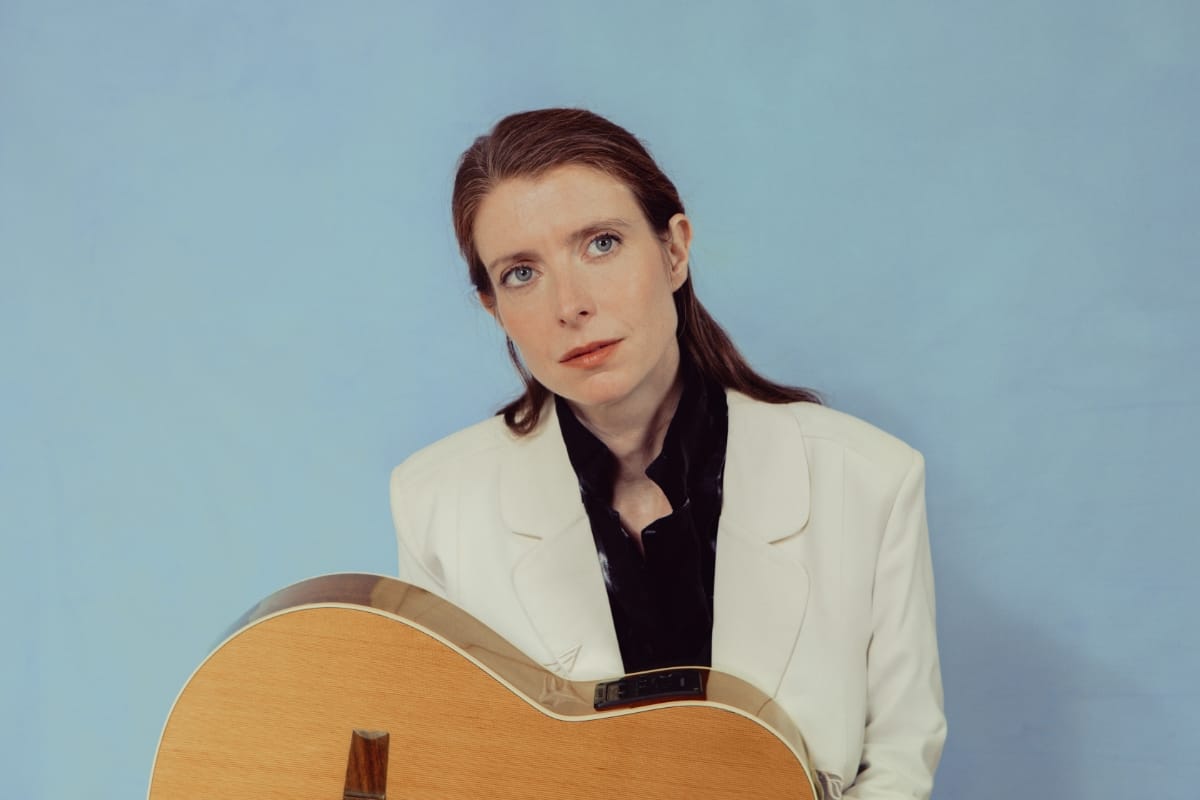
Paris-based artist Aure’s debut album, printemps, was released earlier this year. After her 2023 debut EP, a few notes, which led to performances across Europe as tour support for Andy Shauf and Tom McRae, Aure has expanded her emotive sound and songwriting. There’s something about Aure singing in between English, French, and Spanish from song to song, and sometimes within songs, from verse to chorus. How can a person choose what language to sing in when they’re multilingual? Perhaps this is an American question. Still, it’s a choice and one that Aure makes consistently, not just on printemps, but in her songwriting overall. What if you learn an expression in another language that can’t be quite felt, or a sensation that can’t be enveloped unless the language shifts? When Aure sings in different languages, the inflection shifts across words and syllables and emphasizes vocality, creating part of her multi-textured compositions.
Part of the power in Aure’s voice is her ability to treat each word she sings as important as the next. Words are drawn out to their end, encompassing their weight and purpose. And there’s something to be said about being patient with treating words with such subtle care that it becomes almost a meditation or contemplation of these moments in each song, a slow swelling of living in the moment, and appreciating that something is always being expressed, even if it may live in the abstract.
In “Corriendo,” the guitar is fluttering ever so slightly while Aure enters the song speaking quietly, and in the chorus, her volume increases as she begins to sing. The notes in the chorus are elevated and drawn out, and this oscillation between verse and chorus creates clear contrast and tension. In some chorus refrains, you can hear her voice layered lightly, humming a harmony that seems to reflect the chorus. It’s kind of haunting, this quiet echo. The main guitar never stops playing throughout the song, while a few other instruments melt in and out. These layers are just one example of how printemps explores sonic textures with great depth.
Aure composed the songs and brought in Corentin Ollivier to arrange and produce them, and the result is full-bodied. Even here, Aure draws on minimalist artists such as Atahualpa Yupanqui, Facundo Cabral, Jessica Pratt, and Lhasa, who bring this bareness to their work—what may be revealed by scaling back larger productions in the artist’s work and tone. Subtle, intentional textures seem to reign in printemps. This quiet ambiance of intertwined instruments, sounds, vocals, and production may be where she meets her influences, but also separates from them. The songs have accents and textures, but they aren’t allowed to dominate the space of her voice and, most of the time, her guitar.
And this is where printemps (quietly) screams, “Sit. Listen. Stay in the moment,” because if you don’t really listen to what’s presented, such as life, you may miss the complexities that are all too often easy to overlook—we move on to the next thing, we speed up instead of slow down, and too often, fail to listen, fail to process a feeling, a sensation, a reality that is real. The inflection is always there. And maybe that’s why when I listen to printemps, I can just sit still, not think about anything, and lose myself in a moment of peace because there is no urgency to get anywhere or make declarative statements. printemps opens hearts to a calmness, though this is no ambient album; it has a clear feeling of how it wants to live in breath. There is some uncertainty, but it’s something to live with and live in.
The transcript has been edited for length, flow, and clarity.
Jonah Evans: Your new album is out. How are you feeling about it being out there in the world?
Aure: I feel relieved, I think. It’s beautiful to end things and have everything fixed. And now, knowing the songs are out and will have their own lives, too—in the ears of people or at shows. So now we can continue the journey.
Jonah: I love the cadence of your voice in the first song, “Los Pájaros,” as well as the sound of the birds in the background and how the guitar kind of meanders. What made you want to start the album with that song?
Aure: I like the idea of starting with something where I don’t sing. But with this title, “Los Pájaros,” which means birds, I wanted to start with the idea of birds. And I’m just thinking, “¿Dónde andan los pájaros?” Where are the birds going? It’s as if I was having that thought. That idea really drove the writing, even if it wasn’t conscious. When I started writing, I spent a lot of time looking for a place to go or a place to feel fine. And I still have this idea of a bird. We will know where to go. We will know how to feel good. We will move when we’re not in a good place. We will sing. It’s a little bit literal.
Jonah: Do you think it was more about starting with an idea than a regular kind of song?
Aure: For me, it’s telling a story. And so, I feel it doesn’t have to be only “real songs.” I just wanted to invite you into this story. Maybe in the future I’ll do more instrumental parts in the middle, or things that are even more talking than singing. But I like this idea of having the freedom to tell a story the way we want, you know?
Jonah: I like that because it reminds me of how you had mentioned that a lot of the songs are like images of moments. So I see those birds, but the album name means spring, right?
Aure: Yeah. It’s spring, but in French, it’s the same word: spring or springs. For me, spring is a cycle. It’s not this spring; it’s all the springs you have in life.
Jonah: So it carries multiple meanings. It’s not a fixed moment in time. Change isn’t a fixed moment either. How else did you explore the album’s themes, intentionally or not?
Aure: I felt it was not so conscious. When I started to write the album, I had a lot of ideas, and one day I realized I had the songs. I didn’t know it would end up like that. The songs came, and I was like, “Okay, it’s about this.” I saw that “Green is blue,” “The Sailors’ Tales,” and maybe “La Nuit” are about a frontier. Today, I feel we have to choose one side or the other, and things are very black or white. And I think that there is this idea in a few songs of things that are changing, but also things being unsure. “Green is blue” is about a feeling where you don’t know exactly, where doubt can exist, and the colors can mix together.
And I like this idea of this uncertainty. “The Sailors’ Tales” is similar, about erasing boundaries. In “La Nuit,” there’s also a feeling, but you don’t know exactly what it is—whether it’s sadness, darkness, or something more luminous. Things are a bit melded together. Then there are songs about renewal, the literal sense of spring. “Corriendo” is more about a quest and someone who is looking for something. But it’s also about feeling closer to nature, like a flower reborn after winter. “L’orage” is about after the storm. So many of the songs are about the light that is starting to show.
I don’t know if I’m clear. For me, they all speak about almost the same thing, but through the different emotions I had at the time. Some are more about the light, others about a difficult moment. That mix is what I like.
Jonah: Tell me about “A ti te tengo.” That song had a lot more velocity than the other songs. It’s very pitter-patter; it has this pushing energy. How did that song come about, and where does the urgency come from?
Aure: It’s about the moment after the storm, after all the questing—a very different emotion. It’s a song about finding your place and settling in. It’s a simple and happy song. I worked with Corentin Ollivier on the arrangements. We wanted the end of the song to keep going, with the idea that things are moving now. He helped a lot. I spent a lot of time at his studio. I’d bring a song that was mostly voice and guitar, and we worked together to find the sounds we wanted to give the songs. The album had a lot of collaboration. He was helping produce.
Jonah: You were both producing it together?
Aure: Yeah, pretty much. In the studio, we worked on each song little by little to find the right parts. And I really enjoyed working with him because he really understood the fact that I wanted to keep it simple, and that was very important for me. He understood that sometimes we would try to add things, and I was like, “No.” And I feel we also have the same aesthetic, even if he’s able to do a lot of things, maybe more filled and more complicated.
Jonah: How did you make the decision to even work with him? How did that come about?
Aure: A few years ago we did a live session for my EP, and he played the keyboard. We did just one rehearsal, and you know how sometimes with some people it’s just easy; you have the same aesthetic. We kept in touch and did a show together. And it was very simple. I just asked him. He listened to all my demos, and it was like, “Okay, let’s go to the studio. Let’s see what happens.” Little by little, we finished the album. It’s not easy to invite someone into your music. But with the right person, it gives some songs more depth and makes something less linear.
Jonah: The album and the sounds of your songs give a lot of space to think. To sit and be in it. Do you feel that way in your songs? Do you want that?
Aure: That space is really something I wanted. Yesterday I was on the radio and the host asked me if it was a necessity for me or an aesthetic to do simple things. I answered that for me it’s important to live in architecture or in music. To live in a space. And I want the person who listens to feel the space the way they want to feel it. And in architecture, it’s a little bit the same. I don’t like to make spaces with too much information. I keep it simple because the people who come after will add their own things. And when I said that, I thought, in my music, is that true? In architecture, it’s very clear for me. And in music, it’s also an aesthetic. I’m happy to hear that someone else feels it that way. Because for me, yes, it’s really like the idea of putting someone in the mood when they listen, and then I’m happy if they can go where they want to go.
Jonah: That kind of reminds me of Leonard Cohen and Atahualpa—these ideas of minimalism and not taking up too much space.
Aure: With Leonard Cohen, it’s his aesthetic. When I listen to one of his songs, I can immediately travel somewhere. I’m not sure it’s simple, but maybe it’s simple in that it’s mostly voice and guitar, and there’s strength in that alone, which impresses me. And also, all the lyrics are incredible. For me, Cohen and Atahualpa Yupanqui are both poetry. With Yupanqui, I like the sound of his guitar and the lyrics, too: he wants to give a message. Even if I don’t exactly do that, I trust that a song can deliver a message and maybe change someone’s mind a little.
Jonah: A lot of musicians are adding more digital elements to their records. It seems important, or at least passively important, to still hold on to the understanding that it’s okay not to use a bunch of instruments.
Aure: I think it’s about not being obliged to use all the techniques we have, and saying we can still make songs with just simple elements. And also, for this idea of not filling too much, I also feel like for me it’s a little bit of a necessity because, as you say, we are in a world where we have a lot of information, a lot of things all the time. And I think that what I wanted to make with my music was also like a pause, like in all of these systems. I just want to make a proposition that’s maybe less demonstrative but offers a moment of quietness.
One of my favorite albums from the last few years is Quiet Signs by Jessica Pratt. I’ve been listening to it a lot, and her album feels very contained. She can do a lot in a song with two chords, guitar, and her voice, which is very special, and I don’t even understand all the lyrics she sings. But it’s just a quiet atmosphere. And I like to listen to those kinds of things.
Jonah: So as a former architect, what did you learn from architecture and photography that informs you in your construction of music?
Aure: I think it’s a question of harmony, which is a little bit mysterious for me. You can learn it in architecture or in music, or you can find it by feeling. With a facade, you can use the golden ratio, et cetera, but you don’t know exactly why a proportion is harmonious or not. And in music, I feel it’s a little bit the same. It’s harmonious; it’s nice to listen to.
Jonah: I like this idea of harmony in the two fields that can be found in knowing it or just with an intuition. What’s the golden ratio? I’ve heard that before, but I don’t know what it is.
Aure: It’s like a proportion that was used to draw buildings before. Things need a relationship between the proportions of one thing and another. A window, for example, respects a certain proportion. And so you can calculate all of these things. But before, there were rules about proportion for drawing a nice building. Like rules in music, people used to follow them, but they don’t anymore. The golden ratio is out of favor now. People just design whatever they want.
Check out more like this:
 Carl Dexter
 Jonah Evans


Comments