


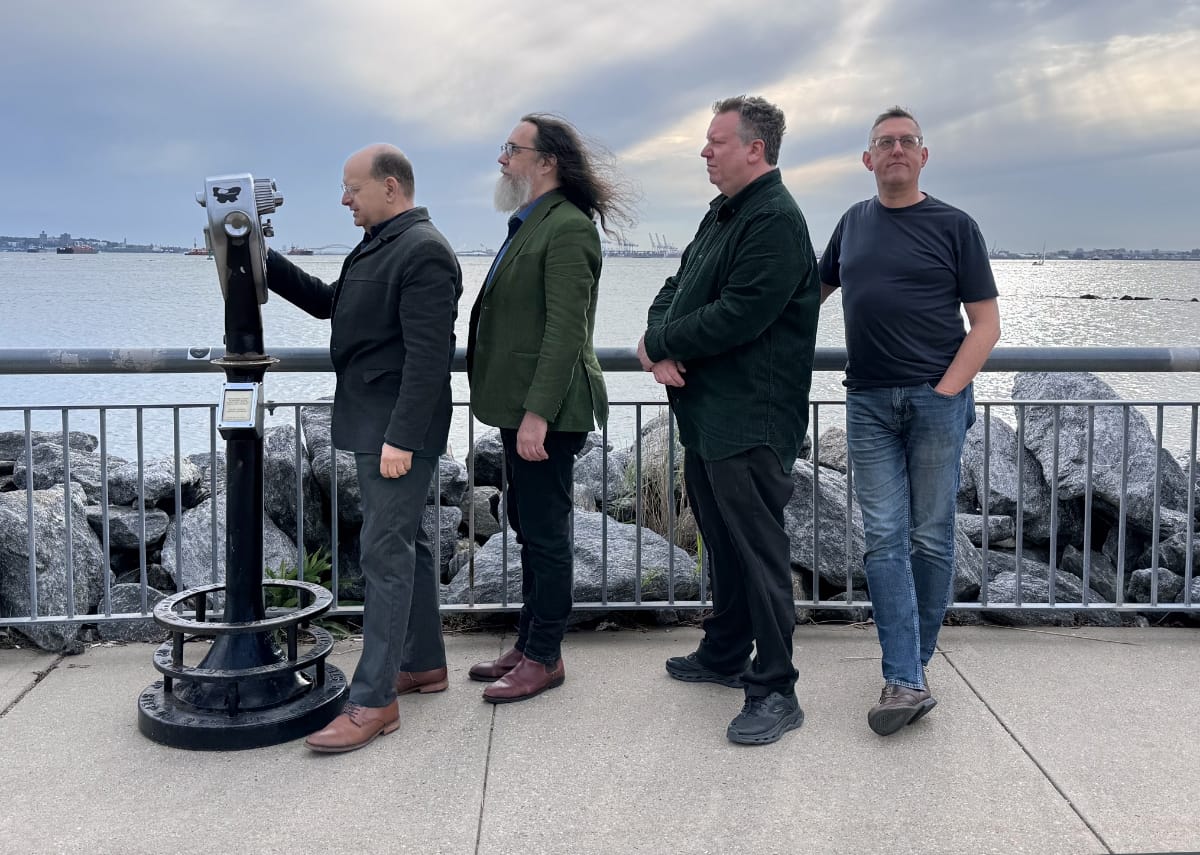
There’s more than one Franklin Bruno. His role as the driving force of NYC band the Human Hearts is the one that’s relevant to lovers of sharply weaponized songwriting and hook-filled but slightly subversive indie rock with a post-punk/New Wave lean. Then there’s the academic Franklin Bruno with a background as a philosophy professor and a passion for symbolic logic.
The twain may never quite meet, but it’s unavoidable for the academic’s chocolate to occasionally end up in the indie rocker’s peanut butter. And as with Reese’s famous confection, the collision can have some delicious results. Beginning at the onset of the ’90s, old-school DIYer Bruno fronted Nothing Painted Blue, a band that at one point included Joey Burns of Giant Sand and Calexico. They mixed an archly engrossing cocktail of power pop, leftfield indie rock, and postmodern conceptualism, evoking a world where Superchunk’s members first met at an Italo Calvino book club.
Since then, Bruno has served up solo projects, headed up the Human Hearts, and gone on busman’s holidays by working with the Mountain Goats, the aforementioned Superchunk, Jenny Toomey, and the Extra Lens, his duo with main Mountain Goat John Darnielle. His latest Human Hearts outing, Faith & Credit, leaves love songs and transgressive posturing to the torpid and trope-happy, focusing instead on making public politics personal (“Sad and Afraid,” “Enemies of Song”), the finer points of finance (“The Old Currencies,” the title track), and much more.
Recorded by the near-mythical Mitch Easter (R.E.M., Let’s Active, Game Theory, et al.), Faith & Credit meets your ear like pop music—at least a Gen Xer and lifelong undergrounder’s version of pop music—and then the edgier aspects materialize. Ultimately, both your head and your heart are hooked. We buttonholed the kindly indulgent Bruno to explore how his philosophical side shapes the Human Hearts’ trenchantly tuneful new album.
The transcript has been edited for length, flow, and clarity.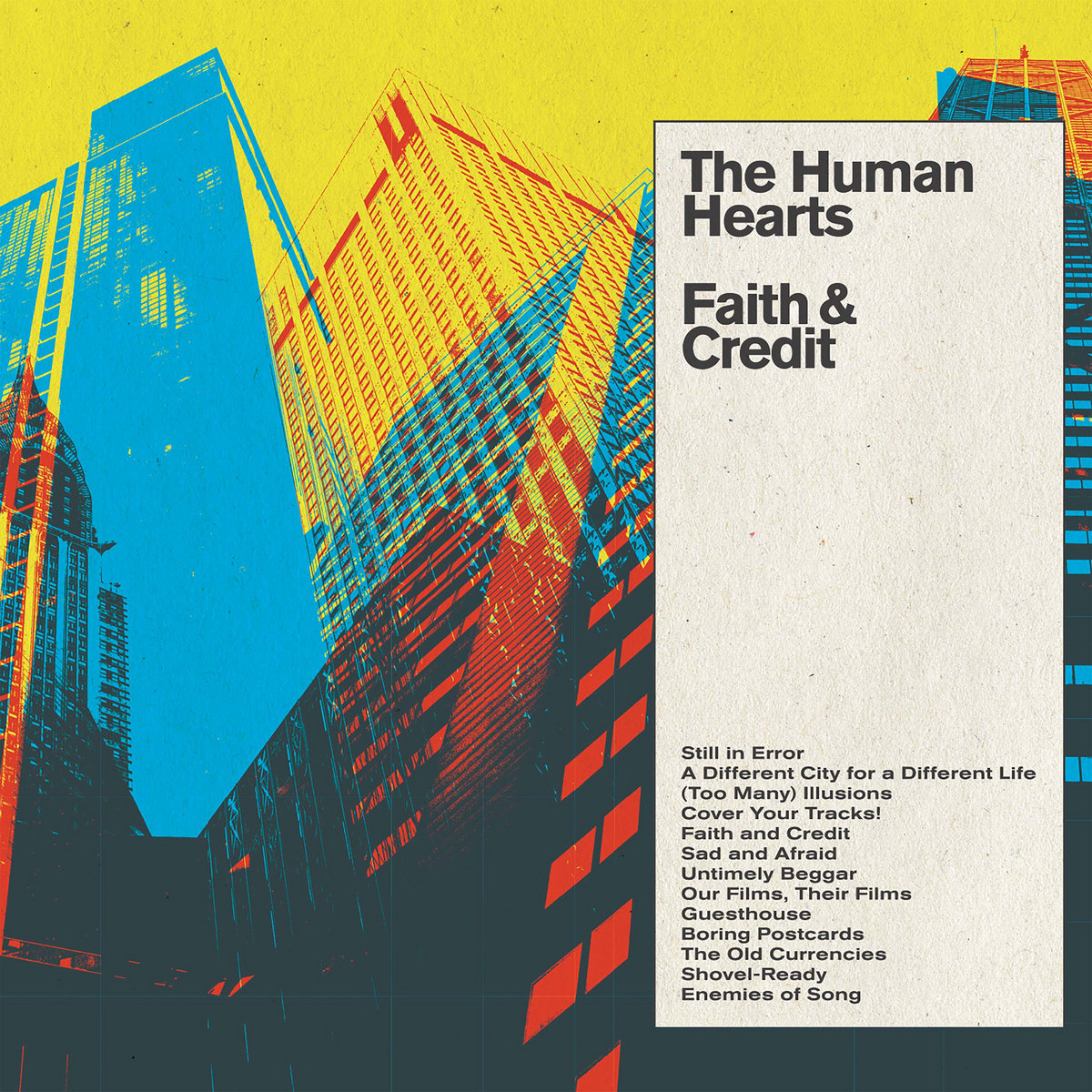
Jim Allen: What did your entry into the philosophy world look like?
Franklin Bruno: When I went to college, my undergraduate BA was in math. I was good at studying symbolic logic, and that ended up taking me toward a certain kind of philosophy of language. I went back to grad school for that at UCLA a few years later. First, I made a bunch of records, and then I went to grad school about 1995 and did that type of philosophy. It took me 10 years to finish my dissertation. By the time I got out, I was writing about philosophy of art.
There’s a question in philosophy of art: What’s the relationship of different performances of a musical work to the musical work itself? What is a work? I can rip up the score of a Beethoven string quartet; I haven’t destroyed the string quartet, so it’s obviously not the score. It’s not identified with any performance, because if that performance didn’t happen, the score would still exist, etc. So, what is a musical work?
Jim: Have you asked that question about your own musical work?
Franklin: I was expanding that question to be not just about classical works but also, what is a pop song? What kind of object is it? It’s not a physical object; it’s not any particular record of it. To some degree, the fact that I became interested in that as a philosophical question came from the fact that I had started to wonder, “What am I doing as a musician? What kind of object am I making? Is it the song, is it the record?” I think more about songwriting sometimes than I do about sound. So, a bunch of different intellectual questions arise about how different types of music are organized. That’s a philosophical question that I am interested in.
Jim: What answers have you come up with?
Franklin: It’d be hard to say how that affects any particular song. I’ve felt for a long time that I was getting a rep for being wordy, quirky, cerebral, and brainy. But I feel like, if the main thing that you get when you listen to the record is, “Oh, there’s a very intelligent person who made this music,” I think I probably failed. I wanted to lead with it being interesting and emotionally resonant. I would like the melodies and chord progressions to be affecting or expressive. The records I’m happiest with are based around a band that plays live, and I like to work on effective small-group interaction. A band that plays together a lot can be a wonderful thing. Those are all things that I don’t think are about philosophy.

Jim: Is there a significant difference between your own philosophical work and what you’ve taught as a professor?
Franklin: I did teach a Philosophy of Literature class, and I taught some aesthetics; I taught a Philosophy of Film class, but I also taught very straight Symbolic Logic classes, almost a math class, that is a requirement for anybody who wants to be a philosophy major. Basically, any college that wants to have an accredited philosophy program has to have someone teaching logic. Which isn’t always the kind of philosophy many students, especially non-majors, want to do. If you came in mostly interested in Heidegger or Baudrillard, or critical theory, or political philosophy, you might not be too excited about the exercise of turning simple sentences into symbols and figuring out how inferences work between them. But I think I’m a pretty good teacher of it.
Jim: Was there ever any overlap between your artistic and academic roles?
Franklin: I never wanted to be at a college and be the Cool Professor. I’m not a particularly cool guy anyway. (laughs) Every so often, somebody might figure out that I played on some record they’d liked, and they’d talk to me about it. I’m not gonna be in denial about it, but I’m also not gonna make that why you should respect me in the classroom. In general, in the classroom I’ve always sort of downplayed what I do in music.
Jim: Sometimes songwriters can seem like philosophers, sometimes storytellers, sometimes poets.
Franklin: If people know what Language poetry was, the kind of avant-garde movement in the 1980s, I was very affected by that in college. It tends to have a little bit of a chilly tone, and a lot of the writers have a pretense of being a little philosophical, being into Wittgenstein and French theory and what have you. I wouldn’t say that’s where my lyrics come from, but it’s one of the things in my head when I think about stylistic possibilities.
Jim: How about storytelling?
Franklin: If you look at the record, I think there are only a couple of songs where you would exactly say they’re storytelling. “Guesthouse,” I think, is a story with a kind of creepy narrator, a first-person guy who’s staying in somebody’s back house and sneaking into the main house, using stuff, and kind of bitter about his landlord. That is a kind of fiction having to do with my memories of when I lived in Claremont, California, a college town where a lot of ex-students or townies would live in someone’s back house for like a nine-month lease, and what kind of relationships that led to. But it’s also a genre play on songs like the Go-Betweens’ “Draining the Pool for You,” where it’s sung by a rich guy’s servant.
Stay on top of The Tonearm.
Subscribe for exclusive interviews, cultural tip-offs, and community fun.
And your support keeps our site free of advertising and paywalls.
Jim: Are there songs on Faith & Credit where you recognize the incursion of philosophy?
Franklin: That song “Illusions” uses a bunch of imagery of optical illusions. In the middle, the singer says, “I don’t want too many illusions but leave me this one,” and I don’t say what that one is. I had a couple of thoughts about what that song is for me. It’s partially about ideology, like how many political lies you can see through and what’s left when you see through them. At the same time, I was listening to a podcast about the 17th-century philosopher Pierre Gassendi, a rival and contemporary of Descartes. The discussion covered his ideas about the philosophy of perception. Both Descartes and this guy—one thing they talked about was: when are we suffering from illusions in our perception? How do we correct our errors?
The examples used turned out to be things like the straw bending in the water [an image in Bruno’s song]. I thought if someone heard this discussion of Gassendi, they might think, “Oh, yeah, that Franklin Bruno guy, he just wrote a song about a bunch of the stuff in 17th-century philosophy of perception and put it down.” And I didn’t. I wrote it years earlier. But it did make me think, maybe I’ve read some of this stuff in grad school in a History of Philosophy class. Maybe the way I think is more affected by philosophical stuff, old texts and old language being in my head, than I’m even aware of. So, there’s probably some philosophy in the songs, but I’m not always aware of it.
Jim: What about sounds in your head that might have snuck into the record?
Franklin: We recorded the record with Mitch Easter. And of course I admire his records, not just as the producer of R.E.M. and Game Theory, but I loved [his ’80s band] Let’s Active and going back to [his ’70s band with Chris Stamey] Sneakers and things like that. So, to some extent, if I point to some model of a record I love, there might be somewhere I’m saying I would like it to be that good. There are models. If you can affect people the way that affected you, that would be ideal.
Jim: What do you feel are some of your songwriting signatures?
Franklin: I am going for specificity. I like it when there’s language in the song that feels like, “Oh, that’s this song.” I want it to feel like this song was written for particular reasons, because it needed to be this song rather than fit together like a hundred other songs. One of the things I loved about the Go-Betweens is there’d be a noun in one of the songs like, I’d never heard anyone mention a pocket watch in a song before, or something like that. That’s something I hope I can do sometimes.
Jim: What kind of music was in your house growing up?
Franklin: My parents were born pre-rock ’n’ roll. Probably the hippest record in the house was Ella Fitzgerald Sings Gershwin. So, at 12 or 13 maybe, when other people were starting to absorb the records their parents had in high school, I didn’t really discover rock ’n’ roll for myself until I got into New Wave. I loved “Whip It,” and I loved the B-52’s. So, I kind of went straight from show tunes to New Wave at a certain age. I had a friend in junior high whose older brother gave him tapes of Magazine and the Undertones, and those are the first things I remember listening to over and over and getting in my head.
Jim: Your father was a writer and professor, right?
Franklin: My dad was a psychologist. More like rats-in-mazes kind of psychology and experiments on perception; he wasn’t a therapist. He taught for about 40 years at a community college in San Bernardino. You could say I come from an academic family, but honestly, having your dad teach Intro to Psychology and Child Psychology to people getting their associate degrees in nursing and fire science in San Bernardino is very different than being like third-generation Ivy League. He wrote psychology textbooks and self-help books and reference books. He was also a lifelong unpublished novelist. Toward the end of his life, he self-published several e-books. So, he always had a literary bent as well.
Jim: Did his example influence you in any way?
Franklin: He was a professor and an intellectual and a reader, but also a very unpretentious person. That’s something I’ve tried to take; I’m doing my thing, but I hope it doesn’t separate me from everybody else. The fact that you could find some intellectual way to describe what I’m doing as a songwriter—I hope it’s not just kind of an exercise in elitism or something. He also read philosophy, and that’s part of why I got comfortable with the idea of the subject before I even went to college. He also played the piano.
Jim: Intellectualism aside, there’s a humor in your work I hope people don’t miss. Your video for “Still in Error” is straight-up comedic.
Franklin: I had the basic idea; I did not know how to ride a bicycle, and I thought, “We’ll document that, and that’ll be the video.” I thought that would be funny and ridiculous and slapstick. But it’s also like a process, like a piece of performance art. Something like a conceptual video artist like Bruce Nauman or Vito Acconci just doing something as long as it takes. The director, Scott Jacobson, is actually a writer for Bob’s Burgers, so he has an eye for that kind of timing. I wasn’t trying to act funny; I was actually trying to ride a bike, and it turned out to be funny. It’s not so much that I’m trying to be funny as I like to approach things with a bit of a light touch.
Jim: If you were cornered, what would you say this album is about?
Franklin: There are some songs that have to do with the political moment. They wouldn’t have been written if American society wasn’t what it has been for the last eight or 10 years. Some songs imagine a coming revolution, and the narrator isn’t always on the right side. I hope I avoid self-righteousness. There’s a song called “Shovel-Ready.” That’s a term I heard during the Obama administration: shovel-ready infrastructure projects as an economic stimulus, and it’s basically Keynesian, as I understand it. That’s where the line “dig a hole, fill it up again” comes in. You want to stimulate the economy? Just give people jobs even if they’re not doing anything. But it’s also this Sisyphean “dig a hole, fill it up again.”
I’ve written about money a lot, about currency and language as media for exchange, ways of getting value or meaning from one place to another with a certain degree of abstraction. So that’s something that comes up in my songs a lot. That’s what the song “The Old Currencies” is about. Also, the title Faith and Credit is something that’s on all of our money. Like, this is money because it’s backed by the faith and credit of the United States government. That idea, faith, which we often think of in a different context, is such an odd wording. And that’s where I went from there.
Jim: Is there any overarching musical intent?
Franklin: I would hope the songs aren’t grim with portent. We don’t sound like Swans or what have you (laughs), and I don’t sing that way. I like to rock out, and I like a little noise, but there are noisy bits; they’re not noisy songs. I like the moments that are a little weird. There’s a little break in the middle of “Our Films, Their Films” where in my head we’re playing non-idiomatic improvisation. I tell the guys, “Okay, try to sound like [UK avant-gardists] Derek Bailey and Tony Oxley” or something. But I do like a hook. When you go to Mitch Easter, you want some jangle. And I probably always leaned a little more toward the jangly bands than the heavy bands. Even in adolescence, the punk rock bands I liked best were the ones with hooks, like the Buzzcocks and the Undertones.
Jim: Pete Galub is far from being some skronkmeister guitarist, but he can tap into this kind of controlled fury.
Franklin: On the song “Still in Error,” he has a nice 16-bar solo. Live, we sometimes go a little further and extend the solo sections for him. Sometimes we interplay; we trade a little bit. If we could get to [Richard] Lloyd and [Tom] Verlaine, that’d be fantastic, but I think we still sound pretty good together. Depending on the song, it can be that, or it can be [Squeeze’s] Glenn Tilbrook.
Jim: I’m curious about the origins of “Cover Your Tracks!”
Franklin: The title, “Cover Your Tracks,” comes from a Bertolt Brecht poem from the mid-’20s; the English title is something like Advice to Men in the Cities. It’s a series of poems, and each one’s refrain is “cover your tracks.” Basically, it’s about Weimar-era young men from the provinces coming to the cities to do menial work and live in rooming houses. And it’s a sort of examination of urban alienation and the notion that you would get along best by hiding yourself in this environment. Most of the lyrics centered around that, paraphrasing parts of the Brecht poem.
Musically, the three chords I came up with sounded like a mid-period Stones riff. In my mind, it sounded like something off of Some Girls. But then you play against that—there’s the hook that goes almost into Gang of Four/Fall territory, with a snare roll, and it’s very tempting when I sing the title to imitate Mark E. Smith and go “Cover your tracks-ah!” And Pete plays that kind of [Go4 guitarist] Andy Gill high, scratchy thing. At the end, I sing, “I’ll buy a clock on Hollywood Boulevard the day I leave.” It’s a line from X’s “Los Angeles,” which is also a song about the city messing you up. And then I sing, “I’ll buy a clock on Roosevelt Avenue the day I leave,” which is near where I live in Jackson Heights, Queens. More than many songs on the record, that has an autobiographical element.
Jim: Any correlation there to “A Different City for a Different Life”?
Franklin: “A Different City for a Different Life” comes from a piece of May 1968 Situationist graffiti and is kind of an urban theory song, but is also about, for lack of a better word, urbanism, and the experience of alienation in the city and what you do with that. A couple of songs make that a recurring point. Some songs come from things I’ve read, but I read them because I’m trying to understand my life. They also have to do with things I’m living through. I don’t often do it from “Here’s what happened to me yesterday.” Maybe that’s the philosophical angle—I find a more abstract angle to talk about that from.
Jim: Well, trying to understand one’s life is certainly a function of philosophy.
Franklin: One would hope!
Check out more like this:
 Bill Kopp
 Jim Allen


Comments