


Carmen Villain’s first album, Sleeper, was a guitar record: shoegaze haze, psych-folk drift, songs with verses. That was 2013. Her new one, Memoria, out now on Smalltown Supersound, has no tune one could hum. What it has instead is flute breath, clarinet ghosts, and bass that seems to rise up through the floor.
The route from there to here wasn’t a straight line, though in hindsight it looks like one. Born in Michigan to a Mexican mother and a Norwegian father, raised in Oslo on classical piano and clarinet, Villain spent her late teens and twenties modeling for the likes of Vogue and Elle before settling in London in 2005. The music came into focus slowly. Infinite Avenue (2017) and Both Lines Will Be Blue (2019) loosened the songwriting, and by Only Love from Now On (2022), which made a stack of year-end lists, she had landed on something close to her own language: dub-weighted, jazz-flecked, spacious, and a little uncanny.
Memoria pushes that further. It opens with flutes, courtesy of longtime collaborator Johanna Orellana, filling the room like air escaping a valve, and over seven tracks the trumpet of Eivind Lønning, Villain’s own clarinet, and bits of her sound archive are chopped up, smeared, and sent through the dub lab. Breath and wind stay audible, but as if heard from another room, or another decade.
Two sources outside music stand behind the album. One is the late composer Pauline Oliveros’s Quantum Listening, a book the musician read the year before, in which Oliveros expands on her practice of “Deep Listening.” The other is Apichatpong Weerasethakul’s film Memoria (2021), whose protagonist is troubled by a booming sound that no one else seems to hear. Both are less concerned with what sounds are than with what happens when we hold them in the mind, an interest that has shaped Villain’s recent work. The Nutrition EP (2024), for example, brought to the surface the dub that had long run beneath her records. Thematically, the album also follows her score for choreographer Eszter Salamon’s Monument 0.10: The Living Monument (2022), a musical accompaniment to a slow procession of tableaux in a series in which Salamon rethinks the idea of ‘monument,’ exploring ways of “re-hallucinating history.” And that is why, in this interview conducted over email, we spoke with the musician about, among other things, the contradictory and deceptive nature of memory.
The transcript has been edited for length, flow, and clarity.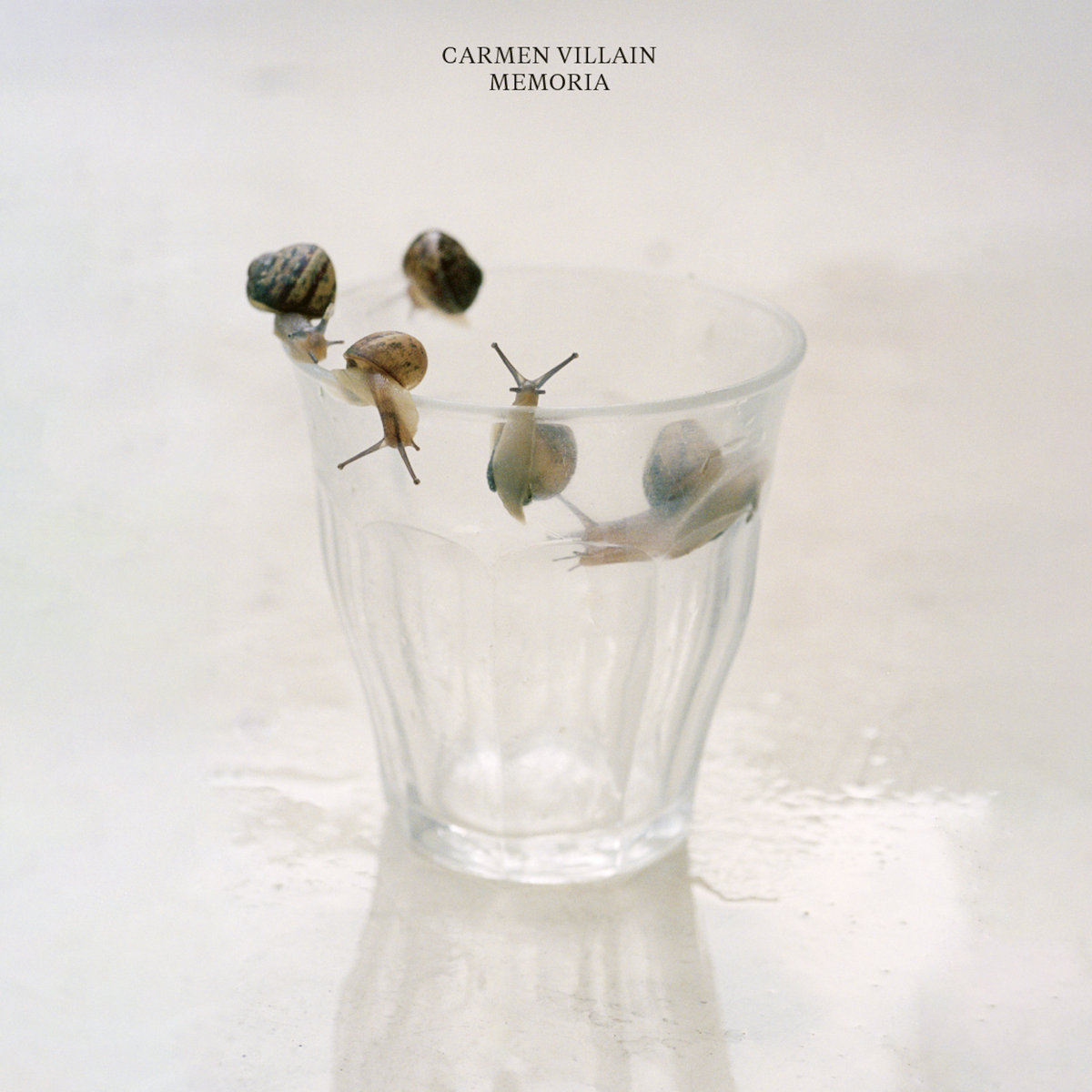
Tony D’Onghia: Listening to Memoria, I couldn’t help but think that the process of subtraction you employed on this album, much like the work of a sculptor, is the inevitable culmination of an artistic journey that you’ve undertaken, step by step, with absolute consistency. Where did the need to move so systematically in this direction come from?
Carmen Villain: I think it’s just me following my interests and curiosities, which have naturally evolved and matured over time. I do recognize a pattern or heightened interest in low-end frequencies, interesting textures, or slightly off-kilter rhythms, which I wanted to focus in on a lot more on Memoria.
Tony: Knowing in some ways what to expect, I approached this album like a riddle to be solved. Then something clicked: I let go of rationality. In your new tracks, you’ve created an atmosphere I would describe as amniotic. It’s like a sort of memory buried somewhere within each of us, one that takes us back to the womb. What do you think of this impression?
Carmen: I find it very interesting to hear what kind of experiences or impressions my music leaves on listeners. Music is so very subjective, and we all have our own way of hearing and feeling things.
Tony: That maybe brings us to Pauline Oliveros’s idea of internally recalled sounds, one of the starting points for Memoria. Is there a sound from your own past that you can still hear vividly, even though nobody else could possibly hear it the same way? Did any such private sound actually make its way onto this album?
Carmen: Yes, I discovered this ability to internally recall a sound by following one of Oliveros’s prompts in Quantum Listening, which I read last year. I was pleasantly surprised that I could remember something with such perceived clarity, and I also thought it interesting that it’s not something I had actively reflected on before. It could be the way the piano sounded when I was practicing as a child, or the sound of the stairs in my parents’ home. I haven’t used sound material in such a direct way on this album; I have used it in a more abstract way. Of course, I can remember recording, for example, the clarinet I ended up using on “Hope Synapses,” but it isn’t there to serve the purpose of any specific memory.
Tony: You seem to treat memory less as something you preserve than as something you continually damage and remake. At what point did that idea become a practical compositional method for Memoria, rather than simply a theme you were thinking about?
Carmen: From personal experience with my own memory, and from what I have learned about it, we can’t really trust our memories to be 100 percent accurate, but our impressions of lived experience are what make us who we are. I find that very interesting. I suppose I developed a methodology while experimenting with different ideas and approaches, but as a starting point I wanted to work toward something abstract, more minimal, and eroded over time.
Tony: You’ve described the record almost as a conversation between an archive and a mixing desk. Did you ever find yourself trying to preserve the identity of a sound, or was losing its identity the point of the whole project?
Carmen: There are a couple of places where the original identity of the sound is still present. But the decisions were always made on the go, just following intuition in the moment.
Tony: The album combines archive material with new sessions involving Johanna Orellana, Eivind Lønning, and your own clarinet, then subjects those sounds to extensive processing. Can you try to explain this process for us?
Carmen: It is always a product of continuous searching for potential within the material itself, which for me is best achieved through experimentation. Erosion, saturation, spatiality, abstraction, and exploration of harmonics and timbre are usually keywords.
Tony: Dub music, or at least its particular production techniques, and the tradition of the so-called bass continuum seem increasingly fundamental to your music. What fascinates you about that kind of sound? Is it the bass, the physicality, the studio as an instrument, or perhaps the idea that a finished recording can remain unstable and open to transformation?
Carmen: I think all of the things you mention are relevant. But mainly I love the physicality of bass and the potential for interesting shapes within the low-end spectrum. To me, it’s a good way to make massive, physical music without necessarily being hard; it can still be nuanced and feminine.
Tony: There’s an intriguing contradiction in Memoria: the music feels intensely inward, womb-like, as I wrote, yet you’ve connected that inward listening to empathy and to the physical environment. Has working in dance, installation, and ambisonic space (like the IRCAM residency) changed what you think a ‘solo’ record can actually be?
Carmen: I think it’s about both: being able to have a personal experience with music, but also, for me, the process of active listening can be an outward one, and through that, being able to connect more with our surroundings. Working in new spatial settings has definitely taught me a lot and has informed the way I approach my work. I hardly used headphones while working on this record. It was mostly done listening through monitors in my studio, which is a bit different from my previous work, where I’d probably be more equally in between headphones and speaker monitoring. This time, my decisions were more than before based on what I was hearing in a physical space. But to me, music can ultimately be both an inward and an outward experience.
Tony: Considering Memoria a sort of minimalistic musical ‘Ground Zero,’ meaning an absolute beginning, a new starting point in your artistic journey, can you already imagine where this might take you in the future?
Carmen: I don’t yet know exactly where this journey will take me, but I do have some sonic and thematic interests that I’d like to explore further in the coming years.
Check out more like this:
 Kallie Marie
 Tony D'Onghia


Comments