


The concept of technology being digital, somehow intangible, and even that electricity itself is this sterile, perfect thing—is in direct opposition to what Concepción Huerta has built in her most recent release, No Queda Nada, Todo Resuena. Huerta explores and shapes the very tangible, organic nature of electricity, tape magnetics, and sound, building on a sonic lineage started by Daphne Oram's writing and work.
For those unfamiliar with the canon of work of either of these women, one could start by saying that Oram's work is deeply influential to electronic music, sound design, and synthesis. Oram's writing examined many philosophical aspects of the function of recorded sound and its relation to memory. Because of the nature of tape recording, every iteration, listen back, or overdub alters the memory. (Tape degrades the recording, and is slightly altered by this with each listen, and in this way is not perfectly preserved. So every interaction with the memory on the tape is altering its form, to some degree.)
Huerta is a Guanajuato-born visual and sound artist who draws just as much from the sonic world as from the visual and the visceral. Today she is based between Mexico City and Berlin, and has collaborated with the likes of Eve Matin, Estrella del Sol of Mint Field, and cellist Mabe Fratti. She is also a member of Amor Muere, an experimental ensemble with Gibrana Cervantes and others. She has multiple creative projects ranging from visual, narrative, and sound. Her latest sonic work joins more than two dozen releases—making her very prolific at her craft, and quite an established voice globally. Huerta's creative output is as vast as it is engaging; being multidisciplinary, it encompasses recorded sound, performance, and photography, along with many other visual and collaborative outpourings.
In our conversation, Huerta has shared insights about her process, her intuitive connections, and the concepts that both drive and inspire her. Her influences are wide-ranging, and they speak greatly to her own understanding of her work and how it sits alongside others in her canon. Huerta holds an understanding and a self-possession as an artist that are rare and hard to come by—especially in the midst of one's own process.
Huerta has taken this exploration to heart and used her residency at Elektronmusikstudion in Stockholm, Sweden—where she had access to an array of vintage equipment for exploration and creation. Her latest release is an expansive and freeing examination of oscillators, the Buchla synthesizer, tape, and space. Born of a lack of restriction, engagement with the subject of sonology, and a devotion to pushing the limits of one's concept of time, the two-track release presents a genuine vastness. It makes the fathomable seem ethereal and encourages examining space in a multidimensional way.
In her exploration of time, space, and how each may be altered, Huerta presents the listener with ever-changing canvases, both textural, spatial, and historic. She references and builds upon her own experiences, but also on the sonic lineage of forebears like Oram, and brings into the fore the true tangibility of the digital world, making what can be seemingly distant and sterile—alive in its changing landscape, and current in its presence as it evolves through her manipulations and experiments.
The transcript has been edited for length, flow, and clarity.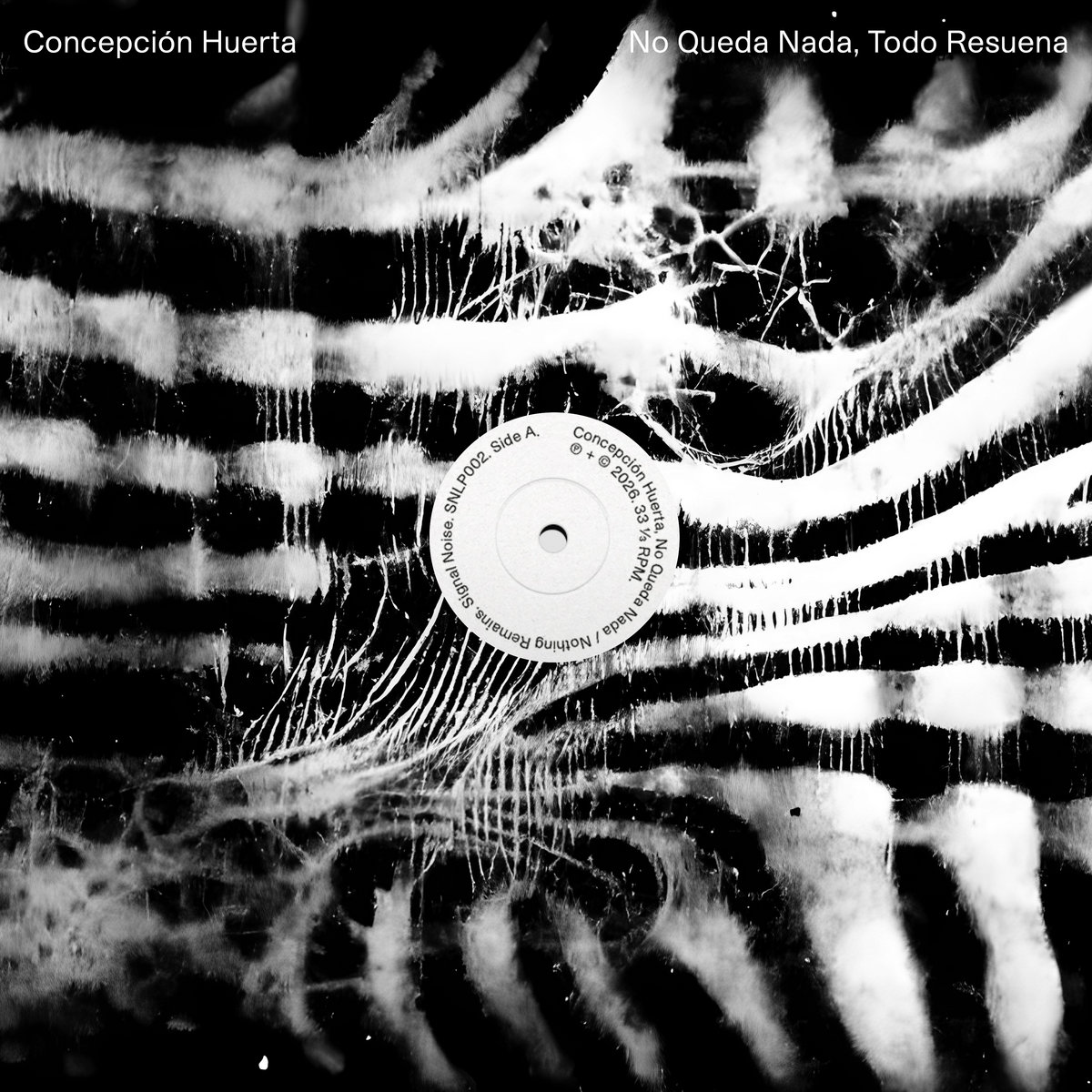
Kallie Marie: The sense of space is quite large in your recordings. What kind of spaces do you work in? Is the reverb we are hearing in a physical space or digital?
Concepción Huerta: Yes, I have recorded in reverberant spaces, but I also tend to edit and add some effects and distortion after recording sounds from specific objects, environments, or instruments. I like to create an acoustic impression of specific spaces depending on the album or project I'm working on.
Kallie: What were some of the acoustic impressions or specific spaces that you were envisioning for No Queda Nada, Todo Resuena / Nothing Remains, Everything Resonates?
Concepción: My priority was to work with the Buchla signals and process them using effects pedals, seeking to give each one its own sense of spatiality. I was interested in creating the perceptible sensation that each channel travels toward a new space based on its recording on the magnetic tape. Rather than reproducing a real acoustic space, I wanted to imagine an open, unknown, and almost celestial one: a place where the signal could travel, transform, and leave a mark. The tape thus functioned not only as a recording medium but also as a means to alter the trajectory of sound and expand the sense of distance, movement, and resonance.
Kallie: What goes through your mind as you create these recordings; is it visual, emotional, spiritual, or something else?
Concepción: I believe there are connections and relationships between everything. I've worked with photography and the visual arts for a long time, and much of it takes the form of images, but it also stems from a curiosity about what lies behind them—their depth and how they can be represented. After all, we are human, and this shapes how we perceive things—our personal life experiences and intellect, what we hold dear, and how we feel physically, spiritually, and emotionally—but it also includes our inner understanding of sound. So everything has an impact, and everything is part of the space-time in which we live and create.
Kallie: When you created these pieces, did you imagine how the final recordings would sound?
Concepción: The most important thing for me is the evocative power of sound—this way of affecting us—and I had a very clear idea of how it would sound and how it might be felt. Once I had the final compositions, I drew on the images that appeared in my head when I read Eduardo Galeano's book Open Veins of Latin America; the writing led me to those images, and the images served as a kind of visual score, guiding me to create "El Sol de los Muertos," for example.
As for No Queda Nada, Todo Resuena / Nothing Remains, Everything Resonates, I think it was better that I explored and processed the sound itself; I didn't imagine what the final result would be like, but I really liked how the signals expanded.
Kallie: And with this evocative power you speak of, was there ever any intent to perform the works live in front of an audience?
Concepción: To be honest, it wasn't something I'd given much thought to while making the album. For me, No Queda Nada, Todo Resuena exists, above all, as a listening experience, so right now I imagine it more as a listening session, where the audience can fully focus on the spatiality, the textures, and the subtle shifts in sound.
However, I'm also interested in the possibility of creating a live performance adaptation in the future. I probably wouldn't reproduce the album exactly as it's recorded, but rather develop new compositions based on that material, expanding it and placing it in dialogue with pieces from other albums. I'm more drawn to the idea of a live performance being a reinterpretation of the work—a new way of inhabiting that sonic universe—than a faithful reproduction of the album.

Kallie: Your recent pieces sound really unfettered—there's a freeness to them. Did you set any limitations for yourself in their creation, or was it an act of unrestricted and creative outpourings or exploration?
Concepción: I'm very honest and free in a way when I'm creating; I experiment, I like to let things happen, I explore different possibilities and let them emerge on their own, allowing encounters to take place—I don't believe in perfection. That sets the tone a lot. For example, on this album, I recorded the Buchla signals on four different tracks plus direct feedback to the 4-track, so the whole thing is a composition created by the oscillators' signals themselves and their recording on the cassette tracks.
Kallie: This freeness really comes through in your work. What's your favorite thing about working with the Buchla, and are there differences for you with other synthesizers?
Concepción: One of the things I love most about the Buchla is that it invites you to think about sound differently. It doesn't encourage a traditional keyboard-based or harmonic approach; instead, it feels like an instrument for exploring relationships between voltage, timbre, rhythm, and movement. I find that incredibly liberating.
The Buchla 200 at EMS is also a very special instrument. Knowing its history and having access to a system used by so many composers over the years creates a unique dialogue among the instrument, the space, and the person working with it. It almost feels as though the instrument carries its own memory.
Compared to other synthesizers, the Buchla constantly surprises me. Rather than trying to control every outcome, I find myself listening and responding to what the instrument proposes. It encourages intuition. That unpredictability is something I deeply value because many of my works begin by following the behavior of a sound rather than imposing a preconceived musical structure.
I think the Buchla doesn't simply generate sounds—it suggests new ways of listening and composing.
Kallie: There are two sides to this release. Did you approach them as separate or as part of the whole? Are they different for you?
Concepción: It's part of a whole; I let it happen—it's more of an experiment—and I let the recorded oscillator signals appear in different forms. It's part of a whole because it was the same recording, just played back and altered by different processes.
Kallie: What were some of these different processes? Does this happen quickly or slowly? Give us a sense of what it would be like to witness this process. Is it hours or days?
Concepción: The actual process of building the Buchla patch took around three or four hours. Recording everything onto magnetic tape probably took another day or two. But I don't think the work can really be measured in hours.
For me, the composition was shaped more by the journey between places and recording processes than by the time spent patching the instrument. It began at EMS in Stockholm, where I developed the electronic material, and then continued months later in Berlin, where I worked with tape, listening, editing, re-recording, and allowing the sounds to transform through each new pass.
If someone had witnessed the process, they would have seen long periods of listening interrupted by very small gestures: adjusting a patch, changing a pedal setting, rewinding the tape, recording again, waiting, listening once more. It's a slow conversation with the material rather than a linear production process.
So while the sounds themselves may have been generated in a matter of hours, the piece really emerged over several months, through different studios and cities, and through repeated acts of listening. The work matured through time rather than being completed in a single session.
Kallie: You've previously worked as a visual artist—because of this, I am curious what physical objects you find most curious and/or inspiring, sonically? Does something translate between the visual worlds and the sonic? What is this process like for you?
Concepción: More than specific objects, I think photography has been a major influence on me—for example, framing, what's inside and outside of it. Right now, I'm very interested in writing, archaeology, ideas, and abstraction: images inspired by what I read or by the abstract and visual aspects of history. I like cracks, light, impressions, engravings, lines, inscriptions, writing, shapes, deep time, scales, spectra, the silenced, scars, depth, immensity… everything is a possibility for immersion.
For example, right now I'm exploring rhythm—what it means, what rhythm is in music, geographical aspects, and its material qualities.
Kallie: Daphne Oram is an influence for you in this work. Tell us more about how you view your work alongside hers and how yours fits into the movement's exploration of sonic technology.
Concepción: I think that by working with the oscillator signals recorded on magnetic tapes, I am paying a kind of tribute to the highly experimental and poetic work carried out by Daphne Oram. It's a meticulous, technical, and philosophical artistic endeavor, yet one that is also deeply sensitive. It is a way of approaching sound, but certainly Daphne and all the research she undertook in the book An Individual Note of Music, Sound and Electronics, where her exploration of sound, in line with sound art and mysticism, explores the nature of sound, covering everything from the physics of circuits to how they connect with human emotions. It is a way of working with sound intuitively, as she does not view electronics as something purely mechanical, but argues that this new technology allows us to create music that is just as organic and imperfect.
Check out more like this:
 Carolyn Zaldivar Snow
 Kallie Marie


Comments