


At a distance, Félicia Atkinson transmits like a grounded whisper held in elegant minimalism. She is prolific in output as a solo artist, as a curator leading Shelter Press, as a duo (notably the recent and well-received Reflections Vol. 3: Water Poems with Christina Vantzou). Atkinson is a sculptor of the atmospheric, her surroundings processed through tape, piano, Rhodes—and often in painting and poetry. I am pouring coffee one morning, the Visible Cloaks' Paradessence plays on a turntable, and I realize even here Atkinson's voice is present in a track titled "Thinking."
In a year of critically beloved releases and contributions to much-anticipated experimental and ambient records, Atkinson's appreciation for cinema is presented in one more project. A live score for Les yeux sans visage (Eyes Without a Face). The classic horror film emerged in the 1960s, beginning a long chain of reverberations in visual culture, with the same questions that remain. Conformity. Beauty and innocence. What it means to be a woman. Men in power deciding things.
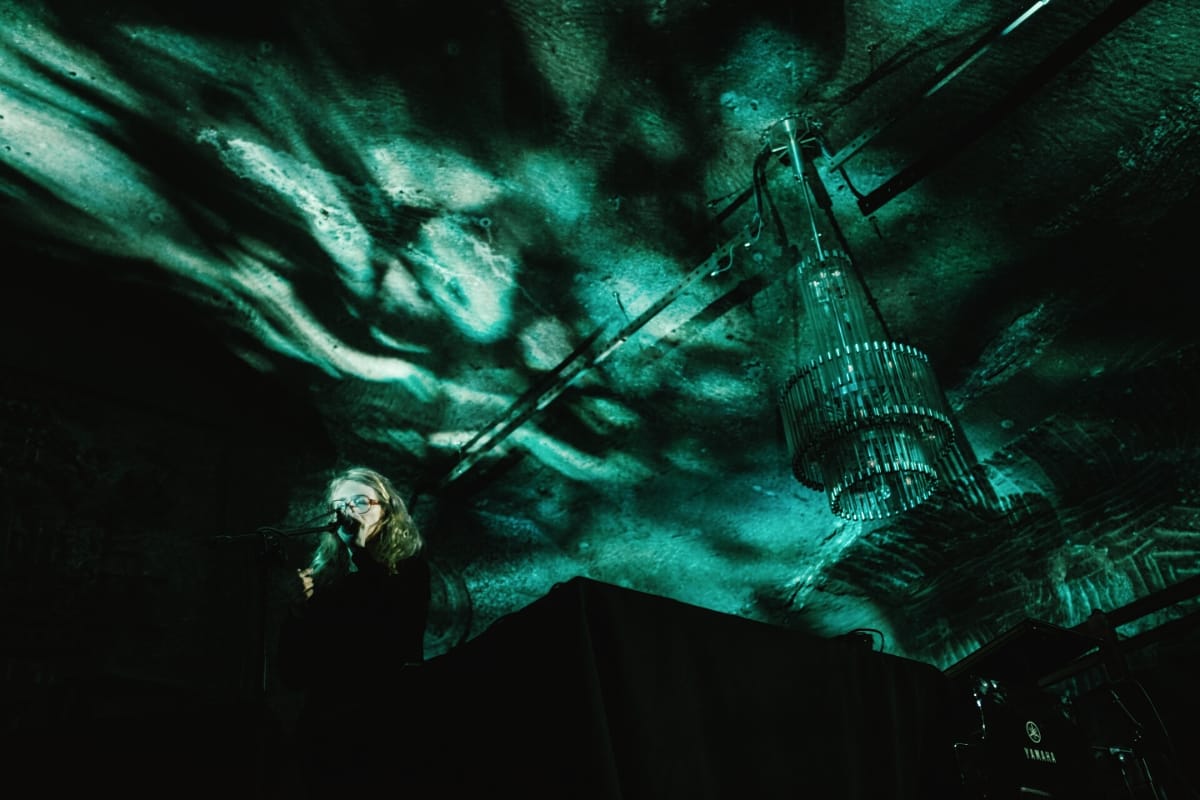
For SANS VISAGE, Atkinson elects to let the voice emerge in your head, in the negative space, in the shadows. Here, dark timbres echo out; the sustain from striking a piano key is left to finish into silence. The record is uncomfortable. Yet, it’s an enjoyable anticipatory tension built on almost campy suspense. Scored in real time at the invitation of the Belgian cultural center VIERNULVIER, Atkinson improvises with ease, showcasing her mastery of voicing the intangible.
While traveling between France and the US on tour, we caught up over email with Atkinson carrying the translation load into English as a French speaker.
Carolyn Zaldivar Snow: How is the transition into summer going for your creative practice? Do you change with the seasons? What is the climate like on the Normandy coast right now?
Félicia Atkinson: I am currently answering from the soulless AMS Schiphol terminal, having a layover between Vilnius, where I played yesterday, and Paris airport. I am listening to INA GRM's François Bayle's reissue, Jeîta ou murmure des eaux, on my headphones, which I highly recommend.
At home in Normandy, there is a heatwave, so I hope I'll have the chance to take a swim in the sea tomorrow, which will be a gift after today's 14-hour trip.
When the weather is nice, I work outdoors at home. For example, I paint in my garden and try to spend more time at the seashore, recording the waves and birds there. But I am also currently in the process of recording my new album. I started recording at ESS (Experimental Sound Studio) in Chicago earlier this month, and now I am developing it at home.
Carolyn: I recently viewed the film Mandy for the first time. I will say a suspenseful, synth-driven soundtrack, coupled with a woman very situated in her intellectual and creative freedom, then becoming caged, feels relevant. Have you seen Mandy? If not, that's okay. I think I really want to talk about building suspense in music. How does one accomplish this?
Félicia: I am sorry, I did not. To be honest, I have a lot of trouble watching any scary movies made after the 1990s. They spook me too much.
Suspense appears as a subject and a contingency while making the music itself. I think I would not make music if I knew where it would end. This is why I make experimental music—because I am going down a path that is mostly unknown. I think it's a perilous path because this is not what is asked of musicians these days. We ask musicians to come with solutions, with clear answers, whether they are academic or pop. I am coming from an art school background. I am making music to understand why and how I am making it. It's about process, and this process brings suspense, in the sense that we don't know how the resolution will appear. I love to hear this feeling of suspense, for example, in jazz music or in music for film, and since this record was connected to a horror movie, it made sense for me to explore those tensions.
Carolyn: Can you walk me through not being able to watch scary movies beyond the 1990s? I am curious whether you identify a cultural shift here from your perspective? I am interested!
Félicia: I have a lot of empathy when I watch a film. I don't take any pleasure in looking at people suffering.
What I like about the making of a horror film, the ones made until the end of the '80s, is that with time distance, you can see that it's fake. There is a distance because of the type of special effects and the era that has changed.
Carolyn: I struggle with celebrated directors being problematic. I am thinking of Kubrick and Hitchcock. Both were masters of suspense and had notable compositions attached to their films. How do you negotiate separating the art from the artist?
Félicia: I don't separate the person from the art. I watched those films when I was a teenager. At that time, I think I was very interested in them, without knowing the context in which they were made. Same with Woody Allen or even, it's painful to say, Robert Bresson. But I have no desire to watch them again now. There are so many other movies to watch, I don't need those in front of my eyes right now.
Carolyn: I am moved by SANS VISAGE being dedicated to Gisèle Pelicot. If you feel comfortable sharing, I am curious about how you are processing this brave woman as she becomes part of your sound narrative. What can we all learn from such a difficult story as we choose to step away from shock and spectacle and recognize the systemic nature of these crimes?
Félicia: I am a musician; therefore, I express what I feel and think through music rather than words.
While composing the music for Les yeux sans visage, Gisèle Pelicot's trial was happening in France. I thought about her and her children and how difficult it must have been to attend all those hours of trials and how brave she and her children were to hold the narrative and see it unfurl. The music I composed is not an essay about this, but more a capture of different timelines. The 1960s and the 2020s, and the fact that often reality is worse than fiction. It is also a reflection about France, my country, and domestic and systemic violence from the 1960s film to the present. Right now, physical violence against women and children is starting to be taken more seriously by society and the government, but it is still not enough. A lot of trials opened by the 'Me Too' movement are happening. I was also very moved by Adele Haenel's trial, of course, and her decision to quit cinema. I think she is a very powerful woman.
What interests me also is the decision those women made to reverse shame. While I was watching Les yeux sans visage and its characters, I wanted to compose something that puts the light on the victims of the film as resilient, strong characters who face evil. I think this is what Georges Franju intended. I think it is actually a feminist film in a cinematic environment that was not always the case, and I thank Franju for that.
Carolyn: Eyes Without a Face has many moments of foundational and world-shifting realizations for Christiane. What shaped you as an artist, and felt altering in the same way as being released from a cage—whether self-inflicted or external or negotiating rage?
Félicia: It's hard to answer because somehow those decisions—to become an artist, a musician, a publisher, a mother, to live out of the city—you have to reclaim those decisions every day. It's an everyday job. It's like cleaning your kitchen after cooking. It will happen again. I come from a working-class background. I did not have a safety net when I made those decisions. You have to make it work on an everyday basis. This is what we do with Bartolomé, my partner, and our kid; we are a team. They support me in my choice to be a 45-year-old touring musician traveling all over the world, and I am thankful for that. I don't think I've ever felt like I was in a cage, but what I know is that I never want to feel like I'm trapped in one. I think the fact that most of my lyrics and piano playing are improvised has to do with this—to react to what's facing you each day, and to make your own decisions according to this and its environment.
Carolyn: In live scoring a film you feel a personal connection to, what happens in your improvising process? Did you have some anticipation of how you would like things to sound? Notably more ominous?
Félicia: It's the same process I did while live scoring Ben Rivers's films a few years ago for CPH:DOX (Copenhagen International Documentary Festival) and Rewire Festival. I composed an electroacoustic piece that is a diffusion through speakers following the images on stage and in the pit below the screen, if there is one. I improvise on piano and a Fender Rhodes while watching the film and listening to the electroacoustic piece. It's a blend of pure emotional response—playing piano while watching the images and diffusing the electroacoustic tape that is constructed and built over time and reflection. For SANS VISAGE, for example, one electronic sound I used was one that expressed Christiane's persona. It was Christiane's sound. Each time she would appear in the film, that sound would manifest. Someone enters a room, I improvise a melody with the piano and Rhodes. That level of being an echo of the images is very liberating.
Carolyn: What is a contemporary film of Les yeux sans visage that you recommend?
Félicia: I love Michelangelo Antonioni's movies. I would say maybe L'avventura is from the exact same year. I would have loved to compose a score for this film, or even Il deserto rosso (Red Desert). The relationship to landscape, metaphysics, and femininity. I need to watch them again; it's been a while.
Stay on top of The Tonearm.
Subscribe for exclusive interviews, cultural tip-offs, and community fun.
And your support keeps our site free of advertising and paywalls.
Carolyn: For the last few months, you have been touring in the US. How has that felt for you?
Félicia: I am not denying that it was stressful to travel to the USA, even with a (very expensive) visa, considering everything happening. But I think music has to be played and shared there. Because music is an expression of freedom. I played in New York, Minneapolis, and Chicago.
Carolyn: What is in your touring setup? How have the pianos in each venue been? Do you have a favorite piano?
Félicia: In Brooklyn at Public Records with Christina Vantzou, I played the Fender Rhodes. Another show was at a super nice jazz club in Minneapolis called Berlin. Another at the Renaissance Society's Logan Square Penthouse in Chicago—that set was with electronics, voice, Fender Rhodes, and grand piano. My favorite pianos are Steinway and Bechstein grand pianos, which have a lot of resonance. I am not a trained pianist, and my way of playing is intuitive and influenced by the piano that is offered to me.
In New York, I saw the wonderful Helen Frankenthaler exhibition at Gagosian, which was inspiring. I composed a piece dedicated to her called "Everything Evaporate" in 2019, but now I want to compose more.
In Minneapolis, I saw my friend Gabriel Saloman from the Yellow Swans and his partner, the artist Aja Bond. We went to visit Christine Sun Kim and Rosy Simas's exhibition at the Walker. I also loved the Fine Arts Museum's antique collections. We showed our respect in the street where Alex Pretti was killed. There is a small memorial made by the citizens of Minneapolis for him and Renée Good.
Carolyn: What are the differences or similarities in sharing wordless music with audiences in the US and France?
Félicia: I actually speak during my show; I improvise the text in French and in English on stage. I have a very small audience in France. I play mostly in other European countries where neither French nor English is actually the language. I am interested in translation and in listening to things you don't understand yet that still have meaning. A few years ago, I made a song in my album Image Language quoting Don DeLillo, saying, "the world is full of abandoned meaning."
With regard to SANS VISAGE, the rights to play the music in front of the film are getting more and more difficult. So far, I've only been allowed to play in two countries. But I can also play a version of the score that is detached from the images. I find it interesting. This is why we made the record, and I might even add voice to it.
Carolyn: Voice seems to be an important foundation in your work. One of the Shelter Press journals explores this in several scholarly articles. Without a voice in the traditional context of a human-made utterance, what becomes the voice in your current compositions?
Félicia: For SANS VISAGE in particular, I was interested in thinking of the voice as a shadow. SANS VISAGE means faceless. I think the voice is hidden or appears as a negative space. You don't hear it, but you can hopefully feel it in your head. A private inner voice. But now I can also play the music with images missing, as a shadow, again. Maybe the voice will replace the images.
Carolyn: A lighter question—what else are you listening to right now? You mentioned Bayle.
Félicia: I am listening to the reissues INA GRM made in their series called Recollection, the one from François Bayle I spoke about, but for example, also Divine Comédie by Bernard Parmegiani and François Bayle. I am listening to The Necks' latest few albums, and I am listening to Pharoah Sanders a lot. Eiko Ishibashi's scores for Hamaguchi. Eliane Radigue, who just passed away, will always be a big source of inspiration and reflection for me. And of course, the Shelter Press releases we're working on.
Carolyn: When did you first encounter Eliane Radigue?
Félicia: Growing up in Paris, I discovered her music pretty early. I think the first thing I listened to was Trilogie de la Mort. Listening to her music is a way to get through a deeper conscience of what the experience of being alive is among the world. It has a real effect on your mind and body, beyond just an aesthetic experience.
Check out more like this:
 Jonah Evans
 Carolyn Zaldivar Snow


Comments