


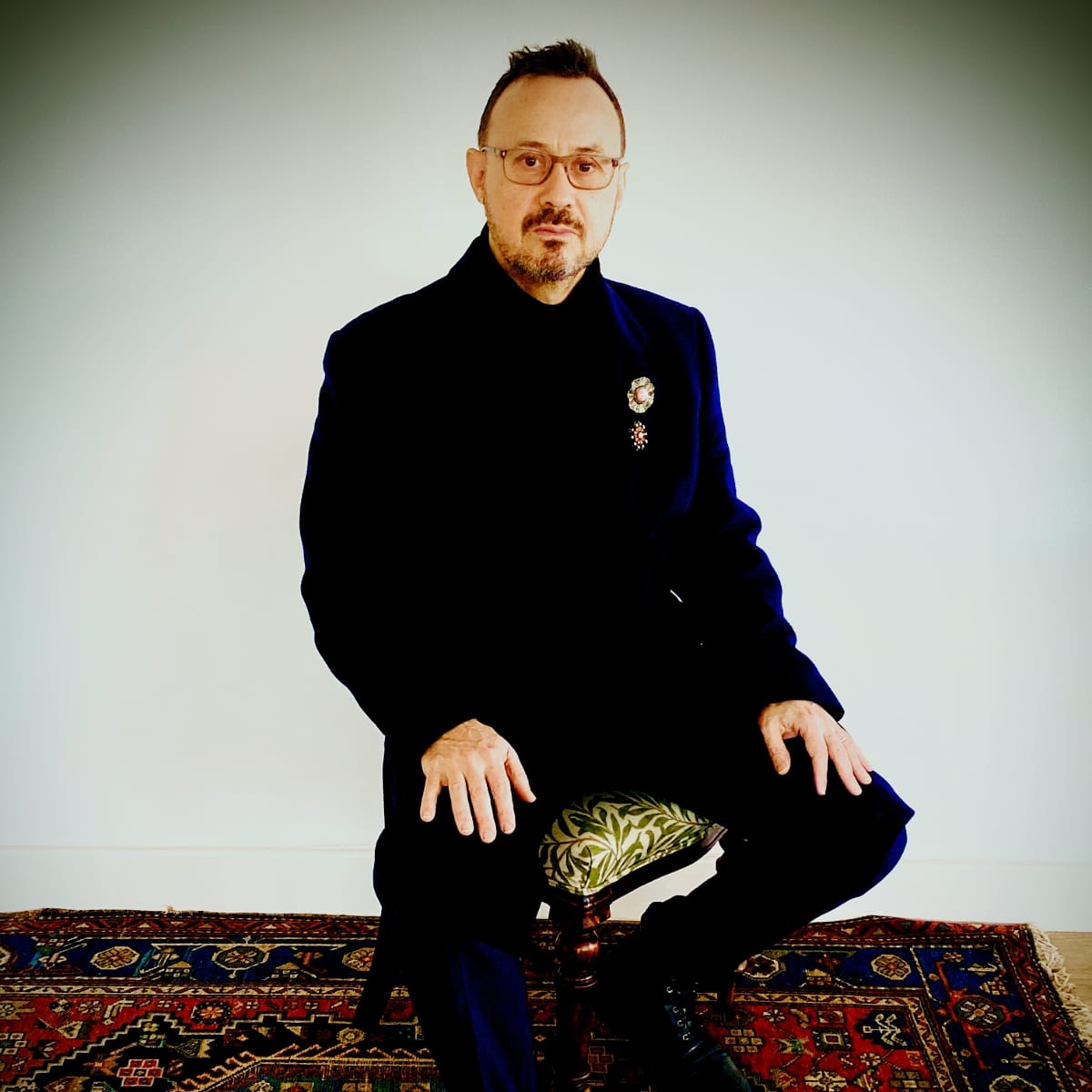
Originally from London, Norland started his musical journey as a chorister, became an early adopter of the rave scene, moved to Los Angeles—the realm of Hollywood and Emmy-nominated film scores—and is now back in London, with renewed vigor and a connection to the place he started. Norland has kept busy with his soundtrack work, which includes director Sacha Gervasi's feature November Criminals, the HBO film My Dinner With Hervé, and a considerable number of scores for primetime news documentaries aired on the US network ABC and around the world. Despite (or perhaps because of) all this activity, his latest album, La Source, released on Denovali Records, is only Norland's second, following his solo debut, Glam Tear Stain, in 2019. His soundtrack work continues to influence his own music and vice versa, expertly blending minimalist classical structures with electronics.
David Norland has an earnest quality that was palpable during our conversation. After the fact, I was struck by how well this is actually conveyed in his music. This isn't easy to do, and I think a lot of composers can get lost chasing sonic trends or some other bravado of mystique. Norland, however, is disarming in his heartening earnestness—and from our conversation, I could really tell that, yes, this is the secret sauce that drives these beautiful outpourings of this very thoughtful soul. What makes any composer isn't just sheer skill, but really how they translate emotions, respond to images, or connect with the essence of everything around them. Norland certainly draws from a variety of areas, varying chapters of his life—as all artists do—but what he seems to do exceptionally well is communicate all of this musically in a way that never quite feels overblown or contrived, and instead heartfelt, articulate, nuanced—almost welcoming, as if the music feels like it might have been written as a journal entry, a letter to a friend, or a shared reaction—an inclusive "Hey, get in, we are going exploring."
Norland shared about the process behind La Source, which grew out of his score for Carousel, a black-and-white film released this year. The album is, in part, an impressionistic exploration of his response to those images, as much as it is an exploration of process through limitations. The director of the film gave him carte blanche—and Norland ran with it. We talked about workflow, creative exploration, experiencing the spiritual as a personal practice, and some of the things he's looking forward to working on next. He hinted that there are special live performances of the Carousel score coming up in Paris and London, to be performed with the film in the style of early cinema.
Kallie Marie: Right now, what is a typical workday in the studio like for you?
David Norland: For my creativity, my neurochemistry, my internal well-being, I have to meditate and work out in the morning before I do anything else. Most of the time, I manage it, and then I'll be in the studio, a place called Cube, which is a sort of hub of studios. Then I knuckle down, which is always that sort of pivotal moment, isn't it? Are we going to accomplish everything we've decided to accomplish today? Or are we going to get sidetracked by any number of the possible diversions that beset all of us these days? The best thing that can happen for me is that I come in and I just dive into something that's already going on. If I have to make something from scratch, if I'm starting something new, quite often the temptation is to get distracted by other things.
All of which seems really important at the time, and then in retrospect, one comes to see that it's absolutely insignificant and simply a self-deluding mechanism to put off the "am I going to make something good or am I going to make something that sucks?"—and that whole premise. In order to make good art, you have to be prepared to make bad art, and getting to grips with that as early as possible in the day is always a good thing. It's all in your own creative practice. It sounds so trite and so hackneyed just to say the process is everything, but it is, at the end of the day, because it's all you've got. That's all you can hold onto.
I have many heroes, but I still think that Bach and Mozart probably put most of us to shame. With Mozart, who I hold in the highest possible esteem—obviously there's no bad Mozart, there just isn't—but there's Mozart that doesn't necessarily reach the transcendent heights of some of my favorite pieces, which are not always the most obvious ones. So if that can be the case for him, which of us should feel bad about the idea that today I might not produce my best work, by whatever metric one judges there?
Then I work. I tend not to work late anymore. I've worked in film and television enough to have done my share of all-nighters and all of that kind of stuff, or working really late, long past the time when anything productive was really likely to happen. If I'm working for someone, I'll try to argue that after a certain point; I can't guarantee the quality of the work. My creative ability, my discernment, all of those things shut down or deteriorate. It's ultimately self-defeating—will the world end if I deliver this at midday tomorrow rather than at four o'clock this morning? Sometimes I feel like there's not enough pushback in the world of film and television against those kinds of practices. As a composer, you never want to push back against anything because you're always worried, "Oh, I might not get hired again," or get a reputation for being difficult or whatever, but at the same time, in many respects, you're doing the whole production a favor.
Kallie: Yeah, and you're also advocating for the quality of life for everybody, all the other composers, because if we all advocate, then it raises the bar of the collective expectation that, like, "Oh, we can't do that."
David: Agreed. As composers, we don't have a union in the States—we are really one of the very, very few groups of people who don't—and it's a miraculous thing to be able to make a living out of your art.
There's this old joke, which I tell and re-tell because at the heart of it is a very bitter truth, which is what makes it funny. What's the difference between a musician and a pizza? A pizza can feed a family of four. (laughter)
It's just such a brutal truth about life in music, and I've been incredibly fortunate that I have fed a family of four. I've been able to raise a family just from music; it's pretty amazing. But there's this pressure. Working as a composer, especially in film and television, where it's so competitive, it sometimes seems like such an out-of-reach thing to get to a sustainable place of being able to support yourself and your family, and to sustain just what other people would consider to be a normal kind of life.
I increasingly think that perhaps people like me should advocate more for treating ourselves like human beings. If we were in France, there are employment laws that forbid making an employee work more than 40 hours a week, regardless of industry. And there were those recent experiments with companies around the world on four-day workweeks—many found productivity increased, and some never went back. Yet, for some reason, in the entertainment industry, there's this expectation, possibly because it's very tightly budgeted. Composers work for an all-in fee. It's not like you are saving anything by getting them to kill themselves to deliver four hours before they would, if they actually got some sleep. It's not even a law of diminishing returns—it's just a pointless kind of time-motion-energy-study vacuum.
Kallie: Does your process for writing for picture differ when you're not writing for picture?
David: It depends on what point I'm brought on. If it's the sort of traditional thing of being brought on once there's already a pretty cohesive version of the cut with temp in it and all of that kind of stuff, then that's a whole different thing from being brought on early, which has happened—sometimes even before there's a frame of picture shot. The great part of it is that you get to develop an in-depth musical relationship with a director long before that relationship is thrown into the hurly-burly of working on deadlines to score scenes, reels, cuts—and you get to develop an understanding of the musical language, and there's much more room for experimentation. The thing that kind of sucks about it is that the early pieces you come up with often don't make the cut.
Therefore, if you measure just in a commercial and economic sense, your time is less well compensated than if you start with a fairly defined cut anyway—then you're thrown into it, it's been temped, and really what you're trying to do is get something which is an original musical language in a short space of time. The temp is useful if treated only as a dramatic signpost rather than a musical one. The best notes are not ones that speak in musical terms, but ones that speak in dramatic terms—as in, "I'm not feeling enough of this at this point," or "this feels too rich, too sad, too on the nose." Those kinds of dramatic notes are super helpful. "The strings need to do a little less of a glissando here" is maybe not always the most helpful kind of note you get.
Kallie: I suppose it's as if you're asking somebody what they're hungry for and they say "black pepper"—that doesn't tell you what they're craving, does it? It's just like, "Okay, I know specifically about an ingredient, but I don't know the whole plate."
David: Yeah, exactly that. Then, if I'm writing for my own work, for my personal work, that is a very different process. Quite often, I'm creating from ideas that have already occurred to me outside the studio. I'm sure, like a lot of people, I hum voice messages all the time, and the ones that stand out then get turned into emails, and those that really stand out from those get capitalized in the titles. So there's this fairly clunky system for prioritizing ideas based on immediate excitement. That's what I get to work on, and generally speaking, an overarching idea of what the work is—what this collection of pieces is in relation to, in terms of what's going on with me or how I'm thinking or how I'm feeling—tends to emerge from experiences more than anything.
I had one just recently. I just got back from a trip to Europe with my wife, and we hiked up one morning to this small monastery at the top of a hill in France, dating back to maybe the 14th or 15th century. In the basement was a private prayer room—a book where people write their prayers, a pad to kneel on, virtually nothing else—but the acoustics in there are spectacular. I was trained as a chorister as a kid and have always sung all my life, and whenever I get into a space like that, I want to sing in it. My wife said to me, "Sing something." She knows that's what I do if I'm on my own—I'll just improvise something. She recorded it on her phone. We listened back, and I was like, "Okay, this is my next project—I'm going to do maybe two or three of these a day in this exact space, bring a couple of Coles 4038s, record it in mid-side, and improvise based on the sense of transcendent peace that this room is bringing me." I don't think it will be difficult to do. I just need to get permission from the people at the monastery, but hopefully, in an off season, that shouldn't be too hard to get.
Stay on top of The Tonearm.
Subscribe for exclusive interviews, cultural tip-offs, and community fun.
And your support keeps our site free of advertising and paywalls.
Kallie: This is a great place to jump into talking about your new work, La Source, and the Carousel score it grew out of. The film's director gave you a "free scoring process." What was that like for you, and how do you think it affected the music you created?
David: Oh, it was wonderful. I started by watching the film, which is a black-and-white, abstract, slow-motion, non-narrative feature. In many ways, the music is the narrative thread in this impressionistic art piece. So it, by necessity, needed to be melodic, or to have some melodic component that drew us through. Other than that, I simply responded to the images. Then I had one other criterion: I love working with limitations, so I decided to work only with whatever instruments I have in my studio that I can play. Just with the equipment that I have—some nice tracking gear, a drum kit, various bits of percussion, lots of bells, my flute, and my voice. There's some bowed guitar, but no actual strummed or plugged-in guitar. It was interesting to have that as my palette because those sounds are all very ancient. They're sounds that could have been around 2,000 years ago: things you hit, things like flutes, voice, and bells—that's about it, really. That then became the intent that sparked the idea to make something that tapped into the feeling I was getting from the film.
This film first came to me just towards the end of COVID. We were all obviously isolated, and Dan Papá, the director, had gone around the world taking footage of folk parades, communities having their happy day of the year—this sense of joyful community that had been so lost at this time of isolation and sequestration, if you like. It also happens at a time when there are many questions about the nature of the human bond and our responsibilities to one another, just as fellow travelers in this life. The film spoke of this, but there was more music coming from it than could just fit in the film, and my harmonic choices, some of the use of filters and processing, making great big organ sounds out of detuned flutes, are very modern, very forward-looking. At the same time, the sounds themselves are tremendously ancient. This sort of span of historical sounds, both very ancient and forward-looking, speaks to me of a continuum. I think that sense of continuum is one of the things that gets lost if you lose human contact. The work itself becomes a screen on which my intent becomes visible to me.
Kallie: I saw that you are interested in mysticism. I was wondering how you see mysticism's interplay with your music?
David: You can't talk about mysticism without talking about spirituality or spirit, and I am a belated spiritual traveler, by virtue of, let's just say, a recovery from pretty intense addiction—a gift, actually, because I don't know that without that necessity I ever would've gone there, or come to discover that it provided context to everything I'd ever felt was valuable.
I guess the best way I can put it is, I belong to a religion of one, and I'm not looking for converts. That's not a thought that's original to me. I heard it, and I liked it; it sums up exactly how I feel. It has to be experiential, and that is mysticism. It's not a rejection of dogma, but just a disinterest in dogma—in finding it, as they say here, "not fit for purpose." The most meaningful experiences I've had have been transcendent experiences that, if I could explain them with my rational mind, perhaps they wouldn't be as powerful as I experienced them. It's this sort of classic human arrogance, isn't it? I only understand a tiny fraction of what there may or may not be in this universe of infinite possibilities. To do anything other than open myself up to its experiences is utterly missing the point. The point is wonder.
There's a great quote: "Either nothing is a miracle, or everything is." What do you want it to be? If nothing is a miracle, what an incredibly miserable world to live in. It's actually not what my experience has been. There's also that great John Cage quote, and I can't do it verbatim, but I'm going to try: "It is not our intent to suggest improvements in creation, but rather to wake up to the very life that we are living, which is so excellent. Once one gets one's mind and desires out of the way and lets it flow of its own accord." Thank you, John.
Kallie: Truly a beautiful quote.
David: I don't know if I got the first part of it exactly right, but when I heard it first, it was really like being hit very gently around the head with a benevolent saucepan. (laughter)
Kallie: Recently, you relocated from Los Angeles back home to London. What was it like as a film composer to make that change?
David: The only time it might become an issue is if a director wants to come in, sit with you, and work. A lot of production and post-production have actually moved to locations outside Los Angeles for tax-incentive reasons, which California has been astonishingly and mystifyingly slow to address. Being in Hollywood is not the be-all and end-all for anyone in production or post-production, and lots of the work has come here to the UK. My agent gets requests all the time for "we're posting in the UK" or "we're producing and posting in the UK, and we need a UK-based composer." It's not been problematic in that regard, and certainly, after a long time in Los Angeles, there's a rejuvenation of just excitement and creative interest in what's around me. I know London well because I grew up here, but I've been away for a long time. On the one hand, it's refreshingly familiar, and on the other hand, it's refreshingly different, and I'm finding it exhilarating!
Kallie: So we will close on this note: what's next for you, and what are you excited about?
David: There is a documentary that I think will come out this year, a valentine to electronic dance music. I've known the director, Jarvis, for a long time. It goes back as far as disco briefly, but then it does a very nice run through the history of music from New York, Chicago, and Detroit, coming to the UK via Ibiza—and I just happened to be a very youthful, aspiring musician in London clubs at that point, and was around as it was all happening. I'm really proud of the score. I did try to persuade him to let me score it with two turntables, a drum kit, and a tuba—just way left field—and that was laughed out of court from the get-go. So I've done a nice electronic hybrid score. Because I cut my teeth in electronic dance music back then, I feel like I've been able to put some of my own emotion into this journey, and that's always really gratifying.
Then, the score for Carousel, which is this black-and-white film—we're going to start showing it in little galleries in Paris and London, and I'm probably going to play some of the score along with it, like an old-time movie house. But because it's fairly orchestrated and I can't do all of it myself, I'm going to be doing it as a sort of dub DJ, and I'll play some of it, but also dub quite a lot of it. So that'll be pretty fascinating, because I have a deep love of all things dub.
Then, this monastery idea I shared with you earlier—I cannot wait to get on with it now. And then I have another record that's not attached to a film and is about three-quarters written. The thing that baffles me every day is how to prioritize them—I want them all out in the world now. What's next for me is knuckling down and putting the brush down, rather than agonizing for years over things that need to find their way into the world.
Check out more like this:
 Lawrence Peryer
 Kallie Marie


Comments