


Roekie Aronds was an Indonesian-born ballet dancer and actress who settled in the Netherlands, became the first person of color to appear in a Dutch television series in 1958, and, with equal conviction, used her dance classes to teach through gamelan, Coltrane, and Jimi Hendrix. Her son, Stephen Emmer, traveled with her through India, Aruba, and Suriname before the family returned to Amsterdam, where he played in experimental free-jazz and symphonic-rock groups, then joined Minny Pops. The avant-garde electro-noise group became Factory Records' first international signing, and they were also the first Dutch act to record a John Peel session for the BBC. In 1982, he produced Vogue Estate, a solo record made at Trident Studios in London with Flood, and joined Billy MacKenzie's The Associates the same year.
After Minny Pops, Emmer built a parallel career as a composer for broadcast media. He eventually became Holland's first in-house composer for the Dutch public broadcasting organization NOS and won the Prix de Rome in 1988. He worked through those years with producers including Tony Visconti and Trevor Horn. Then, in 2006, he began Recitement, a project of seventeen compositions set to literary spoken-word texts, which he produced with Visconti at Looking Glass Studios in New York. Its contributors included Lou Reed, the late Richard Burton, Ken Nordine, and Allen Ginsberg. That project opened a sustained period of autonomous work that continued through several more albums, among them International Blue, a 2014 record with Glenn Gregory and Midge Ure, and Home Ground with Chaka Khan and producer Bob Power.
A serious, progressive loss of hearing in his left ear posed an existential threat to Emmer as a composer and musician, and redirected him toward quieter, more atmospheric compositional territory. His 2024 album Mt. Mundane, recorded at Abbey Road with over thirty musicians, confronted that experience directly. Asymmetrical Dot, released this year, continues from that point into the most personal subject matter of his career. The death of Roekie Aronds, six months after she had become a great-grandmother, and the birth of Emmer's first grandson in that same year shaped a record tracing inheritance across three generations, from the Indonesian and Dutch worlds that formed his mother through his own career to the future his grandson represents.
The family's migration from Indonesia to the Netherlands, a voyage that once took thirty-seven days by sea, runs through the album as a generational backdrop. The track "Amboina," named for the Indonesian city where Aronds was born, offers a direct farewell, and "Benja's Birth" greets the arrival through children's voices and indigenous percussion. Its musical palette places Indonesian folk traditions alongside Western chamber-music writing for vibraphone, celesta, and marimba, with wordless voices woven through the instrumental texture as independent melodic lines. The album's title captures its central premise; asymmetry names the in-between existence Emmer has navigated since childhood, while the musical dot, which extends a note beyond its written value, implies that identity carries further than any fixed moment. An ensemble drawn from Armenia, Peru, Venezuela, Indonesia, the Netherlands, the United Kingdom, and the United States gives the record its layered depth. Beth Hirsch, best known for her work on Air's Moon Safari, and Grammy-nominated vocalist Maria Alejandra Quintanilla are among the contributors.
Lawrence Peryer recently hosted Stephen Emmer on The Tonearm Podcast for a wide-ranging conversation. The two discussed Asymmetrical Dot and its origins in a year defined by grief and new life; the influence of Emmer’s mother on his development as a composer; how hearing loss reshaped his practice; and the relationship between his commercial work and the music he makes on his own terms.
You can listen to the full conversation in the audio player below. The transcript has been edited for length, clarity, and flow.
Lawrence Peryer: Talk to me a little bit about the relationship between purely commercial production work and your autonomous artistic side. I would imagine it's not quite as stark or binary as I'm presenting it, but I'm curious: do you pick up methods and ways of working that benefit you as an artist? What's the dynamic between the two? Or are you completely different people?
Stephen Emmer: No, not at all. In fact, when I started doing the production work—this is in the eighties—there was total freedom with the broadcasters. They said, "You are the guy who is supposed to have knowledge of music, so do your stuff."
As the years went by, you suddenly no longer dealt with the creative producers of the broadcasts; you had to deal with the marketers and the managers. They said, "We have a preference for the Rolling Stones, Stephen—how about doing a new theme tune, like 'Start Me Up'?' And that's where I started to think: it's not as adventurous anymore as it used to be.
I had the privilege of working with the producer, Tony Visconti, and allow me to quote him in answering your first question. He said something I never thought of myself: "Stephen knows how to avoid the clichés best because he's learned all of them." And that's what I did. Production music is often laden with clichés. The news theme—horns, or in today's version, the Morse-code synth sound, like the BBC News—all kinds of clichés. And as soon as something is successful, I suppose, like in the hit rate of mainstream pop, that's where the decision makers say, "We want more of the same."
I got rebellious against that and said: no more of the same—that's the arch enemy of artistry. So that's where I started to become independent.
Lawrence: Looking back, I imagine there's gratitude alongside the discomfort.
Stephen: There is. In the early days, it was like a laboratory for musical adventures. Nowadays it's not like that. In a way, there's an equivalent with mainstream pop. When you hear current pop music, it's quite different from Sgt. Pepper's Lonely Hearts Club Band and all that—the music was a bit more adventurous at the time, here and there. What I did was learn an awful lot, which I would never have learned as an autonomous artist from day one.
For four years, I was music director for Holiday on Ice International, and the skating had to be set to the right 4/4 beat, in the 115 BPM range, with a specific intro, outro, and break. All of that involves very conventional music-making—and you have to learn it to lose it.
I recently saw a painting by Matisse—the painter from France, known to us all more or less as an Impressionist, abstract—but I saw some anatomical studies of humans he made in his early days, which told me the man knew exactly what to do to create, and then tried to get rid of it to find new ways on his own terms. And that's exactly what I've been experiencing.
Lawrence: That's very resonant—whether it's improvising musicians who have to be so proficient in technique and then set it aside and transcend it, or filmmakers who go to film school to learn about lenses and color and then do avant-garde cutting and editing. It's basically: learn your tools before you go try to be some kind of provocateur or avant-gardist.
Stephen: Rejection comes after insight.
Lawrence: When you gave your Holiday on Ice example, something about it struck me: if you were inclined to, you could go to one of those performances and see your work move an arena full of people. That's not trivial.
Stephen: No, it's not. Especially when it's international touring, I had one opportunity where the show would also be performed in South Africa. The perception of music there is quite different from that in Europe. I felt a bit intimidated by the prospect of whether I could bridge the gap. When it seemed like I did—by resonating with that different type of audience over there—I was immensely gratified. And obviously, I see myself more as a laboratory-type composer, in my own environment—no audiences, nothing. So for me, that was quite the opposite experience.
Lawrence: When you are working on your autonomous music, you are the director, the executor, and the implementer. Where does the prompt come from when it's just you?
Stephen: Well, with the first record I made—a spoken word set to music on an album called Recitement, with, among others, Lou Reed and Tony Visconti, who produced it in New York—I sat at my piano with no assignment to give me a head start, and the worst happened. Nothing came out of me, because when there's no assignment, no briefing, no prompt, you can do everything. You could make improvised music, symphonic music, sound design, or bluegrass—too many possibilities.
And then, suddenly, I saw an old cassette on my studio desk with Richard Burton reciting English poetry by Yeats. I thought, "I'll just play along and follow his voice—see what happens." That was my own personal assignment to myself.
Richard Burton has the Rolls-Royce of voices. He starts, he stops, like Charlie Parker. His phrasing is like Sinatra: start, stop, delay, anticipate—on the rhythm. And instead of dominating him with a staccato rhythm, I, as the instrumentalist, started following him—hovering over all the musical subtleties hidden in his voice. And that's where I learned: this is my new personal assignment—to soundtrack human voices and emphasize how musical they truly are. That's how the whole first autonomous album came about—by simply finding my own mission instead of improvising from total blankness.
Lawrence: So, another powerful thing you refer to there is the idea that artists need constraint. When you have too many options, it's very hard to get started or to execute. If you eliminate the possibility, that's not a diminishment—it's a focusing function.
Stephen: Indeed, well put. And if I may add to that, the routine of creation is also something I learned the hard way. The poet waits for moonlight to inspire him, but the video editor pushes the start button. I decided to become a hybrid of those two.
You just start. Don't wait for the moonlight. It's like you exercise the inspiration muscle—it will follow, it will obey, when you just start rather than wait for the moonlight. It's the difference between the two lights.
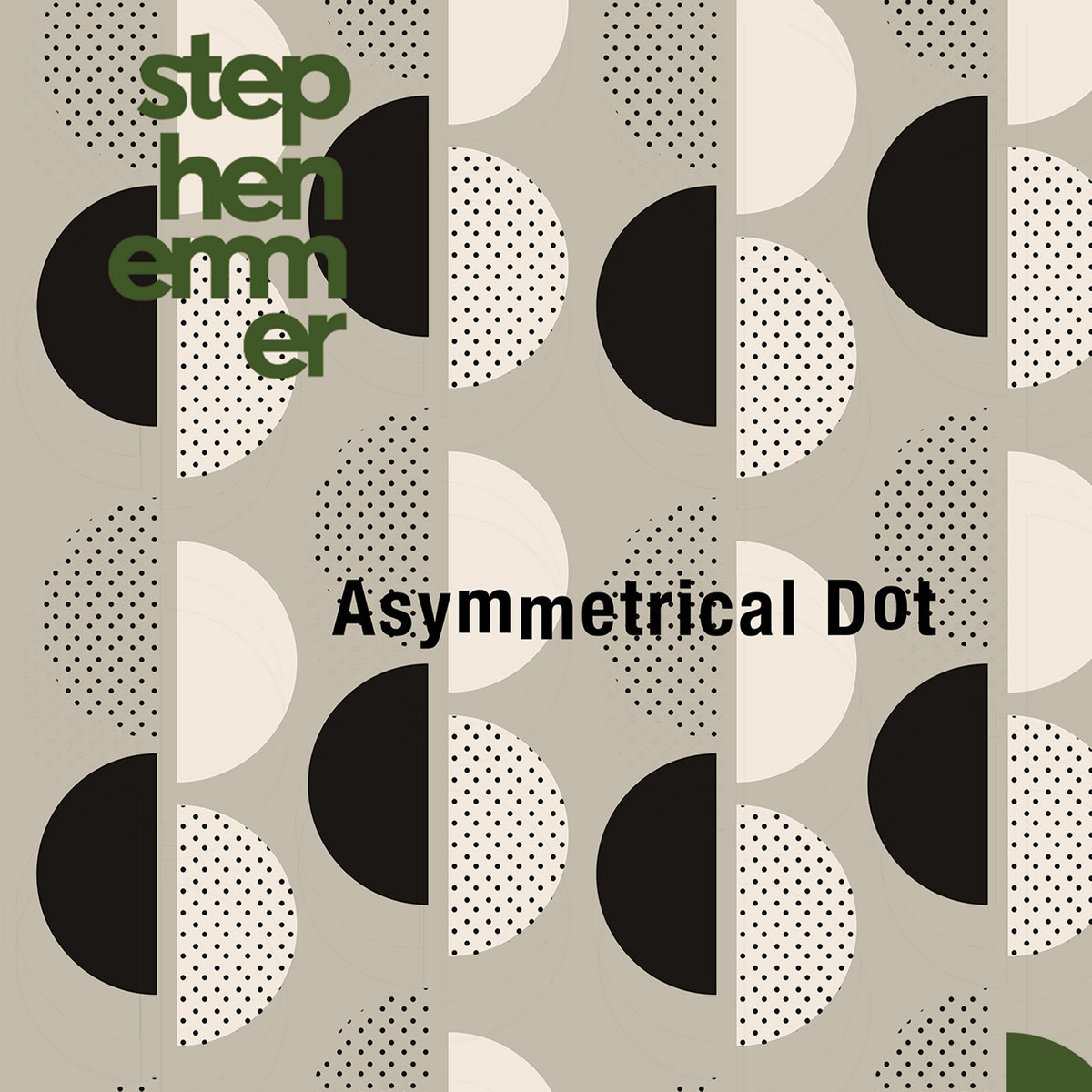
Lawrence: We're here to talk a bit about your latest album, Asymmetrical Dot. I lost my mother over the last couple of years as well, and I'm at the age where people around me are losing their parents, if they haven't already—and it is a natural point for reflection. How did the arc of this record come about?
Stephen: Of course. It wasn't only her passing away—it was an accumulation. Her passing away, and a couple of months later, a new birth in our family: namely, my grandson.
My mother wasn't well at the time, with Alzheimer's. My biggest wish, instinctively, was for the two of them to meet while it was still possible. And so it happened—only once, and for only one hour. I was obviously part of that, but at the same time I felt like an artistic observer—the observer type of person—who witnessed it and thought: this is the zenith of the human existential chain of movement. That might be translatable to art or the horse I know, music.
That was my starting point for the whole venture.
I thought it was a good theme. Trying to avoid overt sentimentality—from one came the other—while not wanting it to evolve in that direction, I suddenly decided it should also not be the type of tribute you create in an emotional mood, with certain musical types known for representing that mood.
Lawrence: D minor? (laughter)
Stephen: Minor, but also a little soppy—with sweet-tooth strings at full blast in that direction. So I thought I should bring in the eclecticism I learned from her, since she was a ballet teacher. As a boy, she exposed me to all kinds of music. At an early age, I listened to Dave Brubeck, whereas my peers were probably singing children's songs. I heard Jimi Hendrix when no one on national radio was playing it, and she used it for her dance teaching. Coltrane, Stravinsky, Villa-Lobos, Santana, Haitian Vodou percussion . . . she used Indonesian music—she's originally from there—so she was the real eclectic, not me. I only carried it into my creative efforts.
Lawrence: Do you have a theory about what drew her toward that eclecticism—whether it comes from Indonesia as a cultural crossroads?
Stephen: Not really—but I do know how it translates into what I'm working on now. Typical Indonesian folk music is performed with a couple of instruments known as gamelan. I am certainly not the first to try to integrate that—Debussy did so when he was exposed to it a century and a half ago. But I thought: I can try to feel it more fully, not adapt it as a stranger in the field, but actually learn its system of composition through the dance routines my mother taught.
I learned that dance rhythm is not the same as music rhythm. I never understood why she would thump on the floor with a stick or cane in what I thought was not the beat. She explained: "No—it's a different interpretation of rhythm. That is because I think in a different rhythm of Indonesia, and try to integrate it in jazz ballet." All of that together was a sort of jumble, and in my memory reservoir, I found an entrance to uncover it for this project.
Lawrence: With a record like Asymmetrical Dot, given how personal the subject matter is, do you feel a vulnerability around it?
Stephen: Yes, it is vulnerable. My daughter and her husband are cautious about me using pictures to show my grandson off on social media, so I respect that and won't. But talking about him in the podcast—I think I'm permitted to do that. It sounds a bit blasé, but I am rather used to it.
There are always haters, especially online in modern times. "Why are you talking about your mother? She was a bad woman." All of that. That's a modernity I wish didn't exist. It's without reason, logic, empathy—you name it. But I can manage it because it's very rare.
Lawrence: The thing that worries me is not whether individuals can handle it, but the artist who can't handle it and stops creating. That to me is the disaster.
Stephen: And some people simply don't feel comfortable exposing themselves publicly. They'd rather stay backstage, where they find fertile ground for their type of artistry. I'm no extrovert either—on stage, I think I'm just one of the boring kind, head down, looking at my instrument. Nothing is going on but the rent.
However, because of the current album, Asymmetrical Dot, I was invited to do live performances of it as well—something I haven't done for twenty years. I'm currently considering it and want it to be a very special type of performance—of the work, as well as rearranged and transcribed versions of the previous album, Mt. Mundane, and the one before that, Maison Melody. I consider those three to be my introspective trilogy.
Lawrence: When you told me earlier about that hour you spent with your mother and your grandson—and how you quickly came to see it through the lens of an artist—did you still feel you were able to be present as a son and a grandfather?
Stephen: Yes. This is where we all ought to follow mindfulness courses—about being in the moment. When you also take the helicopter view, the bird's-eye view, at the same time, it obviously lessens the focus on one department or the other, depending on where you focus. I do think I would rather have been there as a son and not as a composer.
Lawrence: I've had similar experiences where I've struggled to hold both experiences, both points of view, without wanting to give up one of them. In the moment, it felt important to have both.
Stephen: Unfortunately, I also had to obey the inspiration.
Lawrence: When you take a record like Asymmetrical Dot and put it out into the world, you can have all of the intention and all of the narrative arc that you bring to it, but you can't really control how the listener receives it. What's your relationship with that?
Stephen: I feel a rigid concept is simply not communicable to the listener, so you have to allow freedom. I demand that for myself as a maker. So what I say today is: if they can mirror themselves in, or identify with, the gist of the matter, that's good enough for me. And the gist might be that they give it their own interpretation in their own lives. If they find a little angle or a little hook hidden in that musical proposal, then I think I've done well.
Lawrence: It strikes me as incredible that you could not have wound up in any other field. Did you ever consider any other profession?
Stephen: No, not really. Music has been with me since I was, I think, eleven or twelve. I always knew. So for me, it's hard to imagine not having the focus laid out quite organically, which I'm grateful for. But I do realize others might not even have that at my current age, and I see some people who did try but gave up halfway. Not that I consider myself a trooper, but it's too late to switch.
My inner motive is probably more abstract than that. You don't stand up one morning and say to yourself, "I am in possession of the holy fire"—you don't say that in the bathroom mirror—but I now have to say it must be that.
Lawrence: How, if at all, has hearing loss changed your relationship with sound, or how you think about sound?
Stephen: Quite drastically. The whole thing started with me being in support act for a live performance by the heavy metal group Motörhead. Being a support act for Motörhead, their crew found 'joy' in our melodic, what we called "soft," music. (laughter) The crew of Motörhead, at that time labeled the loudest band in the world, thought to play a little joke on me. I was playing keyboard in a soft, melodic ensemble. They said, "Give it a try," and there was no sound coming from the electronic piano—nod, nod, wink, wink. "Try once more," which I did. And then—bang—I had a huge blast in my left ear.
That same night, I could still perform—didn't feel anything apart from feeling somewhat blasted—but no pain, no hearing loss, no tinnitus. But it crept up on me, and this is where I want to warn people: it doesn't always present itself overnight. People think, "Oh, I have to be careful—but I'm okay, so I'll head out to another performance next weekend." With me, it crept for almost twenty years, and then it was suddenly triggered by something minimal. That's where my problems started.
Then it got worse. After the tinnitus, it became hearing loss in my left ear. Ultimately, not so long ago, I suffered dizzy spells and vertigo. It is all connected: the balancing organ is very close to the inner ear. With all of that, I felt quite incapacitated to do basically anything—certainly not music-making—so I stopped for a couple of years, except that I found out I could do it at a lower volume and using different instruments.
I had to kick out everything with a noise-making character—electric guitar, drums, piercing synthesizers, loud brass, you name it. I thought, "That's going to be a bit boring." But the wonderful thing, Lawrence, was that it brought me to a new way of creating.
Out of that necessity, out of that limitation, grew my interest in milder instruments: woodwinds, soft strings, felt piano—the hushed piano—, cup mutes on trumpets, to get a more velvety sound. That had not been a particularly well-developed part of my musical expertise. Still, through the sheer limitation of things, the acoustical shortcomings, I learned a whole new way of composing, arranging, and producing. And therefore the trilogy I mentioned—my last three albums—is without pulse: no beat-bashing, no harsh instruments. It's only mild, slow-tempo, atmospheric. That is just about all I can take, actually, as a listener.
Lawrence: So it's back to constraints. Rather than letting the constraint be the constraint, the constraint is the possibility.
Stephen: That's trying to create beauty out of misery.
Check out more like this:
 Bill Cooper
 Lawrence Peryer


Comments