


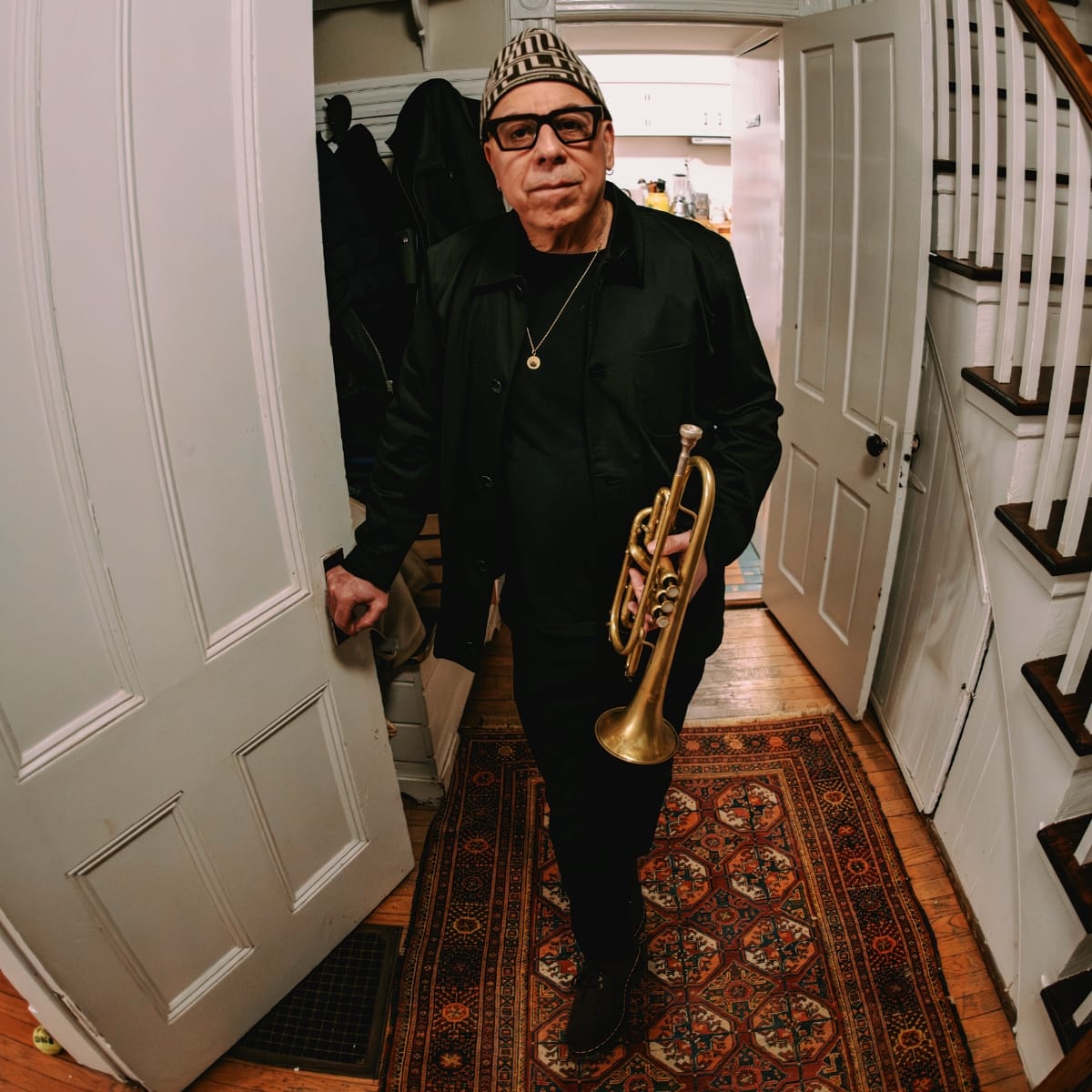
Steven Bernstein was born in Berkeley in 1961 and came up through the Bay Area's jazz education programs before arriving in New York as a teenager, where the cornetist and conductor Butch Morris gave him some of his earliest gigs. In the decades since, he has worked across jazz, experimental music, film, and dance as a trumpeter, composer, and arranger, with a voice that's recognizable in every context.
Bernstein is best known as the founder of two long-running ensembles. Sexmob, the quartet he started in 1996 out of a Knitting Factory residency, has spent nearly thirty years playing without setlists, most recently touring and recording with Laurie Anderson on the live album Let X=X. The Millennial Territory Orchestra, his nine-piece band, marked its twenty-fifth anniversary with a Carnegie Hall program in 2025. He has also recorded the Diaspora series for John Zorn's Tzadik label, arranged for musicians including Bill Frisell and Marianne Faithfull, and scored films. His years in Levon Helm's Midnight Ramble band contributed to three Grammy Awards during Helm's late-career return.
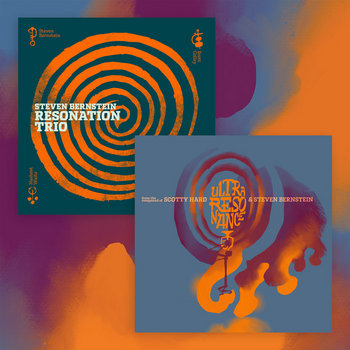
His latest release is a double album of two closely linked records on Royal Potato Family. ResoNation Trio is a spare, chordless date with bassist Scott Colley and drummer Nasheet Waits, and it finds Bernstein playing valve trumpet and flugelhorn throughout, setting aside the slide trumpet that has become central to his sound. Ultra Resonance hands that trio session to his longtime collaborator, the producer Scotty Hard, who breaks it into pieces and rebuilds it as a new work. Bernstein first imagined the project more than thirty years ago, after hearing Burning Spear's dub landmark Garvey's Ghost and wondering what the same treatment would do to an instrumental improvisation record.
Steven Bernstein was recently Lawrence Peryer's guest on The Tonearm Podcast. The two discussed the freedom he found in a trumpet trio, the dub experiment that produced Ultra Resonance, and the decades of collaboration behind both records. Their conversation also touched on Bernstein's Berkeley childhood, the downtown New York scene that shaped him, and his lifelong habit of keeping older music alive on the bandstand.
You can listen to the entire conversation in the audio player below. The transcript has been edited for length, clarity, and flow.
Lawrence Peryer: You said that ResoNation Trio is a bit of a blank slate because of the paucity of trumpet trios. I hadn't really thought about that much before, but I would imagine there are some amazing opportunities in not carrying a lot of the baggage of tradition.
Steven Bernstein: Exactly. I always would talk about the slide trumpet, and why I was so attracted to it was that there was no baggage. When you play an instrument like the trumpet, there's just so much stuff. Freddie Hubbard and Woody Shaw, and then Miles and Dizzy, and Kenny Dorham and Clifford Brown and Louis Armstrong. And of course, someone like me who loves history—all that stuff's in my ears. So with slide trumpet, I just felt completely free, like I could do whatever I wanted.
And now, I'm almost sixty-five years old, and this is like the first trumpet record I've made. It took me this long to feel confident enough to do it, and I chose a way that doesn't require me to rely on my predecessors.
Lawrence: Tell me about the attraction of Scott Colley and Nasheet Waits. To me, it makes conceptual sense because it's like, all right, these are the two other guys to go out into the unknown with.
Steven: I've known Scott forever. Scott's from California, as I am. When he moved to New York, he moved to my neighborhood, and we had a lot of mutual friends. So we hung out socially but never played together because I was involved in the whole East Village scene, and he was on tour with Carmen McRae.
But what happened was that he started playing with Andrew Hill. I had met Andrew Hill when I was quite young. I remember talking to Andrew Hill about Scott, and he said, "Well, Scott is a modern-day Richard Davis." I heard Scott and Nasheet play with Andrew Hill, and I was like, "Yeah, whenever I get to make this kind of music, I'm going to do it with those guys." But it was always, "No—when I make this music, it's going to be with these two guys, and that's it."
Lawrence: When you were a fourteen-year-old getting into those worlds, were you immersed in the music? Was this your music already?
Steven: Oh yeah. That's the crazy thing. I always knew. I was obsessed with Louis Armstrong. When my parents moved about five or six years ago, we were going through boxes, and I found a scrapbook I made about Louis Armstrong and his funeral. Now, Louis Armstrong died in July of 1971. I was born in October of 1961. That means I was nine years old. As a nine-year-old, I was already obsessed with Louis Armstrong. Why? I can't really tell you.
In Berkeley, California, we had the first elementary school jazz program. Peter Apfelbaum saw potential in my playing when I was in sixth grade, and he said to me, "Listen, I want you to be in my band next year," because he had his own band. "But this summer, I'm going to give you some records to listen to. When you're done with these records, you're going to be in my band." And the records were Freddie Hubbard's Straight Life, Horace Silver's Blowin' the Blues Away, Lee Morgan's The Sidewinder, and a Maynard Ferguson record.
Then Peter's like, "Let's start hearing music on the weekends." So we go to Keystone Korner. Within two years, I'd seen Eddie Harris, Rahsaan, Sam Rivers, Sonny Fortune, Oliver Lake. And then Peter goes, "Okay, check this out," and he's playing me the Art Ensemble.
When you're young, you don't have the scientific way of looking at the world. You just go, "It's a record, and it either moves me or it doesn't." By the time I was fourteen, I was already enamored of Albert Ayler.
Lawrence: Were the Grateful Dead in your consciousness? Were the other things going on in the Bay Area happening for you?
Steven: I was such a jazz fanatic that I was completely oblivious to all of that music. I thought the Grateful Dead were a local band. One time, someone pointed out this hippie guy in a poncho and said, "That's Jerry Garcia." And I went, "Okay, that doesn't mean anything to me." I thought Jerry Garcia was a local Mexican blues guitarist who played on Monday nights.
Then I get to Columbia University, and one guy goes, "I saw the Grateful Dead in Egypt. Jerry was looking at me when he played." I'm like, "Who's Jerry?" He goes, "Jerry Garcia." I said, "The guy who plays Monday night around the corner from my high school played in Egypt?" And then it all started to click. When I met Phil Lesh the first time, through Levon Helm, I told him, "Man, that music was mother's milk to me, because I didn't know I was listening to it." I didn't know it was a band because it was so prevalent growing up. I thought it was just a style of music because it was always wafting through the air.
Lawrence: When you're sitting down to write, do you already have the ensemble? Or do you have a songbook, and you just say, it's Millennial Territory Orchestra time?
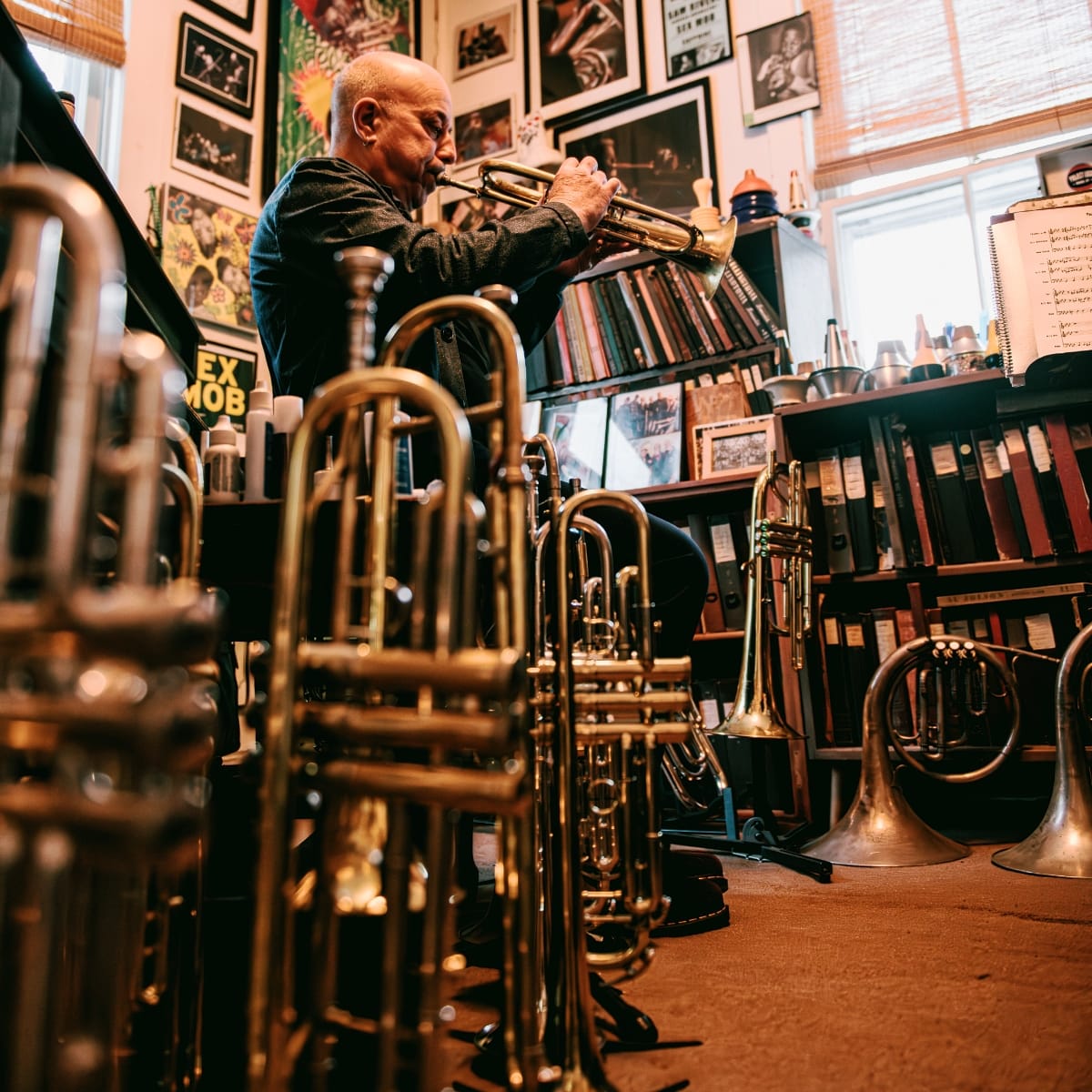
Steven: It kind of works both ways. Sometimes I'll be in MTO mode and be like, "I want to write some new music for MTO." I used to write all on paper, but now I tend to start ideas on paper and then put them into the computer. And the great thing is, I don't play piano. I'm like the only arranger who doesn't—I just arrange from my head, basically. I use this little Casio, which John Lurie got me hooked on, that only plays four notes. It's only a four-note polyphonic instrument, and I use that to check pitches, but basically, I write from my head.
Now, with the trio, I had so much stuff written that I wanted to do something with one day. Some of it was a complete piece, with a melody, a counter-melody, and a chord structure. And some pieces might just be, "Here's one phrase, and an idea for a drum texture and a bass thing, and let's go."
I was telling someone that as much as it's improvisation, it's also spontaneous composition. If I improvise something, you call it improvising. If I take that same improvisation and write it down, it's called a composition. What's the difference? It's the exact same thing. And some of those pieces are that, because often I'll be playing something and I go, "Oh, that's good," press record, boom, boom, boom. "Okay, let me play it back and write it out, because that's a good idea." Now it's a composition. Why was it not a composition five minutes ago?
And I think it's one of those things about Western civilization—something I call a false hierarchy system of music. I play so many different kinds of music. I play with Levon Helm—I still play with the Ramble band—and Sexmob music is related to that kind of music as well, way more blues-oriented. People often think of that as simple music, while if music is very mathematical, has a lot of intervals, is maybe a little more difficult to listen to, and has time changes, that's 'difficult' music. Now, I've heard people who are virtuosos of that kind of music sit with Levon Helm and be unable to play that music.
Lawrence: Sure, I bet.
Steven: It's all difficult music until you learn how to do it. Music is music. There are just different kinds of music—it's not like one is more difficult than the others. All music is difficult, and no music is difficult. The difficulties are very different, because what makes music like Levon's and music like the blues is way more subtle. It's easier to play the flat, one-dimensional version. But to truly play it and create the magic—that's why people want to go hear music.
We were even talking about that yesterday with Nate Chinen. He was talking about being in the room with Levon, and he goes, "Yeah, the vibrations, it was so vibrational." I said, "See, that's the magic. You used the word 'vibrational.' That's the power of music." People like us are drawn to it because there's something about the vibrational magic of music that turns us on.
Lawrence: You brought up the Helm Family Midnight Ramble. It's beautiful that they still happen. It's an institution not only for music fans in that region, but also for many artists who value their experience. It's been a while since it's actually been with Levon, right?
Steven: This November will be twenty-two years I've been doing Rambles. And I think it's been fourteen years since Levon passed away.
Lawrence: What do you still get out of it?
Steven: Unbelievable—that power, that vibration, the vibration of that room. It means so much to me to be there. Amy's done an incredible job of keeping the band going. We bring in new music and new arrangements every concert. And Amy's son Lee plays drums and sings. There's something so powerful about playing music that's that direct.
It's also been really great because Amy really enjoys deep cuts—the not-obvious Band songs. And part of who I am is that I love this idea of being able to play the music of Duke Ellington, playing the music of Nino Rota, playing the music of Sun Ra. I love the idea of continuing the tradition of music and feeling like, "Yeah, I'm actually part of this at this point." I've played the Band's music a lot longer than Robbie Robertson did. (laughter) Twenty-two years. The first version of the Band, I don't know how long it lasted, but it wasn't that long.
For me, it's also the only gig I do where I'm not the bandleader. I just show up. Think about being a trumpet player—you can't be a half-assed trumpet player. You've got to wake up and practice every day. So I love a gig where all I do is play the trumpet.
Lawrence: When you mention the deep cuts in the Band's catalog, to me, there's something fundamentally sturdy about those songs. It's important for popular music and popular folk music to be played—or it dies. This music's not meant to be in a museum, and that's what will happen if it doesn't get played.
Steven: I agree with you, Lawrence. I absolutely do. For over thirty years, we've been playing Duke Ellington's music at almost every single gig with Sexmob. We do it in a way that people might not even know it's a Duke Ellington tune for a while, because it's grooving in a way that puts our own rhythms and our own sound on it. That's keeping Duke Ellington alive.
Lawrence: And again, it speaks to the strength of the composition that it can withstand your interpreting it.
Steven: Yes, it can withstand Sexmob. It takes a strong melody to withstand Sexmob. (laughter)
Lawrence: I'm curious about Burning Spear's role in the genesis story of Ultra Resonance, and specifically why you didn't make that explicit to Scotty while you were working on the record.
Steven: Just because I've been working with Scotty for so long, I didn't even think about it. Scott and I have been working together for 30 years, and the last Sexmob record began with Scott's loops. So I just told him, "Look, I have this idea. I'm making this record, I have it in the budget, and I want you to create a secondary record." And I just left it at that.
Then what happened was, we were driving home from John Medeski's sixtieth birthday party, and it's a long drive. So I was like, "You know what? Let me play this record." And we're listening, and he goes, "This is so cool." I said, "Well, this is what inspired me for this idea in the first place." I literally have been thinking about this since I started making records. The very first Spanish Fly record, I was thinking, "God, wouldn't it be cool to have a dub version of the record?" Well, we had no money, and I was a young guy, so no one would listen to me anyway. And now I had a budget to do it.
Lawrence: Did you ever hear the Bill Laswell record he did with the Miles Davis tapes?
Steven: Oh yeah. Check this out—I wrote horn arrangements for a Laswell-produced Lee "Scratch" Perry record. It's Peter Apfelbaum and me on horns, and Bernie Worrell on keyboards.
You can't play music unless you love it. Every once in a while, some guy will say, "Why don't you call me for this?" I say, "Well, if you don't love loud rock music, it's kind of hard to play with me, because that's part of the gumbo." It's all in my gumbo. If you're not into Albert Ayler and you're not into Lou Reed, it's going to be hard for you to get into the gumbo.
Lawrence: You're an interesting connective figure, because there are people five or ten years older than you, even going up to Zorn, and then cats that are five or ten years younger. You're a bridge figure in my brain, between not only scenes and different styles of music but also generations.
Steven: Yeah, I think it's a good observation, because I've known Butch Morris since I was fourteen. When I got to New York, that's the kind of music I wanted to make. They used to call it free bop. I had heard Butch play with this band, the Saheb Sarbib Multinational Big Band, and I called him up my first summer in New York. I said, "Hey man, that's the kind of music I want to make." And he says, "Well, Steven, they have a record date, why don't you show up?" So I just show up to this record date, a nineteen-year-old kid living in a dorm.
It's the entire East Village there. The trumpet section is Roy Campbell and Ahmed Abdullah. The saxophone section is Jemeel Moondoc and Mark Whitecage. At the end of the session, the baritone player, Dave Sewelson, says to me, "Why don't you come tomorrow? We're playing with the Microscopic Septet." At the time, John Zorn was the alto player. So I met all those guys, and hanging out with them that day were Wayne Horvitz, Elliott Sharp, and Bobby Previte. So now, in like five days, I've met the entire East Village, and they didn't really have a trumpet player. And again, I was a bridge, because I was younger than those guys, and I was more trained in fundamentals than they were, because I came from big band. A lot of those guys were self-taught autodidacts. So I was a bridge between guys like that and then guys like Medeski, who was super well-trained, doing the conservatory music.
Now, when young people get to New York, they all go to jazz school. So now when you meet someone your age: "Oh, do you go to Juilliard?" When I met someone my age in New York, it was, "What neighborhood are you from?" I met the East Village guys, then the guys from the Upper West Side, and pretty soon I was playing in bands with Melvin Gibbs and Vernon Reid, who were from Brooklyn. A lot of people just thought I was a New Yorker because I was a nineteen-year-old on the scene playing gigs.
Lawrence: I look at your touring schedule, and it reflects the diversity of music you're involved with, as well as the diversity in room sizes. Can you talk a little bit about the role of place in the music?
Steven: We played with Laurie Anderson at Central Park on Friday, a whole brand-new show, with extra musicians. The band was ferocious. And I was saying, "God, it's so fun to play a hometown show." And then I also realized—when you show up to the fanciest concert hall, like the Hamburg Elbphilharmonie, and you get your dressing room, and there's the beautiful catering, you're playing a certain way; you're playing the hall. Now, if you're home and you're playing outdoors in Central Park, we just rocked—way more ferocious. That's just the truth.
But ultimately, when we're playing music, we're just playing music and trying to communicate. None of that stuff really bothers me anymore. Two years ago, I did a career retrospective at Zankel Hall at Carnegie Hall and sold it out. So now when someone calls and says, "Oh, we've only sold six tickets," I just go, "Well, you guys need to do a better job advertising your shows."
Lawrence: Sounds like it's a you problem, it's not a me problem. (laughter)
Steven: Yeah. "I sold out Carnegie Hall, I don't know what to tell you!" And I'm at a point in my life where that stuff doesn't bother me because I'm not really trying to achieve anything. When you're young, you're really striving, and I feel like I've been lucky enough to achieve basically whatever I wanted. The old joke was, "How do you get to Carnegie Hall?" Well, I did. Peter Apfelbaum was on stage, who I've known since I was twelve. And on stage with Laurie, there's Sexmob—these guys have been with me for thirty years. And here we are with, I think, one of America's greatest artists. Laurie is so inspiring and pure as an artist. I think she's a real inspiration for the trio record. Being around her gave me the courage to do this, because Laurie's whole thing is, "You don't need to ask permission. You just make something. Don't even worry about it, just make the art." Because I've got to say, I was like, "Is anyone going to want to listen to this? It's just me playing with bass and drums." I didn't even ask Laurie, because I knew if I asked Laurie, she'd be like, "Of course. You want to make some art? Make it." It's really life-affirming to be around a person like that.
Lawrence: There are artists who reach a point where people go along for the ride with you. When I get the press release announcing a new record from you, it's not like I have to be convinced to listen to it. It's like, "What's this guy doing now?" First of all, who would you even ask for permission?
Steven: Well, the thing is, I used to have Hal Willner as my go-to guy, and I don't have him anymore. Hal left way too early. I have no sounding board. Greg Tate was like that too, but not so much with music, more with life in general. Whenever I had a record, before I was done, I would play it for Hal—"What do you think?" And I don't really have anyone like that right now. I just have to go, "Okay, well, I like it, I'm putting it out."
Lawrence: That's a heavy change.
Steven: Yeah, because there's no one I feel understands both what I hear and the bigger picture. I have a very wide picture in my head, and most people just don't have as much.
Lawrence: A lot of artists I talk with refer to their work as research. And you said that the only reason left to put out a record is to experiment and discover something new. Was there a moment when that realization came to you?
Steven: In a sense, if you look at my records, I've always thought that. Every record is completely different. All the Diaspora records are different; all the MTO records are different as well. That's just the way I am; that's my personality, I guess.
I think it's a bit of a blessing in disguise that we've had a glut of recordings now—it's to the point where anybody with an iPhone can make a record and put it out—because that made me realize that if I'm going to put out a record, there has to be a reason. There really has to be a reason, because there's just too much music out there.
Check out more like this:
 Jonah Evans
 Lawrence Peryer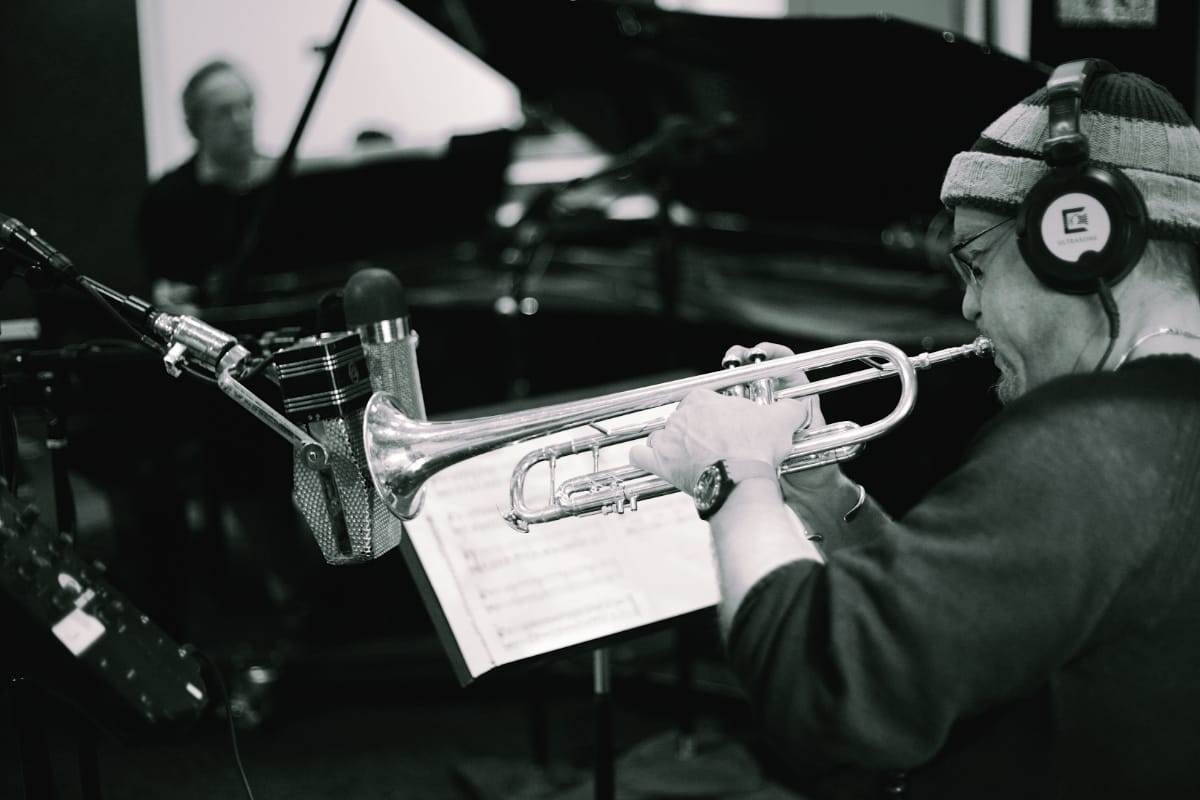


Comments