


Tumblin' tumbleweeds (most commonly the invasive Russian thistle) do not have a fixed size, but their average diameter is roughly 60 cm (about 2 ft). This means the average tumbleweed circumference is similar to the size of a standard beach ball. Note: For the mathematically inclined, a circle's circumference is calculated as C = πd, where π ≈ 3.14159 and d is the diameter. Consider this sentence a roundabout introduction to the Austin, Texas, trio Cento Threeo.
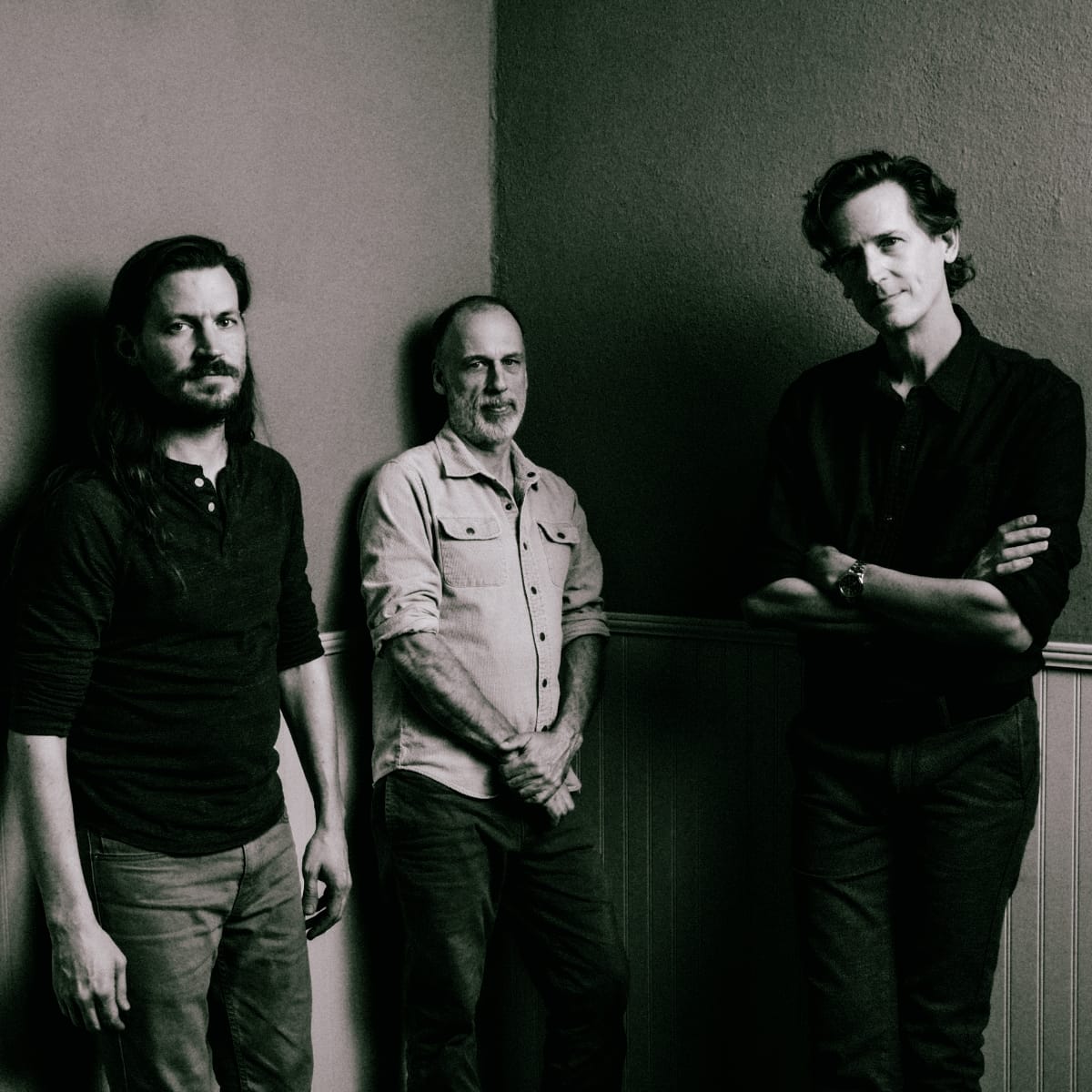
Halfway to Mellowtown is their debut instrumental album, a sound begging the modifier "atmospheric," though that's timeworn. But up the humidity on a Lone Star night when buzzed mosquitoes swarm neon signs—and candidly most are attracted to pale blue argon—and you're getting out my way. This LP features leader Don Cento on guitar, Phil Spencer on upright bass, and Norm Bergeron on drums.
Recorded in Austin by Stuart Sikes (Loretta Lynn, Cat Power, and White Stripes) with Cento as producer, the eleven songs have been described as "Jazz/Americana." The Tonearm reader has their own understanding of those words. Halfway to Mellowtown is, ostensibly, a successful pairing of American music. Each form has deep roots in Texas. But there's more to the music, as Don Cento and I discussed via video call. In these haggard times, Cento Threeo are resisting sloth, haste, and irony. Be grateful.
The conversation has been edited for clarity and length.
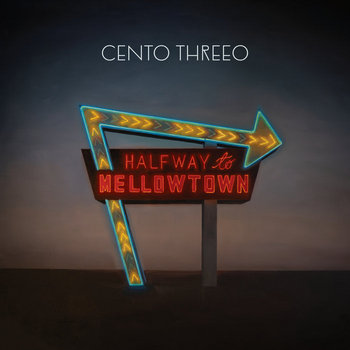
Steven Garnett: So—Halfway to Mellowtown. What exactly would be the midpoint?
Don Cento: A friend of mine made a comment the other day: "What happens if I'm already in a motel room at Mellowtown?" And I said, if you divide a half by half, you get a half—and you do that into infinity. So you're never actually always at Mellowtown, even if you find yourself already there. The midpoint is always eluding us. It's just like life: whatever's next is always down the road.
Garnett: That reminds me of a conversation I had this morning with a fellow parishioner. We were talking about whether time is linear or in endless circles. In neither case is there a midway point in a traditional sense—I'm sure someone with the right degree would refute my claim. I have an English degree. You have a music degree.
Don: I always come back to this kind of thing. I remember reading a long time ago—or trying to read—a book on fractal geometry. That's where the concept comes from: dividing a number in half, you never actually get down to zero. A half of a half of a half of a half—that has always stuck with me. I don't know if I've applied that concept musically or in my life, but when you're talking about time being linear or time being a circle, that puts me in that frame of mind, especially the circle part—because we do often find ourselves circling back on things in life, even though time is moving forward.
Take this record, for instance. My career as a jazz musician: I studied jazz in college in the early nineties, set it aside for a long time, and circled back a few years ago, rekindling my interest and love of it. So in that sense, I was moving forward in my life, but came back to something I thought I had left behind. I don't want to say I wasn't taking it seriously—maybe I felt intimidated by the music's challenges—but I developed other musical interests. I circled back, and here we are.
Garnett: You studied jazz at the University of North Texas, Denton, but you've made every kind of music. Looking at what you've done—not to mention the Barton Hills Choir, working with young people—you are doing so much, and it all seems created with a spirit of joy. It doesn't seem like a burden at all.
Don: No, it isn't. The good fortune of having the opportunity to make music with wonderful people—that's where the joy comes from. There's a joy in music in and of itself, but I have been lucky to play with some incredibly talented people—great songwriters, great leaders, great visionary people. I guess that's part of what draws me in so many directions.
I didn't wake up one day and set out to make an indie rock record, a jazz record, or a classical record. It's just these people I've met along the way who have asked me to participate—to bring whatever small amount of expertise I may have in some area to help them get their project to the finish line. And I think the reason that works is—thinking about it out loud here—a lot of the people I've worked with aren't really one-dimensional. A lot of them make a variety of types of music.
I'm thinking of my friend Kara Pollard and the Imbroglio Sextet. It's a classical sextet with some friends she met in Haiti: half Haitian, some Spanish players. That's the other half of her life. And the other half of my life is making records. So she and that group needed to make a record—they didn't feel entirely comfortable in the studio—and they wanted an interface between the music and the engineer, which is basically what a producer is or can be. That's how I came to be in that picture. It's these friendships, moving forward linearly through time and circling back, that yield these different colors on a palette.
Garnett: I wonder if there's something to being from Texas. Marty Robbins wasn't stuck in a box; Ornette Coleman clearly blew the box to smithereens. And yet we put language with them—"Marty was a country star," "Ornette was a jazz innovator." Halfway to Mellowtown is described in the notes as Americana meets hard bop, and I don't have a problem with those language choices, but maybe there's something about the water in Texas.
Don: I do think about that. The language around music—that's never something I start with. Broadly speaking, we might say we're going to make a rock record or a folk record, but with this, it was never "let's make a jazz record" or "let's make a jazz Americana record." That was never the thought process.
The group started very casually, with the drummer on the record—my good friend from college, Norm Bergeron. He had just been twisting my arm: "Let's get a little combo together. I can get us a gig. We'll just play covers in a sort of atmospheric jazz trio style." Sure. So we selected a bunch of covers from the sixties and seventies—classic AM/FM hits, "Wichita Lineman," "Anyone Who Had a Heart," stuff like that—and just started playing. Then I brought in an old song I had written in college, "Horse Breaking Hector," which is on the record, and it's sort of jazzy and atmospheric. That went over well, and I got excited and started writing. But it was never calculated—the writing came organically. I would sit down with my guitar, and things would just fall out, which I think is generally how writing goes if you're writing for yourself.
It wasn't until the record was done and I was talking to friends about promoting it that I realized you have to put a label on it. You have to give people a doorway to the music. It's an instrumental guitar record—okay, great. Does it sound like Godspeed You! Black Emperor, or does it sound like Grant Green? We just landed on "jazz" because there's a lot of improvisation, and "Americana" because I have some history with that kind of music, and the harmonies are not necessarily seventh chords—there's some more open triad stuff. So we called it Americana; it might lean country-ish. It's just trying to string some words together that might intrigue people, because we want people to listen, and also give them something to hang onto when they get into the record.
Garnett: Probably in 1990, I had a mixtape cassette that was one side George Jones' greatest hits and one side Pussy Galore's Dial M. It was beautiful—I loved it. But it was also indicative of what I was doing: I was starting to explore American and Japanese underground noise, but I was also listening to FM country radio. I didn't care about the rules. I like music, and I'm probably your contemporary, maybe a little older. We're not bound anymore—I don't have to apologize for that mixtape.
Don: I grew up listening to country. That was just what was on the radio in southeast Missouri—late eighties country, I suppose. When you say you don't feel the need to apologize for that mixtape, I feel that way about so many things I set aside in my twenties and thirties when I thought, "I'm too cool to listen to Garth Brooks," or whatever. Here in my advancing years—I'm fifty-three now—I find myself returning to things I once felt strongly about as not being cool, and now I think, I don't care about cool anymore. I just like this.
I don't know if you've had this experience, but have you returned to things you listened to very deeply when you were younger and heard how much you were missing, just because you didn't have the 'ears' on your ears? I've really enjoyed getting back into the jazz thing, going back and listening to the Miles Davis stuff, or the Wes Montgomery stuff, or the Keith Jarrett stuff that I really loved in college, and coming back now thinking, there's so much more here than I was hearing. So my question to you: do you feel like you're hearing that as you age and listen? Do you feel the same way about old music you set aside?
Garnett: I agree with you on that. Maybe it's some sentimental streak, or maybe it's just how we're supposed to get older. Like with Rosanne Cash—and Dwight Yoakam and The Judds, all of that back catalog we could have heard on the radio—I couldn't pinpoint the [Rosanne Cash] cover song [on Halfway to Mellowtown] as I was listening to it without the vocals. But then I picked out something—something like a touch of Pavement's "Range Life" in it. Then I thought, there's no way Stephen Malkmus and company sat down and listened to Rosanne Cash and composed "Range Life." But then maybe there was something about that era, too—the year punk broke, as Thurston Moore called it—when it just didn't matter.
This did stand out to me, listening to your record: one of my favorite jazz records is Ahmad Jamal's Chamber Music of the New Jazz, from around 1955. It's neither chamber music nor particularly jazz, and there are many standards, but it sounds a certain way that I think your record very much shares. I was listening to that literally yesterday and thought, damn, I'm going to be talking to Don.
Don: Ahmad Jamal was definitely a touchstone for us while we were making this record, maybe not directly, but in the back of our heads. Specifically, the famous live record at the Pershing—it's the Ahmad Jamal Trio, recorded in Chicago. It's a classic. The thing that we loved about that record—and still love about it—that we tried to achieve on this record, in the writing and in the improvisation, is concision. Our bass player used that word. It's very concise. We didn't want long, drawn-out solos. We wanted clever arrangements that opened up different parts of themselves as the song moved along. And we wanted improvisation because it's jazz, and I think the band works well together—but we didn't want to just go on forever, because I'm not John Coltrane. State your case and get out. Move on to the next thing.
So about half of the songs focus on cool arrangements that do some neat things, and the other half are just straightforward traditional jazz: melody, solo, melody, end. Which is fine too. That's the Ahmad Jamal influence—though nothing we do is nearly as clever or as smart as those arrangements. The way that trio plays, the subtlety and the way they unfold slowly over time—it's without peer.
You mentioned [Rosanne Cash's] "Seven Year Ache" earlier, which is interesting: that was a song suggested by my wife. When we were developing our set list of covers, it became the way we close our shows, so we decided to close the record with it, too. Another cover we've done—haven't played it in a while—is "Range Life." We never quite perfected it, but we've played it a lot. That might also go back to my wife: she's a huge Pavement fan as well. I'm a huge Pavement fan too.
Garnett: Knowing I was going to talk to you, I listened to Halfway to Mellowtown and thought, let me see what else he's done. I'll just use the word "producer," though I understand you've also done a lot of engineering and played with any number of ensembles. But if it's your hand that gets the final rubber stamp—your ability to arrange, the placement of sounds, the mix—there's something there. It's professional without being sterile. I really recognized it. There's an optimism and a spirit of "let's just do this, and do it really well."
Don: I really appreciate that, because I do think that is something I strive for. I'm especially glad to hear it doesn't sound overwrought, because as an artist—as an insecure artist, as we all are—I have confidence in what I'm doing, but sometimes you wonder: did I push it too far? Did I overcook this meal? Have I cooked out all of the protein? Is the heart still there?
I like trying to make things work, making things clean when they need to be clean or dirty when they need to be dirty, but always trying to remain true and produce something intentional. That's another word a bass player friend of mine uses—James Driscoll, the bass player in Shibboleth. He said "intentional" probably in a conversation twenty years ago, and it stuck with me. So now everything I do, I try to be intentional about, because if it's recorded, it's going to last forever. I want it to connect now, and I want it to connect later.
That's where I'm at these days: trying to be intentional in my productions and in improvisation, which is even harder because you're in the moment. You can get excited by the moment, or overwhelmed by the chord changes, or get inside your head. The challenge is getting out of your head and remembering to speak in complete sentences when you're improvising—instead of just playing a bunch of notes and completing a thought before moving on to the next one. That's really hard.
Garnett: Everything here is within the realm of maybe traditional compositional structure. When I listen to guitar players, I go back to a conversation I had with the late Davey Williams. He said that as a guitar player, when he's composing and improvising, he's really never particularly concerned about what he's doing as a guitar player as much as what the other musicians are doing. Part of that comes with the form of instant composition, but he said the same was true of records. And I remember a Duane Allman quote from a vintage Creem magazine I picked up for a quarter at a used bookstore. There's Duane, saying, "I'm just listening to Miles Davis these days." So maybe you can do something with that—the idea of the guitarist-composer, but with your head focused on the other sonics.
Don: With respect to the other musicians, when we talk about improvisation, what we try to do in the group is—and it's an evolving thing, like dividing a half by half, you never quite get there—I like to call it conversational music. We're trying to have a conversation. Yes, I am now improvising, but if Phil, the bass player, wants to interject something or support it in a different way, I'll try to listen to him and pick up on that. And I'm always listening to the drummer—in this case, our current drummer is Matt Johnson. We've been developing a language, or just becoming aware of the way each other plays, so we can anticipate each other a little more. Sometimes we coincide in really musical and fun ways; other times you're just chasing each other around.
It is about trying to keep a 360-degree awareness of what's going on around you—on stage, in the room, earlier in the day: what was the song we just played, what did we talk about on break? I think this group has gotten better and better because we've been playing more, but also because we've gotten to know each other better. I've known Phil for years, but Matt is a fairly new friend. We've had long conversations at rehearsals—Matt will talk about drums, about rhythm. And sometimes we'll just talk about life and get to know each other. I think those conversations are the most important part of building a band's chemistry that can then reveal itself on stage.
Garnett: And perhaps in the record, too. Those kinds of conversations—even though Matt is newer—you can still feel that these players know each other and care about sharing something through listening. I like that we're closing on the way friendship can factor into making music.
Don: The most important part of it is these friendships. I've had the opportunity to work with some amazing composers, like Richard Martin from Shibboleth. We made a couple of records years ago; the band is still somewhat active, and Richard just moved to Austin from Dallas. So I've gotten to see Richard regularly again, and we've been playing a lot—which has been fantastic.
And there it is—it's a friendship, and it's circling back as we move forward. It's like a boat moving down a stream, and the eddies it leaves in its wake circle around the linear path cutting through the water. I feel like that's what's happening here.
Check out more like this:
 Cary Baker
 Steven Garnett


Comments