


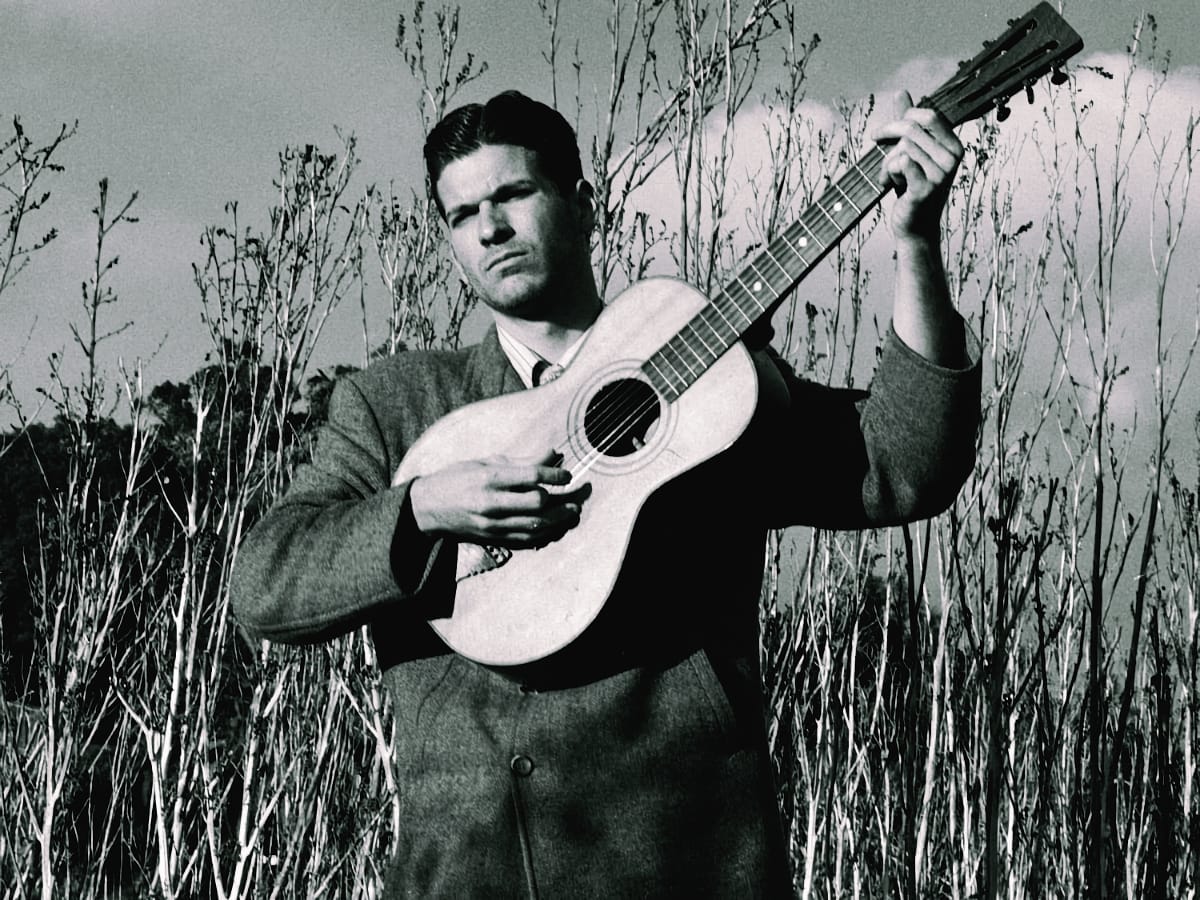
Frank Fairfield was a deliberately anachronistic figure in the early-2000s roots music revival—a Fresno-born, Guatemala-raised, and Los Angeles-based self-taught musician who seemed less like an affection than a time traveler, channeling pre-war American folk, blues, and string-band traditions with an almost ethnographic intensity. Performing on banjo, fiddle, and guitar, usually solo, he favored archaic tunings, antique repertoire, and a rough-edged, field-recording aesthetic that rejected present-day polish in favor of a historical feel.
His brief recording career—centered on releases for Tompkins Square Records between roughly 2009 and 2011—produced a small but striking body of work, including his self-titled debut album and Out on the Open West. These records stood out for their stark, unvarnished sound and deep immersion in early American musical roots, drawing comparisons to figures from Appalachian banjo player Dock Boggs and to pre-war Mississippi Delta bluesman Skip James, not as revivalism but as living continuity.
Critics heard Fairfield's debut less as a contemporary folk album than as a kind of sonic time capsule—"the scratchy atmosphere of an old 78," as Pitchfork put it.
Fairfield also compiled Unheard Ofs & Forgotten Abouts: Rare and Unabridged Gramophone Recordings From Around the World, 1916–1964 for Tompkins Square Records. Released in 2012, it's a wide-ranging collection drawn from Fairfield's personal stash of 78 RPM records, spanning early recordings from across Europe, Latin America, the Middle East, Africa, and beyond. True to his sensibility, it favors raw, pre-LP-era performances—often obscure, unpolished, and deeply rooted in local traditions—presented with minimal modern mediation, as if you'd stumbled onto a forgotten archive of global vernacular music. Much of it—albeit from all corners of the globe—melds seamlessly with the old-timey American music he played himself.
Fairfield busked and performed in intimate settings, cultivating a kind of anti-career: minimal media presence, little conventional promotion, and an almost studied resistance to modern music industry norms.
Which isn't to say that he didn't have his moments in the spotlight: Fairfield performed at Royal Albert Hall and the Kennedy Center, and at the Newport Folk Festival and the Hardly Strictly Bluegrass Festival, with an appearance on NPR's Tiny Desk, widely considered a key career needle-tipper.
By the mid-2010s, he had largely withdrawn from public performance and recording, leaving behind a compact, enigmatic catalog that continues to resonate with listeners drawn to the raw, pre-commercial roots of American music.
Tompkins Square's Josh Rosenthal describes how he first learned of Fairfield: "I received a text from a contact of Frank's and flew down to L.A. to meet him right away. I love stuff that connects new and old, traditional and modern. Strong tugs on the past, with a new angle. Frank was a purist and really wanted to be authentic, true to the original music that inspired him. He could have kept going indefinitely—the talent is there, but he chose to stop. You have to respect that."
Sadly, I was late to the party. Just over the past month—16 years after the release of Fairfield's debut—a friend presented me with copies of Fairfield's solo debut, along with Unheard Ofs & Forgotten Abouts, knowing of my love for street musicians and first-generation blues. I've been listening to it nonstop ever since, and recently decided to track Fairfield down via his website. He responded, and we had a brief but illuminating conversation.
Cary Baker: Your website indicates that you may have stepped away from recording, nowadays focusing on teaching vernacular music and studying 17th- and 18th-century violin repertoire.
Frank Fairfield: That sounds about right. I made some recordings some time ago, but I don't really work in the performance and recording world anymore. I still play and do things for friends, of course, and I'm actually more interested in music now than I was when I was making records.
I've been trying to study music and understand it better. I started teaching sort of by accident, realized I really enjoyed it, and now that's what I do—I teach music.
Cary: You were born in Fresno and grew up partly in Guatemala, right?
Frank: Mostly when I was a kid, yeah.
Cary: So how did you develop this very authentic grasp of old-time American music—banjo, blues, country—whatever you want to call it?
Frank: I don't know if that's really the case, but I've just always been interested in music. My grandparents were from South Texas, and I grew up around that. I was raised in the Mennonite Church, so I heard shape-note singing [a form of communal American sacred music that uses a special notation system in which the notes are printed as different shapes] and other traditional forms.
That said, if we're being honest, especially with Anglo-American culture, a lot of that is basically extinct. It's something we kind of dust off now—the original functions of that music don't really exist anymore. But I still enjoy it for its aesthetic qualities.
Cary: How did you first discover it? Were your parents into it?
Frank: Not really. My parents didn't play much music, though my grandparents sang church music—more Southern Baptist-style stuff. I didn't grow up with much pop music around me. I was raised in a Mennonite environment with missionary influences, so there wasn't much TV or exposure to popular music.
But I don't think there's a simple answer for what draws someone to a particular kind of music. Something just catches your attention, and you want to learn more. One thing leads to another.
A big influence was the Brand Library here in Glendale, Calif. Before it was renovated, it was this old, slightly run-down place filled with records. That's where I first heard Folkways and similar recordings—music from all over the world. As a teenager, it had a huge impact. I was just curious and wanted to hear anything I could get my hands on.
But I mostly came into it through collecting records. That's what really got me excited—listening to people like Fiddlin' John Carson, Eck Robertson, and others. Then I started exploring music from all over the world and hearing how connected it all is.
But stepping away from performing as a job has actually made me more interested in understanding music—what it is, what we mean when we say "music," and why we even do it as a species.
Cary: Did you start collecting records while you were living in Guatemala, or later in Los Angeles?
Frank: I lived in Guatemala as a child, so I wasn't collecting records then. I really started collecting in California in my mid-to-late teens—around 16, 17.
Cary: Where were you finding rare 78s in those early days?
Frank: Primarily in junk shops and swap meets. Then I started meeting other collectors. I used to spend time with the now-defunct California Antique Phonograph Society—trading records, attending their annual meets where people sold large collections. From there, it expanded to auction lists, eBay, and private sellers. Later, when I began traveling for music, I'd look for records wherever I was—around the country and internationally—and connect with other collectors along the way.
Cary: And your interest in international recordings—did that grow out of your travels?
Frank: I've always been interested in music in general, but especially the earlier recordings. The significance of 78s isn't just their age—it's that there was a period when the major record companies were documenting what you might call people's music: actual, lived culture. These companies were essentially trying to sell phonographs—pieces of furniture—so they asked, "What do you want to hear?" and recorded local music to sell it back to those communities.
What's fascinating is the breadth of what they recorded—everything from grand opera to street musicians, from immigrant communities across the U.S. to recordings from all over the world. Slovak miners in Pennsylvania, Polish music in Chicago, Norwegian Hardanger fiddlers [Hardanger violins have five extra strings beneath the main strings] in the Midwest—it's an incredible cross-section of culture.
This moment also overlaps with the beginnings of what became ethnomusicology. For the first time, people didn't have to rely on written descriptions—you could actually hear the music. That changed everything.
It also gives us insight into earlier performance styles. You can hear musicians like Joseph Joachim—who worked directly with Brahms—and realize how differently that music was played. Or early singers like [European operatic soprano] Adelina Patti, with very little vibrato compared to later styles. These recordings reveal entirely different aesthetic values and show how each era relates to its own past.
Cary: Was "Frank Fairfield" your given name?
Frank: No, no. My family is mostly Spanish Tejano. My original last name was Martinez.
Cary: So you adopted a persona, in a way?
Frank: Yeah, definitely when I was performing. You sort of become a caricature of yourself. But music has always involved that—many early instruments are like voice masks, not just tools for beauty but for depersonalization.
Affect has always been part of music. We like to think some people sing "naturally," but that's not really true. When I was busking, especially when I was younger, I was definitely playing a character—almost like a minstrel show—getting lost in that role.
Cary: Where did you busk?
Frank: All around Los Angeles—farmers' markets, different spots. That's where I met a lot of great musicians. Many of my closest musical friends came out of that scene—people connected to the Blasting Company.
Cary: That's a band?
Frank: More like a collective. It centers around two brothers, Josh and Justin. Josh and I play baroque music together—he plays harpsichord, I play gut-string violin.
There are different groups within that circle, like the California Feetwarmers, plus a lot of Latino musicians. It's really a big network of working musicians in L.A.
Cary: I'm surprised I never ran into you in my L.A. years—I've always had a radar for buskers. That network sounds like the Wrecking Crew, the '60s session players from L.A. who backed a lot of '60s singers—a collective rather than a band.
Frank: Yeah, exactly. Busking really brought a lot of us together—people like Jerron "Blind Boy" Paxton, too.
Check out more like this:
 Sam Bradley
 Lawrence Peryer


Comments