


When I attended the Big Ears Festival in Knoxville, Tennessee, I had little idea of what I was getting into. At the opening ceremony, we were told to have our ears open to unfamiliar sounds, to the things we hadn't heard or experienced before. Among the many feelings we have when hearing music, especially for the first time, there is a potent punch that I felt many times at the festival. There is a direct challenge to what sounds should be and what they can sound like. There is an expansion of sound, and of worlds, and it's beautiful.
I heard the voices and rhythms of YAGÓDY at Big Ears while I stood on the bridge of Gay Street outside of Jackson Terminal. I had nowhere to be, and at this festival, it can be good to just wander in, right?
On stage were four women standing in a line, wearing headdresses in white, red, or black. I could tell that the leader, Zoriana Dybovska, had the white feathers. The other singers were Vasylyna Voloshyn and Tetiana Voitiv. All of their crowns formed a perfect half-moon, radiating energy into the air. Their billowing dresses were a deep black and red.
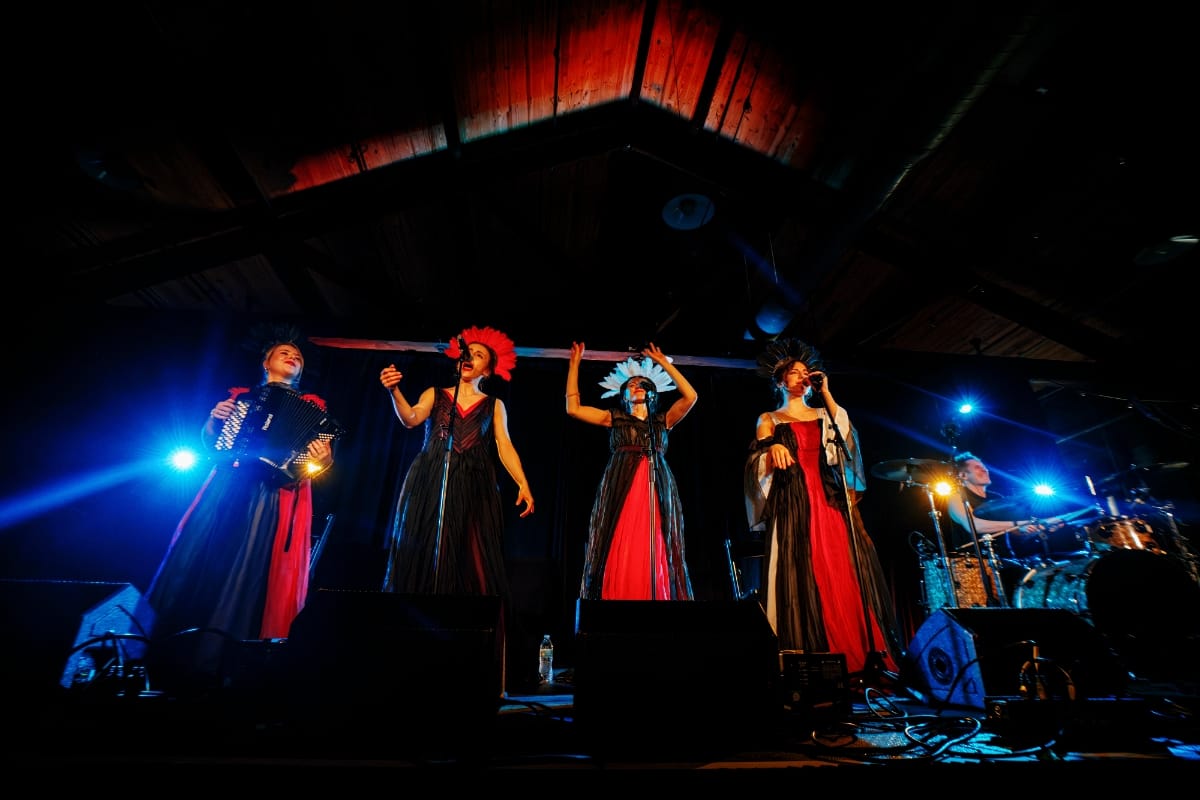
Nadiia Parashchuk was the accordion player. There was also a vibrant, animated drummer with a microphone close to his head. He played with open energy and would often glance at the singers. His name was Teimuraz Gogitidze, or, as he told me during the interview, Tim. This is the space I entered, and it was alive.
They would sing interchanging melodies, sing in harmony, hum the same tune in different octaves, and hold notes like nobody's business. While they sang, their arms were in almost constant movement. Sometimes they would open wide, then circle closed. Sometimes they would swing up to the sky. Sometimes they would swing down and flare out with pieces of fabric from their dresses. I didn't take my eyes off their performance for one second.
Gogitidze played the drums with such joy and life. At one point, one of the singers, Tetiana Voitiv, walked behind the drums during a song. She picked up drumsticks while he was playing, and—I don't know how this happened, in a physical sense—she started playing behind him, or kind of on the side of him. She played the same beat, and then continued while Gogitidze got up and went to the center stage. He did a call-and-response with the crowd, pairing each word with a body movement, and asked us to raise our arms above our heads.
I should say more about the accordion player. Parashchuk, and how she played, helped define so many contours of their sound. As in the song “Shopaiu Ya Hyryadochku,” the instrument plays subtly, building, and lives on a haunting low end. It slowly creeps into a higher range with the vocals. One often thinks of the accordion’s bright tones or its playful trills, but Parashchuk shows another side of the instrument: playful, dark, and solemn. When you hear the range she uses with that large, awkward instrument, it is easy to understand the vitality that breathed through it, feeding the band.
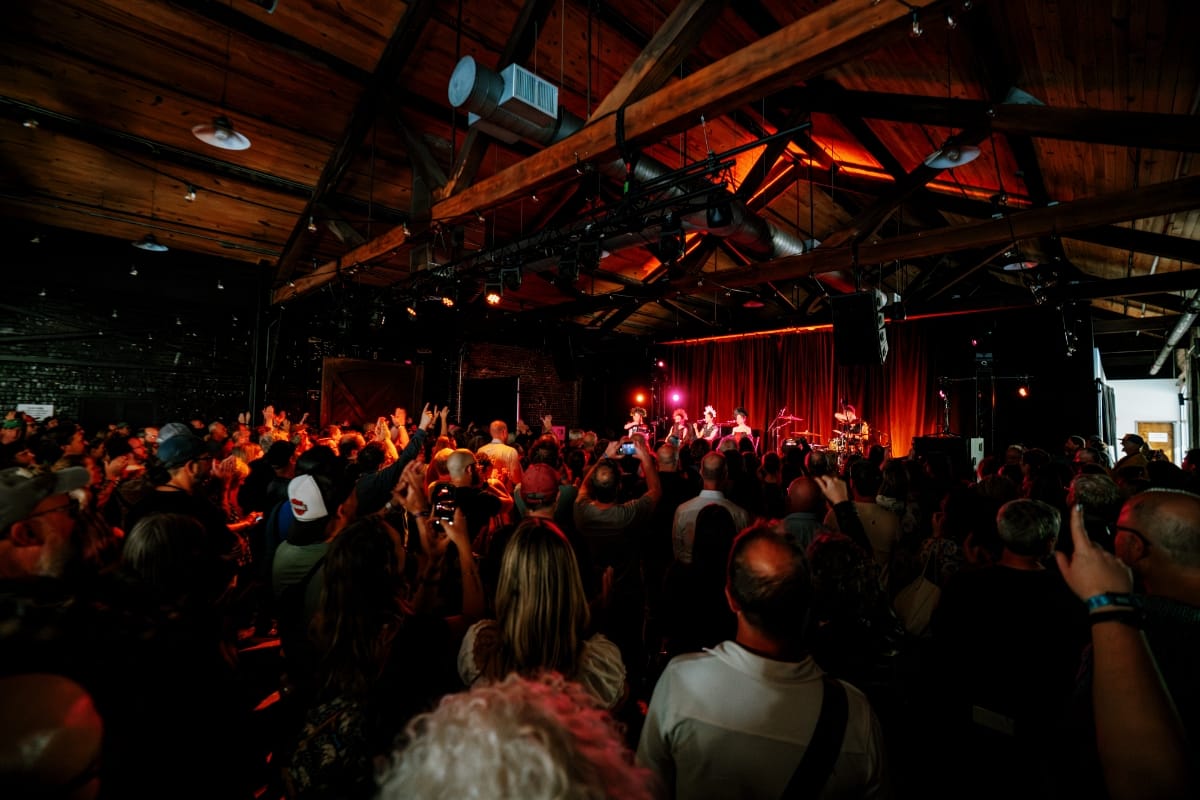
When the show at Jackson Terminal ended, and when the five members bowed, the audience couldn't stop clapping. You might know the kind of clap where you've just experienced where you've been deeply moved, maybe even stunned. We clapped hard, and loud, and for as long as we could. This was the second or third performance at Big Ears I had attended, and I was already sonically dismantled and enchanted. I couldn’t stop talking about their performance for the rest of the festival.
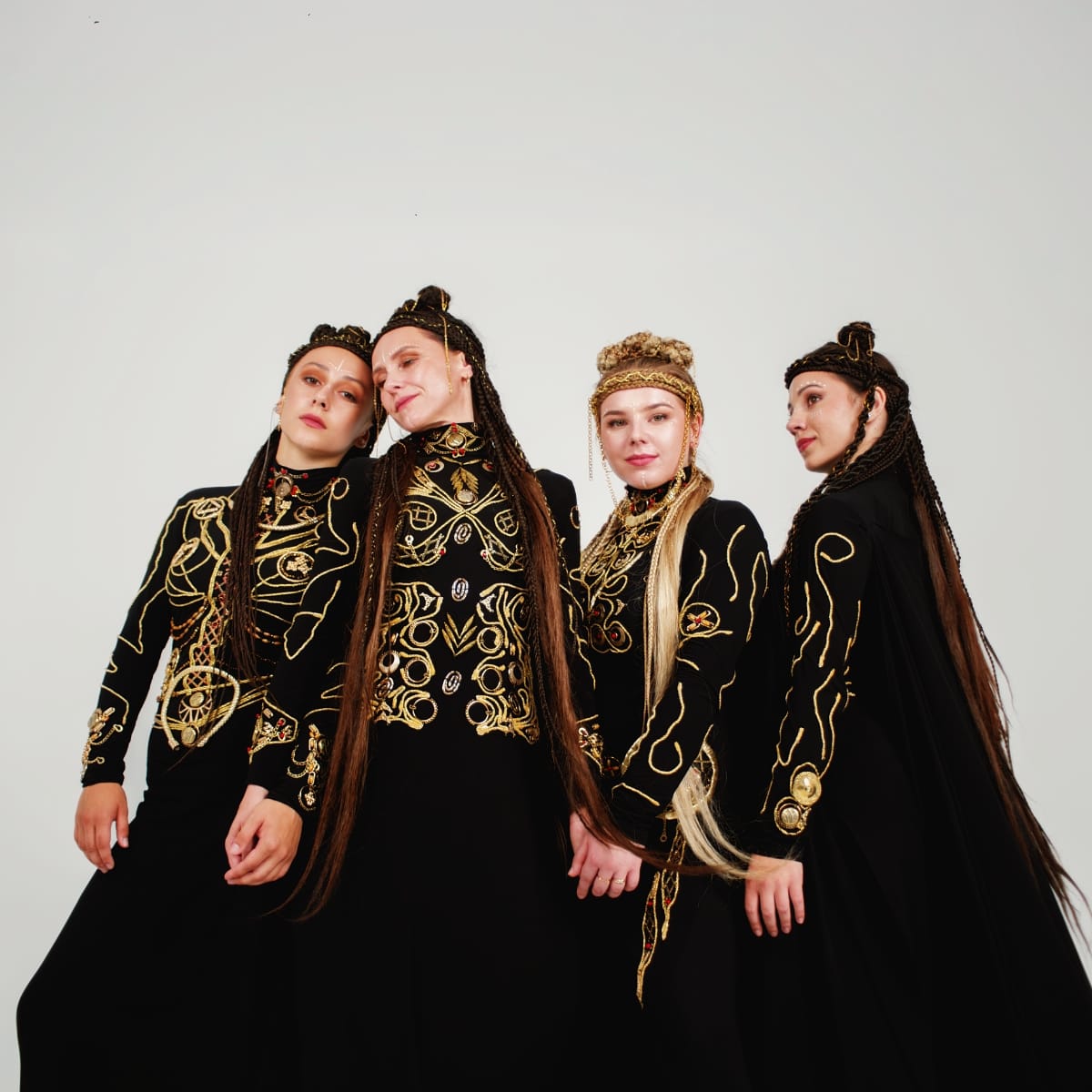
It could be said that YAGÓDY are keeping their Ukrainian culture alive with the music that they create and perform. It could also be said that they are expanding upon this culture and that they carry the spirits of many cultures in a way—echoes not just of Ukraine but of multiple continents, ancient and contemporary, from the mouths of their mothers and grandmothers. They are a powerful voice. They perform for themselves, Ukraine, and the people who choose to watch them.
I interviewed Teimuraz Gogitidze and Zoriana Dybovska via video a couple of days after their performance. They had a day off and were milling about before they had to go back out into the world. Some things we discuss are Dybovska's background in theater, how they cultivate their songs, and how to contrast language and imagery.
Note: This interview was conducted with Tim Gogitidze acting as Ukrainian interpreter for Zoriana Dybovska. Dybovska's quotes are, to a degree, approximated to Gogitidze's translation and my editing. It has also been edited for length.
Jonah Evans: So, how are you guys doing today? How are you going to take care of yourselves on your day of rest?
Zoriana Dybovska: We are sleeping, drinking coffee, talking, and so on.
Teimuraz Gogitidze: Also, meditating and trying not to get too involved with anything. I'm searching for a gym, so my rest is completely different from the girls. I need to work out.
Jonah: So I hadn't heard your music before. I heard these voices coming out of Jackson Terminal, and I said to myself, "I should go in there." You melted my face off.
Zoriana: We're happy that you had such an amazing experience with us, and it's very inspiring for us to hear such things.
Jonah: I've read this quote by Zoriana that says, "Most of our repertoire is songs that our mothers and grandmothers used to sing to us. We don't look for them on folklore expeditions, but bring the living heritage of our culture to the stage." I know there is sometimes research behind some of the music you make. What's the importance of not going on cultural expeditions to inform your music?
Zoriana: There are different expeditions where people go to the deep parts of Ukraine, and they're recording these ancient songs. They're taking those songs and putting them on certain [streaming] platforms. Anyone can hear them from those platforms. We have our own songs in the sense that we have our grandmothers. They would sing these old, ancient Ukrainian songs to us, so they’re already with us. That's why most of the songs we sing are the ones our grandmothers sang to us. It's closer and more intimate, but sometimes we use those platforms.
I was born in a village, and I feel the ground. I feel the earth. And my grandmother and grandfather, all their lives, sang those ancient songs to me. These songs are imprinted in my heart, in my mind, in my body. I live with that. So that's why these Ukrainian folk songs are such a unique opportunity. We share our culture and represent Ukraine.
Jonah: When would your grandmother and grandfather sing? Was it at the dinner table, and would they tell stories about the songs? Would they have you sing with them sometimes?
Zoriana: The song starts from the very beginning of our lives. When we are born, they're singing songs like lullabies. They're singing all the time. At weddings, when working in the field, or in a town, when they're making the food. When we're all getting together at the dinner table, there is singing. This is my expedition.
Jonah: Tim, you're Georgian?
Tim: I'm half-Georgian, half-Ukrainian.
Jonah: Did you grow up in Georgia at all or mostly in Ukraine?
Tim: I was born in Kyiv. And after two years, there was the Chornobyl explosion. So that's why I went to Georgia. My father is Georgian. My mother is from Ukraine. I was raised in Georgian culture, so I grew up with more Georgian folk songs. When I came back to Ukraine, I started playing drums.
I also started playing the piano when I was eight years old. I remember when my aunt died. She was 34, and I loved her so much. I wrote my first composition for her. I have always loved composing and creating. Then I was collecting and exploring folk songs from all around the world. But my first 10 years were just listening to brutal metal. Can you guess my favorite band?
Jonah: System of a Down?
Tim: Oh, yes! My favorite band is definitely System of a Down! They're my neighbors [from Armenia], you know, in Georgia. Anyway, I was collecting everything. Finally, the time came, and I applied all these things to this band. So that's why we are using folk and other music from all around the world.
Jonah: I can hear that. When you guys came together, what was the conversation about what kind of music to make like?
Tim: Okay, so basically, Zoriana is a very famous actress in Lviv.
Zoriana: Nooo! (laughter)
Tim: Her background is theater. But she was born into music, so she sings like a professional. Her profession was theater.
Zoriana: I was in the theater and decided to create a band. I knew a student actress, and we decided to sing together.
Tim: I was playing music all my life. I dedicate myself to music. That's it. I've never worked in Safeway or anything. So when I got a call from Zoriana, she was asking for a drummer because they didn't have one. She wanted to find a wild, energetic drummer. And my friend was in the theater, too—I knew everybody from this theater. She invited me, and when I heard them, I was blown away. How fantastic their singing and the sound were. The first thing that captivated me was the pure energy. It was fresh blood. And I was like, "Wow, definitely, I can work with you guys."
We were just playing different gigs, but when you go to the big festivals, you need big, energetic songs. So you need to have an arrangement. I started helping them with that. I have experienced this because I have been playing at big festivals all around the world. We started creating. We made those powerful songs.
We started creating music in a different way. This is our signature as a band. We are using samples of phrases that we created out of our own language. For instance, when you’re feeling an emotion, you don’t express it. Usually, we say, "Oh my God!" or "Jesus!" But, in most cases, you just don't have time for that. You just say, [Tim yells muddled words playfully], or [and does so again]. Like in Africa, for instance, they already have modes of screaming. I just decided to create that because I am a sound producer, searching for sounds.
Jonah: So, to create a language of the band, you say to yourself, “What is this emotion that I want to express that might be related to this idea? What would that shape look like or sound like in a song?"
Tim: Yeah, and how it's grooving. For instance, let’s take "Chop Suey!" [Tim sings in System of a Down's made-up language]. If you just look at these words, it's ridiculous, but it fits perfectly in the groove. And that's why I remember it.
So I thought that if the words sounded strange and did not reflect emotions, I would create something that would. It’s closer. For instance, the song we have called “Chornomorets,” goes like this [Tim starts singing and Zoriana jumps in]:
Go-palina
Go go go goli
Go-palina
Gopala-gopala-lina
Go-palina (gop-goli-gop-gol)
Gopala-gopala-lina
(gop-goli-gop-gol)
So you see, it doesn’t mean anything. I was checking every country and in every language. I’m just creating the puzzle. Like in our song, “BramaYa.” The lyric ‘yanara’ in the song, it means a light and a beautiful flower.
Also, it's coming from Rome. Janus is a Roman god. And this is what we are using. those different meanings, but there are different meanings in one word. For instance, it's a flower, light, and war. And for instance, there's "Tsunami," but as "Tsunamia”—an effeminate tsunami. It's gentle and strong. So this is all about those contrasts, which is theater. We're contrasting everything. This is what we do, like those saints we have, for instance.
That's why I add something to it, because when you’re singing Ukrainian folk, we know it's different, but overall, people don't know. For instance, my friends are listening to reggae for the first time, and every single song for them sounds the same. When I use those phrases, those samples create something different. We're exploring the sound.
Jonah: It's like you're exploring through an expression of a found language. You're not translating, but creating a language to access feelings, express what you guys want, and make a big sound.
It was interesting when you switched the drums during the show with another member, then came over and started hyping the crowd. How'd you get that to that place?
Tim: I was always watching Freddie Mercury and different bands to see how they relate to the audience. I have always been interested in being a servant to the audience. One of the greatest composers—I don't remember who it was—said that of the musician, “You’re a servant of music." And when you're a servant of music, you're serving the audience.
It's a natural process when you are feeling humble, and everybody likes it when somebody's humble to them. This is like an expression of humility; this attitude, when you are performing the show, is about making people happy mentally with interesting stuff going on onstage. Their ears are pleased, happy to hear something really interesting. It’s something that goes into their hearts. They can feel some emotions; cry, love, laugh, smile, and do things that talk to their bodies, so they can dance. And they’re expecting it, because they paid money for something, but, for me, I just do it because I love it.
Check out more like this:
 Lawrence Peryer
 Jonah Evans


Comments