


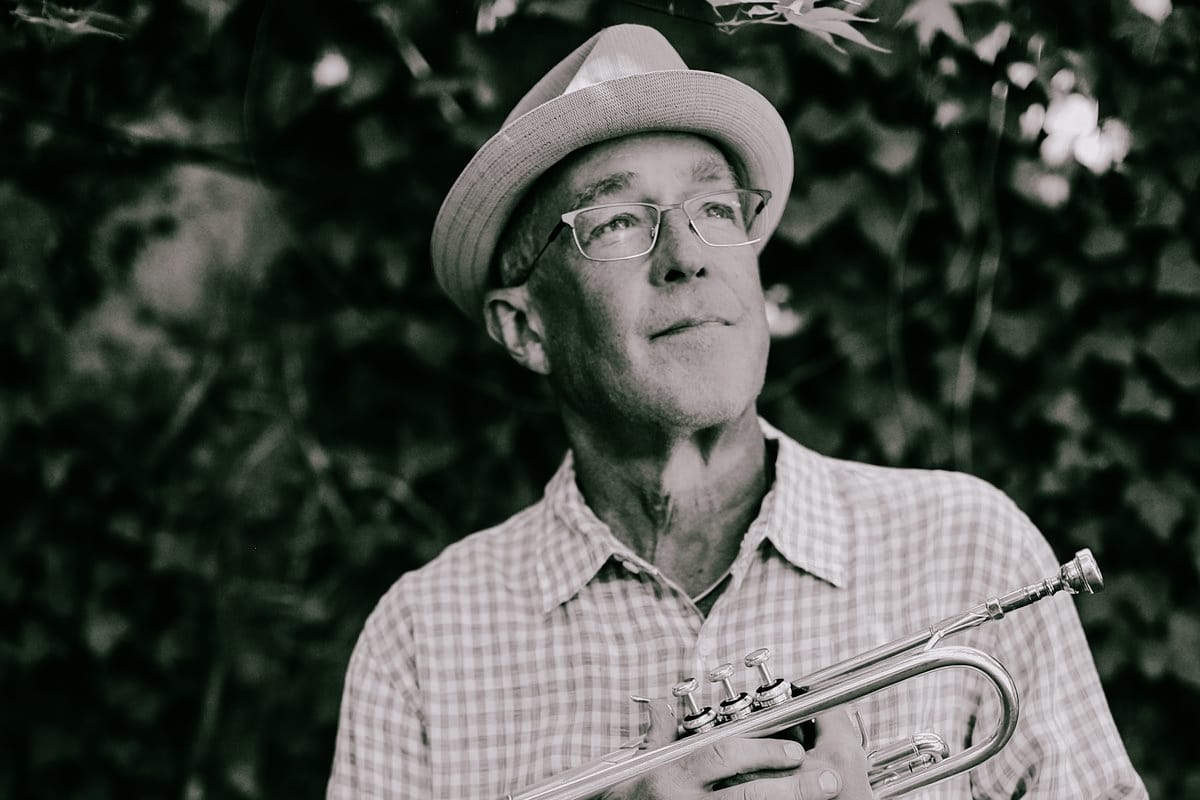
Dave Douglas has released more than fifty albums as a leader since 1993 and written more than five hundred published compositions, rarely repeating an ensemble from one record to the next. A Guggenheim Fellow and Doris Duke Artist Award recipient, he was named DownBeat's 'Trumpet Player of the Year' eleven times between 2001 and 2013. He has also spent two decades teaching at the New School in New York and running Greenleaf Music, the label through which he releases his own recordings and those of other modern jazz artists.
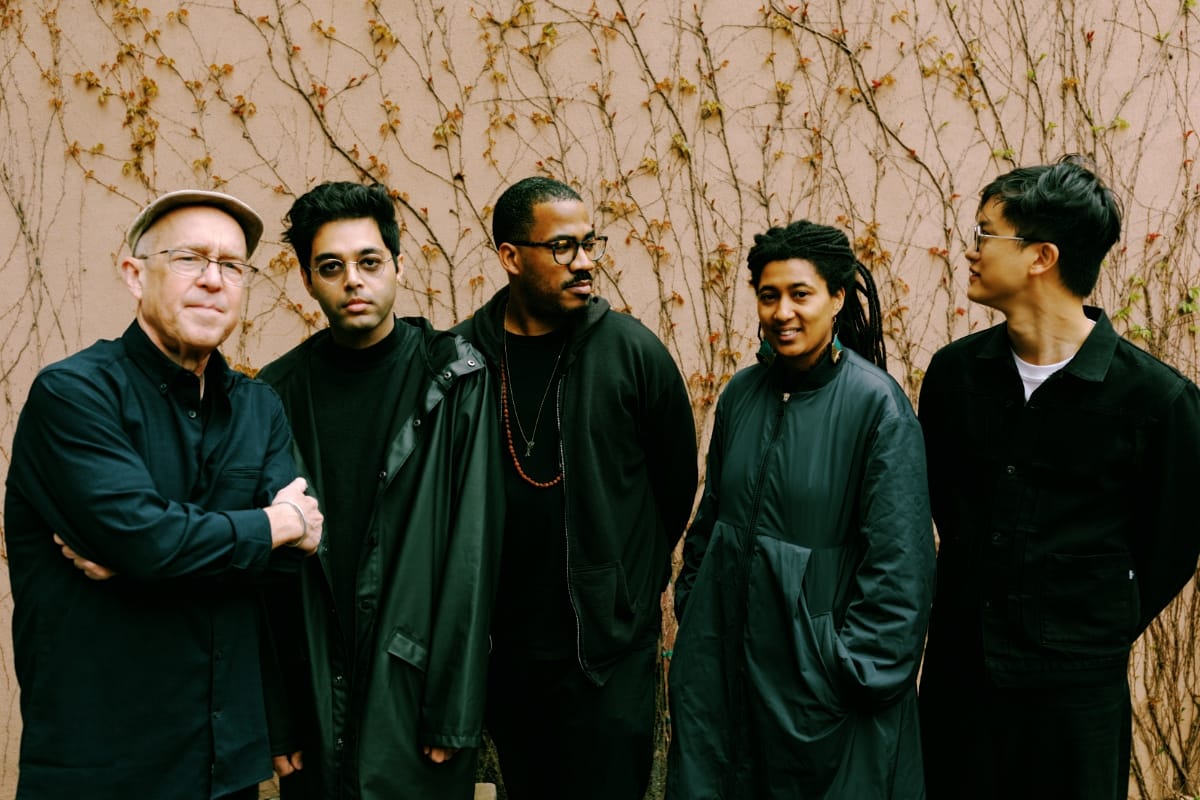
Douglas has long organized his recordings around political and social subjects, from Witness (2001) to UPLIFT (2018), which dedicated twelve new compositions to twelve different causes and released them one per month over the course of a year. He has also consistently sought out musicians from outside the standard jazz idiom. His GIFTS quintet, formed for a 2024 album honoring Billy Strayhorn, brings together tenor saxophonist James Brandon Lewis, guitarist Rafiq Bhatia and drummer Ian Chang of the post-rock trio Son Lux, and cellist and MacArthur Fellow Tomeka Reid.
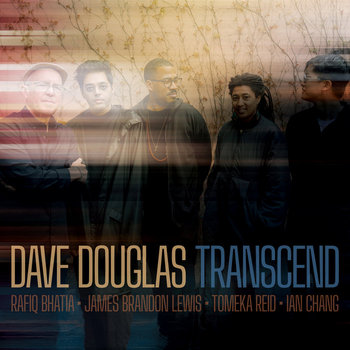
Transcend, the quintet's second record together, was released last April on Greenleaf Music. Douglas conceived the album in response to Duke Ellington's Sacred Concerts—three landmark works performed between 1965 and 1973, widely regarded as the spiritual culmination of that composer's career—and the record includes newly imagined versions of three Ellington works alongside Douglas originals. Several of the new compositions draw on Douglas's encounter with the slab paintings of visual artist Jack Whitten, including the first single "Energy Fields."
Lawrence Peryer recently hosted Dave Douglas on The Tonearm Podcast. Their wide-ranging conversation takes in the album's relationship to Ellington's legacy, Douglas's practice as a composer and educator, what it means to write specifically for the musicians at hand, and where *Transcend *sits in a career spanning more than thirty years. There is also a good bit of process talk, much to Lawrence’s delight.
You can listen to the entire conversation in the audio player below. The transcript has been edited for length, flow, and clarity.
Lawrence: I wanted to start by asking you about the thematic shift in the music from some of your recent work, which was more overtly political in its framing and theming, and now, a push toward the sacred. I'm curious what you're experiencing.
Dave: Well, maybe spirituality is also political, Lawrence. (laughter)
Lawrence: So you're playing with the sacred and the profane.
Dave: If you think about the Duke Ellington perspective, his feelings on spirituality are quite complex. There's a man who lived a full life, had a lot of appetites, wrote so much music, and managed so much. What struck me about the Sacred Concerts is that he's getting to the end—it's clear to everyone. He's lost Strayhorn, his right hand, and now he's on his own. He has written all this extraordinary new music, and he has chosen to take the theme of spirituality—the spirit inside and outside the church, I would say. That really touched me. I'm at a certain age myself. You start thinking about all the different things you've done and wrap them into a statement.
I wouldn't say that anything I've done has been unspiritual. Everything I've done has been political, or maybe a better word is 'social'—something to do with how we live together on the planet. Going back to the beginning of your question, I feel like it's my responsibility as an artist to make each project different. I don't get in a rut and keep doing the same thing. I open my eyes and my heart and my spirit to new things, and every new project is a challenge to find a new way to say what I feel needs to be said in the music.
I don't see Transcend, in that sense, as being so different from Alloy, for example, or Four Freedoms, GIFTS, Dizzy Atmosphere, and, going back further, Soul on Soul, Freak In, Witness, and Parallel Worlds. Without realizing it early in my career, the task and the challenge I took on was how to examine the elements in the music and find a new way to work with them, a new output every time. And so Transcend, to me, feels like a summing up in the way that the sacred concerts were a summing up for Duke. But I also feel like it's a departure, in that all of these musicians are new to this world.
Standard jazz practice is not where James, Tomeka, Rafiq, or Ian come from. I love getting the opportunity to write for musicians who speak in different languages and to find a way to speak to them—and to get them to speak in ways they haven't before. I really love it. Last month, we did a week at the Village Vanguard with the quartet from Transcend, and none of the four of them had ever played there before. It gave me this feeling like, wow. I'm not saying, "Here are these young musicians that I'm introducing to the scene"—I don't mean it like that at all. These are established artists who should be playing there. But I felt a sense of emotion from bringing them into that sacred space for the first time.
Lawrence: Do you have to address that with the band? Do you have to say, "Take a deep breath, it's the Village Vanguard?"
Dave: I don't think you have to talk about it. We do talk about it, but only in the sense of what the experience actually is. It's astounding. It changes the way you play. Of course, everyone's aware of who's been on that stage and the music that's been made there, but the sound in the room is special, and the way that you interact with an audience in a room like that is special.
These are seasoned creative artists who have done a lot of searching and personal research and have played on many stages, so maybe there were some jitters on the first night. Maybe I get them too, and I've been playing there for almost thirty years now. The night I don't feel nervous going on stage is the night I will know something's wrong and need to examine it. I should be nervous because I want to be in a position where I'm not sure exactly what will happen.
Lawrence: You talked about the summing up that Ellington was doing with the sacred concerts. That implied very specific things with him—he had a life fully lived, perhaps things he was thinking about that he needed to address and make right spiritually. You're young, and you have a lot of music ahead of you. What does summing up imply in your case?
Dave: If I knew that, I'd be Nostradamus. Each project is an adventure in itself.
Lawrence: But you're not implying you're done.
Dave: No. I feel like it is turning a corner in a certain sense. I turned 63. I went through the pandemic. We're touring less now. I've been running Greenleaf Music for over 20 years. The whole industry is changing again. I feel like it is a transitional period for me, though I don't know where that will lead.
I did feel like, okay, Transcend—I've got to put everything I've got into this one, because this may be it. I'm still writing every day. I'm still studying Bach every day and practicing the horn. I feel like the practice means not holding on to anything. The more I write, the more I feel like, "Wow, we really don't know anything, do we?" I feel like the practice of music is about finding new things and being comfortable with the uncertainty of not knowing where we're going. When I begin writing a new project, I am literally at sea. I am lost. And like I said about jitters—if I didn't feel lost, I'd feel like, "Oh, I know what I'm doing," so therefore something's wrong here.
I am still working every day, and I wouldn't want it any other way. We lose some great heroes, and their spirits are all around us. Sonny Rollins is everywhere. It's important not to forget that we are a part of that continuum. We're listening to Rollins, and we always will be, and he'll always be listening to us wherever he is. Plug into that.
Stay on top of The Tonearm.
Subscribe for exclusive interviews, cultural tip-offs, and community fun.
And your support keeps our site free of advertising and paywalls.
Lawrence: I spoke to an author who was ambivalent about something they were being encouraged to write. They finally got themselves talked into it by a publisher, and the pitch was, "Nobody but you can write this." And when they sat down to start, they said something similar to what you said: "Actually, I don't think I am the one to write this." (laughter)
Dave: Well, maybe that's the exact reason that they are the one to write it. Because they don't know. There's nothing more boring than reading somebody who knows everything.
Lawrence: And you get a very didactic tone from that, too.
Dave: Yeah. They're just going to tell you. It's funny, because ambivalence was a key word for me in tackling the current version of my introduction to the book I'm writing, which keeps changing and hopefully getting better.
Lawrence: There's an ambivalence of having been taught not to be a show-off—not to be prideful of one's own skills or strengths.
Dave: And at the same time being a trumpet player—the loudest instrument in most bands, supposed to be showy—in an art form where exhibition is part of the practice. I've always been torn by that.
I've started using the word "uncertainty" instead of "ambivalence" because there's a negative connotation with ambivalence—it implies you're not sure. And I realized, no, I am sure, because over many years I've had to make a million decisions about the music. You realize you know how to make a decision when one has to be made. So it's more like uncertainty at the outset of making a piece.
I've never been one to put myself out front. I'm a soloist, and I've been playing trumpet longer than I've been writing music. But as a composer, that's not the challenge I generally put before myself. The challenge I put before myself is: how can I create a unique platform where these five musicians can coexist together and make something that didn't exist before?
Lawrence: Can you tell me a little about Jack Whitten's work? It's always intriguing to me when music artists channel or refract the work of artists in other mediums.
Dave: That's always been an important thing for me—bringing in literature, poetry, painting, dance, visual arts. I don't think you can separate the poetry of all the various forms of expression. Music is the one thing I practice, but the human voice is something we can all understand, and it can help us see things we may not have seen before.
Last year at the Museum of Modern Art here in New York, there was an enormous retrospective of Jack Whitten, and I wasn't familiar with his work. I had a friend who works at the museum, and she kept telling me, "You need to go see this. This is really important." I went to see it, and it just blew me away—first of all because of all the different mediums Whitten worked in throughout his career, and second because of what was so important to him: his process. How he made his work, where it came from, and all the technical practices involved in making it—how they grew from a metaphysical vision that was entirely his own.
I was also already working on Transcend. And it wasn't lost on me that there was a large painting dedicated to Duke Ellington in the exhibit. I was going through, thinking, "Wow, I'm hearing music. This is amazing."—and then suddenly there's this big Duke Ellington painting in the middle of it.
The pieces that most drove the music for Transcend were ones he called "slabs." He developed a technique in which he would place enormous canvases horizontally in his studio and pour gallons of acrylic paint onto them. Then he built contraptions that would drive the paint across the surface from above and drag it. He would let certain layers partially dry, then drag these tools across them, and what you get is blurred images that carry a lot of emotion. You feel the movement, but there's also the mystery of how the layers developed relative to one another. It predates Gerhard Richter, and yet Whitten's work has a somewhat similar resonance.
I was touched not only by how those paintings looked, but by the story of Whitten's life, the milieu he was in, and the fact that it was right on the timeline of the sacred concerts. The way he worked with those elements of paint struck me as a direct analog to the way I work with sound and improvising musicians. So I gave myself the challenge of: let me take some raw materials and scatter them together, and challenge these people to improvise their own noise, sound, music—in a way that would create the feel of those slab pieces.
There are two specific pieces on the album. One is called "Slabs," and the other is called "Curious Species," and they deal with this idea of making raw material and throwing it at the band so the band can throw it back. There's a real feeling of anarchy, creation, and destruction—big forces at work.
I sent "Slabs" and "Curious Species" to my band and said, "This is all thinking about Jack Whitten." And each one of them wrote back: "Oh my God, Jack Whitten has been so incredibly influential for me." James Brandon Lewis said, "I've been following Jack Whitten for years. I have all his notebooks." It was not what I expected. I was thinking I'd be introducing them to Jack Whitten. They were all already familiar.
Then Rafiq, who's always asking questions, asked me whether these pieces relate to Jack Whitten's slabs. We went through, in musical terms, what it was about, and it opened up a whole dialogue for us as a band—a whole way of practicing. My vision was that, in recording them, we would use these developing tools the way Whitten did: out of our comfort zones, not quite knowing the result of all this throwing together of materials. After the record came out, they all said to me, "Wow—I had no idea what that was going to be. But now that I've heard it put together, I get it. Now it sounds like a slab to me." It was a deep, long process.
Lawrence: As a composer, what role does process play for you? Do you experiment with systems, processes, and prompts?
Dave: All the time. I think you have to. "Donna Lee"—the putative Miles Davis composition from the late 1940s—is a process. You're asking a musician to learn a specific set of information, and then you're asking them to join a process by which they play through a series of harmonic motions in a particular tempo, in a particular key, in a cyclical fashion that each member of the band needs to learn and needs to find different ways of interacting with. That's a process. But you can't just keep writing that way. Every piece has to develop a new language: how do we make this work? What is this? Where is this coming from? What is the strategy by which we improvise together?
Lawrence: Listening to you articulate that, I'm reminded of my conversation with George Grella, who just put out a book on minimalism. His thesis is that what defines minimalism in music is that you see the composer marking time and playing with time, and as a listener, you're aware of that—as opposed to music that simply has a minimal aesthetic in instrumentation or composition. The music we refer to as minimalism is about time and the playing with time.
Dave: It's the gift, I would say. A composer like Steve Reich has looked at the problems of time, polyrhythm, and development from many perspectives, yet he has a signature voice in his music. I wouldn't say he's used the same platform or system year over year. It's a music that develops, and there's some basic element of the syntax he's interested in that roots that music in his voice.
Within American composed and improvised music, there have been many moments of people introducing new processes and new ways of organizing systems. I know that for myself, I got to a place where I wasn't really sure what to do with so-called jazz, because I felt like everything had been done. I didn't record standards because I felt like they had been done every which way. Over the years, I've done some covers when I find something unique I could bring to it—for example, a Thelonious Monk song, or Igor Stravinsky, or Ellington, or Mary Lou Williams, or Joni Mitchell. Stevie Wonder is one of my favorite artists of all time, and I've never been able to find a way into playing his music.
When I was going through this issue of feeling like something's got to give in the way we use melody, harmony, rhythm, form, key, and tempo in this music, I couldn't really find it. And then it was through listening to the music of Booker Little that a dam broke for me. The two records he made in 1960 and '61—I felt like, okay, these pieces he's written for these improvisers don't follow that standard format. Different soloists are playing in different areas of the piece. Tempos change mid-song, much like they do in Charles Mingus's music. Not every exposition of an idea results in solos over the idea—sometimes there's just an exposition, and then the music goes to another place. All of that opened the door for me to think about how I could work creatively with all these different elements in this music and organize it differently. So when I say that each project I do examines the process differently, I mean I challenge myself to work with those elements in new ways. What's a way that melody could work that we haven't really thought about?
When I met Kenny Wheeler and played with him, he told me the same story about Booker Little—that was what broke the dam for him, and it would have been around '68 or '69. Then when I interviewed Jaimie Branch, the trumpeter, gone too soon, she said the same thing: "Yeah, it was Booker Little. That changed everything for me." I've had the same conversation with Dave Adewumi and with a lot of other trumpeter-composers. Something about what Booker Little—he scrambled the eggs in a new way. He gave us permission to keep scrambling.
When I get near the end of the writing process, I print out either the scores or my trumpet parts, put them on the music stand, and try to play them as if I'm not the composer. Right away, I can see right through it: "Oh, that's a bunch of bullshit. You can't do that. This is wrong. I need a rest here. This could be written better." Without being judgmental, you have to be your own critic and analyzer. Looking at it from both sides—the player and the composer-conceptualist—is a crucial part of what we do. It's like a poet who always reads their work aloud before typing it up and sending it to anyone. You need that physicality with any form of art.
Lawrence: Conceptual framing?
Dave: Not so much framing. More like: what are people going to do and what are people not going to do in this, and then writing from there. I'm really influenced by the poet Mary Oliver, whose book A Poetry Handbook breaks down the elements of poetic craft. She says great poets are not taught—great poets are made. However, we can talk about the craft. It struck me that it was very analogous to the process I was talking about: looking at melody, harmony, rhythm, form, timbre, dynamics, improvisation, community structure, articulation—how do I take those elements, maybe isolate them so I can work on them in a new way, and plug them into a new work that makes something new? I felt that Mary Oliver put her finger on a systematic way of looking at that mode of creating, and that was really helpful.
So I teach a course at the New School called Creating Music Workshop, where there are usually eight to ten musician-composers, and everyone writes for everyone. We have composition prompts every week, all based on some way of looking at the various elements in the music—we isolate ways of thinking about working with concrete material. Then we bring it in, and everybody plays it. It's great because the composers can't be picky and the players can't be picky—everybody's exposed on all sides. You have to play the stuff and present it.
Something I started doing when I was first working at Banff was singing Bach chorales in groups. Whenever I have a group of musicians gathered, I feel like it's one of the great sacred things we can do. Each of those Bach chorales is like a tiny gem—everything about the harmony, the fact that the melodies sometimes predate Bach by several hundred years; each harmonization is special, some quite simple and some very complex. Then I started asking them to sing Monk tunes. For improvising musicians, a lot of them feel like, "Oh, I know that one." And then they go to sing "Rhythm-a-ning" or "Bye-Ya" or "Off Minor," and they realize there's really a lot going on. What I found was that Bach and Monk are not so different. These are short bursts of incredible information, very compact, with very interesting forms, not making any grand claims—just there, like a pillar that you could play five million ways and it would still be recognizable. These are distilled gems of masterful music that, in both cases, exemplify good, smart, heartfelt, meaningful use of all those elements. And that's what ear training is about.
Lawrence: I always feel self-conscious when I speak with artists too much about their process or the inner workings of how they do what they do. I don't mean to distill it into mere moving parts. So I appreciate you going there with me. Thank you.
Dave: Well, there's a lot to it, and I enjoyed talking to you. I have a podcast, so I've interviewed over a hundred musicians. I'm always interested in how they work and where they come from. But there have been occasions where an artist will push back—"No, I don't have a process. What are you talking about?" And I say, well, when you sit down to write, what do you do? There's one person I'm thinking of—I won't name the name—but they literally pushed back and said, "Dave, I'm against that. I'm against having a process." And I said, well, maybe that's your process.
Check out more like this:
 khagan aslanov
 Lawrence Peryer


Comments