


Koen Holtkamp and Brendon Anderegg founded the label Apestaartje in 1999, while both were students at the School of the Art Institute of Chicago. The two had been friends since middle school, and they formed Mountains to perform their music live. Later based in Brooklyn, the duo released Choral and Centralia on Thrill Jockey. Holtkamp’s own records include Field Rituals on Type, Motion on Thrill Jockey, and Voice Model on Umor-Rex.
Holtkamp later left Brooklyn for the more rural Hudson Valley, and the change of scene shaped Nightlife, his new album for Western Vinyl. He gave himself time to experiment in his new studio with no fixed outcome in mind, and over many late-night sessions a new instrument emerged from his modular system. It uses physical modeling to emulate plucked strings, drawing on his long affinity for guitar soli, the kora, and other chordophones. The late hours honing this sound became a personal ritual and gave the record its name.
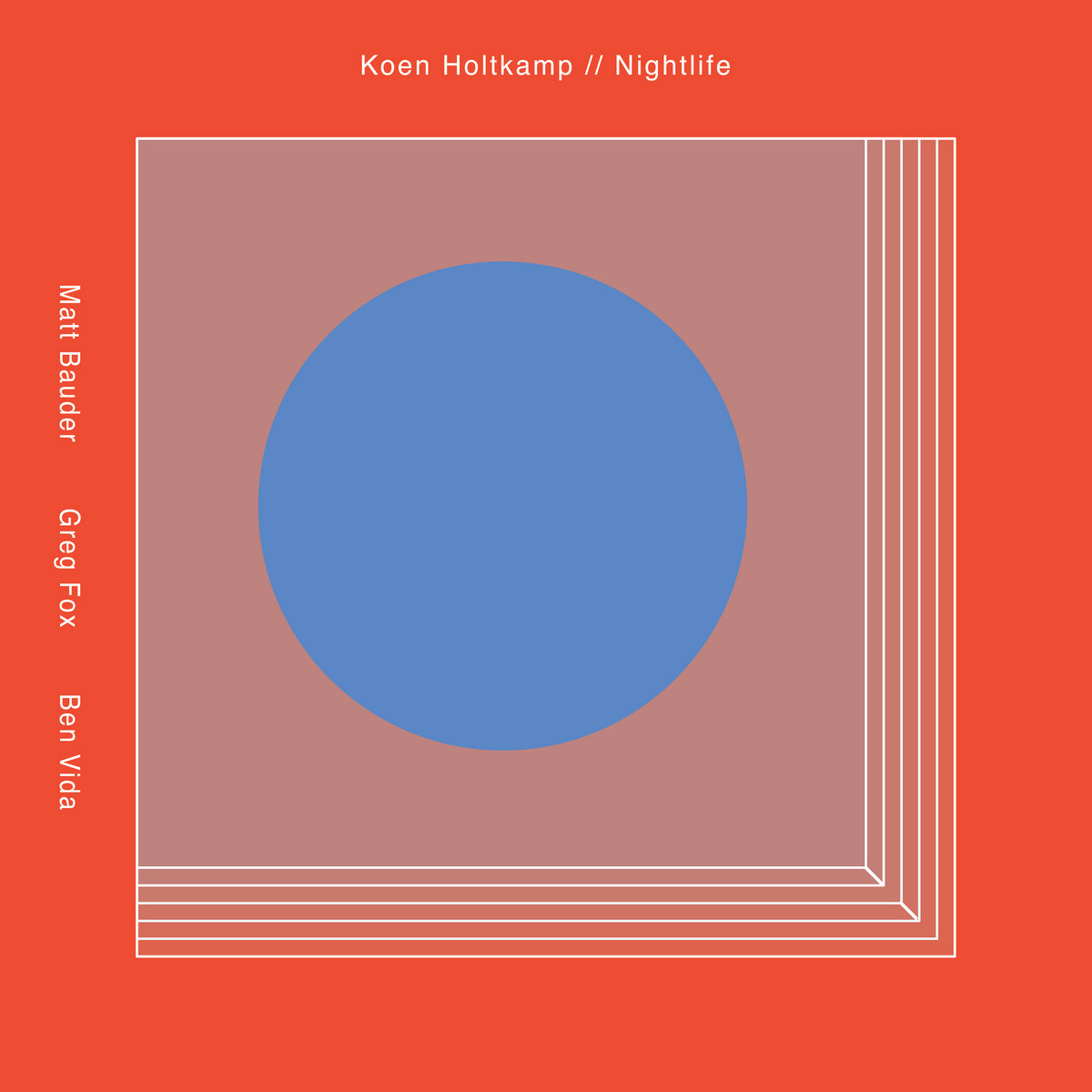
Holtkamp composed the pieces with specific players in mind. Drummer Greg Fox and saxophonist and flutist Matt Bauder contribute extensively, and Ben Vida joins on synth bass. At times, the record resembles a band in motion, yet Holtkamp placed each acoustic and electronic source in its own distinct environment. It’s the perfect approach for a musician who once decided, in his words, that “what I really enjoyed was being in the studio, so I wanted to focus on that.”
Lawrence Peryer recently hosted Koen Holtkamp on The Tonearm Podcast. The pair discussed the late-night origins of Nightlife, synthesizing plucked strings on a modular system, his work with Greg Fox and Matt Bauder, and the creatively informative ways sound and light move through physical space. You can listen to the full conversation in our audio player. The transcript has been edited for length, clarity, and flow.
Lawrence Peryer: What did moving up to the Hudson Valley do to an ordinary day for you, and what did it do for your music?
Koen Holtkamp: I lived in the city for twenty years as well and really loved it. It was a super vibrant place to grow as an artist, and there was a ton going on. But I just reached a point in my life where I was not taking much advantage of that anymore, and living in a tiny apartment, it was sort of like, “Okay, I think we’re ready for a shift.”
So initially it was a big break. I lived in Brooklyn for more than half my life, so this is probably the most rural place I’ve existed in. I felt a huge weight off my shoulders that I didn’t realize was there, just from the claustrophobia of living amongst concrete and buildings.
It’s been a little over four years. I live in the woods, but in ten minutes I can be in downtown Kingston and see a great show and see friends. So, to me, certainly at this age, it feels like the best of all those worlds.
Lawrence: ‘Nightlife’ means something very different in New York City than it does in the Hudson Valley. And even though you’re not starved for culture or cuisine, tell me about the name of the record and the universe it unlocked. What is nightlife to you?
Koen: It is meant to be a little tongue-in-cheek, for the reasons you mentioned. It started as a placeholder. It’s this sound I’d been developing that started to work its way into becoming a record, and most of the time I spent working on it, between day-job stuff and parenting and whatnot, was at night.
It ended up being like, “Oh, this is my version of what that is at this point in my life.” And I really leaned into that and enjoyed it, because in the past maybe I would’ve gone out to see friends or music, and I’m here. My wife still often works in the city, so I’m often here alone, and I literally can’t go anywhere. So it’s like, okay, this is what I do at night. This is the time I have to let go and really get deep into this thing. And I think the process of that specific time, and getting to know this space, is really what turned into the record.
Lawrence: You mentioned a moment ago the sound you were developing. Did you start this process trying to find a sound you were hearing internally? Or are you an experimenter when it comes to sound? What’s the journey that led you to this plucked-string sound, the dominant sonic cue on this record?
Koen: It’s a number of things. After having worked in a specific way with Mountains, doing a lot of looping and layering, and feeling like that had really run its course, I wanted to make a big shift, and that was a conscious thing before we made the move.
Then, coming up here, all of a sudden I had some space and time that I hadn’t had before, and I made a decision not to rush into anything, but to just play and explore, and to think about some influences that hadn’t really made their way into my work. I spent a lot of time listening to West African kora music and guitar soli, a lot of these things that aren’t necessarily associated so directly with electronic music, which is kind of the world I often exist in.
And I just got really fascinated with that style of synthesis. It was really just sitting there and tweaking things for a year and a half. I didn’t have a specific idea of what I wanted to create beforehand. It was very much, “Okay, I’m interested in string sounds.”
This has been a consistent thing. This is why, for example, I initially started playing acoustic guitar. It wasn’t about an interest in playing guitar. It was about the sound. I have more acoustic guitar records than anything, and I’m really fascinated by that sound. With that in mind, I spent many evenings playing and exploring, and I recorded pretty much all of it.
After a year and a half or so, I went back through and was like, “Oh, there’s a through line in a lot of these recordings that I had done without much preplanning.” So I removed those, edited them together into a loose album, and that was structurally what started the process.
Lawrence: I love the kora in that it’s much like the harpsichord to me. It doesn’t quite have the same expressive tone; there’s no sustain, I guess, or whatever it is. But it’s also incredibly expressive. I love listening to a good kora piece. When you’re approaching a sound like that on the modular system, it’s a long way to get to an organic sound, I guess; that would be the way I would say it. It doesn’t sound like a preset. This sounds like a plucked string with what you’re doing, and I’m so fascinated by the idea of using an electronic modality to get to a sound that already exists on an instrument.
Koen: Yeah. Why don’t I just pick up a harp or something, versus trying to synthetically build one? There is an absurdity to that process. I think, first and foremost, the most important thing for me is the sound, not the gesture of performance or playing.
What really interests me, and what I get deep into, is making sounds and tweaking sounds. I am not trying to 100 percent emulate the sound of any specific string instrument. With modulars and electronics, I can skirt between those instruments and also extend what they can do. So while it might allude to something like the kora, there are things structurally I can do with the modular that you would never be able to do with an acoustic instrument.
Lawrence: What still surprises you in your work with the modular? Is surprise, or the unpredictability of it, important to you, or have you pretty much wrangled it to make it do what you want?
Koen: The relationship changes a lot. For me, it’s one tool that I use. I don’t necessarily consider myself a modular synth player. I use it a lot and have for many years, but I won’t use it for a while, then I come back to it, and it feels very fresh.
One of the fun things for me with the modular is that you’re constantly rebuilding your instrument. Every time I finish something, I basically take the whole thing apart and reconfigure it, and it’s new. Even though I understand the parts, the relationships change. I might get rid of some things, put some new things in. So it continues to evolve.
Lawrence: What did you give your collaborators, the other participants in this music? Do you give scores? Do you give track stems? How do you give direction to the collaborators you work with?
Koen: It’s mostly the latter two, directions and stems. The people I chose in particular for this record, Greg and Matt, are friends I’ve followed and admired for years, and I’m very familiar with what they do. When I started carving this more into the shape of a record, I had them in mind, so I left space for them.
It wasn’t so much like, “Oh, I want to get some drums on this.” It was like, “I want Greg to play on this.” I thought his unique approach would be really interesting. And he’s someone I’ve talked about doing something with for years, so I was like, “Oh, this feels like the right moment.” So I sent him a bunch of stems with some brief descriptions, more of the palette. There was one where I was like, “Okay, I want you to focus just on snare drum, no cymbals, and just go for it.” He was at the beginning of the collaborative process, and he sent me the material back, and it was quite different from what I had had in mind.
At first, I was a little taken aback because it was heavier and had a lot of drum tracks. After overcoming the hurdle of it not being what I imagined, I really embraced it, and I was super excited. For one, it pushed me in a different direction, and it forced me to learn a lot.
Moving on, I then took that to Matt. He’s local to here as well, so we had some conversations. And I sent him basically a playlist of references. So it was some spiritual jazz stuff, which is very good, but also Codona, the Don Cherry trio from the ’70s and ’80s. Also Joanna Brouk, sort of a new-age outsider. I feel like that was a big influence on the record, and one he particularly latched onto after I had sent him those tracks: very meditative, open.
Lawrence: Is that process linear or parallel?
Koen: Both, because a lot of me putting it in its place was a reaction to their contributions. The end result was not what I’d imagined when I reached out to them, and I say that with deep gratitude. It went far beyond what I had thought. This was 100 percent a studio creation.
We never played or recorded in the same room. So figuring out how to turn that into a record was really interesting for me as well, because the traditional approach would be, “Okay, I should try to make this sound like it’s in the same room,” because that’s what people tend to do. The more I thought about that, the less interesting it seemed to me. I took the opposite approach: I decided to highlight the sonic characteristics of the different spaces and players, both in how I treated them sonically and, a lot of it, spatialization-wise, too.
If you listen to it in passing, it sounds kind of like a band at times. But if you really pay attention, it’s more like an electroacoustic record. And for me, that goes back to the realistic/artificial aspect of using the string sounds, where in passing it feels natural, but then you pay attention, and it’s like, “Oh, wait, a choir could never do that.”
Lawrence: It’s interesting that you mix your own work. You’re taking everything from composition to mixing, through every step. That could easily become a rabbit hole, right? How do you keep from getting lost or unmoored?
Koen: When you said that, I latched onto you saying it “could become a rabbit hole,” because to me it’s like, oh, it does. It’s not a “could.” I think I spent half the time working on this record mixing and finding placement for everything, and trying to hear all the details of all of the instruments.
There are some folks I played stuff for throughout. Ben Vida plays bass synth on the record and is a big part of the live band we’ve been doing for this, which I think will turn into the new record. He gave me a lot of feedback throughout the process and was very helpful and encouraging. But at a certain point, I just have to let go. I definitely feel like I go a little crazy in that process, and I’m not sure I can put into words how I reach that moment, because I know I could keep going for a lot longer than I do.
For me, the hardest part is finishing things. I love creating sounds. I love playing with people. I love making music. I like mixing, but letting go is hard, and I’m happy once I’ve done it, because then I can move on to the next thing. But that is the work. The rest of it, in light, simple terms, is more like play.
Lawrence: Do you have other practices that help you keep focused, that you can rely on?
Koen: I make visual artwork as well. For the last number of years, that’s been predominantly generative, abstract video work. Sometimes I’ll get into that for months and not make music. I go back and forth a lot, and sometimes they overlap. Taking a break from working with sound but still being creatively engaged is very helpful.
Since being up here, I’ve gotten a little more into meditation. There’s a group I go to sometimes on the weekend, and it’s been inspiring and focusing. I also live almost across the street from a rail trail. I can hop on my bike and ride for miles without getting in a car. I don’t even have to go somewhere. That easy access is extremely liberating.
Lawrence: You said that when you were working on the sketches, you weren’t thinking of it as an album or a project yet. How do the sketches become an endeavor?
Koen: It was a choice not to work towards a composition or a record. I wanted to literally get to know what my new studio sounded like. I wanted to experiment and work towards something new that was a bit of a break from what I’d done before. At a certain point I went back through, and that was the light bulb: “Okay, there are certain strains within that, which together create something bigger that feels like something. So I’m going to follow that thread and see where it goes.”
There was also the point where it made sense to bring in collaborators. Because as much as it was a sound, it did not feel like a solo record. I was thinking a lot about duos and trios. In the past, I had worked a lot with layering and really dense sounds. That was also something I consciously wanted to get away from, because it felt like a crutch. My natural inclination is to do those sorts of things. So it’s like, “Okay, I want to do something very articulated and specific that has a lot of space for other things.” I spend a lot of time thinking about space in terms of spatialization, live performance, working in space.
Lawrence: Putting sound in a space is like points of light in space. They’re different modalities, but they strike me as similar manifestations, or similar searchings: placing things where they go, and pointing to them where they need to be.
Koen: I think there’s a direct correlation there. What those things have in common is that you’re highlighting or reacting to the architecture, the physical space that’s there. Whether you’re working with lasers or light or sound, these are waves. They’re bouncing off of walls. What are those walls made of? You can work with that in the realistic sense. You can work with that in the artificial sense. And those things cross over, too, in interesting ways.
Lawrence: Discussions about light come up a lot in my conversations, especially with musicians in the creative music world or the improvised world. Why are people who work primarily in a sonic realm thinking about light?
Koen: Light and sound are primal sensory experiences. Whether it’s the eyes or the ears, you can have very similar experiences in those relationships. I automatically go towards synesthesia and things like that, which is something I hear a lot of artists talk about.
I work a lot with color in the video work I do, but it’s not something I necessarily relate to when it comes to seeing sound. I think a lot of people would be like, “Ah, this feels very red to me.” I can think about it in terms of warmth, and in terms of softness, touch, these kinds of things. But generally, if I’m trying to visualize sound, it’s more of a sculptural, three-dimensional thing than a color relationship.
Lawrence: I don’t know what burdens come with experiencing synesthesia, if there are downsides, but I am curious about it. As someone who loves music so much and is intrigued by color, I do envy it when I hear people say they experience that. I think, “Oh, wow, I wonder what I’m missing.” But you can’t envy somebody unless you’re willing to take everything that goes with their experience, and because I don’t know the downsides, I don’t know that I necessarily want it.
Koen: I think I felt that way at times in my life, because it sounds really magical. But after thinking about it for a while, I was like, “Oh, I have my own way of seeing sound, and that’s very particular to me and something I find to be very helpful.” And figuring out what that is created a new openness.
Check out more like this:
 Bill Kopp
 Lawrence Peryer


Comments