


A prolific composer, recording artist, and synthesist, M. Geddes Gengras works extensively as a solo artist, in duos and in groups. Over nearly two decades he has amassed a sprawling, synth-centered catalog, much of it made in the company of others — as a member of experimental outfits like Sun Araw, Pocahaunted, and Akron/Family, and, with Sun Araw's Cameron Stallones, as co-founder of Duppy Gun Productions, a collision of West Coast electronics and Jamaican dub that first took shape on Icon Give Thank, a 2012 collaboration with roots-reggae institution The Congos. His solo work has appeared on Room40, Leaving Records, and Holy Mountain, among others; after years in Los Angeles, he now works from upstate New York. Guest List, his latest, is his fourth album for Hausu Mountain since 2019 and the first the label has issued on vinyl.
While his latest project fits seamlessly into his extensive body of work, in a real sense it's a departure. Beginning by creating synthesizer-based recordings, Gengras shared his audio files with like-minded artists who share his predilection for working outside convention, exploring the unknown, and embracing the unexpected. Providing them with little or no direction, Geddes encouraged each musician to add his or her own creative input to the recordings before sending them back. The result of that hands-on-meets-hands-off collaborative venture is the fascinating Guest List, released on vinyl, compact disc, and digital download from Hausu Mountain.
The transcript has been edited for length, flow, and clarity.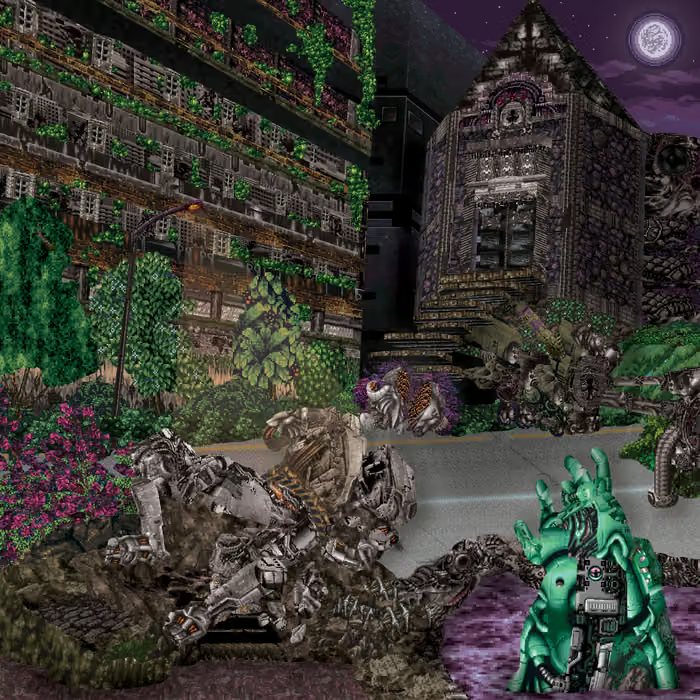
Bill Kopp: Often when an artist contributes to the work of another, to some degree they're bending their creativity towards the artistic goals of someone else. You've done your share of work in that field; what creative itch does it scratch for you?
M. Geddes Gengras: There's something really interesting about that. I really enjoy when somebody has a strong vision as an artist, no matter what the medium is. And being able to contribute to that is something that's always been fun for me. I've always liked being in other people's bands, because things that I couldn't or wouldn't do on my own get brought out of me as an artist. As you said, it's bending what I do into what they do, but keeping what's special about both of those things.
I'm not the person you call if you want somebody who can read charts! But over the years, I've developed my own process. And I think the people who have wanted to work with me are people who see a way that it can fit into what they're doing. There have been plenty of instances where I tried out for bands, and it was just a completely terrible fit. The plus and the minus of doing something that's very individual is that it will fit where it fits.
But the other side of it is that you can't get that anywhere else. I do the thing that I do; I don't know anybody else who really does the same thing. And in over 20 years, I've gotten idiosyncratic in the way I think about making music; I probably have a lot of what people would call "bad habits," but for me, that's the framework. That's what everything's built out of.
Bill: Guest List flips the concept we've just discussed on its head; you provide your work for other artists to build upon, introducing indeterminacy into the mix. What inspired you to embark on this project?
Ged: Like everybody else, during the pandemic I wasn't playing shows for a while. And then even when things started to come back, I was slow to reemerge into that because I wasn't really sure what I wanted to do. After 20 years of this solo electronic thing, I felt I was hitting some dead ends.
I'd been feeling that way for a while, actually. It had happened when I was working exclusively in modular synthesis for close to a decade. I made a record that did the thing I wanted to do with modular synths, which was Light Pipe. But after that, I wanted to do something else because I was like, "I'm out of ideas in this particular area. I've dug as deep into this as I can right now."
One of the things that got me back into playing music—especially live—was doing collaborative stuff. Xylosma is a trio with Greg Fox and Gray McMurray, who are both on Guest List. We've only ever played together when we are performing; there's never been a rehearsal. It's pure improv in a lot of ways. Since I'm doing electronics, I'll have some stuff that's prepared or sequenced, but we don't talk about what we're going to do; we just play. And the experience of playing with those guys! You're just riding on the edge of your ability and your intuition. They're both such incredible improvisers, such natural musicians. They're incredibly hard-working, diligent students of music. And the feeling that I got from those shows was so much fun.
At the same time, playing solo was starting to feel more and more burdensome. The thing about doing it by yourself is that everything is yours: all the successes and all the failures. And there's a predictability that starts to come, even with something like experimental electronic music. I felt like I was replicating the same things, doing the same gestures, making the same patches.
Around that same time, I was also playing a lot in a duo with my friend Ben Seretan, who lives up here in the Hudson Valley. It was less pure improvisation, but we would come up with these structures and just jam. Introducing other musicians brings a totally new thing.
I love playing with these people; they do things that I could never possibly imagine, that I could never write. And over and over again, that process started to make me realize, "The thing I want to do—right now, at least—is make music with other people." The last release I did for Hausu Mountain was a cassette [Expressed, I Noticed Silence]. I had my brother Cyrus play guitar on almost every song. Prior to that, I would occasionally have somebody play a little thing on my record here or there, but I was very much the classic Virgo archetype: "Everything's in my little laboratory; everything is the way I want it to be." That's cool, and that's an interesting place to be, but I think that you're cutting yourself off to so much that can be there.
Bill: How did you choose your collaborators?
Ged: When I started working on the project, I made a list. Some of the people on the list were people I didn't even know: reaches, like, "It would be fun to have this person on it." But what I ended up gravitating toward was people I had played with before, or people I was really a fan of whose music I felt had an intuitive understanding of what their voice was on their instrument.
It was important to me that it was biographical, too; I wanted to have people from all different parts of my life as a musician represented. Ben, who I was talking about before, was one of my new friends. And then John Thayer—who plays drums on one track ["Bad Transport"]—we were in a band together in high school.
Ultimately, you have your list of the people you want to work with, but you realize quickly that things aren't necessarily going to fit the way you want them to. The record was made in a very bit-by-bit, piecemeal process: I would send a track to somebody, wait for them to send me something back, edit it into the thing, and then think about it and figure out where to go next. For some of those, I had ideas; I could already see the branching paths, but for some of them I really didn't know what I was going to get back and where it was going to lead me. And there were a lot of surprises in that too.
I would hear what they had done on the song, and then I would be like, "What does this need? What do I like?" It came to me a lot of the time; a lot of it was very intuitive. For instance, for the last track ["The Weather"] I knew I wanted to have Christina Carter on it; I felt there was something about the synthesizers that had this very beautiful, haunting, sparse quality. And there'd be so much room for her to move her voice around on that.
And having Lou [Louis Johnstone aka Wanda Group] doing the monologue at the beginning; I wanted to bridge the energy of the previous track into that. You know, Lou used to post these voice memos on the Wanda Group Twitter account. So I wanted to give him space. And these things just came together; I don't really know how else to explain it.
Bill: Were there cases in which you got something back from a collaborator and thought, "Oh, I did not expect this"?
Ged: On the second track, "The List Is Millions Long," the drums were the first thing that we did. I had sent the track to my friend Colin [Blanton], and he just played drums over the entire 11-minute track. He sent me two takes and said, "Pick one." I pretty quickly realized I liked them both together.
There was a lot of that with the saxophone solo on that track as well. Will [Epstein] sent me three takes, and I ended up cutting them together into this two-, sometimes three-part thing.
For "Laplace/Montagne," I anticipated that Ben Chasny would send me some very beautiful electric guitar, as he tends to do. What I didn't expect was this noise guitar track that he also sent me. There's this incredible rumbling, churning drone sound that totally completed that track. I was like, "This doesn't need anything else." It's the only track on the record that only has one other person on it, because I couldn't imagine adding anything else; it was full. I didn't expect him to fill the bucket that quickly with guitar tracks.
Bill: Did you really provide the artist with no direction whatsoever, or did you give them some guardrails?
Ged: When I start making a record, I tend to make rules for the record, because I think it's a really good way to actually finish something. Because my problem is that I can go forever and keep playing around with stuff. I also find that the records of mine that I feel the best about after the fact—and the ones that other people seem to like the most—tend to be the ones that are simpler in a sense, where there's execution of one or two very simple ideas, maybe a couple pieces of gear. Not an overwhelming collage thing.
The rules I made for this record were that (a) I was only allowed to play synthesizers and (b) nobody else was allowed to play a synthesizer. Okay, and (c) not telling anybody what to play at all. I broke that rule a little bit, but barely. That was the big part of choosing the people; they understood what I do, and I understood what they do; there's that trust. I really came up in improvised music, so that's always been a big part of that for me. And a lot of the joy in music is finding that thing that happens in that moment; collective imagination is the only way to arrive there.
Maybe I told a couple people, "Send me something rhythmic here." But I never told anybody what to play. Again, I would hear my track and think, "Oh, Greg would sound great playing drums on this," and then maybe I would suggest a vibe. But usually the track was doing that for me.
Bill: Was there any back-and-forth?
Ged: No. Everything is what was sent the first time around. And that was important to me, because that is part of the connection to improvised music; that was the game. And the challenge is, "How do I make this work?" It was easy; I can't say it was hard. There was a fair amount of editing, but I went into this anticipating that I was going to be chopping everything up. What I got was these really beautiful performances; 90 percent of the time it was just, "Let it ride; find a way to balance it in with everything else." And that was mostly [the work of] Chris Koltay, who mixed the record; I didn't do that much in terms of editing. A lot of it was just letting things play out, because it was just beautiful, intuitive performances by amazing musicians. And what's better than that?
Check out more like this:
 Dave Segal
 Carolyn Zaldivar Snow


Comments