


When her second album, klo:yuri, came out in 2008, TIME described Midori Hirano’s music as “at once familiar and odd, with the ineffable quality of a dream.” Hirano began studying classical piano as a small child in Kyoto, later pursued it at university, and in 2008 moved to Berlin to begin performing across Europe.
In Berlin, Hirano released a string of solo albums in which piano and electronics converge, including Minor Planet (2016), Mirrors in Mirrors (2019), and Invisible Island (2020). The music she released as MimiCof from 2011 pushed further into rhythm and abstraction, and over time it merged with records under her own name. She made Moon Synch (2017) during a residency with the Buchla modular synthesizer at EMS Elektronmusikstudion in Stockholm and composed Distant Symphony (2022) entirely on the rare EMS SYNTHI 100 at Electronic Studio Radio Belgrade.
Alongside her records, Hirano composes for film, dance, and installation, most recently scoring Aki Mizutani’s Tokito (2024) and Alex Burunova’s Satisfaction (2025). In 2025, Kunstencentrum Viernulvier in Ghent commissioned her to write a new soundtrack for Nietzchka Keene’s The Juniper Tree as part of its Videodroom series, which invites contemporary experimentalists to rescore classic arthouse cinema. Shot in black and white in Iceland, Keene’s 1990 film retells a Brothers Grimm story through two sisters who flee after their mother is executed for witchcraft, with Björk as Margit in her first screen role. Hirano’s piano-and-synthesizer score debuted live in Ghent and is now out on Viernulvier Records and Thrill Jockey.
Lawrence Peryer recently hosted Midori Hirano on The Tonearm Podcast. They discussed the challenge of writing new music for a film that already has a score, working with field recordings and modular synthesizers, and the restraint at the center of The Juniper Tree.
You can hear the full conversation in the podcast audio player. The transcript has been edited for length, clarity, and flow.
Lawrence Peryer: What’s the live presentation of the music like?
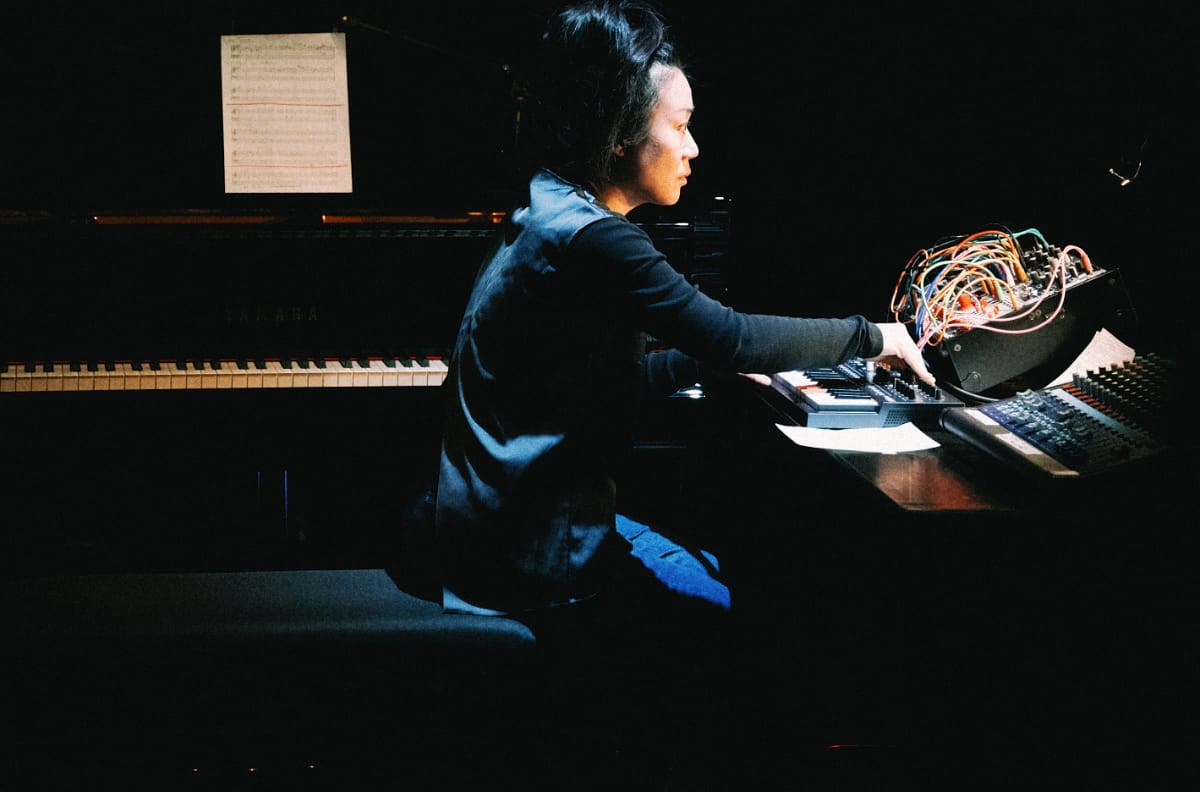
Midori Hirano: Basically, my setup is an acoustic piano, a small synthesizer (Arturia’s MiniFreak), and a modular synth setup. So it’s very simple. Before I started composing this score, I already somehow knew that I wanted to use both digital and acoustic sound elements, partly because these are the instruments I usually use.
But also—I don’t know if you have watched this film, The Juniper Tree?
Lawrence: No, I’ve listened to the music, but I’ve not seen the film.
Midori: This film is quite surreal, and it’s very strange, but also very beautiful. It’s actually categorized as a kind of horror, but it’s not really horror.
It’s about human nature. One person has many different sides to their nature. You can love someone, or you can hate someone. You can be friends with someone but still fight. One person can have many different emotional moments. In this film, it’s hard to define who is the bad guy and who isn’t. So there’s a lot of ambiguity in this film. That is also the reason I wanted to use two different kinds of sound elements, because they can serve as opposites and contrast with one another. I thought this would be a good strategy for scoring this film. My album consists of piano pieces and also pure synthesizer music.
Lawrence: Are you comfortable with ambiguity? A lot of people are not. They need a stricter interpretation or a firmer resolution.
Midori: Yeah, I’m kind of comfortable with it. Sometimes people are complicated, and they are allowed to be. This ambiguity serves as a kind of rescue. You can relax and be honest about who you want to be. It’s a very honest way to show a human being.
Lawrence: How did you come to be involved with the film, and what was your experience of watching it for the first time?
Midori: Actually, I didn’t know about this film, but I got involved with this project because the Belgian cultural center Viernulvier in Ghent asked me to compose a new live score for a performance. They run a concert series, or festival, called Videodroom every year, and they ask, I think, ten or twelve artists to compose a new score for a different film each time. They picked The Juniper Tree and asked me to compose a live soundtrack. That was how it happened.
They sent me the link to the film and asked if I could compose something, and I watched it. At first, I thought it was a very strange film. It took me some time to understand it, or to feel confident enough to think, “Okay, I now understand what it is.” It took me some time to get into the story. At some point, I found it very beautiful, and I felt sympathy for the film because, as I told you, it’s all about human nature and a lot of ambiguity, and it really depends on how you interpret it.
So there’s a lot of freedom in how to interpret it, and I like it. Also, because Björk, who is acting in this film, is a kind of phenomenon. It’s very Björk, whom I’ve loved for a long, long time. So it’s very nice to see her acting in this film.
Lawrence: It’s such an interesting project, to have composers come in and revisit an existing work. I’m curious about your relationship or engagement with the original soundtrack. Did you study it, try to avoid it, or are you in conversation with it?
Midori: When I watched the original film with the original music, it was quite traditional, classical orchestral music. So I understood my role was to compose something new, with my new interpretation of the film. I tried to avoid listening too much to the original music, and sometimes I even shut off the sound to try to follow the image.
That is how I tried to compose at first. But of course, when you score a film, you really need to follow the story. Sometimes you have to stop, or you think you don’t need any music at some moment. So at some point, I always try to hear what they are saying and how they show their emotions. I try to get involved in the story, of course, and in the dialogue, too. It’s kind of like a conversation with the film.
Lawrence: How did Björk’s presence in the film influence you? When we see her or hear her, she’s so recognizable. She’s one of those artists who feels like she’s always been with us, so she brings a lot. Do you channel any of her influence, or do you have to keep her out?
Midori: I couldn’t really avoid her existence. It’s Björk, and even though she’s playing the witch and the witch’s sister, she still looks really like herself. I just couldn’t avoid it. So I tried to follow the atmosphere she creates, but I kept it restrained because the film is quiet, I would say. It develops very slowly, as it should. Sometimes I try to pace it up with the music, and sometimes I try to stop it.
It’s about giving the story a tempo. For some moments, I used only pure piano pieces—like with Katla, Björk’s sister. Because she’s a witch, she’s doing the spell, and there’s tension between her and the father’s son. For these moments, I tried to compose pure piano pieces, which are quite simple. I think it sounds beautiful, and I thought it contrasted well with the very raw human nature. I tried to balance the quite subtle but very scary moments that come from that. It’s all about how I decorate the film with the music, but in quite a restrained way.
Lawrence: I love that word, “decorate,” in this context. And that leads me to what I was going to ask you anyway, which is your use of nature sounds: the waterfall on “Mother’s Path,” the birds on the record. What do those elements mean to you?
Midori: I’m usually fascinated by nature sounds, but also the sound you get from hitting tables or doors, or footsteps—any kind of non-musical sound. I sometimes use these field recordings in my compositions, and I process them a lot, adding effects to make them sound different. I really like this way of composing because I see a lot of possibilities for new music and new compositions. So it was a natural step to use those sounds in this score, especially the bird sounds.
The birds are one of the film’s symbolic characters. The birds come back multiple times, so I thought it would be nice to show the existence of the birds in the music. And also the water. Water is also an important element of this film. So it’s like trying to make a note, or make a memory, of what I was seeing in the film.

Lawrence: All of the music is so beautiful, and my experience is of listening, right? I haven’t watched it with the film yet. I’m curious how you think about that, knowing some people will experience the film and the music together, especially in your presentations, and others will only ever hear the music. Do you think about the different experiences people will have?
Midori: I think I’m happy that the people who listen to this music without the film could have their own imaginary landscapes. Of course, I’m happy if they watch the film as well, but it can be more fun to create your own image while listening to the music. I don’t want to limit the listeners to hearing it as film compositions. I’d love for audiences to hear the music even without the film, and I’m very curious how they interpret it, or what story they make up in their minds.
Lawrence: It felt like winter to me. Not winter when there’s snow on the ground yet, but that time right before, when it’s gray, it gets very still outside, and you can hear nature very clearly, like birds or water running. It brought that time back to me. That was my experience when I was listening to it.
Midori: Oh, that sounds beautiful. I’m very happy.
Lawrence: It was lovely.
Midori: Actually, in the booklet of the LP, there are liner notes written by Anna Bogutskaya, who’s a film critic and writer. She wrote a brilliant text. At the end, she wrote that for Margit, played by Björk, the witchcraft is really about listening to what you usually don’t hear. So it’s about hearing. I find this description beautiful: interpreting witchcraft as a kind of hearing experience, trying to listen to what’s there—not just nature sounds.
In this film, the sisters’ mother appears multiple times. It could be just a ghost, but it’s more than that. Only Margit can see her, and not only because she’s a witch, but because she tries to observe the world so she can see her mother, who doesn’t actually exist in the world. But she can see her. So this is also about hearing, in a sense.
Lawrence: It’s interesting that you bring up that quote from the liner notes, because I was going to ask you about that. The listening aspect, as it relates to the witchcraft, speaks to an attunement or intuition, seeing into and beyond what’s materially there. Does that manifest in your work, that notion of deep listening, or seeing and hearing beyond the obvious?
Midori: Actually, it’s part of my practice, trying to hear what’s actually not there, and it’s also part of deep listening. I just read Pauline Oliveros’s book on deep listening, and I really love this method of hearing the sound and observing the environment. I try to incorporate this—I don’t say strategy, but this kind of way of listening—into my compositions. It’s quite obscure to say, but I think it’s good training when you make new music. You can always catch the sound you didn’t hear the last time.
Lawrence: Something else about your work is how you are often in dialogue with someone else’s work. Whether it’s film or photographs, someone else’s work is a prompt, or an impetus, for you to compose. When you embark on a new project like that, what do you need from the other creator?
Midori: I think it really depends on the project. For example, when I score a film, the director always gives me requests or ideas about what kind of music they need. There are some rules that I have to follow. So it comes from the dialogue. I think I’ve been lucky so far to work with directors who understand my work and musical style, so they never ask me to do anything very different.
Lawrence: No heavy metal album.
Midori: No heavy metal, no hip-hop, nothing like that. So I’m grateful that they could understand and respect what I make. But I also sometimes enjoy having rules, some limitations, so I can train myself, and sometimes I learn many things, not technically, but creatively.
Sometimes I’m fascinated by the music I made for a film, and surprised I made it. I usually don’t make these kinds of things, but it’s quite nice. I really enjoy the process of scoring. The Juniper Tree is different because it was based on the idea that I would play this music only for the live performance at first, and I had complete freedom over what to make. That was the idea of the commission. I really enjoyed composing The Juniper Tree.
Lawrence: It strikes me that there will be people who are introduced to your work because of the film, and there will be people introduced to the film because of your work. Did you feel that would be the case?
Midori: Yeah, true. I’ve played this film concert four times already. People really enjoyed it. Some people came to the concert because of the film; others came for my music. But in the end, everyone came to me to say they really enjoyed both sides, the film and the music, and that they worked together very well.
My music, especially when I give this performance or film concert, brings both sides together. Two different kinds of audience can, in the end, become one audience, sharing the same experience, which I find wonderful. I’m very happy to have made this score and had the opportunity to play these concerts, and I hope to do this again in the future.
Lawrence: You mentioned earlier how important it was to you to use both the acoustic instruments and the synthesizers, the electronic instruments. What is the difference for you as a player and a composer when you’re using something like a Buchla or the SYNTHI 100? It’s interesting that those electronic instruments are expressive instruments, but they’re also tools with a very specific aim.
Midori: In the end, I always find my voice in the Buchla or the SYNTHI 100, whatever I use. Of course, it always takes time to get the sounds I want. I enjoyed learning the instruments, especially when I used the Buchla at EMS Stockholm, the music studio, some years ago. It was very complicated for me to learn everything, and I don’t think I understood everything, but it’s quite playful. You can try whatever you want, even if you don’t understand why it sounds that way. I find it quite interesting that I could play somehow without knowing everything. Somehow I found my voice in the complexity of sounds.
I used the SYNTHI 100 in Serbia, in Belgrade. There’s a radio station called Radio Belgrade, and they have a studio with a SYNTHI 100. I got a chance to do a one-week residency, and I could try it out however I wanted. It’s not an easy instrument, and I was there only for five days, so I didn’t get to use all the functions. I made a lot of recordings; somehow, I found my own voice in those sounds, in those instruments.
Stay on top of The Tonearm.
Subscribe for exclusive interviews, cultural tip-offs, and community fun.
And your support keeps our site free of advertising and paywalls.
Lawrence: When I speak with guitar players, we often talk about where their tone comes from, because a guitarist can pick up any guitar and still sound like them, and they almost all say that the tone is in their fingers. It lives in their fingers. When you say you find your sound on all those instruments, where is your sound? Where does it live in you?
Midori: I think maybe it’s because I come from this classical music background. I learned classical piano for a long time. I changed to electronic music because I got tired of the classical music world. But I still feel like I’m a little bit in this traditional style of music-making, like making chords, harmonies, and melodies. I realize this is still the core of my musical style, but I’m not stuck on making harmonies. Sometimes I like disharmonious sounds, or something that isn’t very tonal.
I think it’s a question of how I interpret it. Everything is in harmony, although it’s not actually harmonic. I don’t know if that makes sense, but I tend to layer different kinds of sound elements, like field recordings, metallic sounds, piano sounds, or digital or analog synthesizer sounds. But I try to make everything harmonic, in the way I think it’s harmonic. I don’t know how I can describe it. I see those different kinds of sound elements as counterparts, or as everything coexisting.
Lawrence: That makes sense. You live in Berlin now?
Midori: Yes.
Lawrence: How much of Kyoto is still with you?
Midori: I actually come from a small city close to central Kyoto. My hometown is called Uji. It’s twenty kilometers from central Kyoto, so it’s a little outside the city. It’s always a joke that many people from Kyoto don’t think I’m from Kyoto. I’m just from the countryside. So I’m maybe not very attached to the traditional image of Kyoto. So maybe I’m quite free from where I come from. But of course, I grew up there, and I think I still unconsciously carry something from where I came from in my music.
I don’t know how much, but maybe some people can hear where I come from. I was part of Kyoto’s music scene before I moved to Berlin. Kyoto has a big folk-rock music scene, and the electronic music scene was part of it, where I was a little involved. This kind of Japanese folk music feels very nostalgic to me. I think part of that feeling is still in my music.
Lawrence: I wanted to ask about the idea of ma, and what that means in your music, or where someone might hear it in The Juniper Tree.
Midori: I don’t think there’s always ma in my music, but I believe The Juniper Tree has a lot of ma, the space. It’s because it’s mostly minimalistic music. Since I wrote this music to follow the story of the film, I tried to make a lot of ma between tones, in all those pieces. It actually has a lot of space. I think The Juniper Tree has the most ma in my catalog.
Lawrence: Is it something you see yourself incorporating more of, or was it unique because that’s what this project called for?
Midori: Yeah, I think so. I usually tend to layer heavily in my compositions. I’m learning to reduce the layers and make it more minimalistic, which I actually find beautiful. At the beginning of my career, I tended to put in a lot of layers, and it was almost too much. Now I am learning to reduce those layers, not only to make it minimalistic, but to find the sound that is actually necessary and what isn’t.
Check out more like this:
 Bill Kopp
 Lawrence Peryer


Comments