


James Ellroy’s literary world connects with the tradition of European noir in ways that go beyond a fondness for trench coats, smoking, and the darkest forms of fatalism. Both grew from the same soil: the hard-boiled pulp of Hammett, Chandler, and Cain, which the French Série noire carried across the Atlantic, where it fed the work of Jean-Patrick Manchette and the Milanese crime fiction of Giorgio Scerbanenco before coming home again in Ellroy’s rotten and blood-soaked Los Angeles. The resemblance is hard to miss. In Ellroy’s L.A. Quartet crime novel series and Italy’s poliziotteschi, the city is a place of back alleys, neon, and smoke, where cops are as dirty as the criminals they chase. Heroes are damaged goods, driven by obsession, lust, or guilt, and doomed from the opening pages. Violence arrives without warning and without consolation. No one finds any redemption, and there is no room for happy endings.
Above all, both see history as a conspiracy and the State as its prime suspect. While Ellroy’s L.A. Quartet and Underworld U.S.A. Trilogy find the mob and the Kennedys wrestling in the dark, Italian crime cinema of the 1970s took its menace from the Years of Lead period with its bombings and shadowy collusion between power and the underworld. Ellroy’s staccato prose has the same pulse as the dialogue in films by Fernando Di Leo: short, biting, and propulsive. Add the sleaze, the swagger, and the sharp suits, and you have two sides of the same coin.
This is the world that the members of Calibro 35 have drawn from for two decades, in particular through library music and soundtracks brimming with wah-wah guitars, loping basslines, and menacing strings. The Milanese band Calibro 35 formed in 2007. The founding lineup comprised producer Tommaso Colliva, whose official brief was “sound research, production, and mixing”; guitarist and keyboardist Massimo Martellotta; multi-instrumentalist Enrico Gabrielli (keyboards, flute, saxophone); drummer Fabio Rondanini; and bassist Luca Cavina, who played with the group until 2023, when Roberto Dragonetti took over.
Their self-titled debut, Calibro 35 (2008), mixed reworkings of Ennio Morricone and Luis Bacalov with a few originals. Ritornano quelli di… Calibro 35 (2010) sharpened the groove, while Ogni riferimento a persone esistenti o a fatti realmente accaduti è puramente casuale (2012) consisted almost entirely of their own material. Traditori di tutti (2013) pushed further into dark, widescreen funk, and S.P.A.C.E. (2015) went cosmic. Decade (2018) took stock of ten years of mayhem, and Momentum (2020) followed. Scacco al maestro (2022) was an homage to Morricone. Meanwhile, Dr. Dre and Jay-Z sampled the band’s grooves, further enhancing (if that were even possible) the international appeal the band has always enjoyed.
But how did they end up composing the score for the documentary Ellroy vs L.A., about the aforementioned writer? This is where our conversation begins.
The transcript has been edited for length, flow, and clarity.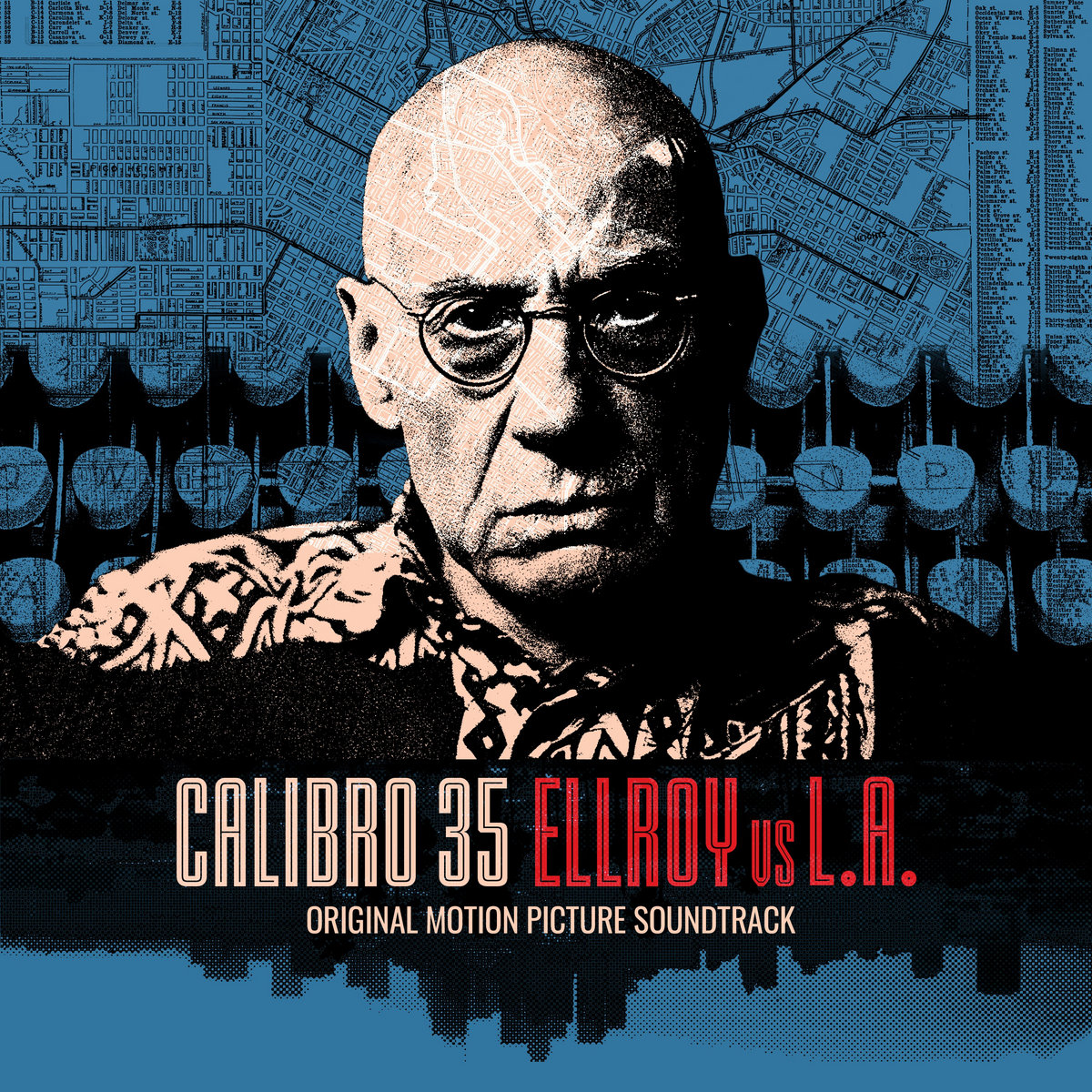
Tony D’Onghia: In Italy, you’re already a household name, and now your work is being associated with an absolute master of crime literature, James Ellroy. That’s not surprising to me, given my familiarity with your repertoire, but it might intrigue people who don’t know you yet. Could you tell us how your adventure began and how you came to be involved in the documentary?
Tommaso Colliva: Calibro 35 was founded to bring back to life—through a modern, contemporary band—some of the soundtracks from the Golden Age of Italian cinema, namely the 1960s and 1970s, while remaining faithful to the sound, performance styles, and production methods of that era. Some of these soundtracks were deeply steeped in genres like crime, action, and whatever else you can think of. We started there, reinterpreting other people’s soundtracks, but we quickly drifted toward producing more and more of our own music. By the second album, it was half our own music and half other people’s. From the third album on, our records are mostly our own compositions. Gradually, requests started coming in for original soundtracks for new productions, whether films, documentaries, or series.
Tony: One peculiarity of your group is that it relies on you, officially credited as producer and recording engineer, as an integral part of the classic lineup of four instrumentalists. In terms of personnel, and I hope this makes you smile, it’s a bit like interviewing the Beatles and finding George Martin at the microphone. It’s very unusual. Could you explain it?
Tommaso: The idea started with me. I put together about fifty tracks that we could cover. The initial intention was for our shared project to begin and end there. I explained the concept to the others and had them come to the studio to have fun. We had no desire to play live or form a band. From there, it became a journey that has led us, twenty years later, to still talk about it. Over the years, I’ve handled the actual direction of Calibro. I’ve suggested the type of cover repertoire and the increasing integration of original music, and each time I’ve suggested the kind of imagery to draw inspiration from and the direction in which to develop the sound: adding more orchestral arrangements, as we did on the album Decade; pushing toward greater use of synthesizers, as happened on the latest records; or, as with the album Momentum, basing our work more on building grooves than on themes. All of this directorial work is what I take care of. Over time, of course, there’s been an ever-greater exchange with the other members, so I also write songs, while the other musicians likewise take part in these kinds of decisions. As a working method, ours is more like a collective than a band in the classic sense.
Tony: That brings us to this latest soundtrack. What was your approach to this kind of work?
Tommaso: Two years ago, Francesco Zippel, a very talented Italian documentary director who won a Golden Lion at the Venice International Film Festival for his documentary on Sergio Leone, requested a soundtrack. While producing his documentary on James Ellroy, based on an interview in which the writer talks about his relationship with Los Angeles, he thought of us for the soundtrack, given the general tone of the writer’s work.
Of course, there was a brainstorming phase in which he sent us some excerpts from the long interview he had filmed. We sent back demos of original instrumental pieces. When Francesco heard them, he said, “As I listen, it’s as if I can see you playing. Let’s make you part of the documentary.” In fact, a good percentage of the documentary consists of footage of us playing in the studio, commenting in real time with our sound on the images of the Ellroy interview.
There’s a connection between Europe and America, between American crime and European noir, that comes alive again in this project and automatically made me think of the soundtrack Miles Davis composed for Elevator to the Gallows—with all due respect, of course, that this comparison requires.
Tony: Sure. And it’s a film soundtrack more famous than the film itself.
Tommaso: Absolutely, as has happened with many other movies.
Tony: Here’s a reflection I had while thinking about your music, but also about library music and film scores more generally. I’ve always found the figure of the session man fascinating: musicians who walked into the recording studio at nine in the morning and walked out at five. It’s an intriguing world, comparable to that of an artisan in a workshop. It’s even more intriguing when, as in your case, this work accompanies film or television images. What do you think about it?
Tommaso: Calibro was born from a desire to investigate, study, and understand music and the mechanisms underlying the interaction between music and images. The world you mention, the one we also refer to, the soundtracks of the 1960s and 1970s and library music, was an enormous field of research for generations of musicians.
To be more specific, I’d add that library music and Italian soundtracks are also interesting because Italian musicians often had very American reference points, even though their backgrounds were completely different. Most of the soundtracks we started from were made by musicians who were relatively young at the time. We’re talking about kids in their twenties and thirties who, in the 1960s or 1970s, loved jazz, rock ’n’ roll, or progressive rock, but who had to play the music of a composer who had studied at the conservatory during the Fascist ventennio (the twenty years of Fascist rule) and therefore had a very classical training, and who was given a soundtrack by Quincy Jones or Isaac Hayes as a reference.
You realize this creates an incredible cultural and musical melting pot. So you have a composer born in 1920, who is nearing fifty in the 1960s, trying to copy the Shaft soundtrack and handing it to twenty-year-olds who like Archie Shepp. That, in my opinion, is the distinctive quality that defines the sound of Italian soundtracks.

Tony: In that sense, how did you approach Ellroy’s literary universe? How did you prepare, especially to compose and interpret it musically?
Tommaso: We didn’t prepare by studying his work in any specific way because, as I said, noir atmospheres have always characterized us a bit, and in any case, the intention wasn’t to make a philological exercise. The beauty of this documentary is that reality and fiction are very much mixed. Ellroy talks about his real relationship with Los Angeles, the city he described in several works of fiction that drew on real episodes from his life. So it’s an exciting short circuit between reality and fiction.
We approached it in a, let’s say, non-religious way. We didn’t want to be retro, and we didn’t want to be modern at all costs. Above all, we wanted to let ourselves be carried by the rhythm of what Ellroy says in the interview as he recounts historical events in Los Angeles. So it ranges from the Kennedys to Marilyn Monroe to the famous riots, and all these descriptive triggers, all these subjects, called for a different sound.
Tony: Right. And the titles are all inspired by that imagery, either through the titles of his novels or through references to episodes the writer describes. That’s another reason you’ve done such a good job of matching images to sounds and titles.
Tommaso: Exactly, like “Chalet Manson” or “Riots,” but there are also titles like “Black Dahlia” and “White Jazz” that refer to his novels, precisely to underline this duality between reality and fiction.
Tony: In my opinion, this is also one of the darkest albums in your discography. In a way, it’s a return to your beginnings, given that over your evolution, you’ve touched on many different genres and moods.
Tommaso: Yes, it’s part of the research we undertook a couple of years ago to understand which kind of jazz suited us. If I go back through our Ellroy soundtrack, I find many things we couldn’t have brought out before investigating a sound more inspired by Black music, as we did on our album Exploration. That album was an opportunity for us to engage with a genre, jazz-funk, that had always been lurking around us but that we had never tackled openly. On it, we took on Grover Washington Jr., Herbie Hancock, the Headhunters, Bob James, and Miles Davis, the cornerstones of that culture. That helped us a lot in dealing with the atmosphere of Ellroy’s world.
Tony: Do you know how the writer reacted to hearing your soundtrack, assuming he heard it?
Tommaso: I think he hasn’t listened to the soundtrack apart from the images. But I do know he was very happy with the final result of the documentary. I think our music plays a good part in that. Our compositions rest on the rhythmic cadence of Ellroy’s speech, trying to amplify it, following the train of his thoughts and the paths he takes, phonetically and expressively. So that’s something we made an effort to do, and I’m very satisfied with the results.
Check out more like this:
 Lawrence Peryer
 Tony D'Onghia


Comments