


In the 1940s, while living in his native Florence, the influential composer Piero Umiliani stumbled upon a record by Duke Ellington, till then almost unknown in Italy, where jazz was banned by the Fascist regime. Despite the ban, he was deeply moved by songs like "Mood Indigo." With the arrival of American troops during the war and the spread of so-called V-Discs (Victory Discs)—records produced exclusively for servicemembers through a World War II–era collaboration between the U.S. government and major record labels—the then-twenty-year-old was finally able to discover and fully appreciate the rhythm and sound of jazz: a love of music and a desire for discovery and exploration that would accompany him throughout his entire life.
A quarter century after Piero Umiliani's passing, echoes from his master-tape vault emerge into the light. La luce dell'alba, the new album from the musician and producer Fabrizio Martina, aka Jolly Mare, arrives via 42 Records, breathing new life into the Maestro's discography and the material preserved inside Rome's mythical Sound Workshop Studios, founded by the composer himself. Created in the very rooms where Umiliani shaped the sound of postwar Italy, the ten tracks it contains combine new instrumental parts recorded by the producer and his musicians with archival material, using the original tapes, analog machines, and instruments left behind by the composer and meticulously safeguarded by his family.
But who was Piero Umiliani? Though forever associated with the novelty song "Mah Nà Mah Nà," the Maestro's legacy stretches far beyond that unlikely global hit. One of Italy's most prolific and inventive tunesmiths, he amassed an astonishing catalog of film scores, library music albums, and television themes, while also shaping the country's independent music infrastructure through the Omicron label and as cofounder of Liuto Edizioni Musicali.
His international breakthrough came in 1959 with the jazz-inflected score for I soliti ignoti (Big Deal on Madonna Street), featuring the unmistakable trumpet of Chet Baker. Alongside contemporaries such as Ennio Morricone and Riz Ortolani, Umiliani helped define the distinctive jazz-inspired sound of European cinema in the 1960s and '70s, scoring everything from spaghetti westerns and giallo films to spy and exploitation cinema. Constantly exploring new musical directions, he later embraced electronic experimentation, blending synthesizers with live instrumentation in both his film scores and the extensive production-music catalog published through his company, Liuto Edizioni Musicali. Effortlessly stylish and remarkably forward-looking, his work remains highly influential and has enjoyed a lasting revival through its use in films including Ocean's Twelve, Playing by Heart, and Thick as Thieves, as well as in television advertising, introducing his music to new audiences around the world.
Released during the centenary of Umiliani's birth, La luce dell'alba, rather than exhuming a lost past, treats the original material as a living organism. Granted access to this dormant archive, Jolly Mare resisted the lure of digital reconstruction, choosing instead to work exclusively with real instruments, vintage circuitry, and the beautiful unpredictability of analog decay. Tape hiss becomes atmosphere, orchestral bleed melts into fractured rhythms, and faded sambas and dreamy melodies dissolve into luminous new forms. As Fabrizio Martina described it, very poignantly, it is "less a tribute than a conversation across time"—one that allows Umiliani's singular musical universe to breathe once more.
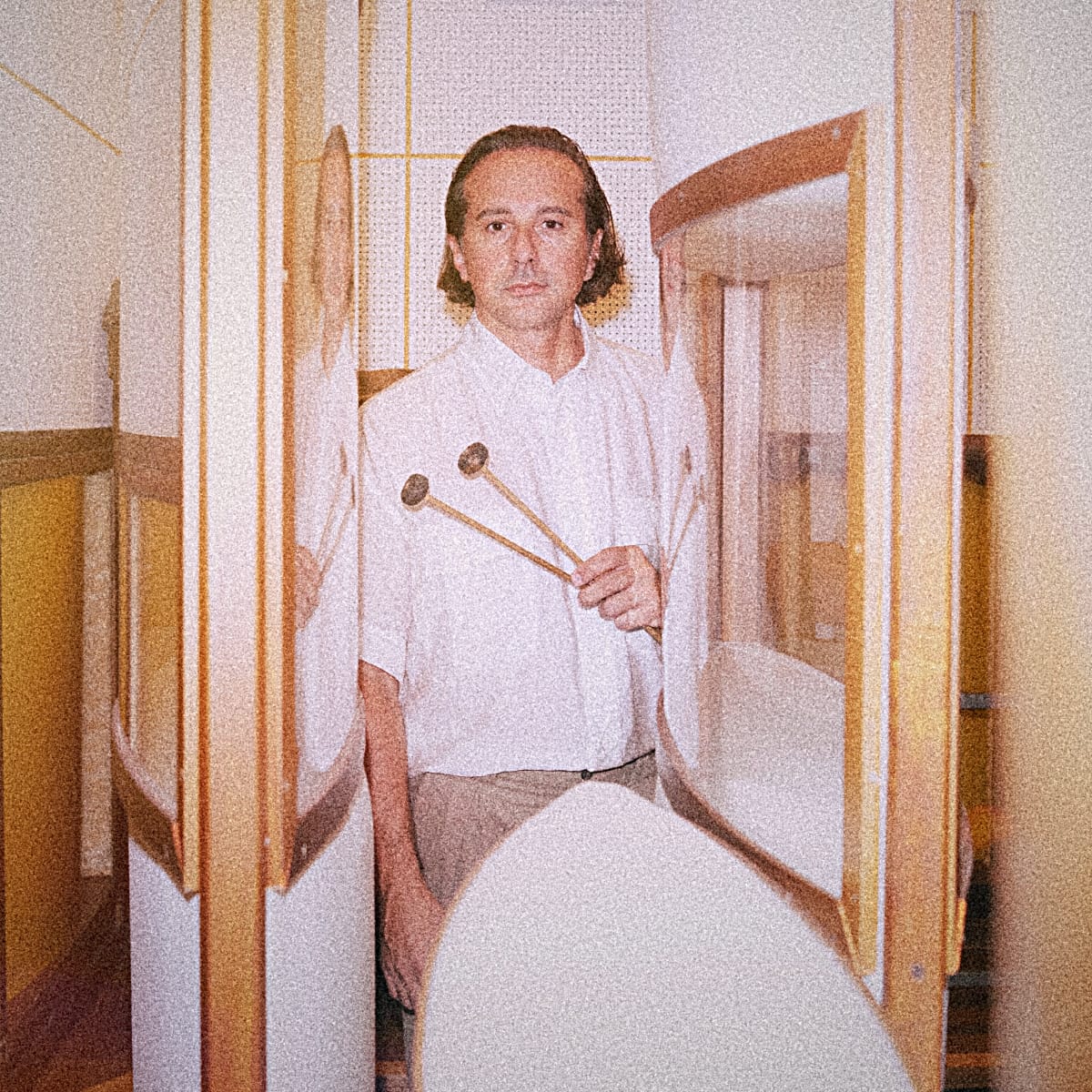
To learn more about this project, we interviewed the producer in his studio.
The transcript has been edited for length, flow, and clarity.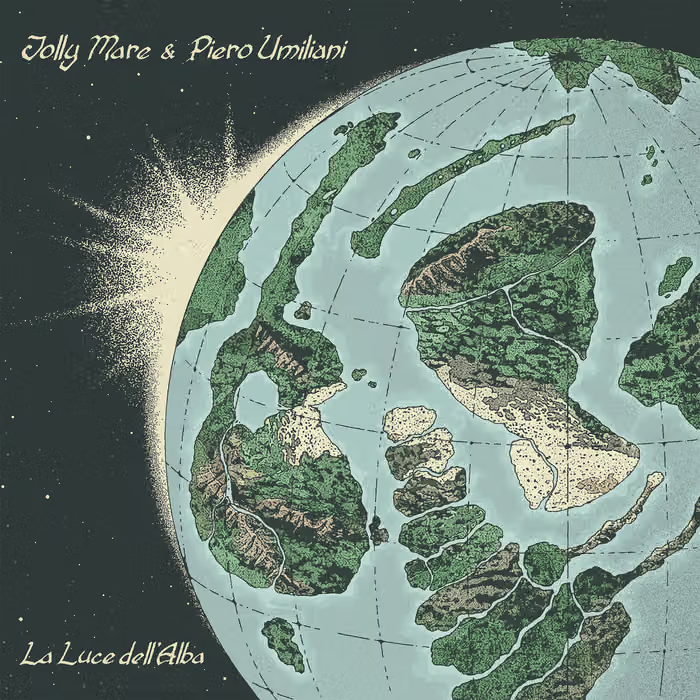
Tony D'Onghia: Your artistic background is very diverse. Could you try to sum it up for us?
Fabrizio Martina: Ever since I was a kid, I've had a deep, visceral connection to music. That passion first led me to study guitar and bass, and later to immerse myself in DJing. I went through a turntablism phase, competing as a scratch DJ in both Italian and international competitions. After that came music production and building my own studio.
Those two things developed side by side because I quickly realized that working exclusively on a computer wasn't for me. It didn't give me the expressive freedom I needed, and it left me unsatisfied. That's why I started searching for instruments and constantly expanding my knowledge of them.
Alongside all of that, there was always a deep passion for record collecting, back when the term "digging" didn't even exist. At twelve or thirteen years old, I was already hunting for records at flea markets. Those discoveries eventually brought me into contact with extraordinary records and incredible collectors who opened the doors to their archives. They let me hear music that completely changed my life. From that point on, it became a continuous journey of searching—searching for music, searching for myself, and always trying to do the very best I could at that particular moment.
Listening back to my first album, Mechanics, I realize that the person who made it isn't the person I am today. But at that time, it was the truest thing I could create, the work that represented me most honestly. That was followed by Logica natura, a deliberately disruptive record in which I completely abandoned the traditional song format. I experimented by having percussion instruments generate melodies through a system connected to all of my synthesizers. It was an album worlds away from pop music, a genre I later reconnected with on Epsilon. That's where I feel I finally brought together everything I had absorbed over the years: research, taste, songwriting, my love for pop, for great music that anyone can enjoy, for library music, but also the spirit of experimentation and the desire to push sound beyond the boundaries I had explored on the second album.
Looking back, I realize I never really followed a logical path. What drove me was simply an ever-growing need to go deeper—to understand more, to immerse myself more completely in music, both on a theoretical level and on a sensory, emotional one. It has always been about the need to explore.
Tony: That drive to explore is something you share with the pioneering side of Umiliani's career—what we might call a true "sound explorer." The project began after meeting his family, who gave you access to his studio. What did you find when you first walked in?
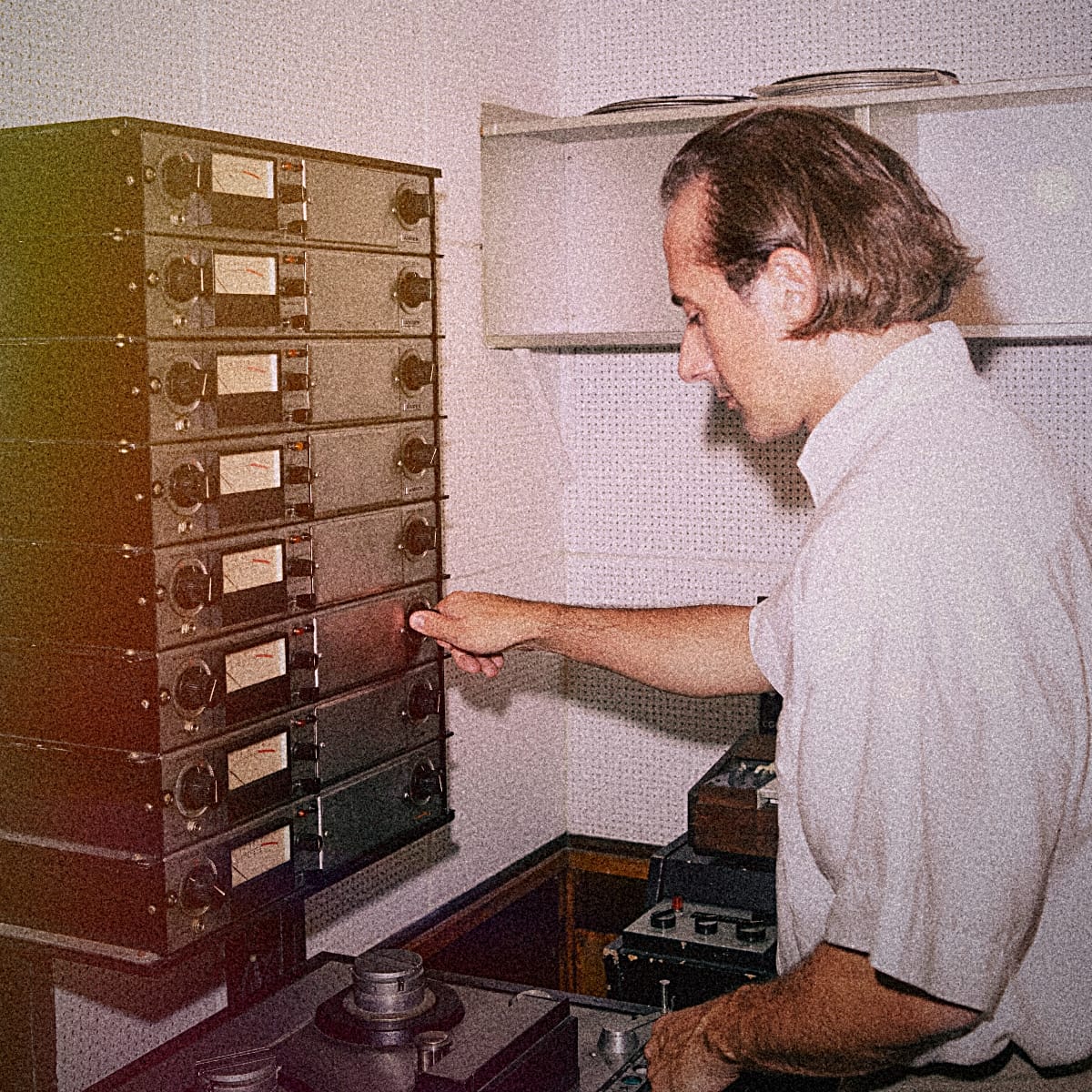
Fabrizio: Everything the Maestro used is still there in the studio. There's the very first ARP 2600, the early Tonus version, which differs slightly from the later models. He bought it himself in New York. Then there's an EMS VCS3, another groundbreaking synthesizer that he purchased in London. I believe it was one of the very first to arrive in Italy, complete with its incredibly rare keyboard, which allows it to be played like a traditional instrument rather than simply used as an effects generator.
There's also an entire collection of electric keyboards: a Clavinet, a beautiful and very early Rhodes Silver Top—the same model used by the Beatles, in fact one of the very first ever made—a Wurlitzer 200A, an ARP Solina, a wonderful vintage Minimoog Model D, and a Novatron, a rebranded version of the better-known Mellotron, the world's first tape-based sampler. In short, it's a collection of virtually every great classic in the history of keyboards and synthesizers.
Those were the vintage instruments I found myself standing in front of. I asked if we could turn them on and hear them, and that initial encounter eventually grew into a much deeper exploration over the many visits I made to the studio afterward.
Tony: We've highlighted Umiliani's pioneering spirit. In that regard, I'd like to hear about the sound exploration you undertook while creating the tracks on the album.
Fabrizio: The Sound Workshop is a special place, full of instruments and sources of inspiration. It has unique acoustics that are as integral to Umiliani's aesthetic as his sheet music is. It came naturally to me to focus on one specific aspect at a time—whether it was an instrument (VCS3, ARP 2600, Novatron, drums) or the sound of the main hall, where, during the guitar recording sessions, I used a miking setup designed to emphasize the room's acoustics. To avoid getting lost, I approached the composition one possibility at a time, then reshuffled the elements during the reworking phase.
Tony: How did you go about working with the original masters?
Fabrizio: I didn't use anything that was previously unreleased; all of the tracks are part of Umiliani's discography. When I selected them, I went on Discogs and listened to them there, and I already owned some of them on vinyl. I put together a selection of tracks that I felt were the right fit for me, so I drew from the official discography.
Tony: In what way did the composer's family contribute to the making of what I like to call "a labour of love"?
Fabrizio: I first got to know the composer's family while working on my remix of Umiliani's track "Discomania." We initially got in touch over administrative matters, and since they spent their summer holidays in my area, we had the chance to meet in person. On that occasion, the composer's daughters, Alessandra and Elisabetta, invited me to visit the studio, and a few months later we met again to get to know each other better.
I proposed the track selection in 2022. After confirming that the original audio material was available in high quality, I was given the green light to proceed. From there, I spent a great deal of time developing the demos, and about a year later we listened to them together. It was always a collaborative process. The daughters were often with me in the studio while I was working, listening to what I was doing. They were also present with the musicians during the recording sessions, so they followed the project closely and oversaw the work. They never imposed vetoes or asked for things to be changed. Rather, they were consistently involved, and their presence undoubtedly contributed to the project's success.
Tony: That's an interesting aspect. Did you have the impression that, from an emotional perspective, in some way, they were expressing something that you and the musicians involved then translated into music?
Fabrizio: Enthusiasm. Their enthusiasm for their father's music, their enthusiasm for life in the studio. I think that simply by making the studio and the instruments available, by being present and listening, they showed a genuine desire to be part of the process. Their contribution was crucial to the success of this album.
There's one track in particular, "Montagne di sabbia" ("Mountains of Sand"). Elisabetta felt very strongly that it should be included. It had been recorded one evening when she had just returned from a trip. She arrived at the studio while we were working on it. At the time, I considered it an outtake, but later she told me that the track was important and its dreamy atmosphere reminded her of that evening and how good it felt to listen to it. And that happened not only with this track, but on other occasions as well.
Tony: Still on the topic of exploration, and in keeping with the Maestro's artistic universe, you, too, chose to imagine a sort of exploration of places, some more exotic than others, in the composition of the tracks on the album. Would you like to tell us a bit about this "geographical" element and also about the love of nature that comes through when listening to the music?
Fabrizio: Escapism is clearly a common theme in many library music albums, and the same could be said for this one. Perhaps there aren't so many references to specific places as there are to the sensations one might experience while in imaginary settings. The Caribbean atoll of "Orizzonti lontani," the excitement and fear of the journey into the unknown in "Altrove," the horse-drawn caravan moving slowly in "Montagne di sabbia," a car speeding away, leaving the past behind in "Il senso," the "Foresta Nera" populated by creatures moving in the twilight around the protagonist. Each track could be associated with moving images.
Tony: Is there any particular track that you'd say you're most attached to, or that for whatever reason you consider particularly emblematic of the entire project?
Fabrizio: "Dentro la notte, la luce dell'alba" was the first fruit of this imaginative collaboration, created at the Sound Workshop while improvising on the Maestro's ARP Solina on the melody of "Canoe." It really came together in just a few minutes; the sound of the synthetic strings blended perfectly with the solemn backdrop of the original track. Everything evolved into a call-and-response between the instruments, then transformed into a crescendo that unfolds as the sun rises.
Check out more like this:
 George Grella
 Kallie Marie


Comments