


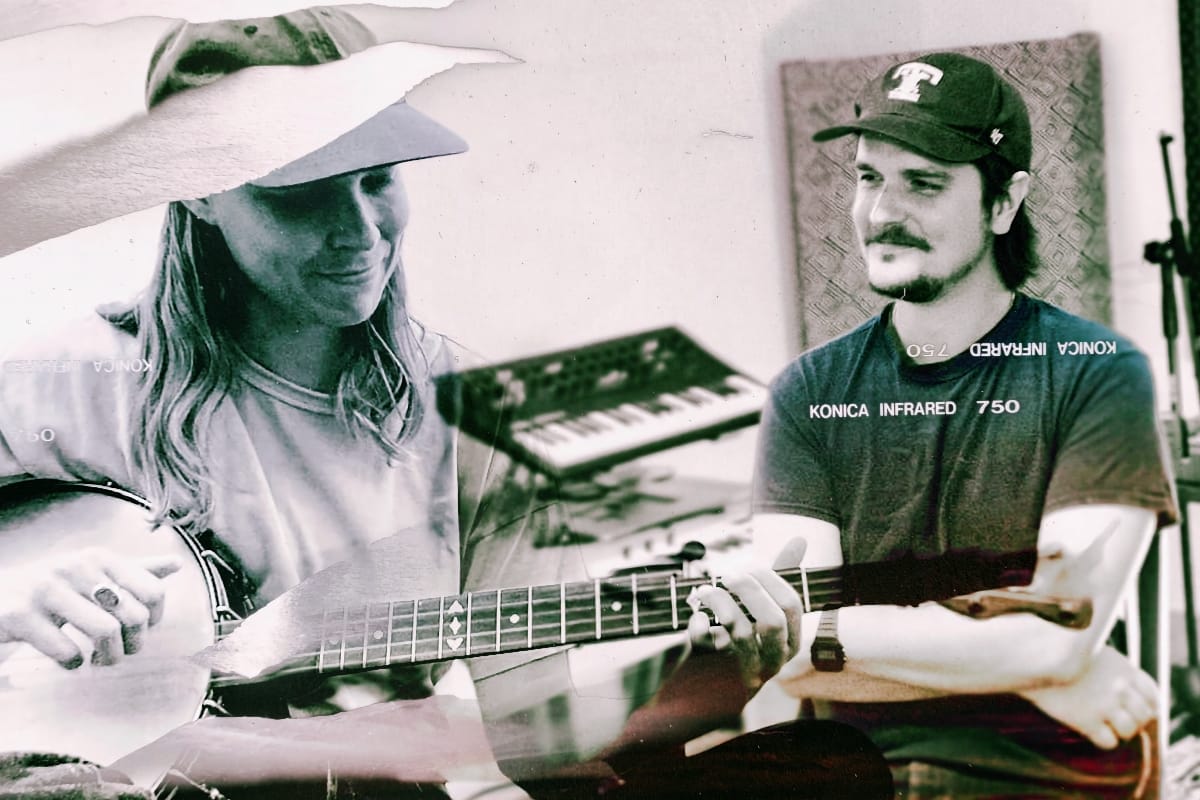
Getting to know another person can be difficult; who really wants to make small talk? Water cooler gossip at work, sports, weather, you know the drill. For Allison de Groot and Rich Ruth, getting to know each other meant creating a record that serves up what can only be described as an organic and original take on banjo music. De Groot is best known for her work in old-time and traditional music, while Ruth’s projects (as Rich Ruth and his given name, Michael Ruth) tend to exist in a synth-laden, psychosynthetic world of spiritual jazz and ambiance. Originally intended as a solo record for de Groot, the collaboration fuses humanity and technology through its worldbuilding and adventurous spirit toward what is new.
The opening track and single “Nervion” immediately highlights the collaboration’s special nature and the sound of the album with its open, atmospheric pull, while “banjo runs through looping and delay . . . at the center of the arrangements, its rolling figures gathering krautrock-like momentum before giving way to Ruth’s synthesizers,” per the presser. “Distance From Then” evolves from what feels like an old-time duet set in floral pastorals, dripping with so much fresh air and nature that even the term “field recording” seems too manufactured, into its lead-heavy, soaring crescendo of an ending. At the halfway mark of this six-minute tune, you can feel the musicians discovering their shared voice. I found “10-14” to be a very tribal, marching kind of arrangement that flirts with a somewhat harlequin or sinister side. The self-titled record also features contributions from Patrick M’Gonigle and Spencer Cullum, “widening the album’s atmospheric reach.”
I spoke with de Groot and Ruth about their lengthy, relaxed recording process; the expectations and virtuosity of traditional music; their fascination with each other’s work; and the shift from Allison’s solo record to a fully collaborative effort.
The transcript has been edited for length, flow, and clarity.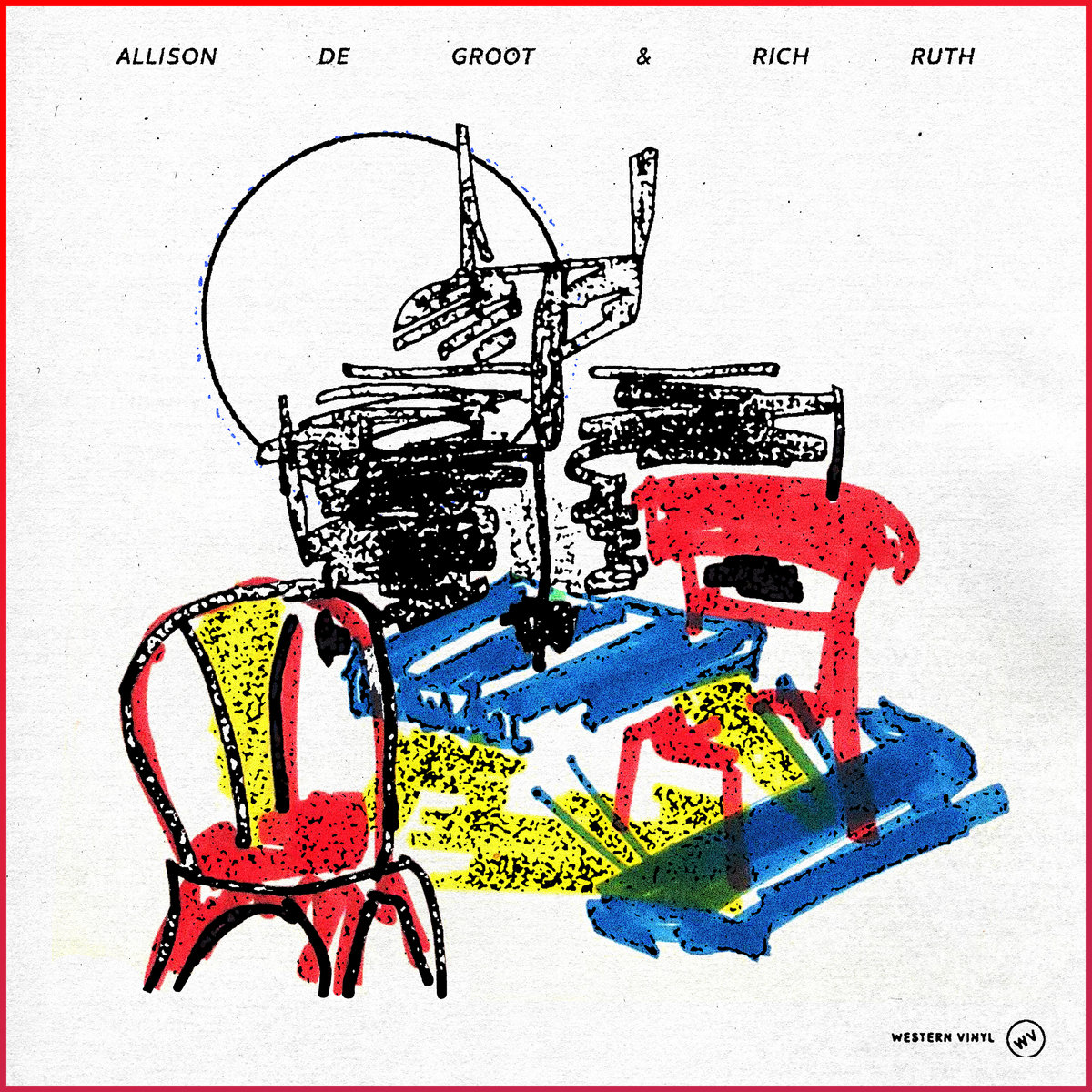
Sam Bradley: What are some things that influenced you early on? What is your relationship with that nowadays?
Allison de Groot: When I first started playing, I loved fiddle music, a lot of Irish traditional music and American old-time music, particularly from the South. Rage Against the Machine was also my favorite band in high school, though. I got more into Joanna Newsom then, who was also one of my favorites. When I look back at that kind of weird array of music, I feel like it kind of makes sense in the context of this project. Because I play traditional music and I’m Canadian, I’m from Winnipeg, I’ve never lived where the traditional music I play comes from. I liked these sounds, but it was never really part of my daily life. So I’ve always had to find my own way with the banjo. If I wanted to play consistently, I had to find basically any situation that would have a clawhammer banjo. For me at least, it’s not that crazy to do something like this, just letting the instrument create the sounds I hear.
Sam: I’ve spoken with a lot of folks about the rigidity of old-time and traditional music. Do you think that geographic distance freed you of some of that pressure?
Allison: I think I do just because of where I grew up and how I started playing music, but I definitely feel that pressure as well. I have taught at a lot of traditional music camps, and I go to traditional music events. A lot of my friends are from places with a strong traditional music history, like Virginia, and they play a very specific style. It’s also so important to keep those traditions going and to have people who are that rigid. I think it’s all part of the musical landscape: someone like me, rooted in traditional music but not regionally, and people carrying on the tradition locally as amazing players. It’s such a different approach, so I definitely feel that pressure, but I have accepted my place in the broader sort of traditional music landscape. I have a project with Tatiana Hargreaves, and our project feels very traditional to like 99.9% of people. But for the 0.1% who dig so deep into traditional music, it really isn’t. It’s the perspective for sure.
Sam: I’ll bring us back a bit. Michael, how do your pivotal influences stack up? Were there a lot of similarities coming into this record?
Michael Ruth: I think part of what makes this whole record interesting is that our backgrounds are so different. For me, when I think about the formative stuff that led me to this point, it all reinforces this idea of leaving any notion of boundaries at the door. That is an essential part of my creative process. Whether I was in college in my early 20s getting really into German music like CAN and Kraftwerk, or getting into minimalist composers like Steve Reich and Philip Glass, I think that’s part of the foundation of how I approach music in a very free-form way.
I spent a lot of time with Allison’s partner Patrick, who played fiddle on this album. He and I started hanging out, and I think part of our bonding was that rigidity you mentioned earlier. I feel like maybe he was at a point where he was searching for something a little more musically open. We started just getting together and making music for fun. I could sense it was a bit liberating for him because I think my view of music is so opposite of those forms. Whether it’s traditional bluegrass, classical composition, or old-time, they can have intense boundaries, which is also what keeps the tradition alive in a way people can keep interpreting it.
Sam: I had read how this was initially just going to be Allison’s solo record, but sort of morphed into this kind of collaborative thing. How intentional was that change, and how quickly did it come about?
Allison: I feel like it happened pretty quickly. I had all these tunes I’d written, and they were more in form, but ultimately I really loved Michael’s music after Patrick, my partner, introduced me. I could hear these tunes being a collaborative sound. I had more of a vibe, and I had no idea how to make that happen with these written-out tunes.
I asked Michael to produce it, and I quickly realized he was putting in so much creative energy, coming up with all these synth lines. I’ve been really into Laurie Spiegel; she’s a composer who uses lots of repetitive electronic lines that hit against each other in a really cool way. It suddenly became clear to me that the tunes were too much in form, and Michael kept coming up with really cool parts. It isn’t really what I was thinking of at the beginning, and that wasn’t even that clear. It’s morphing into a very collaborative thing. So we were just kind of like, “Well, let’s just make an album together.” My partner Patrick was super involved as well; we would all get together when we were both home from tours and stuff.
Michael: It was a very interesting creative process, I think partially because we didn’t really know each other that well beforehand. Patrick and I had become friends, but neither of us really knew what it should be when we started. I think we had ideas in mind.
The way I work on my solo records is that I love working with versatile, talented musicians and seeing what they come up with on their own. I don’t like to give too many boundaries. I’d make a synth loop or just a little sequence, four bars or so, and then I’d just record Allison playing clawhammer along with it. I’d take a two-second loop of it and start processing it through delays and things. We’d write songs around these motifs that I found inspiring and interesting. It’s a hybrid of experimenting with the clawhammer banjo’s hypnotically beautiful sound and building little worlds around her playing, so it’s not just aimless looping or experimentation. We could actually build songs out of it. After a few months of kind of seeing where all this stuff landed, I think it was just pretty clear that this probably sounds more like Rich Ruth music than it does when people think of Allison de Groot. It was very natural.
Allison: I’m thinking about all the tunes that I had thought maybe would end up on this record, and I think there’s only like one on there. Most of the other stuff was written at that time, sparked from this back-and-forth thing.
Michael: It took us a little while to find it because, you know, aside from a couple of reference points of records that we were passing back and forth, there really was no discussion before or during this of what we should try to make it sound like. The banjo is used so specifically in a couple different contexts. A lot of banjo records have an academic level of efficiency and that sort of approach. I didn’t want it to be like that.
Allison: I really appreciate that too, because I feel like the banjo has such a complex history and is tied to specific traditions. There are always expectations, but in this setting it’s so fun because I feel like I can just be like any other instrument. It doesn’t matter that it’s a banjo. It’s just like, “Oh, that’s an instrument that makes cool sounds.”
Michael: Yeah, and once we started looping it and putting it through stereo delay and things, it almost took on the role of an arpeggiator.
Sam: Just like the way the banjo is made, too; the drone string has this swelling, hypnotic quality.
Michael: Yeah, there is an inherently hypnotic quality to it. I think that’s always what I’ve been drawn to with bluegrass and old-time music. I’m such an outsider in that world, but when I played with Tatiana or was exposed to it, I always thought that was the side to expand on.
Allison: I like the word you used, swell. The banjo is interesting because the sustain is so short. You have to forcefully keep the rhythm going.
Sam: How important was that idea of potentially challenging banjo norms, particularly with clawhammer, when constructing this record?
Allison: I don’t really feel like I have an agenda for what I even want other people to think about it. I just feel like I love the instrument and I love the sound, and then I try to make music that I like the sound of. This is just what happened.
Michael: Maybe once we got rolling a little bit and found what it was going to sound like, there was some realization that what we’re doing with this instrument is a bit different. But I don’t think either of us were setting out to do that. I think it was just the natural evolution of the way Allison plays the banjo and my approach to what I find exciting about it.
Sam: What can you tell me about working under a deadline with this music? How does that change the open-ended creative process?
Michael: I think it was ultimately really good to have a bit of a deadline, because the nature of how we were making the album was really open-ended, very back and forth, and all three of us were gone on tour a lot. It felt like if we didn’t cut it off, it could’ve gone on forever, and we never would have finished it. We were both playing at the Big Ears Festival two years ago, and it felt like, “Well, this feels like a good time to just have the album finished.” We set up a separate gig where we basically performed the whole album.
That also forced our hands to attempt to play it live; it was very much not conceived that way. That is kind of how I do things in the studio; I’m just not concerned about how to play it live. I just kept telling Allison, “I don’t know how we’re going to do this, but we’ll find a way,” and we did.
Allison: I get caught up in the perfectionist mindset in old-time music. I feel like in my world it is very easy to go down that route of technicality, you know, not a ton of edits. You got to nail this very specific thing, and I feel like I was getting a bit into that mindset. Michael was just like, “No.” It felt really good to shut down that perfectionist side.
Michael: I don’t want to sound any kind of way, because I truly don’t mean this negatively or anything. I do think a lot of modern acoustic players have a kind of sheen. They’re so extremely talented and have probably mostly been doing it since they were children (laughter).
So I think there is this perfectionist thing; sometimes I feel like it’s a little too sparkly perfect, you know? That’s something I always want to steer away from with instrumental music in general. I think when you get to a certain degree or pedigree of musicianship, that’s just how it tends to sound because people are so good and care so much. You can lose a little bit of the grit of things.
Allison: I have a joke with our friend in Nashville, the great cello player Nat Smith, about the “Mikey approach” (laughter). I mean, I know everyone has complicated inner workings, but it just seems like you’re so good at just making music that feels very joyful and then you put it out, and it’s great. Whereas I tend to circle things in my head, thinking about how it could be better and different, and that wastes so much energy. I really struggle with that.
Stay on top of The Tonearm.
Subscribe for exclusive interviews, cultural tip-offs, and community fun.
And your support keeps our site free of advertising and paywalls.
Sam: I feel like I have talked with a lot of people about that, especially when we talk about what we consider a ‘solo’ album. I imagine it can do a number on that perfectionist mindset, having your name attached to something.
Michael: I think I have a parallel to what you are saying. For me, both this album and the Shrunken Elvis album have that because they are ultimately such collaborative efforts. Because there’s another voice, or more than just me, I feel less attached to the preciousness of it. I feel like I can move through it quicker. If it were just my record, I think I’d obsess about everything a little differently.
Allison: Oh, so the Mikey approach only works for collaborative stuff?
Michael: Yeah. You don’t want to see the Mikey approach on a solo record.
I will say, for this record, to my knowledge, there is nothing quite like it. I mean, not to sound like we’re special or anything, but I’m not aware of many reference points that sound like these two things put together this way.
Sam: That was actually something I wanted to touch on. We talked influences earlier, but more so of that idea of reference points. Did anyone introduce either of you to a reference point during the process?
Michael: We had reference points for, I think, the way that acoustic instruments and synthesizers and electronics work together, but not with banjo that I had in mind.
Allison: There’s The Horse Flies, an amazing string band from Ithaca, New York. I feel like they kind of made those sounds. There was some electronic stuff, but mostly I feel like they had this really wild, super repetitive groove that featured interesting modalities. But they are a reference point for me. Most of my reference points weren’t traditional music references.
Sam: I find this storyline sort of fascinating, really, just in terms of this much freshness and originality coming from folks who had never worked together. If you draw a parallel to other unfamiliar contexts in music, take a social thing like a bluegrass or a jazz jam. At first, the only familiarity people have is the songs, your “Nine Pound Hammer” or “Days of Wine and Roses,” respectively.
Michael: I think it was pretty new terrain for both of us. That’s what makes it interesting: I think we came in equally intrigued by one another and our respective worlds, which we also didn’t know much about.
Allison: I felt so lucky because I really had been wanting to do something with sounds like this. Working with somebody I fully trusted is nice. I trusted the aesthetic; it let me bring my world and my instrument into it.
Sam: It definitely feels like its own unhurried sort of world.
Michael: Yeah, it feels good in retrospect now that I have some space from the creative process and mixing it and stuff. Now when I listen back to it, I think the whole thing is a very pleasant space to kind of just sit in for 35 or 40 minutes. It’s not too rushed or too busy; I don’t think it challenges the listener too much, in a good way.
I always have this barometer where I think of my mom. You know, as soon as the weird part of an album would come on, she’d be like, “What are we listening to? Can we change it?” Sometimes I have this barometer through the music I make where I never want to be too far out that my mom can’t enjoy it.
Allison: My mom loves this album.
Michael: Yeah, I haven’t sent my mom the private link yet. I’m making her wait till it comes out. You got to preorder like everybody else, Mom. It was Bandcamp Friday last week; where were you?
Check out more like this:
 Chaz Underriner
 Sam Bradley


Comments