

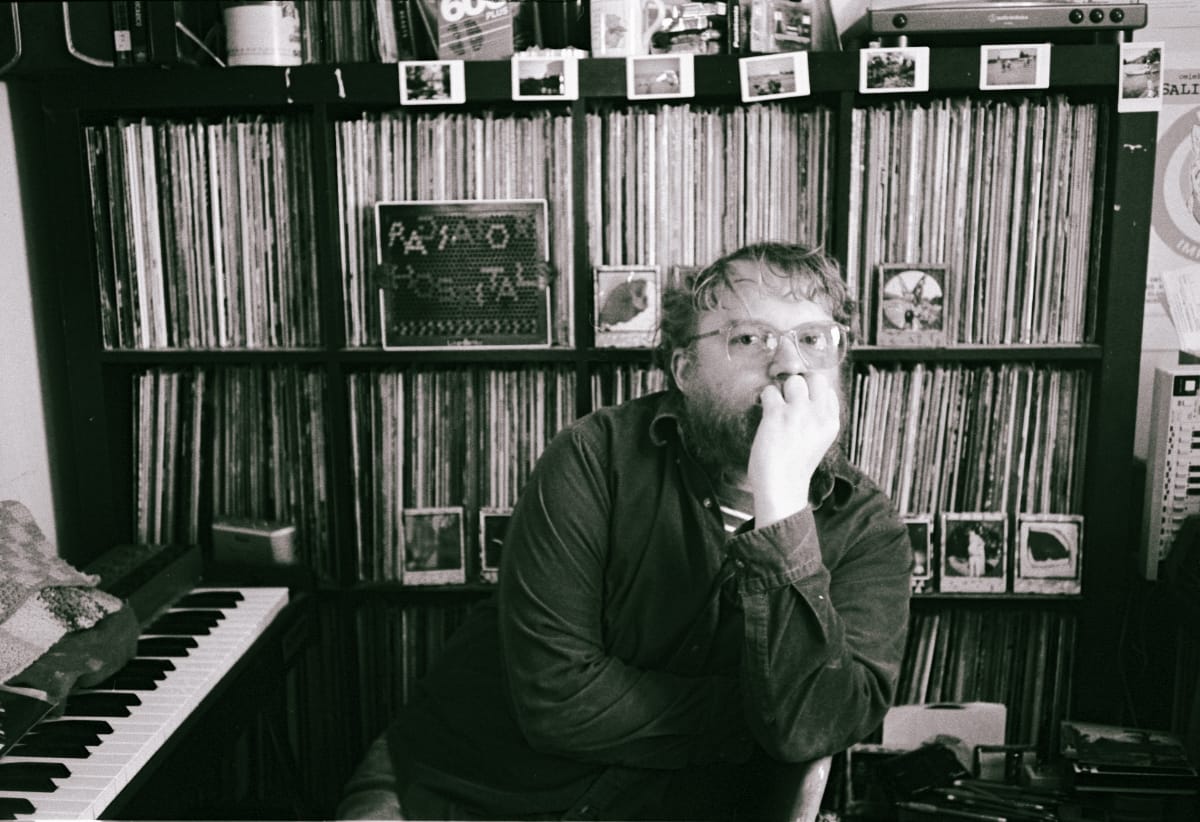
By the end of 2023, it seemed that Radiator Hospital were finished. After more than a decade of making music under the name, the last ten years with the same lineup, Can’t Make Any Promises marked the end of that era. Sam Cook-Parrott continued making music, notably with the Afterglows, but the idea of starting over with a new group, or turning Radiator Hospital into a traditional solo singer-songwriter project, didn’t feel right.
Then a tour changed his mind. Instead of putting together another band, Cook-Parrott recorded backing tracks on a four-track cassette machine and performed over them onstage alone. The experience not only gave Radiator Hospital a fresh way to perform live, but inspired a new album. Written and recorded between December 2025 and February 2026, Distorting Time returns to the lo-fi recording methods of Cook-Parrott’s earliest work while using them in new ways.
The album also finds Cook-Parrott looking in several directions: songs about composer Leo Ornstein and Big Nose George Parrott (a distant relative by family legend) dig into the past, while “Walk With Love” is focused on present events. Elsewhere, he turns inward, questioning age and longevity as a musician.
I spoke with Cook-Parrott about Radiator Hospital’s return, the possibilities of four-track recording, the quick process behind Distorting Time, the album’s theme of time, and his unconventional approach to live performance.
The transcript has been edited for length, flow, and clarity.
Carl Dexter: When I looked into your discography and recent history, it seemed that after 2023, Radiator Hospital had come to an end with Can’t Make Any Promises. But then you toured, and that idea of things being over seemed to change. What happened during the tour that made you think there might be another record?
Sam Cook-Parrott: So I started this as a solo project, and then I played with various people in a band for many years. For about 10 years, I had the same lineup, and that ended after our record Can’t Make Any Promises. After that, even though I knew I could technically do it as a solo project or even do it with other people, it had just been these four people for so long, so it didn’t feel right to do it with other people, and I didn’t necessarily want to do a solo singer-songwriter thing. Years went by, and I did other music and different things. I got asked to do a tour, and I was gonna do it by myself, just a guy with a guitar, singer-songwriter style, but then I did this thing where I had a tape machine playing a full backing track, and I would sing in front of it, which was really fun to do. It went really well, and it inspired me to make this whole new record. When I went on tour, I only did old songs (the backing track stuff was only old stuff), so I was really excited to make a whole new record with that style in mind.
Carl: Do you see a connection between Distorting Time and some of your earlier work from the early 2010s?
Sam: Yeah. Our first LP was in 2013, and I home-recorded about half of it; before that, I made a bunch of releases that way on cassette, so it definitely feels connected to that. When I play live, I use the same tape machine I used to record my earliest records. It’s cool because the music I’m making feels different, and I’m writing songs differently than I did then, but I’m using some of the same equipment, which ties it together in a cool way.
Carl: Do you think there’s anything you’re able to do in a four-track recording that you can’t do in a larger studio?
Sam: Yeah, certainly being able to do it on my own time without worrying about running down the clock of a studio. There’s that aspect of it. But I also love music, I love records, I love cool sounds, and experimenting on my own time is so much nicer than being on studio time. The thing about paying for a studio is you’re often trying to use this really nice gear to approximate some of these same sounds that you’d get with your crappy gear, with your demos. I love distorted, crunchy guitars, and a really nice mic and preamp setup won’t make that sound better than plugging straight into a tape machine.
Carl: Was there ever an idea that you couldn’t pursue because of the setup?
Sam: No, not at all. I mean, I’ve never really had ambitions to make music with an orchestra. And nowadays, people make stuff that sounds like a grand production on a laptop, so it’s really not that crazy. I recorded the sounds to tape, but we still used all the digital technology people use to make sure the record sounded good.
Carl: And as far as Distorting Time, you started writing and recording around December, and you finished sometime in February. What do you think this pace brought to the recording process?
Sam: It kept it fresh every day because I was literally doing it every day. I really wanted to make this record as if it were my full-time job: get up every day, write songs, and record them. The record was inside of me, and it needed to come out. You can do that over a longer period of time, or you can do it over a shorter period of time. The pace kept me from second-guessing myself because I was just going for it.
Carl: So it helped everything sound more cohesive too, I would guess.
Sam: Exactly. It’s being recorded as it’s being written, and I’m writing each song one at a time, but it does accidentally create cohesion. Some of my past records have been that way, too. I usually write in little bursts when I’m making a record.
Carl: Diving deeper, “Wildman Dance,” for instance, is about Leo Ornstein, who stopped performing in his 30s but kept making music privately on his own into his 90s. What about Leo, specifically, made you want to write about him?
Sam: I had read into his story a bit, and it really interested me. His peak of making music was in, like, the 1910s, and it was really out there for that time. Basically, no one understood what he was doing. It was pretty dissonant and weird-sounding music. Even just 10 years later, people were already embracing his style, but by then he had basically stopped. He had already turned his back on that kind of music. He did that in his teens, but then lived to 108. That was what fascinated me and made me think about my own life. Sometimes when I’m making my music I can feel like shit. My debut album was fucking almost 15 years ago—like, am I totally washed? And I’m like, “Wait, what if I actually live to be 100, and I’m still only at the very beginning of my music life?” I thought that was an interesting topic for a song.
Carl: And some musicians play for 40, 50, 60 years. I think the Rolling Stones have been playing for 60 years now. Maybe you are just at your beginning.
Sam: I really do think that. I always say no band breaks up anymore. And we’re still in the Rolling Stones album cycles; they haven’t even stopped putting out records and doing live shit and doing their thing. Who knows where my life could take me if I live to be that old?
Stay on top of The Tonearm.
Subscribe for exclusive interviews, cultural tip-offs, and community fun.
And your support keeps our site free of advertising and paywalls.
Carl: It’s fun to think about the future, but looking back, “Ballad of Big Nose George Parrott” seems to have a tough, dark history. How did you figure out what kind of tone you wanted for that song?
Sam: I was writing about a story from the Wild West, so it made sense to keep it as a cowboy ballad and make it an acoustic song. But it’s also half about the story and half about me and my life, so it came out naturally.
Carl: He was a distant ancestor?
Sam: I haven’t done a DNA test to prove it, but the story that was passed down to me is that he was a great-great-great-great uncle. But regardless of whether he’s related to me or not, I find the story fascinating—an absolutely brutal situation. I mean, his skin was tanned into a pair of shoes, and his skull cap was used as an ashtray—very Wild West/medieval shit.
Carl: It sounds brutal in a lot of ways. And another song, “Walk With Love,” was written shortly after Alex Pretti was killed in Minnesota. Obviously, a very terrible event. What encouraged you to turn that into a song?
Sam: It was just what was happening while I was making my record. I was watching the news like everybody else while this was unfolding, this horrible situation where first Renée Good was killed, murdered by these people, and there were some of the biggest demonstrations in U.S. history. Then, literally the day after that happened, Alex was shot and killed. I was in the middle of making my little fucking fun dancey drum machine record, trying to write songs about stupid bullshit, and I couldn’t ignore this awful thing that was happening. It really affected me and made me so sad that I didn’t want to write songs or make music.
But I understand the impulse other people had at the time to write songs about the situation in this book style, like, “We need to spread the word.” I thought of making a song about living day to day, people who are just watching the news and seeing this happen, and it makes them really sad.
When you have to go to work, and your government is unafraid to murder you in cold blood in the broad daylight, and you’ve just got to keep living your everyday life—it’s insane. That came out less like a protest song, less like an angry hardcore song about the fucked-up shit we’re living through, and more like it came from a place of my own sadness about it.
Carl: Did you find yourself thinking about the passing of time differently when making this album?
Sam: It was just interesting to me. I hadn’t made a record in a couple of years, but then I was trying to make one in two months, so I was distorting time in my mind. I was messing with the way time passes in my life. But I also thought about how I knew when I wanted the record to come out. I wanted it to come out in the summer so I could tour in the fall. Knowing those plans while I was making the record was also a funny distortion of time in my own mind. Once I started musing on it, I didn’t stop.
Carl: When you’re recording on your own versus playing live, what are the biggest differences that a casual fan might not notice that you’d encourage them to notice?
Sam: I recorded the album knowing I wanted to play it live in this particular style, with no musicians on stage other than me, and I’m not even playing a live instrument. It’s a fully recorded backing track; that’s the live version. I’m definitely deconstructing what a live music performance is, and what a Radiator Hospital live performance is, because I’m doing all these old songs, mixing them into my new songs, and doing them in this weird way. I hope that if you come to the show, you’ll enjoy it for what it is, and it’ll hopefully strengthen your appreciation for my songs.
Carl: When you say deconstructing the concept of what live music is, is there anybody that you’ve drawn inspiration from to help you in figuring that out?
Sam: Totally. Le Tigre is a big one. I was just watching the Le Tigre documentary and was struck by how cool it was that they did certain songs where none of them were singing.
Nowadays, many artists play live with just a sampler. My buddy Mikey, who I play in a band with called the Afterglows, does a solo project called The Goodbye Party, where he uses a sampler to play the track while he sings. All of that made me realize I could do my own version, and it also helps me emphasize the singing so I can focus on it without having to think about playing guitar.
Carl: I remember reading in the ’80s that Mark Edwards of My Dad Is Dead would come on stage by himself with a drum machine, and people were saying, “Where’s your drummer? Get an effing drummer!” They’d throw cans at him. But it sounds like nowadays people are a lot more open to how versatile you can be in expressing yourself musically. I don’t know if you’ve noticed a change.
Sam: For me, it’s based on my fear that that is going to happen. When I started doing this, I had that thought that someone was going to be in the crowd yelling, “Play the fucking instrument! Why are you just standing there singing?” But as you said, audiences now are way more attuned to that and have seen it way more.
I’m doing it with a tape machine. Most people use a sampler or a laptop, but plenty of people perform the way I do. Like you were saying, people are more open to all kinds of ways to express themselves, and nowadays, a lot of people make really produced tracks at home on a computer. They’ve never even played a physical instrument before, but they’ve produced fully recorded tracks, and they go live that way. I like that it’s something new.
Check out more like this:
 Jonah Evans
 Carl Dexter


Comments