


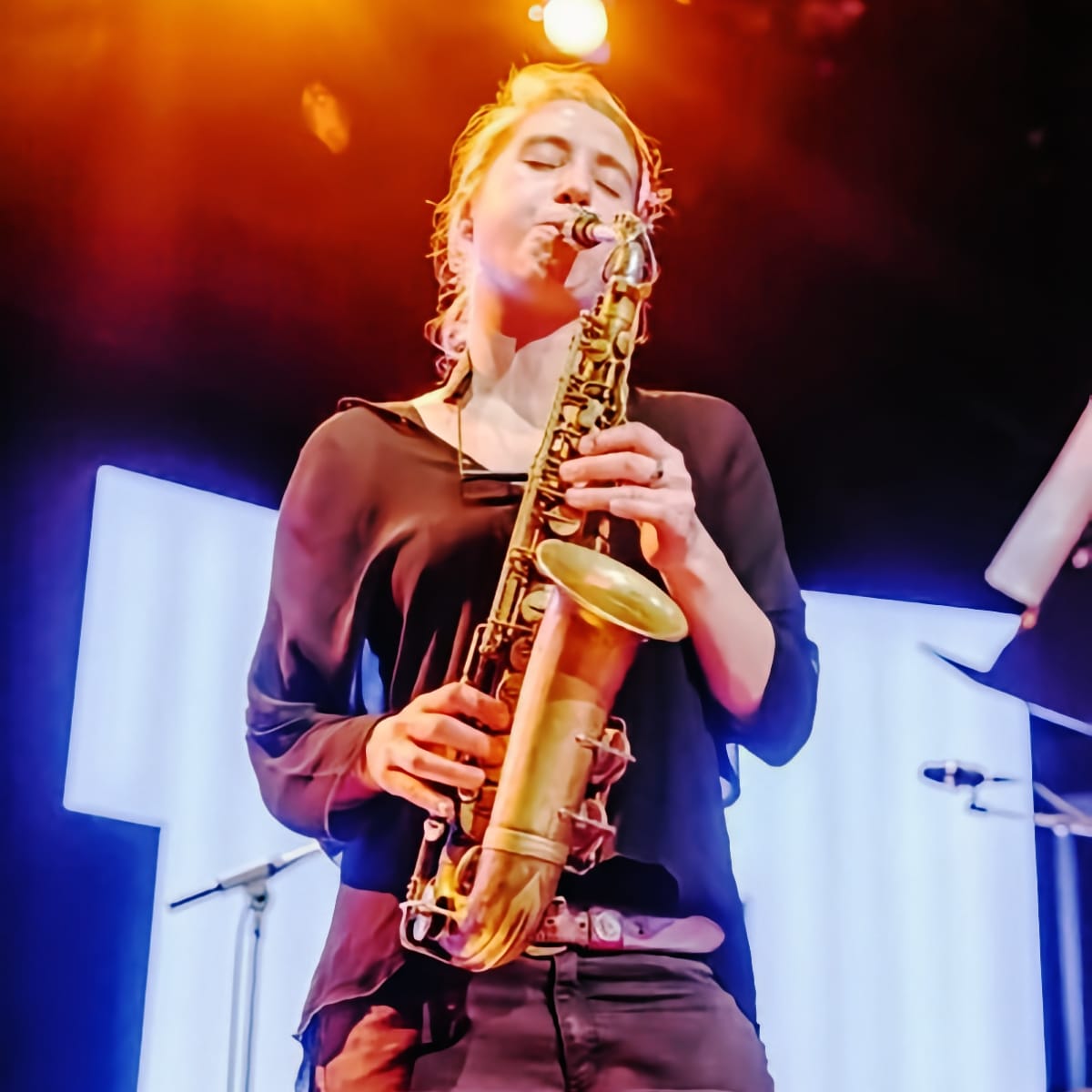
Charlotte Greve started classical flute lessons in Germany at eight and took up the saxophone at sixteen. She went on to study jazz at the Jazz-Institut Berlin and founded Lisbeth Quartett there in 2009. In 2012, Greve moved to New York, where she found that “nobody cares what you do. Nobody cares. You can just do what you want to do. You can experiment.”
In Brooklyn, Greve launched Wood River, an indie-pop-influenced band whose songs she writes and sings, adding synthesizer to her alto. She formed the trio The Choir Invisible with Vinnie Sperrazza and Chris Tordini, and she has played in the bands of Cassandra Jenkins and Laura Veirs. Her 2021 piece Sediments We Move, made with Wood River and the Berlin choir Cantus Domus, earned her Artist of the Year at the 2022 German Jazz Prize.
Waterbodies, out now on New Amsterdam, is her tenth release as a leader and the first under her own name. Greve wrote it while pregnant with her daughter. Shahzad Ismaily produced it with a cast that includes the vocal ensemble KHORIKOS and the Bratislava Symphony Orchestra. Improvised jazz, orchestral pieces, ambient drones, and ’80s-inspired synth-pop all appear on the album. The album’s sentiment is encapsulated in the song “Membranes,” which Greve says is about having “many different hearts in one breast, musically, and not only musically.”
Lawrence Peryer recently hosted Charlotte Greve on The Tonearm Podcast. They discussed the power ballads she grew up on, the trust she placed in Ismaily, tracking the record with a baby on the way, and the song that gave her the most trouble.
Listen to the full conversation in our audio player. The transcript has been edited for length, flow, and clarity.
Lawrence: First off, where did the love for ’80s pop and power ballads come from?
Charlotte: It’s always been there. When I was twelve, I had a cassette my mom originally owned. It was called Power and Soul, and it had Anita Baker, Whitney Houston, all these amazing singers. It was basically a cassette of power ballads from the late ’80s and early ’90s.
I was so into it, and I listened to it a lot, just this one cassette, and that’s actually true for a lot of my influences. There were certain records where I was like, “I’m just listening to this now. This is the thing.” So the music that’s coming out of my brain now, and that ended up on this record, accumulated over many years, starting from a young age. I went the jazz path through the school system, doing a bachelor’s degree in jazz performance and a master’s degree in jazz performance.
The music I played live with my own bands was very focused on that, and when that ended, I found different outlets to use those influences, but they didn’t have much space in the music I was making. So yes, they’ve always been around.
Lawrence: Maybe some of the obvious commonalities or traits of that music are certainly drama, melodrama, but also melody, a real commitment to melody. So it doesn’t surprise me that you wouldn’t abandon that.
Charlotte: It’s all very connected. I’m curious to hear how this record sounds to other ears, whether people can hear the connection, or if it’s more like, “This is not a record. This is just an accumulation of songs.” To me personally, it’s all the same, and it’s all so close to each other. The music is showing different faces of the same thing.
Lawrence: I don’t know if you said it exactly this way, but what struck me was that this record seemed to be not a culmination, but a really expansive view of your world, backward and forward and now. This is who you are and where you are.
Charlotte: Yes, exactly. That’s exactly how it is. That’s why it’s the most personal record I’ve ever made, and a very vulnerable presentation of where I am right now.
Lawrence: Were you previously more guarded or reserved?
Charlotte: I think I made nine records as a leader, and they were more one thing. Six records were with my first-ever professional band, Lisbeth Quartett, a saxophone quartet that played jazz, contemporary, and, some people would say, Euro jazz. That was the first place I found my voice on the instrument, the saxophone, and the first place I was really composing.
But that band is one thing, and there’s a certain thing that we do really well, so those records are in that vein. And then the other three records were also more just one thing. None of the records had my actual name, even though it was all my music, and that was a big part of it.
I wasn’t ready to say, “This is my name.” I always wanted it to be the band. It’s about the band. It’s about the project or the collaboration. Even the choir piece, the whole thing, obviously my name is there because I wrote the whole thing, but I was like, “No, no, it has to have this project name.” That’s just how I felt for all this time, and then I was like, “You know what? The next record is just going to have my name, and if it’s going to have my name, it has to have this whole array of things on it,” because that’s the most honest representation of what I think I am as a composer, as an artist, as a player, as a performer.
Lawrence: Tell me about the collaboration with Shahzad Ismaily. How did that come about, and what did it bring to this?
Charlotte: When I first had this idea of making a record like this that has all these different things on it, I was very aware of the danger of making it sound random and not connected, and I said, “If I’m doing it, I need someone who I trust fully to help me bring it all together.”
I worked with Shahzad on different projects over the last few years, where he produced another person’s project and I played in the band, or he asked me to do a lot of overdubbing for other artists he was producing. We played a bunch together, so we share a lot of music and a lot of the same understanding of how we make music and approach things. I feel really close to him, and I really trusted him with this record.
We had long talks. I sent him all the demos, and I was like, “Do you want to work on this and help me find a uniting thing?” He was up for it, and it was so helpful because I already had a clear vision, but he’d point out one tiny thing I would never have thought of. He would be like, “I think this drum machine needs this certain delay. This is what we have to do.” And I wouldn’t have heard it. I didn’t know that that’s what it needed. Something tiny, and suddenly, “Oh, my God, that’s the track.” So it was a subtle thing in every little moment.
We did the basic tracking, but hadn’t done any overdubs, and then we went back and forth. It’s like, “Okay, so how do we approach the next step of post-production?” And he would be like, “This track needs to stay, let’s say, fully acoustic. Think of overdubs you can do with more acoustic instruments that sound like synthesizers but aren’t synthesizers.” Stuff like that. Eventually, we did add a synthesizer to that track, with him playing the Moog. But it was taking these little steps together and finding points of connection between all these different songs.
Lawrence: Really what you’d hope a producer could do, right?
Charlotte: Totally. I think it’s one thing if it’s one body of work written around the same time and then you have a producer. But this was like, “Look, it’s going to be pretty contrasting moments, but how can we find some through lines sonically together?” I really needed his bird’s-eye view, sort of, so I wouldn’t lose myself in details or in, “Well, I really want this on this song,” when it wouldn’t have connected with the rest. So I was really happy to have him there.
Lawrence: A moment ago you used the word “vision.” In your vision for a piece, how early do you know what’s going to be saxophone versus synthesizer versus voice? Do you hear a melody in a sound, or do you have to go find the sound that matches the melody? I’m so intrigued by that.
Charlotte: It really depends on how I start the song, on how I start writing. A few of these songs, I would say at least four, came out of a challenge my musician friends organized to write a song every day. They did it for a whole week and asked if I wanted to be part of the group, and I said, “I can only do four days, but I’ll do four days of the week.” I wrote four songs in four days, and they’re all on the record. And every day I said, “I can’t do the same as yesterday. Today I’m going to start with the words.”
That song “Lighter Blue” was basically a poem, because I was like, “I want to experiment with having the words first and then see, by reading them like a poem, if I can hear a rhythm, if I can hear a melody in the rhythm.” So going that way, versus jamming on the piano or the keyboard and singing random lines, which I also do a lot, versus “I just want to play the saxophone in the most comfortable way I can imagine.”
The very first song on the record, called “The Well,” is me just playing the saxophone, many, many long tones, and that’s the original demo that’s on the record. That was late at night on this bench I’m sitting on in the living room. It was so late, and I had to go to a rehearsal the next morning, and I was like, “I have to do my song.” I couldn’t wake the neighbors, so I was playing pretty quietly. There were also some synthesizers. But it depends where I start.
Lawrence: I have to ask, though: you talked about those four days, a song a day. How much of the day is that?
Charlotte: Back then it was between one hour and seven hours, depending on the kind of day you have. I did it again now. Now I hosted it, and I had ten amazing people doing it, and we did only four days, because that’s how much I could do. Now I’m also a mom. I have a kid and everything, so I had to do everything very fast. But back then I didn’t have a kid, so I had more time, and I could spend many hours on it. And then you also record the song and produce it a little bit, as much as you can, and send it to everybody.
Lawrence: That’s an amazing exercise.
Charlotte: It’s the best. It’s very community-building, encouraging each other to show up and deliver something, and then you can draw inspiration from it. That song “Olive Tree” was also written in an hour and a half.
Lawrence: Well, the other thing about that is you don’t have enough time to second-guess yourself. If you have to send a quick demo to everybody, you’re just doing it.
Charlotte: You have to do it, yes. And I really need that kind of pressure; otherwise I don’t do anything. That’s how it is.
Stay on top of The Tonearm.
Subscribe for exclusive interviews, cultural tip-offs, and community fun.
And your support keeps our site free of advertising and paywalls.
Lawrence: Tell me about making a record while you’re gestating two things.
Charlotte: Certainly intense. It was really special. I think it’s in the press release: I told one of my close friends, “I am pregnant, and also, at some point, by the way, I want to make this record.” She’s like, “You’re making this record now. You go home now, and you’re calling the people that you want to go to the studio with.” And I was like, “No, there’s no rush.” And she’s like, “There’s actually a big rush, which is that you’re having a baby in a few months.” I’m forever grateful to her, because she was very right.
I did a bunch of overdubs and mixing and stuff later, but just getting the tracking done. And the thing that can happen in pregnancy sometimes, or what happened to me, is that I was very relaxed. It’s like your body is being told, “It’s fine. I can give birth. That’s totally fine.” So my brain was super relaxed and hyperfocused in the studio. Very focused. I could do things I couldn’t do before, which was really interesting, because somehow I was able to focus only on the music and not think, “Is it good? Is it bad?” No second-guessing, because again, not a ton of time. I just had to get this record done. That was an amazing experience. Also emotionally, because the baby’s already there, chilling.
We played the synthesizer and sang at once, and kept a lot of those tracks, which I normally would have redone. On the two songs Charlotte Jacobs is on—an amazing singer in my band—Shahzad was like, “We have to keep the live vocal from the live band tracking.” And we’re like, “No, but it’s not perfect.” He was like, “Yes, but the way you’re singing together with the band in the moment, in the studio, we have to capture that, and I don’t care if it’s not perfect.” And I was like, “Okay. I trust you.”
Lawrence: Do you have any sense as to whether the baby recognizes the music?
Charlotte: I mean, no. She’s just into music.
Lawrence: Isn’t that fun to watch through the eyes of your child, how they gravitate toward music? It’s incredible.
Charlotte: It’s so good. And she has very distinct taste. The other day she had a meltdown because she hated the record we were listening to, and we were like, “What’s going on? We’re eating. It’s all your favorite things to eat. What’s your problem?” At one point we’re like, “Do you not like this album?”
She does recognize me, because I had to listen to all the test pressings for the vinyl and stuff; she recognizes my voice, and when I play saxophone, she says, “Mama,” and that’s so nice. She likes the solos. There’s this track, “Membranes,” and the saxophone solo is at the end, and she would say, “Ofo,” which means saxophone. So I always had to scroll to the end of the song where the solo is happening. So she has very distinct needs musically.
Lawrence: Tell me a little bit about the relationship between the saxophone and the voice. Do you learn from singing, and vice versa? Obviously they both use breath, but I’m curious how much more there is to it.
Charlotte: They definitely help each other, I would say. When I started singing, I had to learn to stay loose. I’m still working on it. With the saxophone, the way I play uses a good amount of force, I’d say, in terms of breath, and a pretty hard setup: an open mouthpiece and a hard reed and all that.
With singing, you want to not push out the air. So it’s definitely been a journey to learn singing and to incorporate it into my practice. But musically, they’re so connected. I also sing a lot when I compose for saxophone. When I play saxophone, the feeling of the tone in my throat informs how I think about tone production, especially when I sing. Basically, I think a lot about how it sounds to sustain a single note, how it feels on the horn, and how it should feel singing any melody. So there’s a lot of connection there.
Lawrence: Does the singing breath originate from a different place physically than the horn breath?
Charlotte: No, they come from the same place, but on the saxophone the air comes out with more speed and more impact and more pressure than with the voice, ideally. But everybody has a slightly different technique, too, and I try to focus on the tone and what happens in the throat. So it really helps me both ways.
Lawrence: I wanted to ask you if there was a piece on the record that gave you the most trouble, or that you really had to work at, and what the trouble was. What does that kind of conflict look like for you during the process?
Charlotte: Do you have a guess which piece could have given me the most trouble?
Lawrence: I’m embarrassed to say, but I was going to say maybe “Own Lap,” because the solution was the orchestra.
Charlotte: No, you shouldn’t be embarrassed.
Lawrence: It’s a dramatic flourish.
Charlotte: It’s so dramatic. No, not that one. But that’s okay. It’s just interesting to me. The hardest piece of all time was “Desert Song.” And now you will understand why. Just notice a million different parts and moments. It’s like, “Okay, now I’m going to add this, and now I’m going to add this. And then this happens, and then we have a four-on-the-floor disco moment that then goes into a jam.” So many different things happening.
I was commissioned to write an evening-length program for orchestra, my band, and, in parts, a choir. A huge project that was really amazing to do, but I had never written for orchestra before. So I ordered a book on instrumentation and read it at my table, and kind of learned how to do this thing. I literally studied by myself with a little book and a pencil, going, “The oboe, the cello, the range.” Orchestration, instrumentation, the whole thing, arranging. I had done some of it at school, but not really, and definitely not for orchestra.
It was very overwhelming, but I did it. It was all done. It went well. I came home feeling so empty. I was like, “I can never write music ever again. I’m just dead inside.”
There’s a deck of cards by the songwriter and artist Laura Veirs called Kaleidoscope Creativity Cards. It’s for writers and for composers. And I was like, “I’m just going to draw a few cards from this deck, because I’m so empty I don’t know what to do.” But I wanted to write a new song for my band. And the card said, “Write a song that includes the desert in some way.” I was like, “This is crazy,” because I feel like I’m the desert. I feel so empty. There was nothing; no inspiration, no life anymore, just exhaustion.
At the time, I thought I was going to learn guitar, but I didn’t; I had my downstairs neighbor’s guitar, and I found this major triad. I was like, “Oh my God, I found a triad.” That’s how the song started, and then all these different parts happened. Then I brought it to the band, and it didn’t quite work, so I changed it and made a new demo. It was that kind of song.
Lawrence: That makes so much more sense now.
Charlotte: You’re like, “Oh yes, that one.” But now I like it. Now I’m just embracing the different moments and the eeriness of it and stuff. But making it was a pain.
Lawrence: Tell me about the sequencing, because I always find it interesting, especially in the creative music realm. To me, sequencing and narrative are the same thing.
Charlotte: The original sequence was different. This is, I think, the third version, the final version. It came to me one by one, and at first it wasn’t easy, because there are a bunch of songs that are quite slow, or ballad-y. But they ended up in different places, and it was important to me for the first statement to be the saxophone, a synth drone with mostly the saxophone on top.
That first song, “The Well,” is really what the name says. Everything comes out of that thing: how I play over a saxophone drone. That’s where all my music comes from, pretty much. Years ago, I wrote a piece called “Original Source” for my quartet, Lisbeth Quartett, and it also originated from a single, long drone.
In order to understand the record, I think the first song is the starting point for all of this other stuff, be it a choir thing, be it an orchestra, be it an indie pop–adjacent thing. It all originates in listening to one note and imagining melodies on top of that note. So it was really important to me to have that as the opening statement.
Originally, one of the orchestra pieces was the last song, and then I said, “No, it has to end with a saxophone-centric piece too, to bookend it.” So I put “Scorpio,” which is saxophone and choir, at the end, which feels kind of like an afterthought to me. After all this stuff, all these emotions, the big feelings and the rhythms and the busyness and the sparseness, it ends with a very contemplative afterthought of, “We did it. We watched the movie. We listened to the movie.” Because I think of the record a little bit as a film, where different scenes are happening.
Years ago, I watched a film, and I don’t remember which one, but I remember a scene of a person going through different rooms and opening doors, and behind each door was something super random, like goats. He closes the door, goes to the next door, opens it, and it’s just water. It was kind of a psychedelic scene, and this is how I felt about this record. Different scenes are coming and happening, and we’re in this world now, but we’re still part of the same movie.
Check out more like this:
 Carl Dexter
 Lawrence Peryer


Comments