


In the tangled networks of a great city, the telephone is the unseen link between a million lives . . . It is the servant of our common needs—the confidante of our inmost secrets . . . life and happiness wait upon its ring . . . and horror . . . and loneliness . . . and . . . death!!!
These words serve as a brief prologue—appearing onscreen with a suitably dramatic score—for the 1948 noir thriller Sorry, Wrong Number, following an overture that cleverly interpolates a telephone dial and a busy signal. The movie, directed by Anatole Litvak, tells the story of Leona Stevenson, a bedridden Karen who, through crossed telephone lines, learns of a murder plot. From the outset, we see charmingly antiquated elements: the anxious, outdated, buzzing pulse letting the caller know that a call can’t be placed because the phone is in use at the other end, for instance, or even the very notion of “crossed lines,” something altogether alien, no doubt, to many who grew up cellular.
Sorry, Wrong Number largely plays out over the telephone. Stevenson, played by Barbara Stanwyck (who was nominated for a Best Actress Academy Award for the role), is forced to try to piece the murder plot together from the bedroom of her posh Sutton Place apartment on Manhattan’s Upper East Side. Screenwriter Lucille Fletcher was nominated for Edgar and Writers Guild of America awards for her script, which was an adaptation of her 1943 radio play of the same name. Both the radio play and the movie are available on the Internet Archive, and both still have the power to excite and surprise today.
Fletcher’s film script is a bit bloated, however, overwrought, pumped up with complex backstories and flashbacks within flashbacks. The radio play, which starred Agnes Moorehead, is a 30-minute straight line. We only have Stevenson’s perspective, and her only interactions are on the phone. It’s often argued that novels are more powerful than movies because they exist in the mind. Radio is more insidious than either of them. It exists in the mind but plays in real time. There’s no time for rumination; it just whispers (or screams) in your ear.
A telephone call is a similar experience; words are implanted through the ear and form mental images. The eyes are free to wander, take in unrelated input, potentially allowing the audio information to be accepted unquestioned and unfiltered. Whether a murder plot or a loved one’s voice, the words exist somewhere between internal thought and external information.
Telephones have been valuable storytelling tools for about as long as the motion picture has existed. How many white courtesy phones have interrupted onscreen dinners? How many bright red hotlines have threatened annihilation? The telephone was the tool of the stalker’s adoration in Play Misty for Me and the longed-for means of resolution in E.T. The reporter, the kidnapper, the secret lovers, all rely on the telephone, or at least did, when modes of long-distance communication were fewer. And where does horror hide? The calls are coming from inside the house.
The telephone does double duty in composer Whitney George’s Eavesdropping. Like Sorry, Wrong Number, it’s a trepidatious tale played out through telephone calls. But Eavesdropping is also accessed by phone. The audience is on the stage, and the stage is in your ear. Unlike that earlier radio drama, Eavesdropping is nonlinear, ambiguous. And as opposed to Wrong Number’s half hour, Eavesdropping runs about 14 hours, with more to come.
It’s a good story, surreal, suspenseful. Once you get into the rhythm, it’s not that hard to follow—with the caveat that it’s about two people who don’t know what’s going on. Sometimes the plot advances quickly; other times it’s more like sound collage. But it doesn’t take long to get a feeling for the story. That won’t be included here, though. No spoilers.
Accessing the work is easy: simply call 646-594-1921, and you’ll be guided through a menu of episodes or offered an option to “enter the loop” and be dropped in midstream. I favor the latter. I cede control of the timeline and end up somewhere in the series of calls between Iris and Alexander. Figuring out where I’ve landed in the timeline isn’t always easy, especially since some sections repeat, sometimes playing underneath another one. There are extraneous sounds and a piano score that runs through most of it, but if the listener makes a sound, the call is disconnected. You’re supposed to be eavesdropping.
“When you are eavesdropping, you usually don’t get to start at the beginning of the conversation,” George said. “There’s this feeling of responsibility that, sometimes, eavesdropping can elicit in us, the difference between overhearing and eavesdropping. You move from the feeling of overhearing to starting to make judgments about the people and what you’re hearing.”
In face-to-face conversation, George speaks quickly, animated, dropping names and drawing parallels, touching on (among others) composer Luciano Berio, Mark Z. Danielewski’s labyrinthine novel House of Leaves, the films of David Lynch and Stanley Kubrick, and the immersive Shakespeare adaptation Sleep No More.
The seed that was fertilized by such novels and movies and music to emerge as Eavesdropping came to George at the beginning of 2026.
“I finally verbalized this thing,” she said. “I have done a number of large-scale pieces. The most recent one had been No Man’s Land [a Depression-era deal with the devil set in the Oklahoma Dust Bowl]. I spent two years writing the opera, and I really sold my soul trying to get people to come.”
Two years of writing plus two weeks of rehearsals for two performances led her to consider other platforms for presentation.
“I thought to myself, ‘What is the art that can and should exist without a start or stop time? That I don’t care if anyone shows up?’ I wanted to make an art that reconsiders some of the things that I’m really frustrated with, that felt like a bad relationship with a bad boyfriend.”

George started working with smaller installation ideas before her focus fell to her telephone. “I both love and hate my fucking phone,” she said. “I call it my ‘sadness rectangle.’”
The work was ambitious from the outset. George’s first draft involved 23 interlocking, hourlong conversations between a group of friends and acquaintances. But, she thought, “ultimately, snooze. A little boring. I’m not sure I would call back. ‘Not sure I would call back’ for your own piece, that sucks.”
Once the phone became a plot point for her, a storyline came with it. With Eavesdropping, George doesn’t break the fourth wall so much as she permeates it. Iris and Alexander sometimes suspect they’re being listened in on, but other sounds on the line suggest there’s a third party who isn’t the listener. There are other voiced characters in the work, as well as characters only referred to and characters that might or might not be there, all connected by telephone. Even the phone Alexander uses and the room it’s in are mysteries.
“The phone is an entity in the story,” George says. “It is the mover and shaker of the entire story. The phone is the reason that the two of them get together in the first place.”
As with opera, music drives the narrative. The piano score runs through the background for most of the series, sometimes clipped or otherwise electronically modified, cinematic études designed for a telephone receiver.
Appearing intermittently throughout the score is a recurring motif George calls her “Laura Palmer theme,” referencing the haunting and immediately recognizable music Angelo Badalamenti wrote for Lynch’s Twin Peaks. “It doesn’t have anything to do with Laura Palmer at all,” she explains. “I’ve never written a 14-hour piece before. You need themes, but you also need repetition. Repetition creates importance for us. The entire thing circles, but each episode also creates these tiny circles. It’s circular, but really, it’s a spiral.”
As a story told only aurally and existing in the mind’s eye, Eavesdropping is a radio drama. But it’s also an audio installation that has existed in actual, real-world galleries. Direct-line phones have been temporarily placed in an empty East Village storefront and at ThinkOlio Lighthouse in Brooklyn. It’s at its best, though, as a decentralized installation, with the listener alone on their own phone. Familiarity breeds consternation.
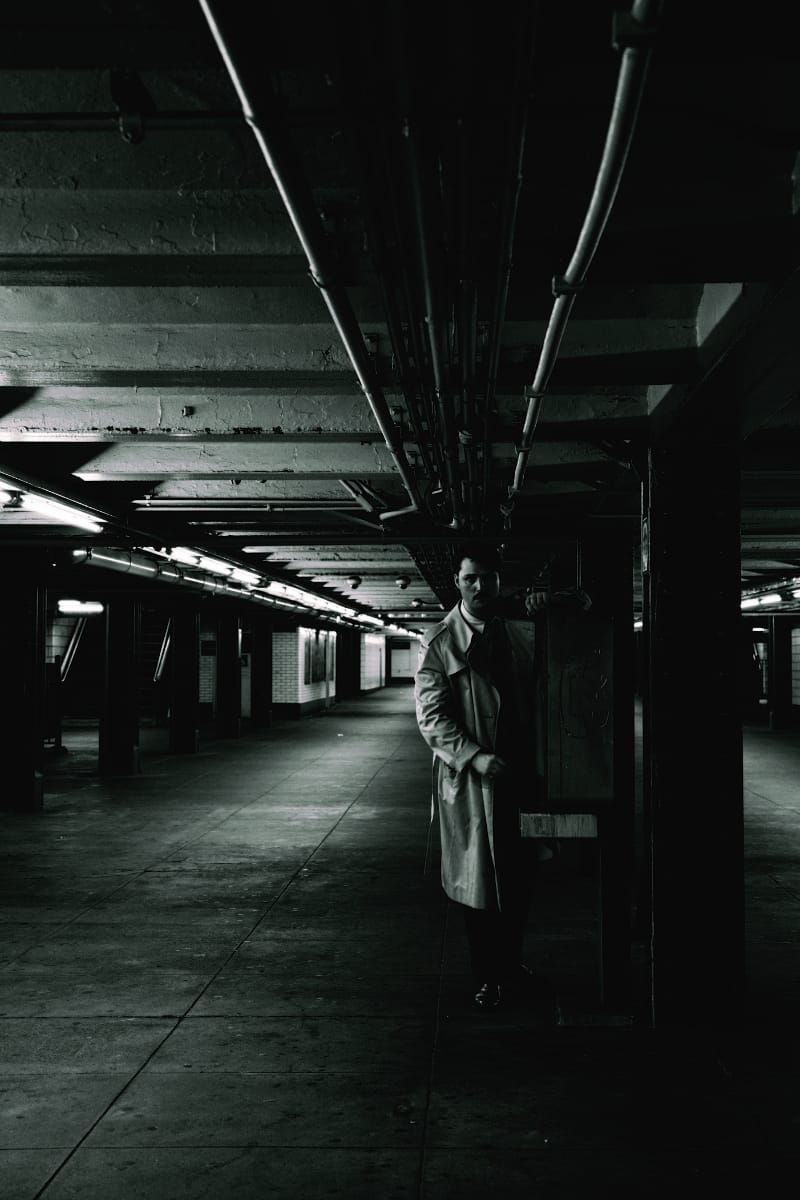
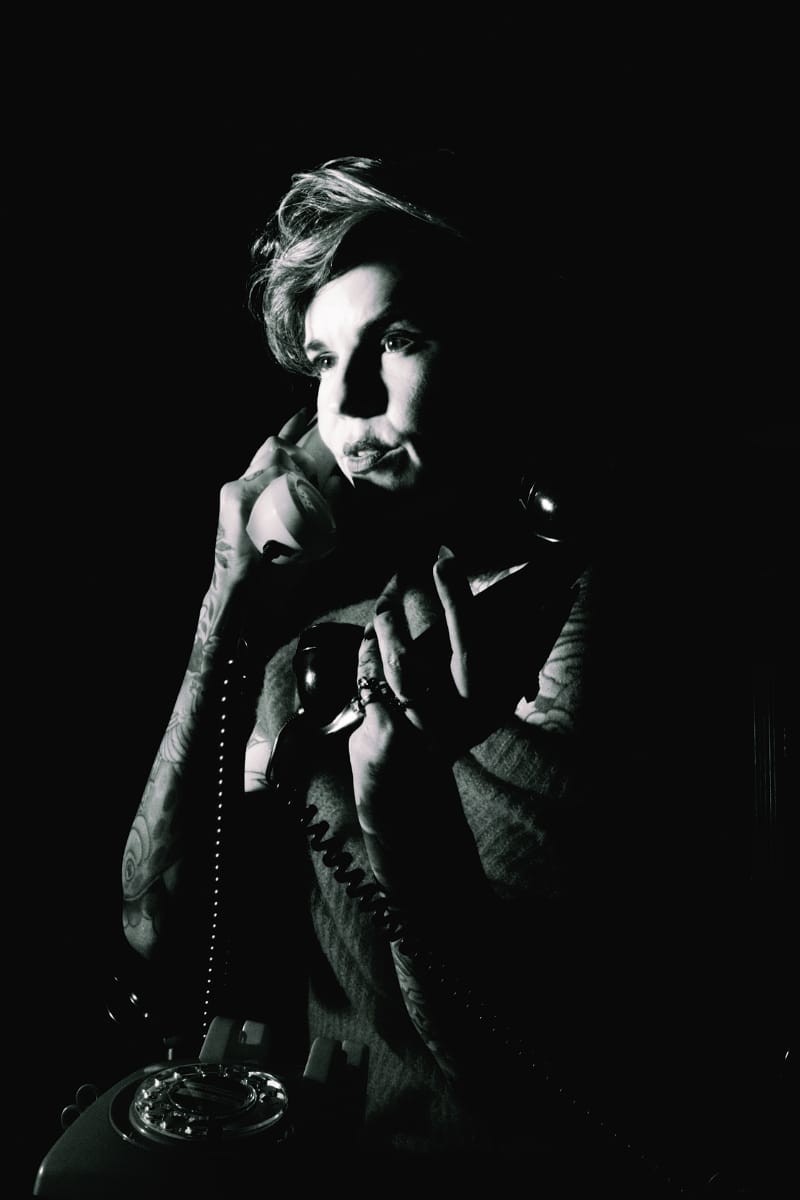
(L) Kyle Decker Pitts in the role of the mysterious Alexander Vail. (R) Whitney George listens in. Photos by Bennett Hoffman
For the most part, I’ve listened to Eavesdropping on headphones while walking the streets of New York. (Interference and signal drops create another, unintentional level of suspense.) But in the bedroom of our Upper Manhattan apartment sits a fire-engine-red telephone, on loan from George. It’s a prototype for a home edition of Eavesdropping, an effort to materialize the piece and monetize what is essentially an ethereal work. It’s a rotary desktop model, similar to the classic Bell Model 500 but of more recent vintage. Using the home phone, I’m drawn closer to the drama. Walking around with the story in my ears is fun—I tend to grow suspicious of everyone else on the street—but alone, with the base on a stand next to the bed, feels like the way the story should be experienced.
Wired telephone handsets were awkward. Callers were forced to give up use of a hand or pin it to the ear with a shoulder. Alternately, they could recline and craft a holder from a pillow to keep it in place. But phones also held the world. You remove it from the cradle, nestle it against your face, and disappear into a zone occupied only by yourself and the person at the other end. I still remember my first telephone number, when I got my own “teen line” as a birthday present, no doubt intended to free up the line we already had for the rest of the family. (I tried calling the old, central Illinois number I still think of as mine while writing this and, rather surprisingly, got a busy signal.)
Even earlier, as a child, I dabbled in telephone eavesdropping at my grandmother’s house in West Tennessee. The tiny town of Finley still had party lines. Multiple houses in town shared a physical line, something like multiple landlines in a single home. If your neighbor was on the phone, you couldn’t make a call. You could, however, sit on the floor by the telephone table and listen in. I never heard anything remotely interesting while eavesdropping on my granny’s party line. It was just the thrill of getting away with something. As George puts it in the recorded announcement that plays at the beginning of each call to her line, it’s all about “the forbidden pleasure of listening in.”
Stay on top of The Tonearm.
Subscribe for exclusive interviews, cultural tip-offs, and community fun.
And your support keeps our site free of advertising and paywalls.
There’s something quaint about eavesdropping on a telephone call in an era of automated surveillance, when bots can “listen” to phone calls, programmed to catch key words, when even our refrigerators listen to us. Maybe there’s something even comforting about thinking it’s only another person listening in, flesh and blood capable of inattention and errors in cognition. It’s kind of a sweet word, too, “eavesdropping,” dating back to the 1600s when someone could stand outside, under the eaves of the roof, and listen in on a conversation through the open window. It’s quaintly outdated, like the phrase “hold the phone,” which was used by switchboard operators asking a caller to wait while she (was it always women?) physically connected cables to allow the call.
While George’s Eavesdropping is a slow, suspenseful, somewhat dystopic piece of science fiction, it stirs recollections that are familiar, even nostalgic. The series, as it now stands, will stay on the line, so to speak, indefinitely, she says. Additional physical installations in NYC galleries are in the works. A second season is also in the planning stages, again with the phone in a pivotal role.
“The phone is the piece, and the piece is the phone,” she said. “It just didn’t make sense to me for the phone to not be a part of the drama.”
The drama is in the expectation, an “uneasy feeling that you may not actually be alone.” She drew a parallel to the unseen horror in The Shining.
“It’s like the Overlook Hotel,” she said, referencing the haunted locale of Stephen King and Stanley Kubrick. “It feels occupied and unoccupied at the same time. That’s what satisfies me about the phone alone in the room. It implies a sort of presence without requiring one. Someone could call, someone could answer, something has already happened there—or is about to. The object makes the room feel inhabited even when no one is physically in it.
“The idea of the phone alone in a room by itself is cool; that’s satisfying to me. That is the piece.”
Check out more like this:
 George Grella
 Carolyn Zaldivar Snow


Comments