


Jon Hassell gave up the ghost on June 26, 2021. When I heard the news, I wrote:
Now that Jon’s gone his music has a finite size and shape; there will not be any more new Jon Hassell albums. But within that finite collection of music there is an infinite space.
It turns out I was wrong. There is now, in fact, a new Jon Hassell album: Music Is Invisible, released on October 2, 2026. The album is a reworking of a live performance from 2015, described by Hassell’s label Ndeya as the third part of the “Pentimento Trilogy,” assembled and co-produced by longtime Hassell collaborator Jeff Rona.
I have questions. I’ve been listening obsessively to Hassell’s music for forty-five years since discovering Fourth World Vol. 1: Possible Musics as an eighteen-year-old student. I got in on the ground floor, and Hassell’s music and Fourth World concepts have been a guiding star for me ever since. In 2005, I got to know Hassell personally a little when we had an extended email conversation about many things, and he was kind about my music and visual art. In 2015, he played trumpet on the score I composed for the film The Trials of Spring. And in 2024, I released a sort of Hassell tribute album, The Apprentice to The Surgeon of The Nightsky (Fourth World Volume XVII).
I mention all of this to say that I have skin in the game. Which is why I have questions. Is this new album worthy of Hassell’s legacy? Is it truly the third part of a trilogy, or is that a marketing conceit? Listening to Pictures (Pentimento Volume One) (2018) and Seeing Through Sound (Pentimento Volume Two) (2020) are widely considered to be among Hassell’s best works, and are remarkable for their radical experimentation and expansion of the Fourth World concept, both created when Hassell was in his eighties. Does Music Is Invisible extend the ideas of the Pentimento trilogy into new terrain?
To answer my questions, I started listening to Hassell’s music all over again. And then I listened to Music Is Invisible quite a few times. And then I had a chat with Jeff Rona, the co-producer of the new album.
The transcript has been edited for length, flow, and clarity.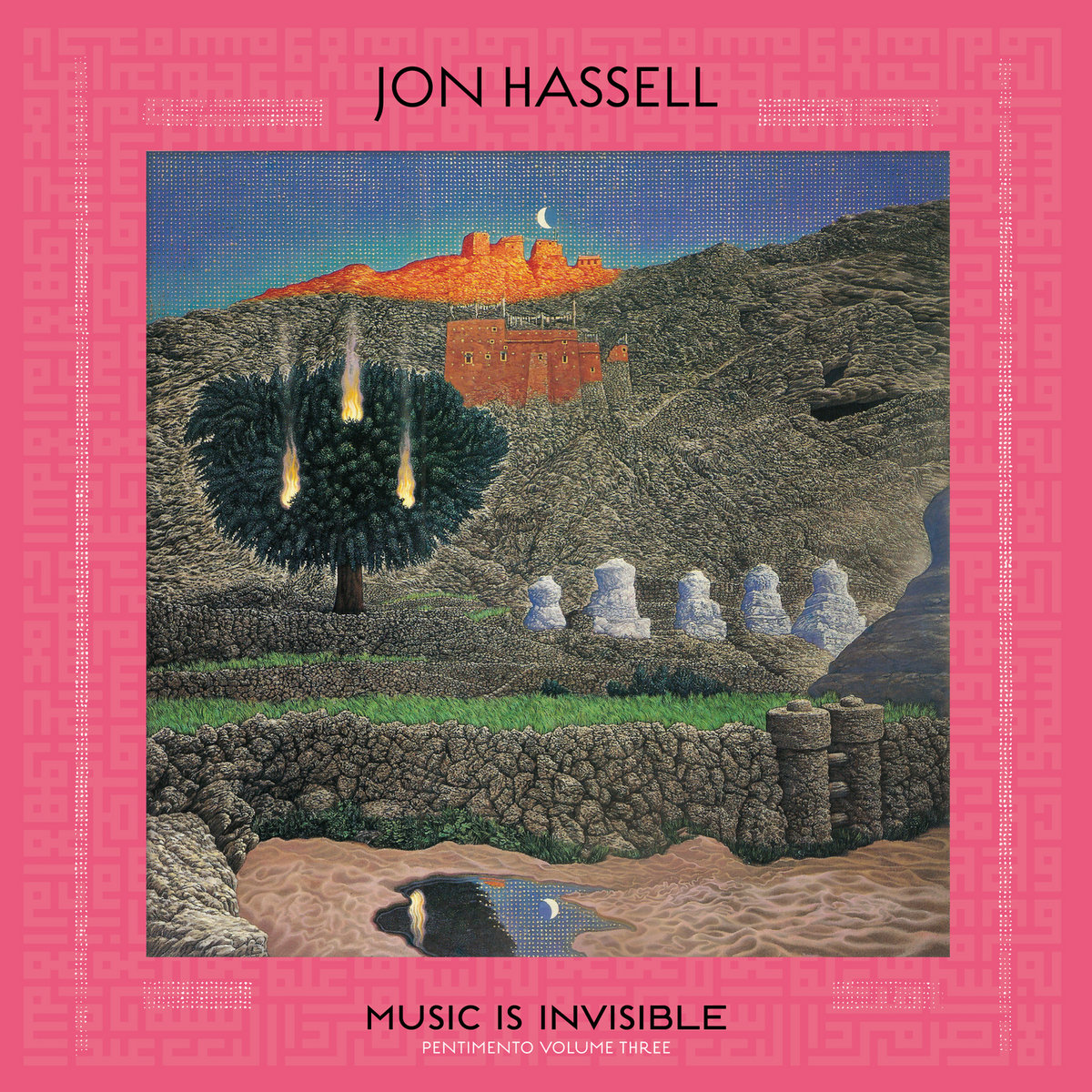
Blake Leyh: So when did you first discover Hassell’s music?
Jeff Rona: When I was younger Power Spot really got to me. I was very aware of him, and I found his music fascinating, but then a friend of mine introduced us when he moved to Los Angeles in 1989. I was a zygote musically. But I joined Jon’s band. I was in the band for a couple of years, which was an opportunity to really understand him and his process. We did an album called City: Works of Fiction.
Blake: Yeah, that’s one of my favorite Hassell albums.
Jeff: We would come to his house and jam. He’d usually have a little loop, one really trivial little idea, and then we’d jam on that. And then a week would go by, and he’d have us come back, and he’d say the parts that I really liked were here, here, here, and here. Expand on that. Then we’d have our next rehearsal. And we would do that for weeks and months. It was a process of experimentation, exploration, and filtration. Getting rid of things, building on things, focusing on things, leaving things, putting things in, leaving things out. It’s dozens and dozens of times, and by the end, suddenly you have a track for the album.
So we went to a recording studio in Hollywood called Group 4 and spent three or four days tracking the album. Then we moved to a mixing room across town and spent a couple of weeks mixing. At the time, I was listening to a lot of Lee “Scratch” Perry. I was into the whole dub culture; I was just fascinated with it. So we had all of these takes, but it all boiled down to eight stems, just rhythm and synths and trumpet and a few others, drums and guitar. After we’d done all this mixing, I said, “I want to try an experiment. Let me automate just these eight buttons, just the mute and solo buttons.” And I did a kind of a scratch thing of just soloing and muting for an entire pass. For four bars, just the drums, and then switch to the guitar, and then bring the whole band back in. And at the end, it ended up becoming kind of a cool part of the shape and density of the music.
Then Jon came back to my apartment in Silver Lake and the two of us spent the better part of a month rethinking everything. I had an early version of Pro Tools, and we brought all of his pedals, and his Eventide Harmonizer, and whatever plugins I had, and whatever tape delays, and gizmos, and we deconstructed the album one last time, and rebuilt it, and we took entire sections of tracks and ran them through weird, flangy things, and then edited it back in. So we did this kind of final step of exploring what interesting stuff we could do to finish up the record. And then the record came out on Opal Records, which was Eno’s label.
Blake: Is Jon’s trumpet treated as categorically different from all the other things on an album like City? Is it just one more element recorded with the band, or does everything else get put into shape and then he comes in and lays the trumpet on top?
Jeff: No, no. One of the things on City that I don’t think Jon had done before was that, during our rehearsal process, I recorded Jon’s trumpet mic through his pedals and everything. So I had these recordings that were identical to the parts that he was doing for each piece. And I would lay them out as samples across a keyboard. So there was Jon playing trumpet, and I was triggering these little trumpet moments. There are many sections in City where Jon and I do kind of a call-and-response. I would play little flutters, phrases, and bleeps, and then he would do his version. So it’s like a call-and-response between sampled Jon and live Jon.
So we learn that City: Works of Fiction was created in 1989 through a sculptural, collaborative exploration with a group of musicians, and then massively deconstructed and recombined using dub techniques, editing, and additional audio processing to create the final record. Hassell clearly worked this way more and more over the years. His first album, Vernal Equinox (1978), is plainly a group of musicians playing together in real time with the processed trumpet in front of the ensemble as a lead instrument. By the time we get to Seeing Through Sound (2020), the recognizable band, the human ensemble, has dissolved into a field of fractured musical splinters, granular shards of percussion, and twitchy skittering samples of unknown origin. Even the trumpet often feels like an interwoven spectral voice, rather than the instantly recognizable lead sound falling somewhere between an animal cry and a freight train horn.
I asked Rona about this evolution over the course of Hassell’s work, from a more traditional band format to an electronic landscape with less featured trumpet.
Jeff: When Jon plays in the band, whether live or recorded, he has his trumpet but he also has a little keyboard and he’s actually playing and triggering samples. He’s also triggering keyboard sounds, piano sounds, chords, and he’ll have different harmonies that are sampled. He was a samplist, but what he sampled was himself. He was drawing from decades of ideas where you’d have a drummer in a studio or a guitar player, a bass player, a keyboard player, or just thousands and thousands and thousands of hours of just Jon playing trumpet.
In the late ’10s, and by 2020, Jon started having health problems that became a substantial challenge to his trumpet playing. His plan was to create a library of Jon Hassell so that, as his ability to play trumpet waned, he could use that library. Which is why on the last couple of albums he’s often either triggering samples or he’s pulling from the archives.
So the idea that Hassell’s music became more deeply mediated by technology over time is true, but perhaps at the end not only for purely aesthetic or conceptual reasons. Although he always repurposed previously recorded musical elements, Hassell became more and more interested in sampling himself, digital manipulation, and radical sound experimentation over the last fifteen years of his life. By the time he created the Pentimento albums, he could make brilliant Fourth World music despite his waning ability to play live trumpet. In some sense, he achieved his earlier idea Rona described from the City sessions of “a perfect band made up of multiple Jon Hassells.” Hassell merged with the technology and became one with his archive.
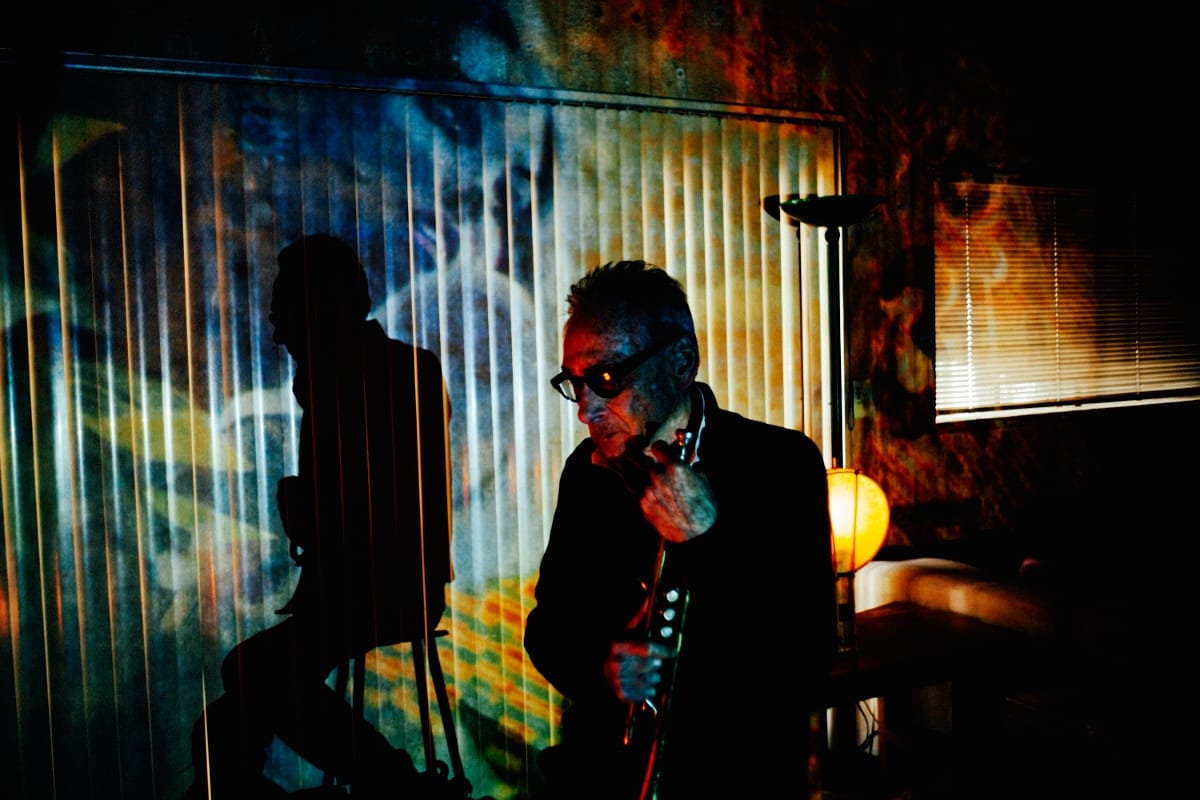
The concert that became Music Is Invisible was recorded in 2015 at Hackney Church, London, and is actually the last time Hassell played trumpet publicly. With longtime collaborators Rick Cox playing guitar, synth, and electronics, and John von Seggern on bass, drums, and electronics, they performed a concert that includes all of the classic Hassell elements. The instantly recognizable voice of his trumpet prevails over landscapes of granular-processed percussion, wah-filtered electric piano, and breathy washes of drones. If you know Hassell’s work, there are many samples and quotations drawn from earlier recordings. When the filtered talking drums from Possible Musics appear in the track “Electric Forest,” they sound the triumphant return of old friends.
On the opening track “Blue Ba-Ya,” Hassell’s trumpet initially sounds slightly tentative and fragile—not unusual for a horn player at the beginning of a live concert. Rona speaks of first getting involved with Music Is Invisible when Hassell asked him to repair a few moments of his live trumpet playing. That mission soon became a co-producing role involving deeper explorations and expansions, initially working with Hassell, then alone for the final rounds following Hassell’s death in 2021. On the finished album, Hassell’s trumpet after those first few phrases is confident and undiminished.
The second track, “Club Gris-Gris,” is a seamless extension of the Pentimento concept, and would be perfectly at home on either of the first two albums. A swampy, hocketed rhythm element is joined by dense electronic textures shifting back and forth to reveal other underlying elements. The ethereal harmonized trumpet joins, playing an oblique melody, then falls away to leave a middle section of shattered beeps and ticks. This music is pure Hassell, pure Pentimento, and it is glorious.
Side two opens with “Broadway Boogie-Woogie,” which has no detectable boogie-woogie, but does have a jazzier-than-usual harmonic groove and a repetitive drum machine pattern that feels like it wandered in from the 1980s. It all gets fed into the transmogrifier with the trumpet.
By the time we get to the fourth and final track, “Electric Forest,” Hassell and the band are firing on all cylinders. The swampy filtered drum loops ground us in the recognizable Fourth World; the drones are the sediment, the harmonic splashes keep us off guard. We’re escorted on a sixteen-minute journey through all of Hassell’s finest ideas. Fourth World, Pentimento, quotations from the past, sounds of the future, people and machines working together to make something unimagined but familiar. This track alone is worth the price of admission, and stands strong alongside Hassell’s best work. When it finishes, the following silence feels heavy.
Time is a loop, and perhaps it is fitting that the final entry in the Pentimento trilogy was recorded before the first volume existed. A man of great creative power lived his Fourth World ethos by combining his breath and his ideas through technology to make powerful, singular music that will stay with us forever.
Check out more like this:
 Lawrence Peryer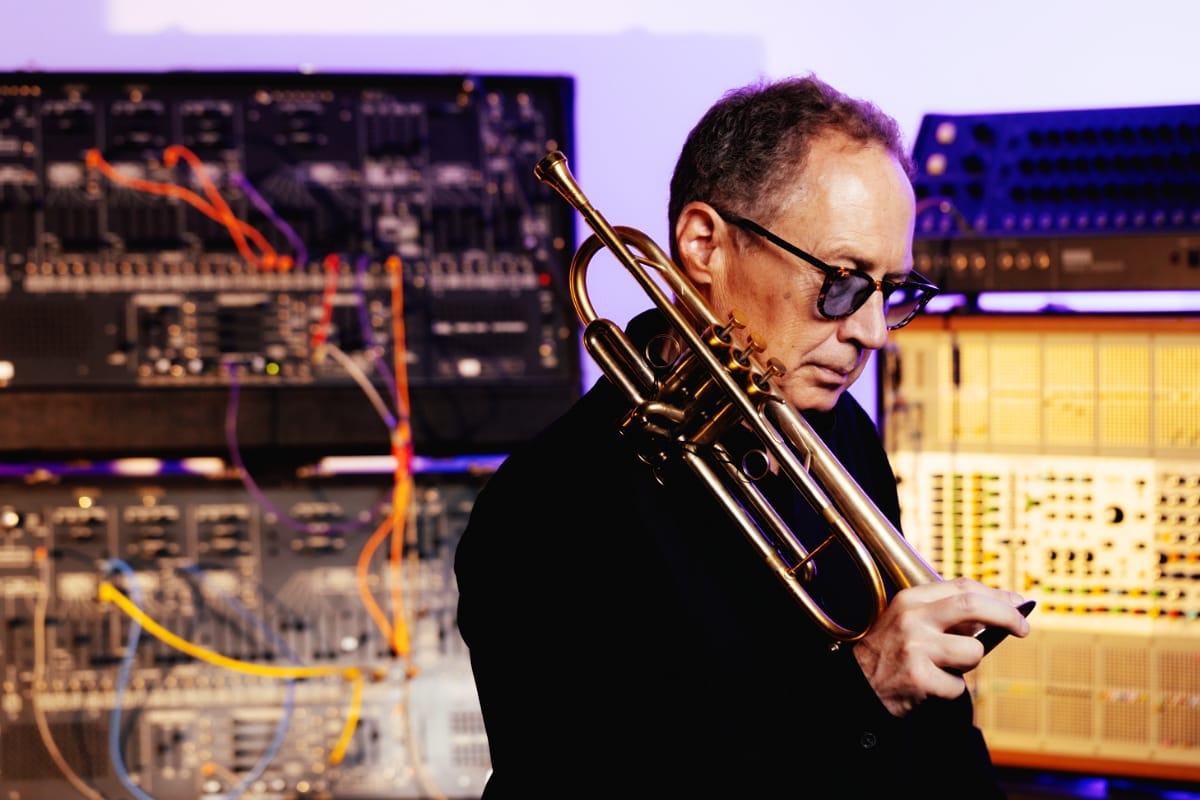
 Michael Donaldson


Comments