


There’s a desolation and solitude to the beginning of autumn. The sea reflects back in muted colors, mirroring earlier sunsets and moody weather. A tone develops, and the atmosphere presents distant pasts and speculative histories. This place is Liguria, a strip of coastline in northwest Italy. It is dotted by coastal caves, their vastness showcased in formations mimicking sharp teeth and bone. In friendlier terms, this fixed place is the Italian Riviera, with humans dating back to prehistoric times.
Jolanda Moletta presents this mystical geography as a canvas, a studio, a focal point to consider the feminine, the treacherous, the haunted. In May, Moletta released a series of compositions titled Oceanine, pieced together as a document of intersectional feminist collective memory. Sirens often work together in groups to make a point—here collaborators (and the roster is long) wield vocal solidarity for what harms, what resolves, what dreams.
Unveiled for the first time to an audience outside the confines of Moletta’s inner circle, an October-tinged short film to accompany the record. She also shares a few thoughts on a history of sirens, witches, and the occasional bird-woman. Appearing almost as a phantom apparition in conversation with the sea, here are some of the mystical histories of the lands inspiring the sounds.
The transcript has been edited for length, flow, and clarity.Carolyn Zaldivar Snow: What is something that makes you a siren in your real life?
Jolanda Moletta: I was always drawn to the idea of being a siren, and I often pretended I was one as a kid. I would spend hours swimming in the sea in summer, imagining I was living underwater, away from school, rules, and all the things I never really felt comfortable with. I recently reconnected with this archetype in a completely different way after researching the siren myth while making Oceanine.
One book that influenced me a lot is Sarah Clegg’s Woman’s Lore: 4,000 Years of Sirens, Serpents and Succubi. It explores the history of female demons and mythical women, including sirens and mermaids, Lamia, Lilith, snake women, and more, and how these figures have been portrayed and transformed over thousands of years.
After realizing how this archetype evolved throughout the centuries, I started imagining a different kind of siren I could identify with, one closer to the Greek mythological bird-woman who, through her voice, sings the truth and connects our world to the beyond. Perhaps that’s why some fear her, especially those in power who want to keep reality as it is and convince us it is the only world possible.
Carolyn: Did you grow up with any childhood fairy tales or myths from your region about sirens?
Jolanda: The fairy tales and myths I grew up with are mainly about witches. Liguria and Piemonte are regions where so many people, especially women, healers, and midwives, were accused of witchcraft and persecuted for their knowledge. The main period of witch hunts in Europe was between the 15th and 17th centuries, but those stories kept echoing until WWII; older people still have tales about the village healer who was believed to be a masca (witch), so when she was walking down the street, you had to hide, otherwise something bad would happen to you. They were often described as shapeshifters, using herbs and spells mixed into Christian prayers.
I came to sirens later, at school, when I started studying ancient Greek and Greek mythology. Interestingly enough, I recently discovered a small village in Piemonte, not far from where I was born, where there is a local legend of Maria Bissoula, a snake-woman in the fashion of the more well-known French Melusine. Water nymphs, snake-women, and sirens all feel connected to me, part of this same family of feminine figures associated with water, transformation, seduction, and danger.
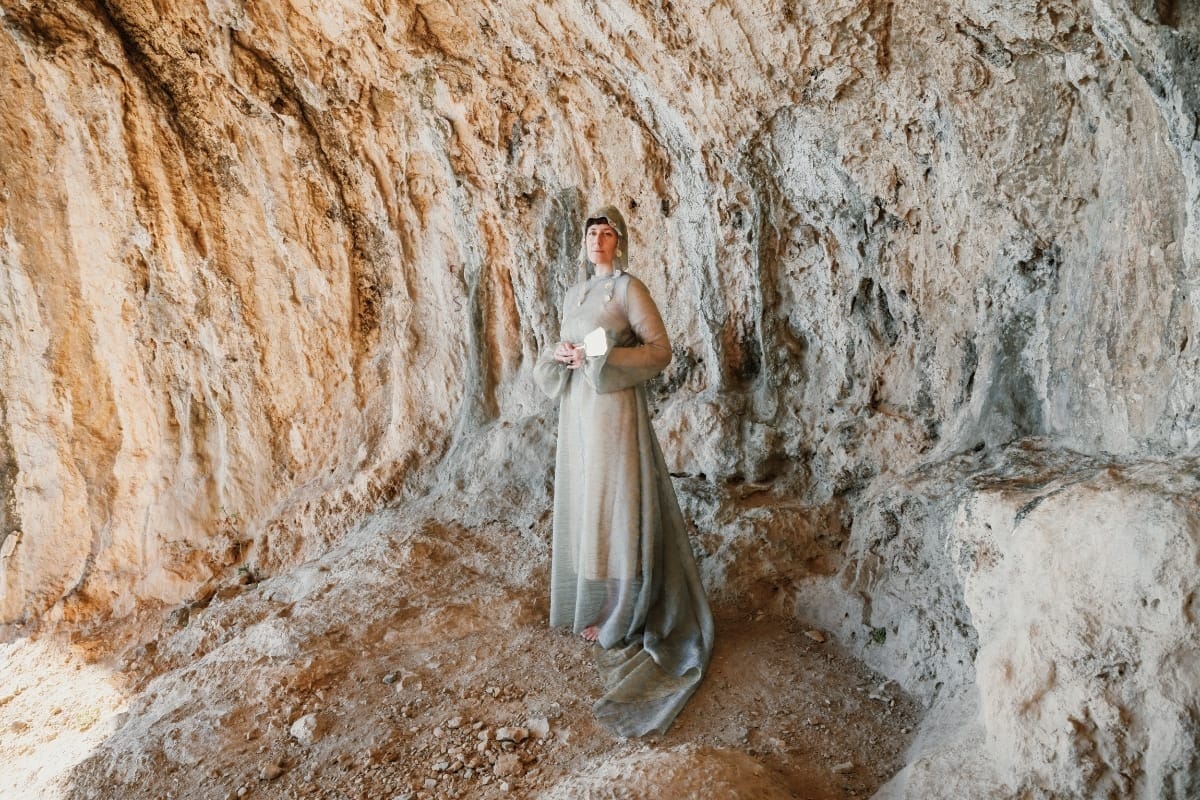
Carolyn: I really am taken by the worlds you build visually around your music. Your collage work, your short film, your use of muted palettes and wardrobe. I was reminded of The Color of Pomegranates as well as some coastal vignettes in Italian cinema—La grande bellezza, L’avventura.
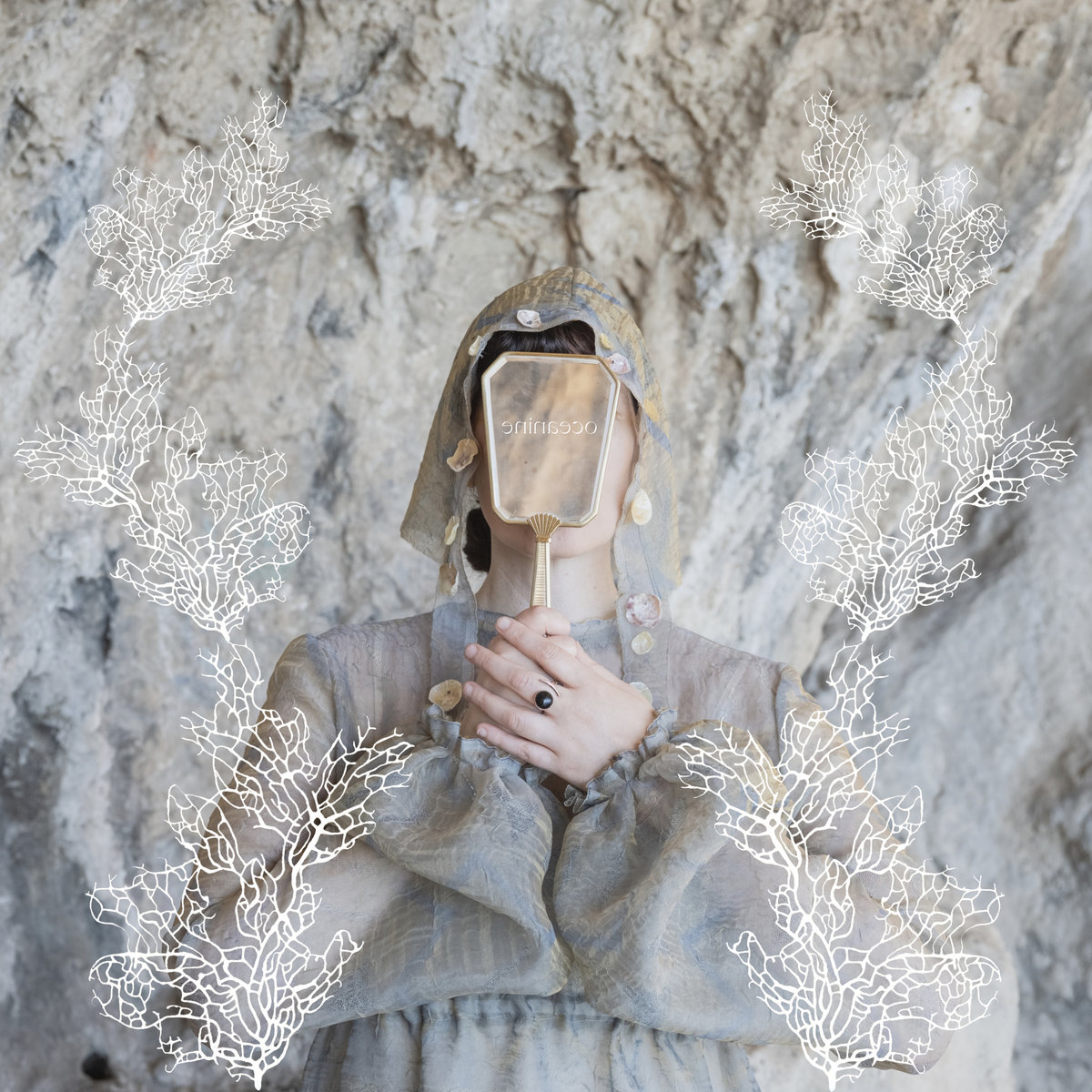
Jolanda: Since I started working on my solo project, the visual side has been as important as the sonic world. For my collages, I mainly combine pressed flowers and other natural elements with old black-and-white photos. I enjoy mixing found natural materials, specific fabrics, watercolors, and more. For example, when creating the dress for the film accompanying Oceanine, we found a fabric with the same color palette as the cave where we were filming. We were so lucky to find it, and we also added natural elements like limpet shells and abalone shells. When it comes to directing, I love experimenting with color palettes that bring me back to the films and aesthetics I love.
I consider The Color of Pomegranates a visual masterpiece. I discovered it relatively recently, just a few years ago, so I’m really happy you mentioned it. When it comes to Italian cinema, I love Antonioni’s atmospheres; they are so melancholic and enigmatic. For the Oceanine short film, especially when it comes to the color grading and the color palettes, one of my main references was Pasolini’s Medea. The locations, the cinematography, the costume design: everything is just perfect to me. It was a huge inspiration, both visually and poetically.
Another Italian film that inspired me so much over the last few years is Fellini’s Giulietta degli spiriti. The dream scene by the sea is incredible. The way color is used in that scene, the rich, velvety red of the old man’s gown in contrast with the blue of the sea, Giulietta Masina’s immaculate white dress and golden shoes, the almost unreal quality of the landscape, the characters whispering, exactly as in dreams, and Fellini’s omnipresent sound of the wind. That dreamlike suspension was something I wanted to bring into the Oceanine film as well.
Carolyn: How do you translate the visual sonically? How do you bring your caves and coasts to the listener in your sonic storytelling?
Jolanda: When I move from the visual world into the sonic one, I use writing, journaling, drawing, collage, and notes, trying to translate the images I’ve experienced into symbols and words. In this way, I create these kinds of symbolic maps that help me move from the visual into sound. My creativity is deeply connected to the visual world; every piece of music I compose feels like a soundtrack to a film that does not yet exist, except as a collection of images in my head, unfolding in the place where I composed or gathered the material.
Carolyn: What is it like to compose from a site-specific situation—for example, a bona fide sea cave?
Jolanda: It’s not like being in front of a blank canvas. Nature already gives you a background, a specific atmosphere, and from there you can start tuning into the place, its energy, a silence that feels completely unique, a specific light filtering through a tiny opening in the rocks, until something starts to emerge.
When I was composing, recording, and filming for my previous album, Night Caves, I had the chance to work in a series of ancient caves and get lost in those natural chambers. That album wouldn’t exist if I’d stayed home in the studio, fantasizing about being there. It takes time and silence to connect to a specific place, to what the ancient Romans called genius loci, the spirit of a place. In these caves, I deepened my understanding of how we, as humans, first began to create: by painting, expressing ourselves, leaving a trace, and connecting with the invisible. I came back to a cave in Liguria to film Oceanine, and I was immediately brought back to that liminal space where the mundane seemed to dissolve.
Carolyn: How does the sea speak to you?
Jolanda: I love sitting on the beach at night, when no one is around. The sea on a moonless night looks infinite. That’s when its voice feels louder. I also love it on a full moon, when the reflection of the moon on the water turns the sea into an obsidian mirror. I find it so comforting to sit there and let go, send all my emotions to the water, all my dreams and worries, and ask the sea to hold them for me.
Carolyn: How does it feel to exit a location as exquisite and mythical as the shoreline—then enter a controlled studio environment? Does it affect your work or creativity?
Jolanda: When I bring the raw material to my home studio, the work becomes more intellectual. I sit at the computer, open my DAW, and start thinking about possibilities. I always try to touch the raw material as little as possible, to be in service of it rather than imposing too much on it. The first part of the work is about inspiration and vision; the second half is more about arranging, layering, and mixing. Of course, I use intuition here too, but sometimes production is just technical.
Carolyn: What language do you compose work in?
Jolanda: My solo work is primarily composed through wordless vocals, rather than any specific language. It’s less about what I want to express intellectually and more about what the human voice can convey from that liminal world I was talking about before. It’s like having the most beautiful dream, and in the morning, only a feeling remains, something that we can’t quite express with words.
Check out more like this:
 Jonah Evans
 Carolyn Zaldivar Snow


Comments