


From the archive: this interview first aired on September 26, 2024.
Jazz drummer and composer Devin Gray timed Most Definitely, his first solo record, to his fortieth birthday in June 2023. He played twenty shows in the five weeks around the release, starting in Köln and ending in Portland, Maine, with stops in Athens, Lisbon, Fayetteville, and Denton along the way. The show was still on the road nearly a year later, when this conversation was recorded.
The album runs to twenty-three tracks and more than an hour of music. Gray sorted the pieces into soft, medium, and loud, then ordered them to his preference. His preparation list for the session included an “ASMR style” piece for drums, quiet finger and hand solos, punk-thrash grooves, false clave patterns, and what he called “Max Roachisms.” Some of the titles, among them “Bad WiFi,” “Doom Scrolling,” “Pull to Refresh,” and “Subscription Fatigue,” read like a phone’s notification screen. He credits Risto Pikkarainen, who edited and mixed the tracks, with having “blended and balanced my madness.”
Gray dedicated pieces on the album to Milford Graves, Ed Blackwell, Jack DeJohnette, and Tony Williams, and to two friends who died during its making, Daniel Levine and trumpeter Jaimie Branch. His liner notes open by asking what the world needs more of, and a few lines later he answers, “The world needs more listening.”
Gray grew up in Maine and moved to New York in 2006. He has played with David Liebman, Gary Thomas, Satoko Fujii, Marc Ducret, and Eve Risser, and All About Jazz has compared his drumming to “a cross between Fritz Hauser and Roy Haynes.” His debut as a leader, Dirigo Rataplan (2012), shares its name with his quartet, which included Ellery Eskelin, Michael Formanek, and Dave Ballou. Relative Resonance, with Chris Speed, Kris Davis, and Chris Tordini, followed in 2015. The quartet reconvened in 2018 for Dirigo Rataplan II, the first release on his own label, Rataplan Records. He recorded 27 Licks (2020) as a duo with the drummer Gerald Cleaver, and Melt All the Guns (2021) is a trio album with Ralph Alessi and Angelica Sanchez about gun violence in the United States.
Gray has released four more records since this conversation. To the Point, his quartet with the Belgian musicians Robin Verheyen, Bram De Looze, and Nicolas Thys, recorded an EP in Brussels. Ralph Alessi returned for Melt All the Guns II, this time with the French pianist Myslaure Augustin. Gray made Hz of Gold (2026) in Berlin with Andrea Parkins and Frank Gratkowski, a trio that has met twice a year since 2015. El Bronco, a duo album with the alto saxophonist Nathaniel Morgan, came out in October 2026.
Lawrence Peryer hosted Devin Gray on Spotlight On, the podcast now called The Tonearm Podcast. They discussed his Maine childhood, his conservatory years, the scenes he found in New York and Berlin, and the electronics, samples, and spoken statements he added to the live set. Listen to the full conversation in the audio player. The transcript has been edited for length, clarity, and flow.
Lawrence Peryer: What was the appeal of the drums? How did the family know you were into drums? Were you listening to pop music, or were you one of those kids who started banging on the Tupperware?
Devin Gray: A little bit of banging on things. But the really fun part about my town and my neighborhood is that I grew up on a little hill, and down the hill there was a big barn where this older drummer would play. He would have rehearsals, and we could hear it from our house, which didn’t bother me at all but may have bothered the neighbors.
There’s a house above ours, and they could hear him. He went on for a lot of years, and then he eventually moved, and then I started playing drums, and those neighbors heard all of that. So when I eventually moved out, and there were no drums there anymore, those neighbors were finally like, “Okay, now we can be friends with your parents,” because all the drummers were gone.
But to answer the question more directly, I remember hearing that sound from outside the house and being like, “Wow, music in the air.” Being in Maine, it’s kind of quiet, so when you hear a melody or a sound growing up, it sticks out. I immediately gravitated to it.
Something about the sound of the drums coming out of that empty space—I was just like, that is what I feel. I remember a couple of other occasions with friends of friends who had drum kits in the basement, and every time I was just losing my mind because of the sound. It’s the coolest thing. You can get your body to move and make cool sounds like this. I was like, “Yeah, I can do this for the rest of my life.” And I’m trying to. (laughter)
Lawrence: So when you got to New York, what was the New York you arrived in? What was the state of the creative music scene then?
Devin: I moved to New York City in 2006 from Baltimore and lived in a basement. There was a lot of music happening. I didn’t want to limit myself to this or that. With a lot of free jazz players, especially in Europe, this happens a lot, where they’re like, “Oh, it’s free jazz.” And I don’t really like putting free jazz in a box.
Lawrence: As if there’s no room for composition.
Devin: Exactly. Again, that’s putting borders around things, and I’m just not interested. New York is a magical place to experience many different types of music. If you’re crazy enough, like I think I might be, you try to play all that music, not limit yourself to uptown, straight-ahead jazz, which I love and is beautiful. We also go down to the downtown scene, and there are all these different histories. And it’s all cool.
For me, especially back then, it was about absorbing and learning more. It’s not that I had some teacher saying, “This is what you’re going to do,” or “You’re going to be successful if you do this.” No one ever did that with me, so I think it’s been hard. But I also pride myself on that, because I am open to all these things.
Lawrence: Talk to me briefly about your relationship with Berlin.
Devin: I first went to Berlin in 2006 on tour, which was right when I moved to New York, so that was a crazy time to be there. I remember walking around before the gig and being like, “What is going on here?”
In 2012, I think, I started subletting in Berlin. That just fast-forwarded to going more and more. Now I’m commuting between New York and Berlin. I started playing gigs within the scenes and meeting all the people—Germans, Europeans, everybody from everywhere. It was like, “Oh, this feels kind of like New York,” where everyone’s from everywhere. Also, they fund things, and that keeps the movement going. I’m not talking about just getting paid. Every scene has a lot of activity, and it’s beautiful to see the arts supported in these societal, governmental ways, which—full disclosure—I’d like to see more of in the United States.
Lawrence: I speak to a lot of artists, both from the States and from outside, and it’s so stark. Even if you just wanted to apply for a grant to make an album, you can do that in certain places. I know there are pockets around the country with private funding or regional arts groups, but it’s the exception to the rule here, and it’s really tragic. You have to make your own universe. You have to constantly work and create your own thing, because it’s not sitting there waiting for you.
Devin: I first went to Europe twenty years ago. In 2004, I left the US for the first time specifically to go to Europe for music, because I’d met a Swedish friend in Baltimore when we were studying, and he said, “Yeah, come over to Stockholm and check it out.” It’s like, “Oh, we need a bass amp for the band. Okay, just write a little letter.” A week later, you’ve got a bass amp. And I was like, wait, what is this? My brain was upside down. Here I am raking blueberries at my grandfather’s farm in Maine to buy a cymbal—that’s true—and these guys are like, “Yeah, that’s what that money is for. That’s why we pay taxes. That money goes back to the people and does something for them, and they see it, and that’s why they’re cool with it, because it helps them.”
The European support starts in academia. I see a big disconnect with the US way of thinking about learning, where we’re learning all this stuff that isn’t functional by the time you finish. It’s not always like that, and it’s probably changed. I know the Manhattan School of Music specifically started an entrepreneurial class, and they have a teacher saying, “This is how you open an Instagram profile. You might need to learn how to do that.” It’s behind in one way, and in other ways, with the music, every place is a little different.

Lawrence: Let’s talk about your album Most Definitely. Beyond the music, what really struck me was how much supplemental material there is. You wrote a fair bit in the liner notes and artist statement. One thing I wanted to ask you about, because it comes up a lot, is sincerity. I’ve often seen you use that word in response to interview questions about your approach. What does sincerity mean to you? Is it in opposition to irony?
Devin: I think I’ll link the sincerity thing to the title, Most Definitely, which has a lot of different implications. The truth is, in some sense, I can be a very dry person. I don’t want to say bullshit or whatever, but I want to be as honest and pure as possible about what I am most honest and pure about, which sounds kind of silly. I very much mean this: artistically, I’m searching for a sound and a feeling that is not easy to find. It’s not easy to grab. It’s not easy to replicate. It’s not easy to make. It’s very slippery. The goal of Most Definitely is to play that unknown with the most definitive form of commitment possible in the moment. I don’t know what it will be, but I do know that when it’s happening, that is most definitely what I want, and I most definitely mean it.
I’m sorry to frame it like that, but it’s very serious. It needs to be at a standard above my standard, pushing myself higher than myself. I’ve been using a bit of a religious connection these days, where music is basically my religion, whatever that means to you. The music needs to be on that level, just beyond what I’m able to do. I have to be so in there. To do that, sincerity has to come from a place of love. It has to come from a place of compassion. It has to come from a place of understanding. A place of awareness comes to mind, too—global awareness.
People look at my tours and ask, “Why are you doing so many dates in a row? That’s insane.” And I’m like, yeah, but I can allow myself that space to try to dig deeper into what I just described, which is the core of the purest artistic expression I can personally come up with. I know this is getting into the heady stuff, but it’s honestly how I’m thinking about it. So it’s a big challenge, and I like it, and that’s one of the reasons I’m doing this project.
It’s also one reason I still practice all the time and keep working on these things, because I’m trying to get to something. I have something I haven’t been able to express yet in my other projects. I love them all—the people, everything’s great. But this one is very personal in a new way and challenging, and I want to allow myself to accept that challenge and keep going into the unknown.
Lawrence: I was struck that it comes back to sincerity, because you can’t necessarily read tone in the written word. You overlay tone. I left feeling a real need in the person writing the artist statement. You were looking for a connection. You were looking to be heard. You hoped the listener would understand at least a bit of what you were trying to convey.
Devin: Thank you. I think anyone willing to take this music seriously—and not just music, but art and expression and the truths in these human expressions—is valuable. Every listener is very valuable. And I think it’s a very delicate process to make art. Maybe some of what you were reading was me being vulnerable to the fact that I’m putting out a solo drum record. Even last night—I played in Brooklyn last night—I overheard someone as I was setting up: “Oh, it’s like a drum solo,” you know? And it was funny, because in the back of my mind I was thinking, oh yeah, it kind of is what I’m doing.
Lawrence: It’s a little absurd.
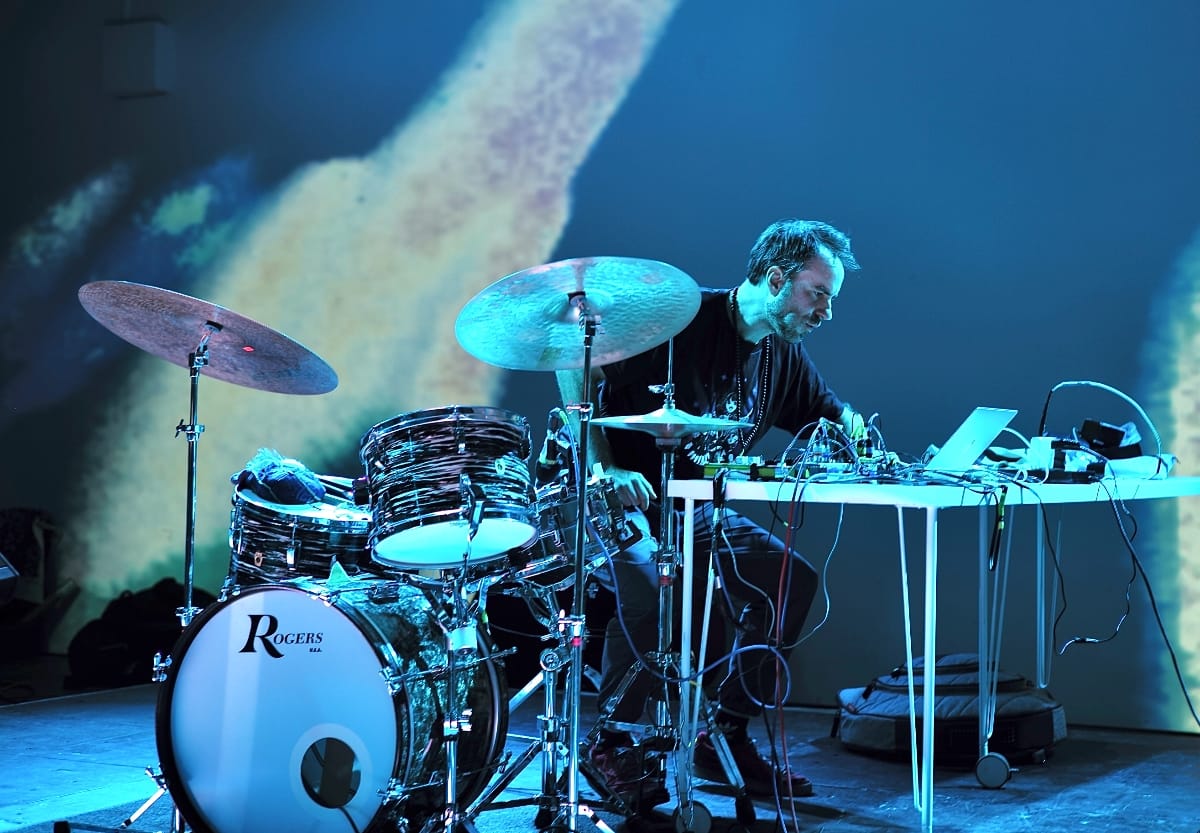
Devin: It is. I’m also working with a lot of other influences, especially in a live setting, and that gives me fuel every day to keep doing a solo drum performance. I’m not just playing acoustic drums. I have samples. There are things and statements I want to share. I have activist interviews from the ’70s, ’80s, and ’90s. I have Sun Ra clips. I want people to hear these, too, in addition to this whole process. So it’s not just me playing drums.
With technology and the little setup I’ve been designing, I’m kind of like, “I’m just DJ’ing.” Here’s the DJ part. And here are some different things I’m broadcasting that I can’t do with just the drums. I can imagine them. I can think of them and transmit them metaphysically, and I feel really good about actually performing and delivering them.
For example, gun violence. I have some segments with statistics on gun violence in the United States in the last couple of years, and I’m just pressing play and improvising with it. It’s not that I’m playing the rhythms of the guy talking about it. That’s cool; people do that. But on a sociological level, I’m sitting there saying, “This is not Fox News, but this is my news, which I truly, sincerely believe in and can broadcast.” It’s an honest expression I want to deliver to audiences, which is another reason I’m doing this project the way I’m doing it now.
Lawrence: You made another statement about why now to make a solo drum recording and do this work live. You said something to the effect of it taking you all this time to face the situation truthfully. That was a real humdinger of a statement to me, and I wasn’t sure how to contextualize it. I think I understand it more now, in terms of the vulnerability you needed to bring to say some of those things from the stage or through the recordings. You have to buck up to do that.
Devin: Without a doubt. Being so obsessed with music, I was pretty deep in the academic thing. I probably could have continued into a PhD, but I really wanted to move on to playing, which is where it’s at for me. It’s about responsibility and being me.
I don’t think I was mature enough ten years ago to do what I’m doing now. I’ll probably say that ten years from now, too, but I really believe it. I just didn’t have enough stuff together. Maybe not musically, but maybe not socially, maybe not historically, perhaps not globally, historically, or just in terms of more perspectives. So I feel like I wasn’t able to make statements the way I needed to outside of what I was doing. This is a broader way of expressing more. I don’t think I could have done it if I hadn’t done what I’ve done so far, of course. It’s just an ongoing part of the process.
And many people asked, especially with this record, where the other instruments are. It’s a solo record. Shouldn’t you be singing and playing bass and everything?
Lawrence: Like you’re Stevie Wonder. You have to play it all. (laughter)
Devin: Exactly. And it’s funny, because I think I wrote a lot of those things with that in mind. Look, this is not about that. I’m very confident that I can write melodies. I’ve done a lot of that, and this is not that type of solo record. So I want to identify more specifically what type of expression I’m trying to transmit, so it’s a little clearer that, okay, this is that type of recording.
Also, on the vinyl, the A side specifically has many short tracks produced with electronics. The B side is pure solo—eighteen minutes of solo acoustic drums, just me in the zone, going for it. But I didn’t want the whole record to be that. I’m not just sitting on one way of doing things. That leads me back to academia, where I was surrounded by incredible teachers and different influences who told me I should probably just do one thing, and that would probably work. Instead, I’ve tried to do a little bit of everything, and none of it works—but now it’s working differently for me.
Lawrence: Could you indulge the process nerd in me a little and tell me about the editing that was done to the tracks? So many of the pieces are under three minutes. Were they excerpts from longer improvisations?
Devin: Long story short, I probably recorded, I don’t know, four to six hours of improvisations, with little or no ideas in mind, trying to get to some specific little goals. And then I basically mined all of those recordings for the most powerful moments, like what I was speaking about earlier, where I was like, these are the gems to my ears. Whatever happened in that moment is what I’m going for, or what I think is interesting.
Having been around a lot of music for many years, I want people to hear the idea directly. With pop music, it’s pretty obvious immediately. And with improvised music, I don’t think it has to be hidden. You can express the idea immediately, even if it’s improvisational in whatever shape or form. That said, I think the editing had to be a bit glitchy, which has to do with a lot of the electronics I’m using live, and mostly with a sound and feeling I was interested in and still am. And it’s funny, because some promoters and folks ask, “Well, is this what it sounds like live? Are they one-minute tracks?” And I’m like, “No, but it could be.”
Lawrence: You’ll see when I get there. (laughter)
Devin: Yeah, totally. At the end of the day, I’m an improviser, and as I said, that’s what makes it really hard. I have some goals and stuff, and it’s not like starting from nowhere, but . . .
Lawrence: By the way, what’s the right answer? Imagine the promoter saying to Coltrane, “Are you really going to come play a thirty-minute version of ‘My Favorite Things’ with a twelve-minute bass solo to open it? I don’t know if I’m going to book that.” (laughter)
Devin: I know, right? So that’s a slippery slope when we start talking about dividing.
Lawrence: You talk about listening so much, and the importance of listening to you. I wanted to share an anecdote with you. My most recent listen, before our call this morning, was where I’m sitting now. I’d been taking notes and doing some prep work, but I sat back, and the volume was so low that the music was mixed with the ambient sounds of the world around me. I live near the airport, and I could hear an airplane. A little further away, there’s a daycare center, and I could hear kids running around, all mixed in with the music. And then, very subtly, the sound of bells or chimes came through. It was the track “Case by Case.” For a thirty- or sixty-second moment, it was all happening at the same time, and it mixed very organically. As a listener, it felt like a magical moment.
Devin: Thank you for sharing that. That’s basically everything right there. You experienced music and had an incredible moment with it. It doesn’t matter if it’s my music or Coltrane’s music or whatever. That’s how I feel when I’m trying to feel that with music—living with music, that relationship with music. The experience you had is so beautiful. I really like that sound, and the feeling the sound gives you, no matter how it comes at you or from where.
Check out more like this:
 Bill Kopp
 Lawrence Peryer



Comments