


Peter Gall's approach to music knows no stylistic boundaries. While he's primarily known as a jazz drummer, the German musician and educator works extensively in musical idioms across the spectrum, from electronica, indie, and pop to experimental and straight-ahead jazz. As a member of contemporary jazz quartet Web Web, Gall has recorded and released eight studio albums; their latest, 2026’s Kover Kover, features inventive jazz reinventions of songs like Nirvana's "Come as You Are" and Black Sabbath's "Planet Caravan." With transatlantic post-bop group Subtone, Gall has released five albums.
But the native of Bad Aibling (a small town southeast of Munich) has more musical ideas than can be reasonably contained in one or even two groups. Gall also leads a jazz quintet of his own; the Peter Gall Quintet won the coveted BMW Welt Jazz Award in 2021. The Quintet's most recent release, Love Avatar, was named 2025's Album of the Year by the German Jazz Prize. And as he explains in our conversation, the record deal Gall landed for Love Avatar led to a true solo project. Released September 4 on Compost Records, Drum Seeds was originally conceived as one thing, but it soon became quite another.
The transcript has been edited for length, flow, and clarity.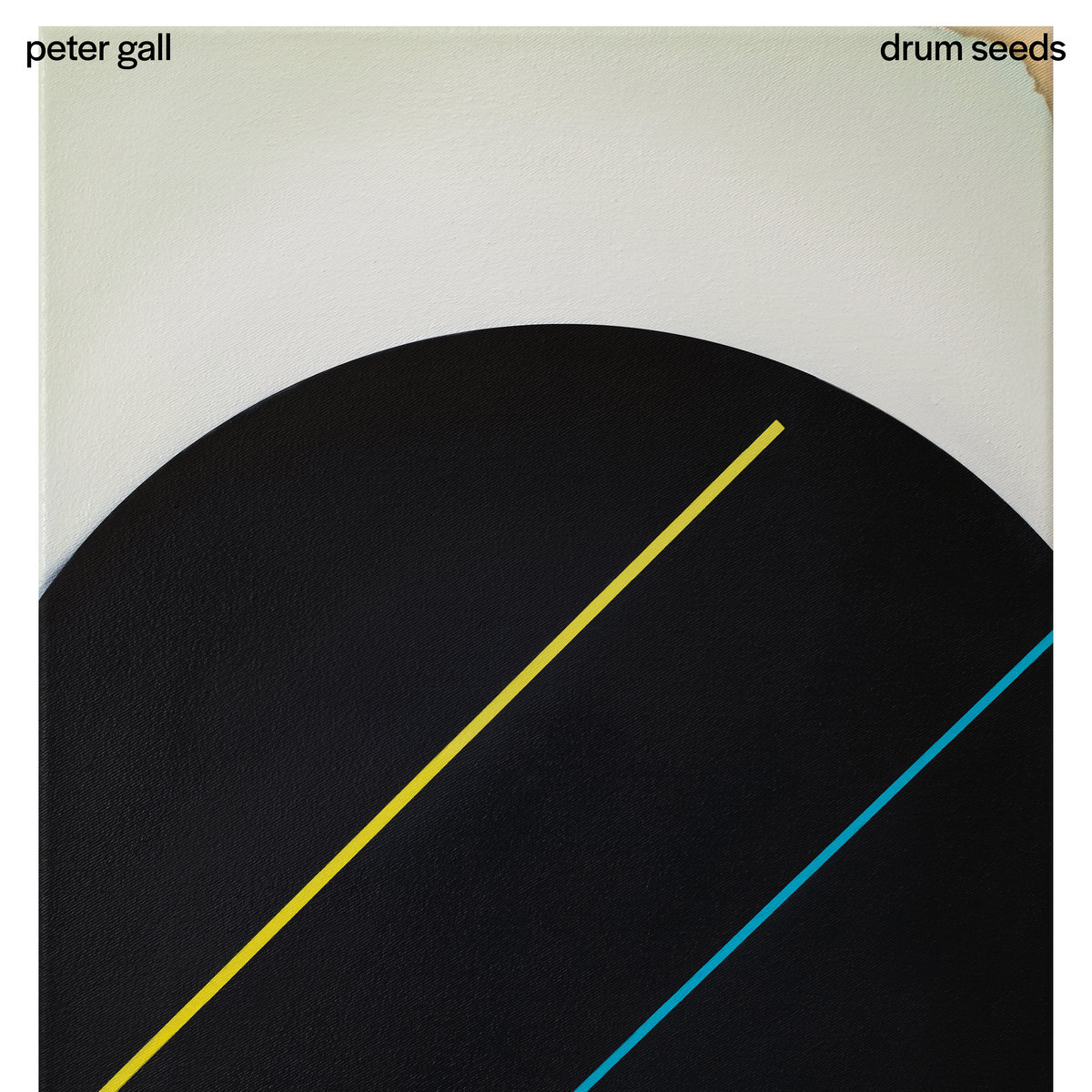
Bill Kopp: The opening track, "Groove Receiver," has a kind of breakbeat feel. It breathes, but it also sounds almost technical in its precision. With your drumming, do you aim for that kind of sweet spot between the two approaches?
Peter Gall: Hard to tell. In that case, on the first track there are two drum sets. There's a kind of rocky drum set, and there is a jazz set, which sounds a bit nasty on that one. To get that precision, we had to record with a click track. Otherwise, it's hard to get two drum sets together to get that kind of groove. So that's maybe where the precision comes from. But of course I try not to think about that too much. I just play and hope it feels good.
Bill: With Drum Seeds, you've managed to make a drum-centric album that's very musical. Did the compositions all begin as drum tracks which you then built upon, or did they come about a different way?
Peter: The original idea came from the label, from Compost Records boss, Michael Reinboth. He signed my last band album, which is completely different. And he said back then, "I will sign your band album if you promise me that we do a drum album."
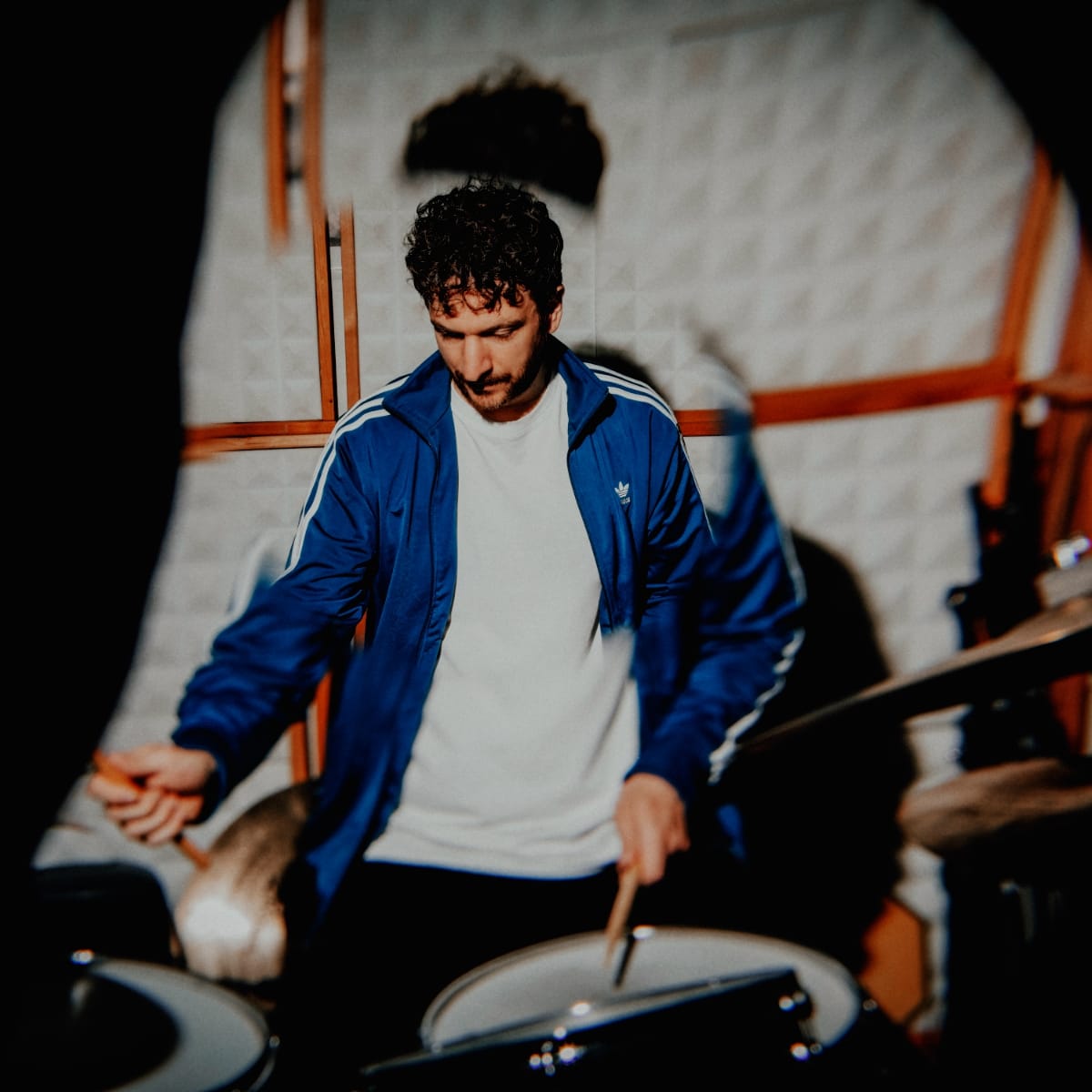
So the original idea was just drums. With that idea in mind, we went to the studio and laid down around 30 drum tracks. He and the engineer sat in the listening room and gave feedback: what felt good, what didn't. So maybe 15 or 20 beats out of about 30 or 40 had a feel to them. We took that home. I was listening to it, and I didn't really know if I really wanted to do that, to just have drums on a record. Because for me there might be something missing. That's when I started bringing in these instruments: the Juno, the Prophet, the MS-20, and some other stuff. I started producing around the drum beats, and that's how most songs developed.
I tried to leave some drum focus in there, because it should be a drum album. So it has a lot more drums than a normal band album. When I compose for a band, I don't think in terms of drums; with this album, I really did. But I also want—need—more atmosphere to it, so that's why a lot of other stuff came in. And then it's a rabbit hole; you get sucked in, and you just do your thing.
Bill: Did Michael Reinboth require any convincing? He wanted an all-drums album; when you came back with something different, did you get any "Wait a minute, this isn't what we agreed to"?
Peter: I think the first one I sent him was "Groove Receiver." This was probably the first one I really finished. I sent that to him and said, "Hey, look what I got." And he was like, "Oh, yeah, I like it. Okay, cool." From that point on, I felt, "I can do what I like to do." There was actually never a moment where he rejected something. Of course we had conversations about which tracks we would choose, and the track order. As a jazz musician, which I am originally, I want to involve the label when I do something that is a bit more for another market. So I value their opinion a lot.
Bill: Did you find that something about the character of what you had laid down on the drums suggested what kind of keyboard textures you might add to it? How did those ideas come to you?
Peter: It sounds stupid, but they just suddenly appeared. I had phases where I worked on the stuff for two weeks in a row, always late at night, and with a lot of frustration because nothing came out. Then suddenly there's this moment, and you have an idea, and this leads you somewhere. And if you have the first idea besides the drums, it's actually easy for me when I have a hook, where you can hold on to something. And a hook could be anything. It could be a bass line, a melody, or a nasty sound. Or just reverb; that's a hook as well, because it's something that brings characteristics.
From that point, I just try to feel my vibes, feel my heart, whatever. But sometimes it was hard to get the first idea. And from this total—17 tracks including the bonus tracks—I had maybe 10 down. And I felt, "The album is not really finished. It needs some more adventurous stuff."
So the more adventurous songs came towards the end. Last November, I went to a couple of record shops, and I bought 25 new records. Everything from Slum Village hip-hop, Dr. Dre, and a lot of Aphex Twin to jazz: Art Blakey, Herbie Hancock. For two weeks I listened just to that stuff. I sat down on my couch and listened to the vinyl—A and B sides—and did nothing else. For some reason, this helped a lot, especially listening to the first Aphex Twin album, because it told me, "Hey, you can do whatever you want, and it's fine as long as it has some vibes." It was really mind-opening to listen to a lot of stuff that has nothing to do with my jazz world. And it took some of the pressure off.
Bill: You have quite an arsenal of keyboards. Was there any kind of intention on your part to use a wide variety of different synths, or was it more dictated simply by the kind of sounds that you wanted?
Peter: It's a matter of what inspires you, probably. The Juno is good at something very simple, but for the most part, you add it later. That's how I deal with the Juno: it's something for the very end. I got the Prophet pretty late in the process. I had a Prophet 6, which is prominently featured on the record; I sold it and got the Prophet 10, which is a lot more nasty. And the sounds have more character; it helped me to get new ideas. So I see what the synth has to offer, and that gets involved in the composition process.
Bill: Thinking for a moment of electronic music, some progressive music, and some jazz, those forms often favor longer tracks. The tracks on Drum Seeds stick largely to pop-song length. Was that an intentional decision on your part?
Peter: I think it's more that that's how they came out. That's where the ideas ran out, probably!
I did think that it would be good to have everything a little more compact, because most of the tracks have a very specific message, and not much more than that. So a couple of minutes usually was enough. Also, there are no soloists. There's no jazz improvisation from other people. When I'm doing that, like on my last two albums, I want to give them space. And that makes jazz pieces longer.
Stay on top of The Tonearm.
Subscribe for exclusive interviews, cultural tip-offs, and community fun.
And your support keeps our site free of advertising and paywalls.
Bill: Another word that came to mind when I was listening to the album was cinematic. Have you ever considered pursuing sync licensing opportunities for film or television?
Peter: Well, it was not the intention when I did it. It's funny, though: a friend of mine listened to it, and he said the same thing—that it's very cinematic. I didn't think about it much, but I'm happy the label is pushing that. If something like that happens, it's great.
I think the cinematic aspect also comes sometimes from a lot of reverby, wet stuff. There's a lot of spring reverb on the drums, which has a very specific character. The spring reverb takes you somewhere, like the '70s or even the '60s.
Bill: Other than the two-kit approach on "Groove Receiver," did you use one drum kit for the entire project, or was it a different setup for each one?
Peter: It was one big rock kit, which was in the studio, and a jazz kit which I brought. But I also have to mention that a year later, when I was looking for more tracks, different ideas came up in the meantime. I was recording in my studio here in Berlin with my other drum kits, like an old Rogers. I'm not a guy who has one drum sound; I always try to change as much as possible. I've already sold some of the cymbals that are on the record.
Bill: You recorded all this music yourself. Will any of these pieces find their way into live performance in any context?
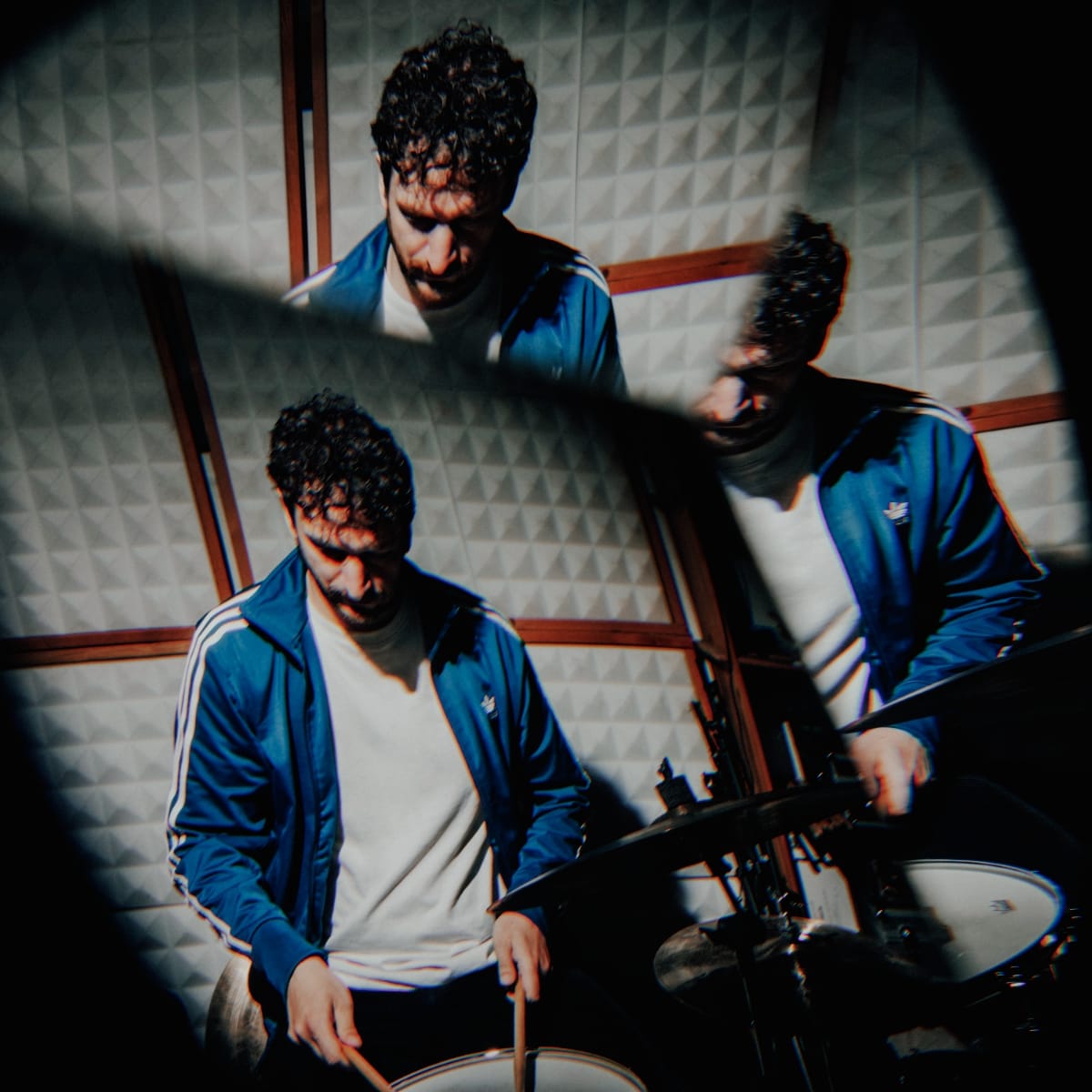
Peter: Well, at first I thought, "No, it's not reproducible." But I am actually working on a solo performance. My solo show premieres on September 23. There's a jazz club in Neukölln, a very nice one called Donau115, and I'm having a solo experiment there.
It's just me, and not even half of the pieces are from the record. Maybe one third of the pieces at least contain some bits of the records. It's not exactly that I'm doing the same stuff. It will sound different, but I use a lot of samples, which I trigger from my drum set with a system called Sensory Percussion. I've been working on that for the last half a year. So it's kind of a record show, but not really. That will be the first time, and there might be more.
But also I'm touring with my band, my jazz quintet. The next tour is in late October; we play songs from 2024's Love Avatar.
Bill: Did the process of making this album inspire ideas for other projects?
Peter: Yes. It was a very intense process, being alone with no musicians to help you or hide behind. And with that in mind, a lot of ideas came up: What is possible with humans, without humans? I'm thinking, "Will the next record be with friends, without friends, or maybe a mix?" I don't know that yet; I think I need a break first. Maybe it'll be next year. Let's see what comes out.
One thing I want to add: I'm into music when it's for the listener. What I mean is that the music and the listener are in a conversation. And I don't want that to be ignored. Music rarely stands alone; there's always a listener. There's a player's perspective and a listener's perspective. But for me, it's a conversation.
Check out more like this:
 Lawrence Peryer
 Sam Bradley


Comments