


American culture was at its most overwhelmingly ’70s in 1974. John Denver, Barbra Streisand, and Steve Miller topped the charts. The Watergate scandal came to a head. And the cruel hegemony of bell-bottom jeans was in full swing. We had no idea how much we needed Trouser Press.
Fortunately, Ira Robbins and his cohorts did. With a weapons-grade level of musical knowledge and an unnatural amount of moxie, they started an underground magazine aimed at passionate record geeks—the kind who were dismayed by the bland-out of the rock/pop mainstream and sought their kicks on the route less traveled.
Trouser Press’s first couple of years stand to prove that there were plenty of cool, cultish musical pleasures to be found in the pre-punk era, especially across the Atlantic. But when punk and New Wave rolled around, TP was perfectly situated to spread the gospel. With arch wit, encyclopedic knowledge, and an endless supply of undying, fannish heart, they went deep with everyone from The Damned to Devo, but they never turned their back on their older preoccupations, proudly flying the flag for pre-punk underdogs like Roy Harper, Nick Drake, and Roy Wood.
Zip It Up! Too is the second volume collecting the best of Trouser Press’s groundbreaking 1974–1984 run. Packed with interviews, ‘autodiscographies’ (more on those momentarily), scene reports, and more, it celebrates a magazine that was America’s gateway to underground, alternative, and independent music in an era when the nation was awash in MOR and AOR. The penetrating pieces collected in the book cover a broad spectrum of cult heroes including John Cale, Steve Reich, The Modern Lovers, Can, Bill Nelson, Sparks, and loads more. TP co-founder and editor Robbins—who runs Trouser Press Books these days—was kind enough to walk us through the times, the tunes, and the tribulations of swimming against the mainstream media tide.
The transcript has been edited for length, flow, and clarity.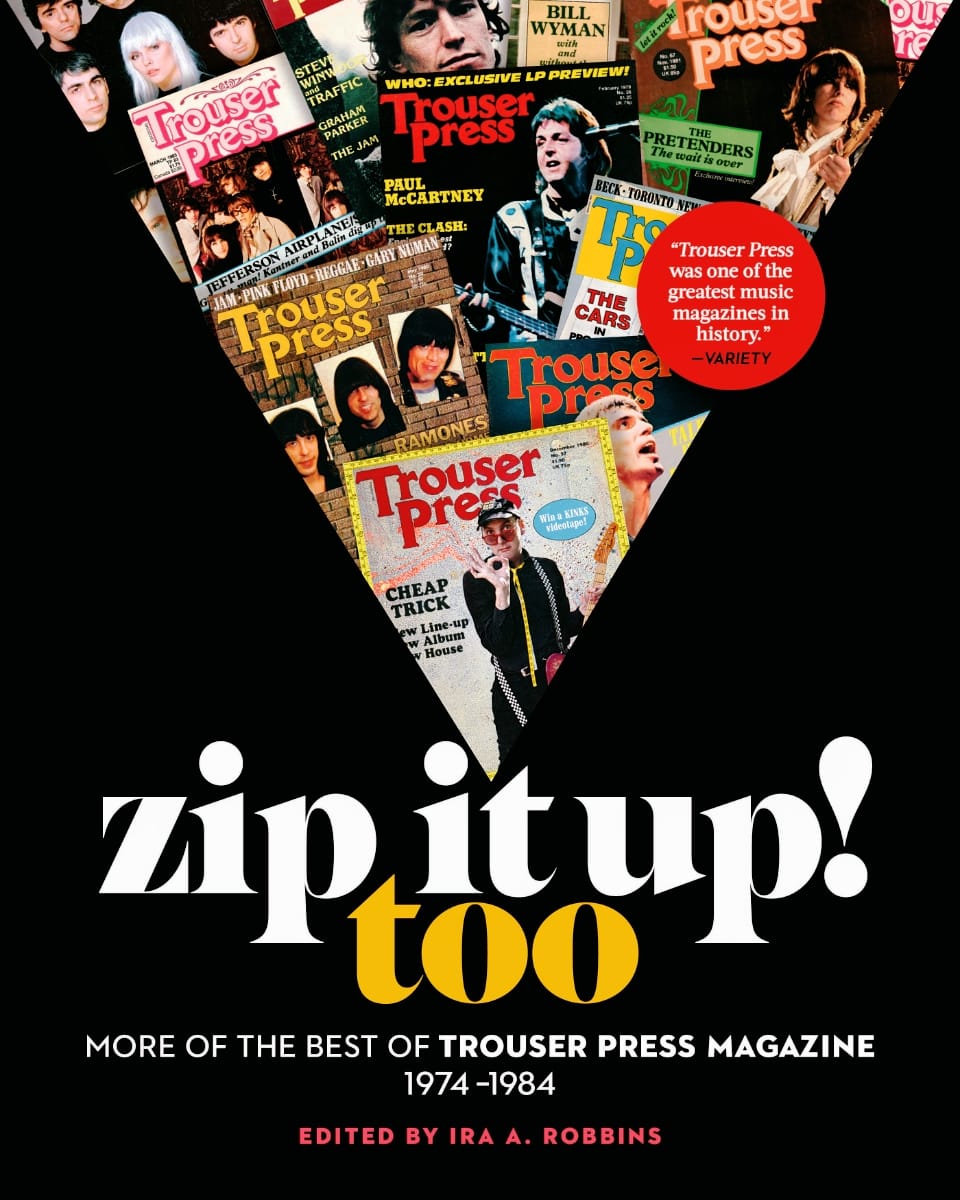
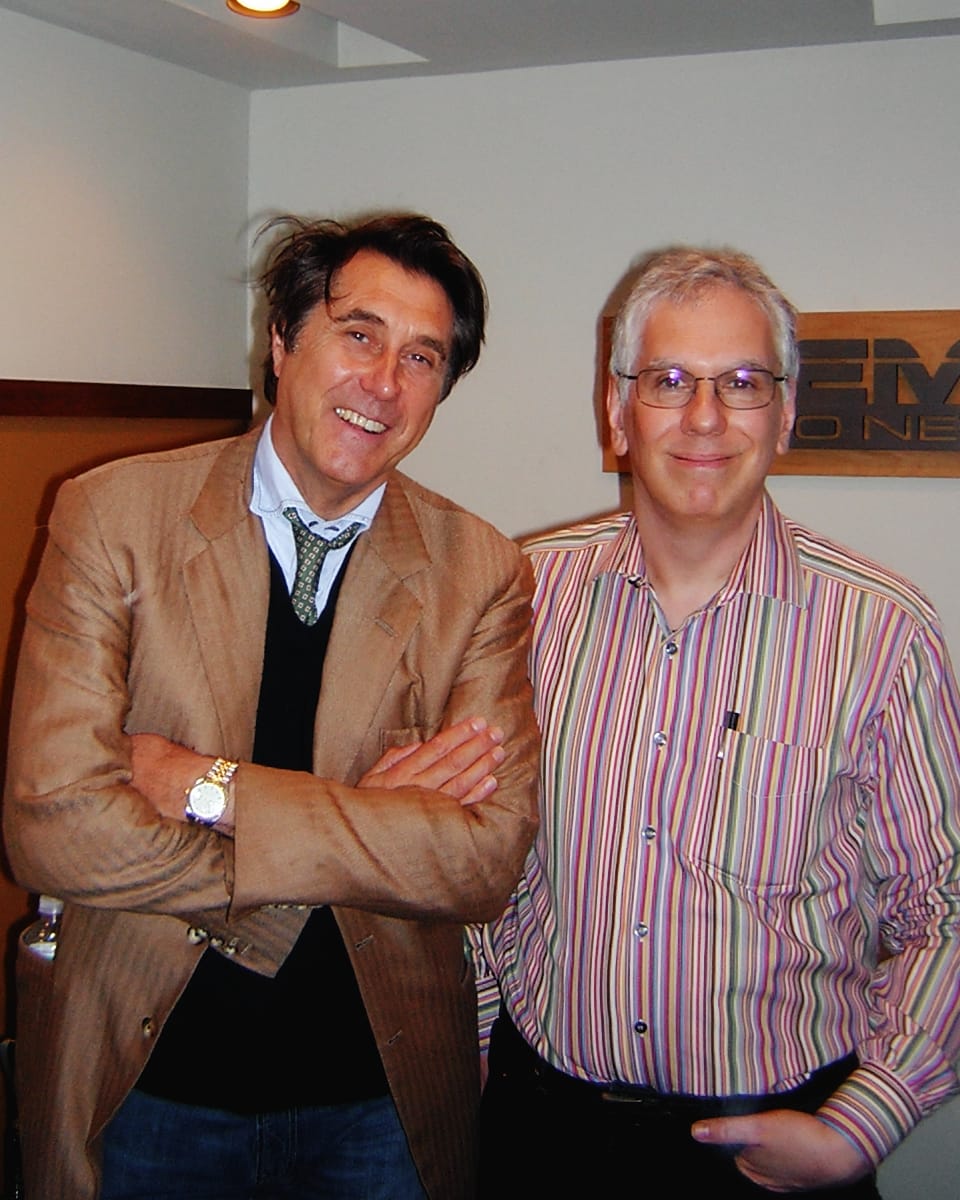
The cover for Zip It Up! Too and Bryan Ferry hanging out with Ira Robbins. Photos courtesy of Ira Robbins.
Jim Allen: When you started Trouser Press in ’74, you were operating on a totally DIY street-level basis, true?
Ira Robbins: We were DIY without thinking about it. We were just kind of like, “I like [post-psych/proto-punk UK band] The Pink Fairies, I’m gonna write an article about the Pink Fairies.” We were writing about the bands we cared about. Then we became more critical, both as bands we liked disappointed us and bands we didn’t like came onto the radar. We became surly in a way that I think was fun and helped establish us for people. When we conceived the first issue, the idea that Dave [Schulps], Karen [Rose], and I had was, “Let’s write about somebody that’s playing in New York, so we can go to their gigs and sell outside.” That was our shabby marketing plan.
Jim: You all assembled the early issues in a painstaking, manual way, starting with a mimeograph machine. How did those actually work?
Ira: A mimeograph machine is a drum with a handle, and you put a stencil on the drum, and you put paper in a tray, and you turn the handle, and it picks up ink. It inks the stencil, runs the paper under it, and it comes out printed. We typed directly on the stencil, and it punches holes in the stencil, and the ink goes through the holes onto the paper. You have to print one side, wait for it to dry, turn it over, and print the other side. It’s not a convenient process.
I have the receipt downstairs, framed in my cellar, for the paper and ink that we bought for the second issue. It was like 10 reams of paper and four tubes of ink; it was like 40 dollars. That was Trouser Press. We collated and stapled at my parents’ dining room table. It was a process. I’ve got no complaint about having done the hard work in those days, because it connected you to what you were doing. Now you lay out a magazine on the screen; you can do it on your phone. In those days it was a wax machine and paper boards you laid stuff out on; a T-square, rulers, and X-Acto knives. Everything we did was the hard way.
Jim: At the risk of being too on-the-nose, you could say it was punk journalism.
Ira: We were pre-punk journalism [laughs], and then we became post-punk journalism. When I was going to a lot of shows in clubs, ’74, ’75, everybody that I knew thought that this [early CBGB scene] was our little hometown fun. It wasn’t part of the music industry. It wasn’t the farm club for the major labels. It was entirely self-contained. There were no scouts coming down to see Television in 1975. Patti Smith put out her own single; Television put out their single. Those were entirely local, self-financed little things that sold at the Strand bookstore or at Bleecker Bob’s.
It’s impossible to explain to somebody who wasn’t there that it wasn’t like we were waiting for the world to find us. We didn’t think the world was ever gonna know about this. We became huge fans of all the bands that played. With Trouser Press, we saw it as something we loved to do, but it had no relevance beyond the city. There was no reason for somebody in Minneapolis to want to read about this band, Television, that they would never hear or see. Granted, I was completely wrong. We wrote about those bands early, but not to the extent that we should have.
Jim: One of the most fascinating pieces in the book is Jim Green’s roundup of the New York underground bands from 1978, which is loaded with artists that most people today have never heard of.
Ira: If anybody put out a record, we covered it. Even if it was a cassette tape. It’s amazing because it’s so of its time. Some of those bands are completely forgotten. It’s really an amazing snapshot, because there’s so much of it that’s like, “Okay, this didn’t turn out to be the way we thought it was going to,” or “this really changed, and these guys really blew up.” I especially liked his attack on Teenage Jesus and the Jerks: “Yes, they’re teenage, and yes, they’re jerks.” (Laughs.) There was a time when these bands were babies. You don’t think of Elvis Costello anymore as the angry guy standing on his ankles, with the sunglasses, shouting into the microphone, dripping sweat profusely. This is what it was like in 1977. This is who they were. Early Ramones, early Talking Heads, a lot of this stuff is just really interesting before it became what everyone knows it as. I think that’s a valuable service, to show people where it began.
Jim: What did you see in the new bands that spoke to you in the same way as older artists you loved, like The Who and The Small Faces?
Ira: Aggression. Energy and aggression. To me, The Who, The Stones, the better sides of the Beatles, it was all teenage excitement. It was energy and aggression, throwing stuff around and breaking guitars. The Who were always my first and foremost band, and they just set me on a path of like, “It’s gotta fight for something, it’s gotta be angry.” The Stones songs I liked best were “Street Fighting Man” and stuff like that. When the punk bands came along, it was the same.
When I played in bands, we always played everything as fast as we possibly could, because that just changes the entire vibe. I wasn’t naive enough to find the politics of punk particularly appealing. I’d been in radical politics for a while, so I had my own ideas. But the way the bands played—I always liked fuzzboxes and Jimi Hendrix and things that were louder and faster. So, faster and louder, that was good for me.
This was the era of a nonstop barrage of great punk and New Wave singles. We used to get stuff shipped from Jem Records, the importer in New Jersey. We’d open up a box, put on every record, and every record was better than the one before. Generation X, The Sex Pistols, The Vibrators, The Clash—it was an unbelievable collection of stuff.
Jim: One of the great things about Trouser Press is that it was never doctrinaire. You always kept artists in the mix who were a million miles from punk. One of the most poignant articles in the book is T. Joseph McGrath’s 1983 piece on Nick Drake, about visiting the house where Drake lived with his parents. Was there already a resurgence of interest in him back then?
Ira: Only in the small world that we inhabited. There wasn’t a resurgence; there was an ongoing interest. There were always fans of British folk rock, and Drake was adjacent to it. It wasn’t like, “Oh my God, we’ve got to jump on the bandwagon.” This guy came to us and said, “I visited his family in this tiny town in England, and I wrote the story; would you like it?” It just appealed to our sense of esoterica, quality, British culture, and all those things. He was just one of those figures, like Syd Barrett, who was mysterious and intriguing. People always wanted to know more about him.
Jim: There’s also a great piece about Can from 1982, when most of your American readers probably knew zero about krautrock.
Ira: Steve Grant was a regular writer of ours; he’s a very famous comic book author now. He had a little more esoteric taste than the rest of us. When we started the magazine, one of the things that we kind of embraced was European music. We just drifted into the world of imports. Our affection for things not covered by mainstream music media led us to that. I included it in the book because it was a strong, detailed history of a band you probably don’t read about much, but that everybody from a certain era cites as an influence. John Lydon always said that PiL was essentially his interpretation of Can, on some level. And I know Pete Shelley of the Buzzcocks was a huge Can fan.
Stay on top of The Tonearm.
Subscribe for exclusive interviews, cultural tip-offs, and community fun.
And your support keeps our site free of advertising and paywalls.
Jim: A huge chunk of the book is devoted to autodiscographies, in which you have artists go through their catalogs, album by album.
Ira: We were still incredibly reverent about some of these artists. So, if we had the opportunity to sit down with [The Move’s frontman] Roy Wood, we were gonna do it; Roy is the bomb. Especially since what we were doing with discographies was going back over the good stuff. We weren’t going, “Tell me about what you’re doing right now,” the where-are-they-now pieces that people do. It was more like, “Why did you make that single? Hey. Dave Edmunds, how did you come to make [a rock version of Khachaturian’s] ‘Sabre Dance’?” As we got older, we never lost our appreciation for a lot of those artists. It made sense to us.
Jim: It was also a great opportunity for geeking out to the max with them.
Ira: Part of it was that there’s a certain redundancy to feature articles about musicians after a while. “We started, we got good, we got bad, the record company fucked us over, a guy left, somebody died.” There was a certain fatigue factor in our world of writing the same kind of articles. In some cases, we’d already written the detailed history, we’d done the interview, so what are you gonna do now? Plus, it gave us a chance to plant our flag in the history world without being too didactic. Let them tell it. It was an opportunity for the artists to share what they wanted. Some of them were funny, because we had to show the artists the records. You brought a collection of records along so they could hold the record in their hand and look at it while they remembered making it.
Jim: What do you think your stable of writers had in common?
Ira: Kind of an underdog appreciation. A resistance to commercialism. We all agreed that selling records was not in any way, shape, or form a vindication of an artist’s creative quality. That’s at the root of all of it. That was always what Trouser Press meant to me. If a band put out a cassette that we liked, it was as good as an album by Van Halen. It didn’t matter that one of them was gonna sell 10 million copies, and one was gonna sell 10 copies. Because I’ve always believed that art exists in and of itself. Commodification has absolutely nothing to do with quality. That was always the ethos of Trouser Press. We were always in favor of underdogs, integrity, and people who were actually in it for the right reasons.
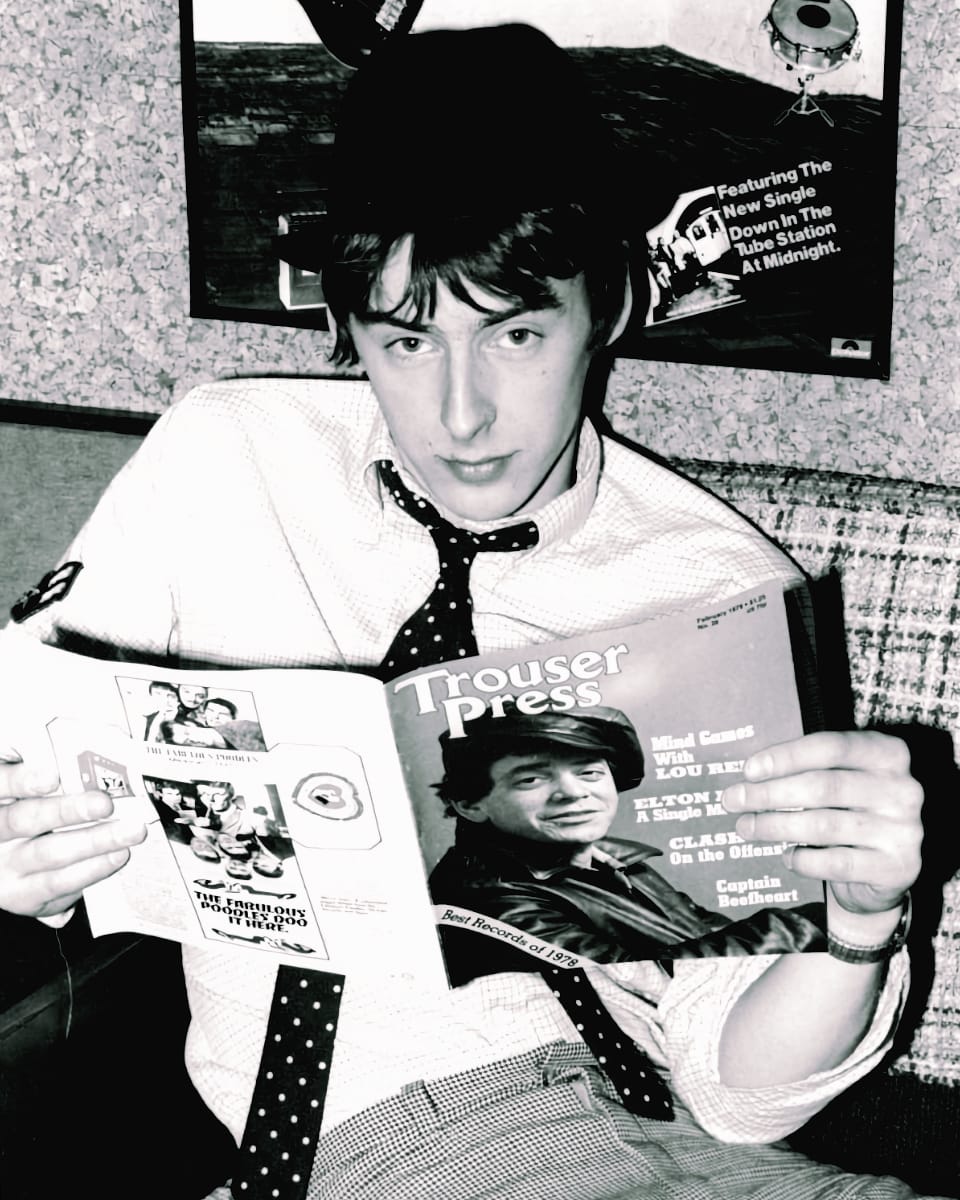
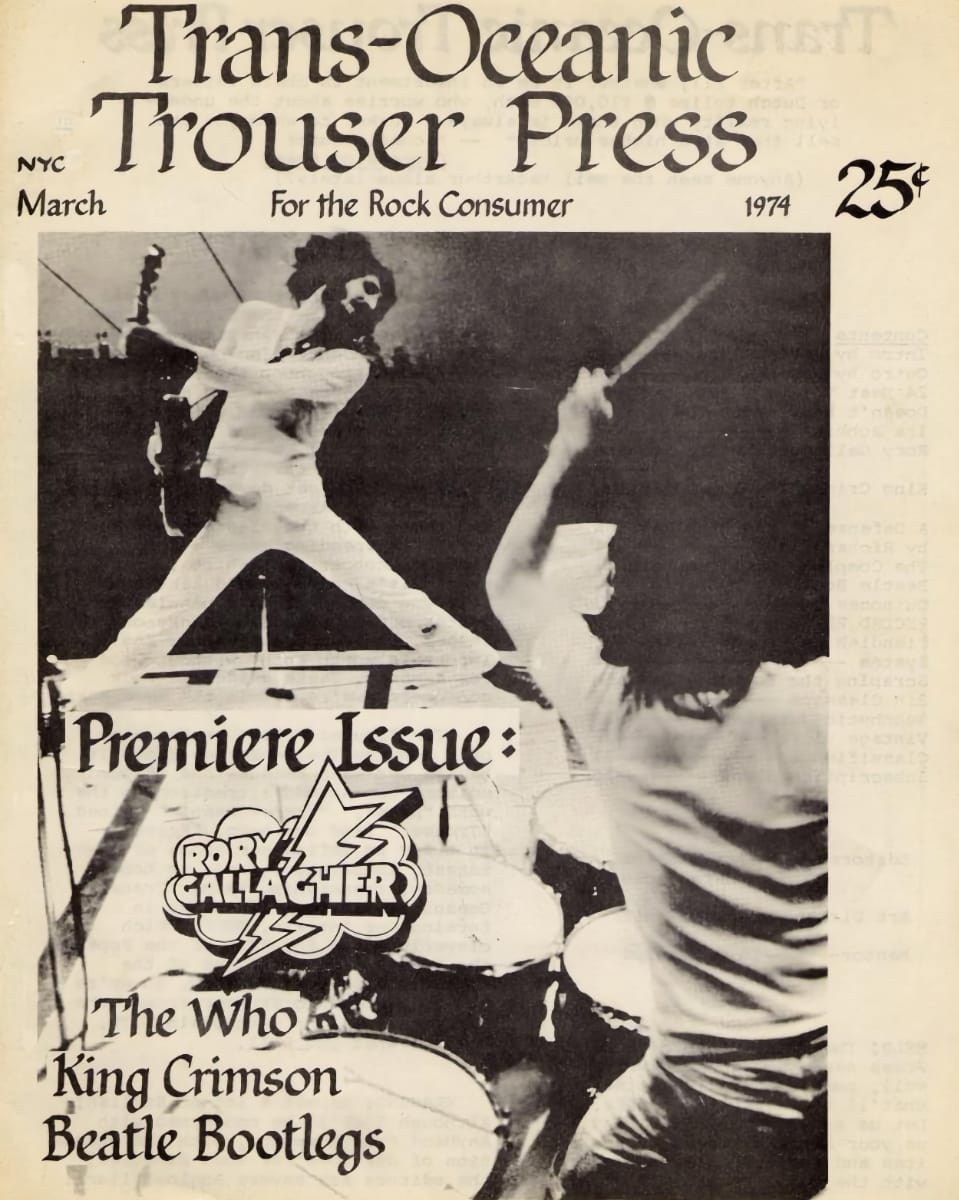
Paul Weller taking in an issue of Trouser Press, and the very first issue of the magazine. Photos courtesy of Ira Robbins.
Jim: Who are some of your favorite artists with an inverse quality-to-commerciality ratio?
Ira: [Illinois power-poppers] Shoes for sure. The people we put in the Characters section of the book—John Otway, John Cooper Clarke. My world is filled with bands I love that never sold any records. We loved Television, and Television never sold dick. I would say Shoes are number one on that list, but I’m sure there are others I’m not thinking of. We liked a lot of bands that didn’t sell any records. Holly Beth Vincent’s another person I think was really great and never got any commercial success other than one single.
Jim: It seems like if there’s one overarching theme that comes through in the book and in the whole history of the magazine, it’s the dance between underground and mainstream.
Ira: In the world of music and the world of Trouser Press, both those things occurred for sure. We’re publishing this book by Tony Fletcher [POW! When UK Punk Went Pop], a memoir of his growing up in England in the early ’80s. And one of the themes in his book is how the bands that started out as anti-establishment/countercultural eventually bought into the pop machine. Scritti Politti is one of the bands he cites as having started off as Marxist, weird, crazy art rock, then made “The Sweetest Girl” and said, “Oh, let’s have a pop hit.” In Trouser Press, certainly there’s a lot of that going on. The Human League went from “Being Boiled” to “Don’t You Want Me.”
In Trouser Press land, we felt that pressure for our own survival. We can be true to our own impulses and do crazy things that we want to do, or we can do things that people want to pay actual money to buy a magazine that writes about. It’s the idealism versus the rubber of the road problem. We resisted it for a long time; we were very bloody-minded. But after MTV came along, we realized that some of the bands that we were writing about were actually selling records. At that point, by the early ’80s, we were kind of struggling to stay in business, so there was a reality factor for us.
Jim: What would you say this second volume adds to the Trouser Press story that people didn’t find out in the first one?
Ira: I knew we were leaving out all the autodiscographies the first time, and I knew we’d have to do something about that. Then, when we signed a distribution deal, I was looking down the road at the books we were gonna release and decided we might as well pull the trigger on another Trouser Press book. I realized how much really good stuff we were overlooking. Making sure people like Bill Flanagan, who was a really important contributor, got represented, and Lester Bangs’s Ramones piece—it was the only time he ever wrote for us, and obviously he’s the sine qua non of rock journalism that people know about. It’s an adjunct to the first one. I hope people will have both; I don’t think you get the full picture from either.
Check out more like this:
 Lawrence Peryer
 Andrew Hamlin


Comments