


From the archive: this interview first aired on September 5, 2024.
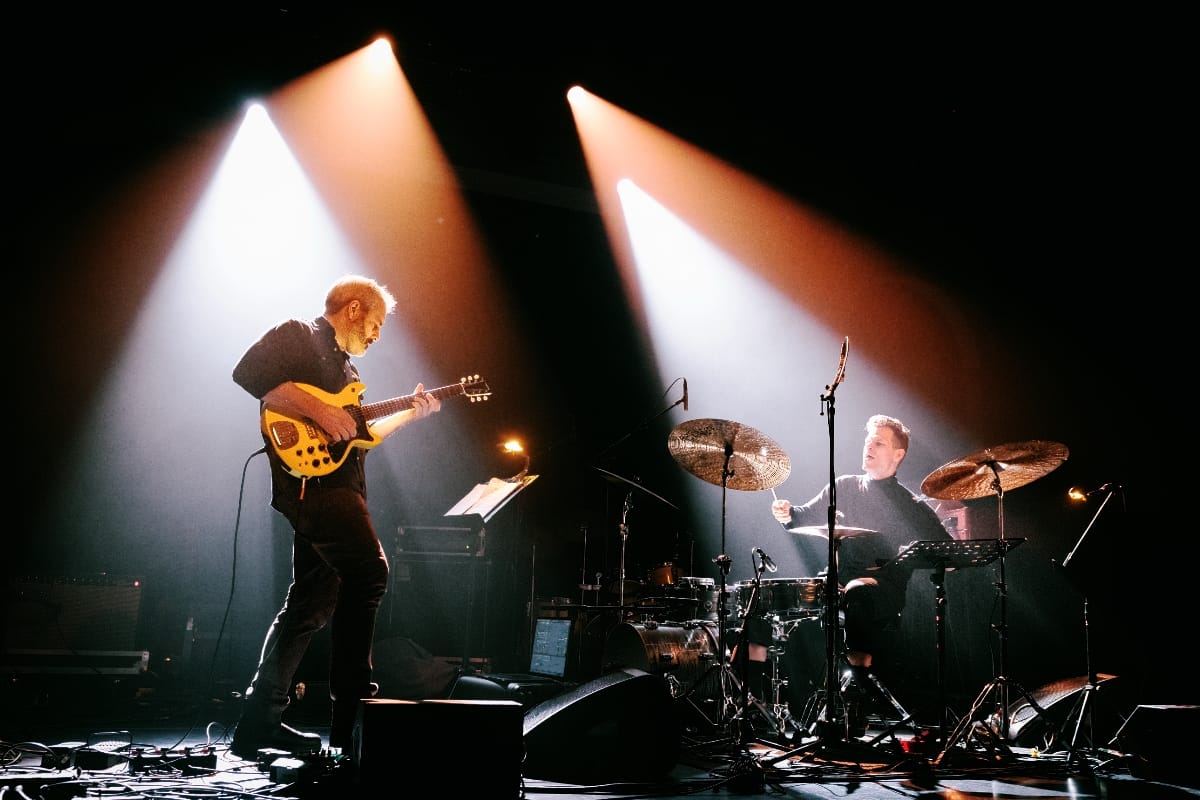
Gordon Grdina plays electric and MIDI guitar on Duo Work, a February 2024 album with the German drummer Christian Lillinger that fits twelve tracks into thirty-eight minutes. One of them, “Gerhard,” takes its name from the painter Gerhard Richter, whose paintings, Grdina said, “feel so metallic, modern and bright, yet have this warmth and soothing feeling to them.” He could have been describing his own record.
Grdina took up the oud as a teenager and used both instruments on his debut as a leader, Think Like the Waves (2006), a trio date with bassist Gary Peacock and drummer Paul Motian. Haram, the ensemble he launched in 2008, reworks Arabic, Persian, and Sudanese songs from the 1950s and ’60s through free improvisation. China Cloud won him the JUNO Award for Instrumental Album of the Year. By 2024, he led at least half a dozen bands, including the Nomad Trio with pianist Matt Mitchell and drummer Jim Black.
His label, Attaboygirl Records, released Duo Work alongside Gordon Grdina’s The Marrow with Fathieh Honari, which pairs his oud with cellist Hank Roberts, bassist Mark Helias, and percussionist Hamin Honari. Hamin’s mother, the Persian vocalist Fathieh Honari, sets two Rumi poems to Grdina’s music. “In Persian music they say that it’s not really music unless there’s poetry,” he said ahead of its release.
Grdina has released three more records since this conversation, and all three came out on the same day. His Persian quintet, Qalandar, captured Reza live with Hamin’s father on kamancheh, shortly before Reza Honari died in 2023. Ash is the Nomad Trio’s third. Turnpike, with the pianist Russ Lossing, began at a concert in Poland, when Grdina’s quartet ran out of tunes for encores, and the two of them carried on without the others. He has also formed RU’YA, an international group with the Belgian-Tunisian singer Ghalia Benali. It debuted at the Pierre Boulez Saal in Berlin and has a recording on the way. Still to come are a duo with Michael Formanek, a trio with the Italian bassist Andrea Grossi and Lillinger, and a new Square Peg album due early in 2027.
Lawrence Peryer hosted Gordon Grdina on Spotlight On, the podcast now called The Tonearm Podcast. They discussed the MIDI rig behind Duo Work, his years with the Honari family, the risk of exoticism for a Western-born oud player, and his studies with Gary Peacock. This transcript has been edited for length, clarity, and flow. You can listen to the full episode in our audio player.
Lawrence Peryer: Given how prolific you are, especially over the last few years, do you work on projects in parallel or on them linearly? Do you have a method for your madness?
Gordon Grdina: The duo record with Christian we had recorded on a different tour I was on. I had a few days off and was close, so I could make it happen. But that was two years before it came out, or a year before. Capturing the music is the most important thing, so I try to find it whenever I can, when it’s happening. I am a little slow getting them finished.
I’m always working on things at the same time. They’re project-based: this project’s coming up, so I’m writing a whole bunch and recording for it, and once that’s finished, it’s right on to something else. It’s the ADHD way of making music or something. But the key I’ve found, because I’ve had that disposition to want to be interested in a lot of different things and be thinking about them at the same time, is that when I’m doing them, I have to a hundred percent focus on what that project is.
Lawrence: Given how much of your work consists of different sets of collaborators, do you always record in person with the ensembles? Or do you move files around and have people add pieces?
Gordon: Everything is in person for now. I haven’t done much remote recording. I like listening to a lot of music that isn’t made that way. It’s a distinction I’ve started to develop. I like listening to music differently than how I enjoy making it. I like to make it in person with people doing it. That’s how I work best. We’re just playing, and then I’m capturing it.
In this Duo Work record, we recorded a bunch of songs and did a bunch of improvs. Then I edited, mixed, and put them that way. That’s the most post-production way I’ve gotten into it, but for me, the real creation is with the people in the room.

Lawrence: So much I’ve read about Duo Work emphasizes your MIDI setup. When I think about some of the MIDI guitar sounds from when guitarists first started stumbling across it in the late ’80s and early ’90s, people would try to make saxophone sounds and all this stuff. In this instance, other than “Song Two” at the end of the record, a lot of it just seemed like exploratory guitar music. It wasn’t a guitar player trying to sound like a horn section. And I appreciated that it didn’t lose the guitar-ness.
Gordon: That’s been the concept. I didn’t want to be a band-in-a-box. The idea was just a sonic thing, to add these colors to what’s happening. I’m not a techie guy, for sure. I’ve never really been into guitar pedals. I love the sounds, but I get exhausted. Some people love that. I just want to make music and have it happen. It took a while, because I want the interface to be completely natural, so I can improvise, do whatever I want, and play with what I hear. But then I’ve got this new palette of sounds that I can also use.
During the process of making the record, we didn’t have any of those sounds. I have a big guitar sound setup where I split, and I’ve got bass and guitar going simultaneously through amps, and that’s how we played it. So everything’s alive off the floor. While that was happening, I tracked MIDI, and I could take that information and add colors and everything I wanted later in the studio.
Now I’ve got a live setup where I can have all that and switch between them on the fly, so that I can do that at the moment and not have it be like, “Oh, it’d be nice if this line had that sound of acoustic bass, or strings or keys.” It’s like guitar foot pedals. It’s got this instantaneous thing that was very guitaristic, an extension of what I’m already doing, more than, like, I couldn’t afford to hire a bass player.
Lawrence: How did you get to the live rig? Is it just you out in the wilderness figuring it out?
Gordon: It was a lot of that. I’ve got a couple of friends who are more in that world and do much more MIDI stuff. I was using Logic. That’s how I originally found all my sounds and made a bunch of samples. But then I found out that the program isn’t great for live performance. So my friend was like, “You need to be using this, bro.” So I had to learn Ableton.
We did our debut live duo concert in Belgium in February, when the album was released. I figured out the whole system and got a MIDI pedal and a foot switch so I could switch things in Ableton with my feet, because most people use knobs and their hands. I want to be able to do it on the fly. I finally got the tricks, and then it broke the day before. I panicked, but I found one and learned it on the plane, got there, and had a day to get it to work. And it worked.
Lawrence: Is there a wall or a demilitarized zone for you between the guitar and the oud? Do you ever do any of the more experimental or electroacoustic things with the oud you’re doing with the guitar?
Gordon: They’re definitely not two different worlds. I did a solo concert last night, and it was the first time I’d ever done it with just an acoustic oud and an acoustic steel-string guitar. I got a new 1930s Gibson that I love. I was noticing how I play now for both things, which is almost becoming the same, sounding less and less like an Arabic oud player and looking less like a guitar player. I was going, “Wow, these are turning into the same thing.” It’s unifying more, all those things.
I do have a mic, and I sometimes process the oud through guitar pedals. I don’t do MIDI stuff with it. I’ve focused more on the instrument’s acoustic timbre. I was divided when I first started learning the instrument, because I needed to understand it to use and play it. And because I love the music, I wanted to honor it as best as I could. There’s such a history and such a sound. So I studied it as best I could. I’m not trying to speak for Arabic music. I’m being me with this instrument, and it’s paying homage to all these great people that come out of this history.
Lawrence: I’ve talked to other Western-born players who play instruments from those traditions. Do you have concerns around things like exoticism or even kitsch, or a more extreme version, musical colonialism? Do you have to wrestle with that, or is it about purity of intent?
Gordon: Of course, that’s been a big thing. If you’re going to be dogmatic to a certain point, no one’s ever allowed to create anything, because all music is some sort of combination of other things and influences that come from people and what they hear. It’s impossible not to hear what I’ve heard.
For me, there’s intent, which is a big one, and then authenticity, like what makes something authentic. I feel like it has to do with time spent and what you’ve done for that music. The time spent with the instrument gives you authenticity. That lets you make music and connect with people in different traditions, and have something to say and talk to them like you would in any conversation, celebrating those differences. When I play with more traditional musicians, we’re conversing between two people. Part of mine is my interest in what they’re doing and how they’re doing something. I’m not trying to take advantage of them. I want to create with them. It goes both ways.
It’s a constant awareness of what’s happening, because you can step over that line. Also, you become too timid and unable to speak how you want. It’s the same thing as my understanding jazz music, or when I first started understanding blues music. To be an authentic blues player doesn’t mean you have to have suffered in any real physical sense, but you must live with the music. At a certain point, I’m nonauthentic enough for jazz or something. Someone’s always going to be pissed. (laughter) But the jazz musicians I love, this is exactly what they were doing. I feel like each individual needs to answer that for themselves, whether this is a real, honest thing they’re trying to express.
Lawrence: What you just articulated also strikes me as the beauty in all this music, their ability to have these dialogues across time and space and culture and backgrounds.
Gordon: You talk to musicians; musicians want to play with each other. Musically, we’re all humans. So whenever you do this, you speak directly to what it means to be human. Even the meaning of poetry changes when you don’t understand it, but when you hear what someone’s saying, you get a deeper understanding of what they’re trying to express. Music is a place where you can connect with everyone no matter what. We’re all more connected than we’re not.
Lawrence: How much did you look at other figures who had attempted similar things? I think of Ornette Coleman, or, to an extent, Coltrane. My entryway into a lot of this music is Simon Shaheen, particularly his record of the music of Mohamed Abdel Wahab.
Gordon: I was on tour once with an avant-garde rock band. It wasn’t a super harmonious band. Someone did piss someone off, and it was upsetting, and we were trying to find music to play on the radio, and no one could agree. I was like, “Hey, check this out.” I put that record on, and we listened to it four times. Everyone just shut up and was just like, “Goddamn.” That music just hits everyone. And his record with Vishwa Mohan Bhatt, that’s a fusion right there. That’s the first time I heard the oud, and it blew my mind that that sound could happen on an instrument.
So the concept of not doing that is weirder to me. Okay, this is Eastern, this is Western, mixing them. I always listened to them together. I already heard it.
Even the record I made with Gary Peacock and Paul Motian—I heard the oud with those guys, because I saw many similarities between free improv and taqsim: the Arabic music, how much they modulate, and particularly that Gary and Paul Bley vibe. I remember we were doing one thing, and Paul said, “Man, I don’t know what the hell you want. We’re playing this thing in seven. This isn’t working.” And I was like, “No, this is exactly what I want. I want you to just do you on this thing, and me and Gary.” And then the record comes back, and he’s like, “Man, I love that shit.” His favorite thing out of it. (laughter)
Lawrence: That’s some heady company to be in.
Gordon: Paul Motian and I only did the recording for a couple of days. I worked them quite hard. Now that I’m much older and looking at it, I’m like, “Oh man, I worked him way harder than I should have.” We only had a few interactions, Paul and I, but Gary, I studied with him for five years. He was one of the few people who completely changed my understanding of music.
Lawrence: Could you easily sum up how?
Gordon: Gary studied biology in Japan, so he had this amazing way of articulating organic construction.
Lawrence: Systems.
Gordon: Systems, totally. Working with Gary and understanding how he hears music changed everything. He could articulate all the things that no one talks about. Everyone’s got those records where they’re like, “What the hell is happening?” All the nooks and crannies, these mystery spots in music that I couldn’t get anybody to talk about or think about, Gary could articulate those things.
Lawrence: Could you tell us a little bit about your relationship history with the Honari family?
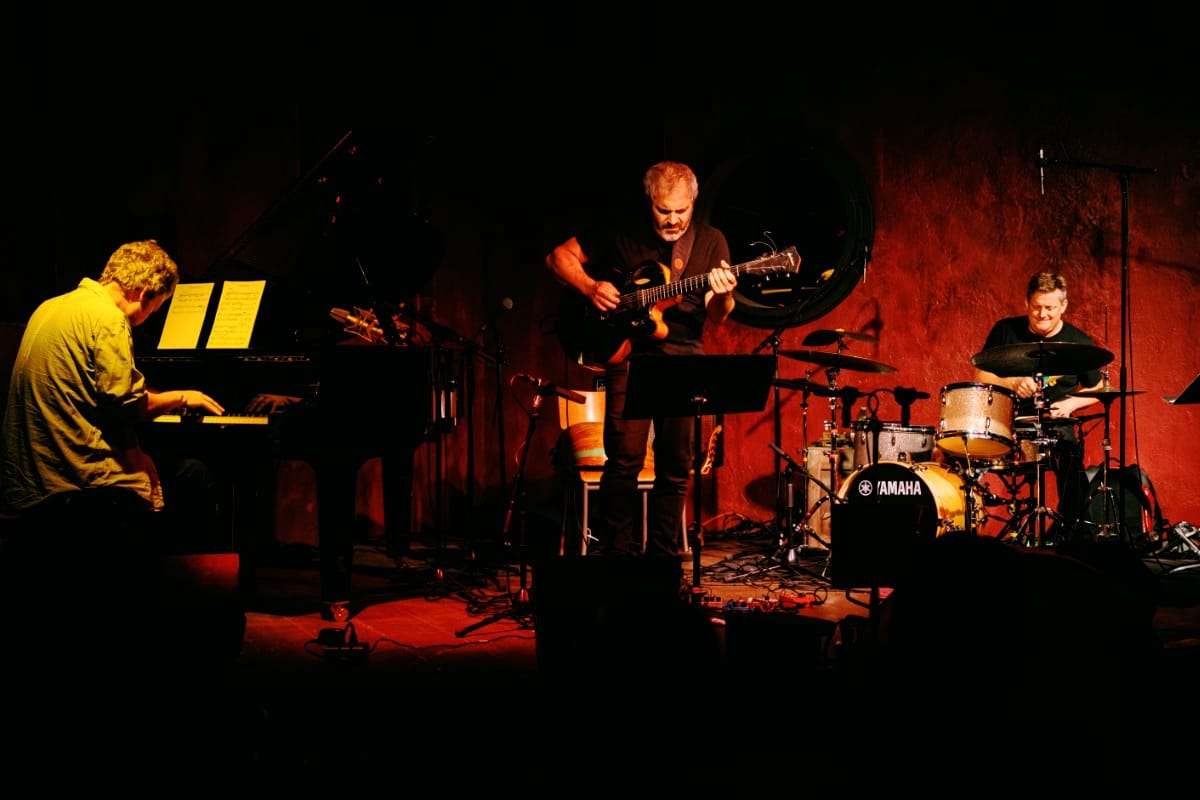
Gordon: In university, I was friends with Neelamjit Dhillon, this great tabla player. I hadn’t even started playing oud yet. He was good friends with Hidayat Honari, who’s an amazing guitarist. Then I started playing the oud, and we found out that Hidayat plays tar. Through Neelamjit, I met Hidayat, and then he was like, “Well, you know, my brother plays,” and I was like, “What?” So then I got to know his brother, and we had a group called Sangha, which was Hidayat and Hamin and Neelamjit. It was tabla, tombak, daf, tar, and oud, and we wrote all these pieces. It was a big learning curve for me, figuring out how these instruments can work together and how to write for them, and I learned from their compositions. We’d usually rehearse at the Honaris’ house.
So then I got to know his dad and his mom. Loved his dad and loved his mom, loved it all. We became really close and did a ton of albums. Hidayat was on the road for years playing guitar and then moved to New York. So his dad started filling in for Hidayat when he was out of town, and then he was part of the band, and I’d get to play with their group sometimes; then I’d have some event, and I’d hire them all.
That was my introduction to the Persian music scene in Vancouver. We did a lot of touring, a lot of playing together, a lot of playing with Fathieh. So when we were doing this band, it was always in my head that at some point it’d be great if Fathieh would want to play with us, so she did. That’s how she came into this project.
Stay on top of The Tonearm.
Subscribe for exclusive interviews, cultural tip-offs, and community fun.
And your support keeps our site free of advertising and paywalls.
Lawrence: Is it a big deal to be playing twelve-tone and microtonal music? Do you have to use different parts of your brain or technique?
Gordon: It’s more instrument-focused. If I’m playing the oud, the music aligns differently on the oud. I do have a fretless guitar that I play in one project that’s a smaller scale, so it feels almost like an oud, but it’s tuned like a guitar. That’s the part where my brain still has to go, “What the hell?”
All those things are intrinsic in how I play. When I’m playing the oud, I’ll hear a thing, and that’s what I’m hearing because I’m used to hearing it that way. With the new MIDI thing, I’ve tuned some things to quarter tones so that I can play it, but it’s more in the improvisational context. The whole goal of improvising is to be exactly where you are when you’re there. So we’re playing a piece that has this, this, and this; I’m in that world. If I was playing guitar trying to fit into that world and I couldn’t, and I’m trying to bend notes to get there, that’s when my brain starts to explode.
Check out more like this:
 Jonah Evans

 Lawrence Peryer


Comments