


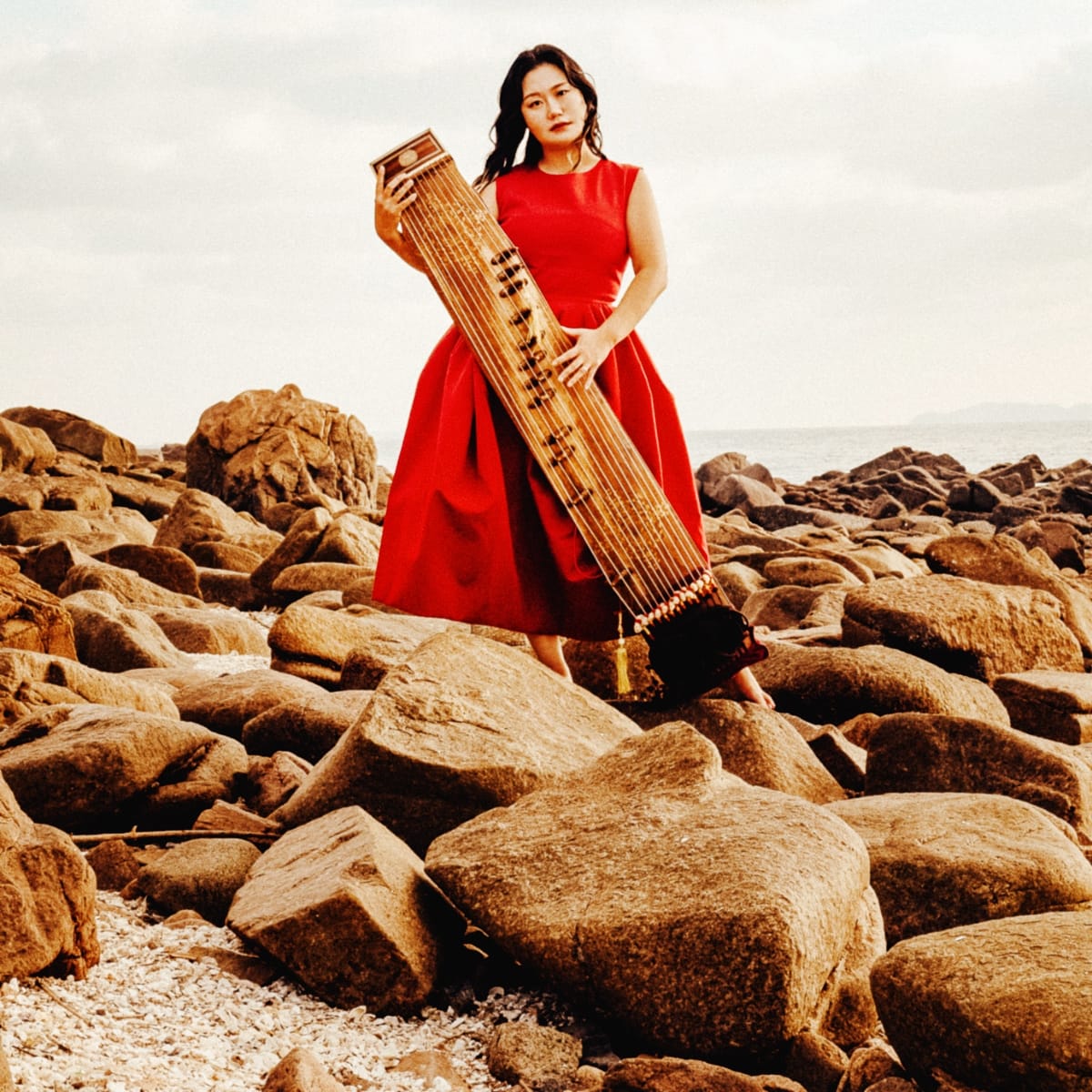
When I found out I was going to the Big Ears music festival about a week before it was set to take place, I started fervently skimming through the long list of performing artists. I came across DoYeon Kim. In her artist profile photo, she's standing on an oceanside beach filled with small boulders. She's on top of one, barefoot, holding her gayageum, and the instrument itself is almost as tall as her. The picture is striking: Kim, surrounded by nature that so often swallows the subject, yet in this case, it feels as if the two are in a unified conversation.
I watched the video accompanying the profile titled "[Abstraction from Inspirations] DoYeon Kim - From Me to Me." I was immediately impacted by how she navigated this instrument, which I was unfamiliar with. I felt the stress and tension between her fingers and the strings while watching. Her body movement seemed free but intentional. I could see, at least I think so, the relationship she carried between herself and the instrument and the sounds it emitted. She was in tune with it.
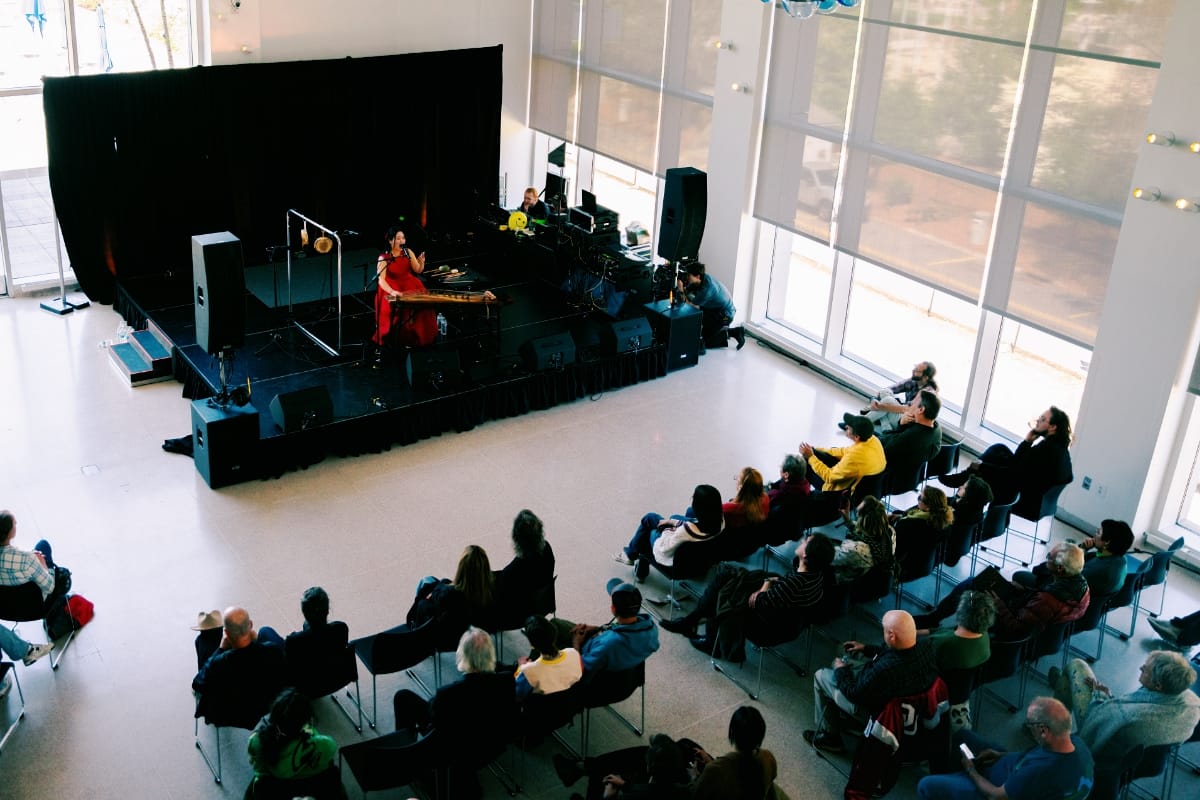
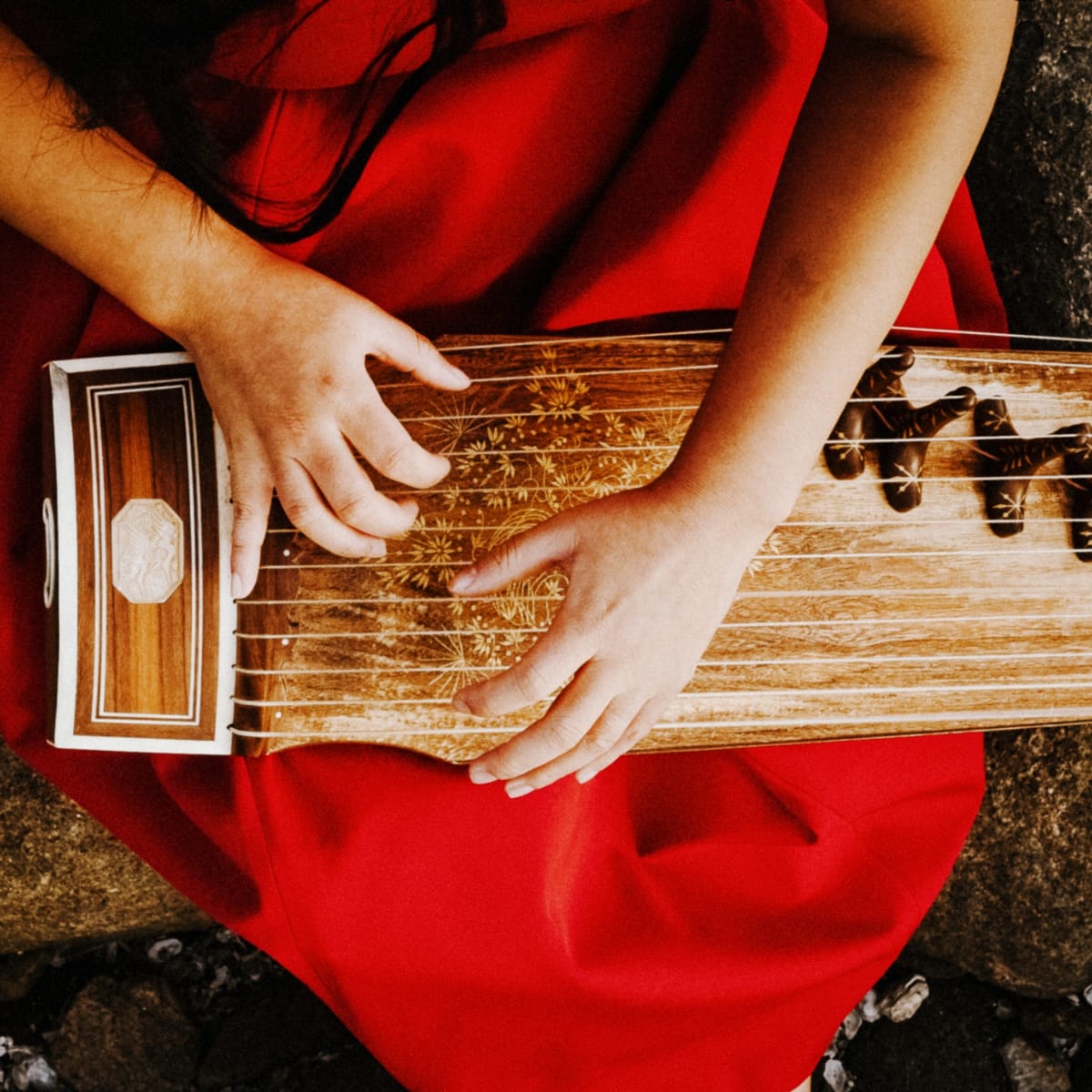
At Big Ears, I entered the Blackbox theater in Old City Knoxville, excited to see DoYeon Kim live. One of many built-in venues incorporated into the event, the Blackbox operated like a black-box theater, with folding chairs, a black ceiling, and black floors and walls. A blank canvas. On the small stage was just Kim and her improvisational partner for the session, Rafiq Bhatia. As they played, Kim’s hands moved freely across many of the gayageum's surfaces. Sometimes her fingers moved like waves across the strings—her fingertips, her palm, and the tendons in it, the undercurrents helping to dictate the energy. Sometimes she plucked short, fleeting notes. Other times she used a bow from a stringed instrument, and when used, the notes were drawn out, long and aching. A stand with mallets and various metal and wooden improvisational tools that she could use with her hands. To the left of her were two pan-sized gongs that she occasionally hit.
Kim and Bhatia—the latter of whom, whose latest album Environments explores ambient, jazz, and post-rock—played off each other well. Bhatia's guitar sound was ethereal, meandering, at times finding points of escalation with Kim, and at others, filling the spaces left open. Together, they created this beautiful emulsion of sound that felt like the stakes were always high. I would describe the performance as many moments of acute tension. From warm to disruptive, from comforting to discomfort, the performance was incredibly diverse and quite gripping.
Some short, shorthand notes I took while watching the performance include: Rhythm of hands. Hand Placement. Theater. Language. Urgency in the singing. High-pitched voice. Body motion. Eeriness. At one point, she pulled the strings, and the instrument slightly jumped off the stand! Is that supposed to happen? Later in the performance, Kim stopped playing and spread out her left arm; she bellowed out to the crowd in Korean. I don't know what she said, but the question was so striking, so immediate. And her body was fully committed to posing this question to the crowd.
The performance made me think, "How does she take care of her hands?" I really wondered about that because they moved so freely, sometimes so intensely. I thought I should ask her—and I did. At the end of our video chat, she showed me this metal pan in her office. The pan had golden-shaded water with a little wax in it, and it was heated. She uses it to protect her muscles and joints. There were a few other tools and remedies that she showed me, and said that without these tools, she couldn't “serve," as we talked about how she clarifies playing as serving. We also get into a little bit of the gayageum's history, how she learned to play it traditionally, only to eventually create her own sound with it, as well as some of the fundamentals that informed her creative decisions.
This interview has been edited for length and clarity.

Jonah Evans: I was thinking about the Big Ears performance and how much energy you put into it. How was that experience for you?
DoYeon Kim: That was the first time with Big Ears, and I always wanted to be there. It's a dream come true. I heard the Rafiq [Bhatia] album, saw his performance, and really wanted to collaborate because I had not collaborated on any electronic music before. So, why not? He will be there. I wanted to try a different atmosphere. I really like how he plays; when I hear his music, it makes sense. I think, "Oh, I can lead music this way." I imagined it, as I planned it in my head. And it actually happened. What I imagined is there.
So yeah, I listened to his music a bunch of times to know his taste, his musical sense, how he uses electronic music, and how he plays. I really loved it. And how we played was totally improvised. We didn't discuss a single thing.
Jonah: Really?
DoYeon: Yeah. We didn't discuss a single thing. But when I hear his music, I can imagine what I can do, and that just happened.
Jonah: Big Ears really does encourage those types of performances. There's a moment I remember when you were hitting the side of the gayageum while the guitar was playing. Then, all of a sudden, you opened your arms to the whole crowd, as if pleading with the audience. I felt like I needed to give you an answer.
DoYeon: Yes. I'm asking, "Why are we here? What is the reason we are here? You can hear me! You can feel me!"
Jonah: So, even though I didn't understand, because I don't speak the language, you were asking a question to be answered. But then you didn't know you'd say that. It was improvised.
DoYeon: Yes.
Jonah: That's a very large question to ask in improvisation! When you play shows, how often do you improvise, and how often is it more structured?
DoYeon: Oh, it's different. Actually, the music video you probably saw of me is also all improvisation, but I made my own graphic score. There's a different graphic score because it's about rebirth. So I'm questioning. A theme of East Asia is that your life is going to reverse itself every time.
Jonah: Reincarnation?
DoYeon: Yes, reincarnation. Maybe you saw the video of the three women. That's all me. I play the drum, I sing, I play the gayageum. That all represents me. But the important thing for me is what I choose, how I choose, and the effect I choose. That's all like a rebirth. You know all the choices. It doesn't mean you're actually rebirthed. I feel like all your thoughts, all your sayings, all your choices, every moment, are reborn.
Jonah: So you're saying that in that moment at Big Ears, you were thinking about this idea?
DoYeon: Yes. First, I record the gayageum, then the drum, and finally the voice overdub. So it's all my choices. I imagine I need to make space for this time, so I improvise. I hear my past choices. Now I'm playing with it. And that also affects the future. The important thing is that these choices are mine.
Jonah: You improvise in different ways and follow your instincts in different ways. So, with recording, it's not all set—yet you might allow each layer, as you've already given it life, move on to the next thing, and let that song become whatever it needs to become from that point.
DoYeon: Yes. And then, when it feels nice, I say, "Ooh, this is destiny."
Jonah: Does this process have anything to do with Korean tradition or Korean idioms?
DoYeon: Actually, I never think about it like, "I'm playing a Korean traditional music," and I never consider that I'm playing Korean traditional music. Even though I'm not thinking about it, I'm still playing this instrument. The technique I learned, who I am, how I'm thinking, my gestures—everything—the tradition will be there, no matter what. These are my roots. I can't escape them. So I just accept it. I'm more focused on how I can serve. What does this mean? How can we share this together? What did this mean to me? What did this mean to them? Why am I here?
Jonah: It seems that the instrument demands a lot from you and your hands. I would say you even push the instrument's limits. I looked up some videos of other people playing the gayageum, and they seemed much more restrained. How did you get to a point where you could explore the possibilities of the instrument?
DoYeon: When I was in Korea, I really struggled with that. You know, historically, over almost 5,000 years, there have been lots of wars and occupations. So protecting this culture, this treasure, is very important. The music also represents this society and what happened because it's played by people who live in it. But some people define this as a tradition. At one point, they said it's a cultural asset that we need to preserve rather than modify. We are stuck here. I remember that when I played traditional music, I felt okay, but I needed to express myself differently.
I was young, and tradition is treasured, so it was really hard at first. Culturally, I needed to follow my teacher's way. I still feel very proud, then and now, of how strong Korean culture is. We preserve the strength of our music; you can't find it anywhere else. At the same time, looking at the historical instrument, created in 6 BCE, it is almost 2,000 years old—I felt like, "Why can't we move forward?" But people think it's a Korean tradition. Some people, of course, choose to preserve it, but the music for me—I feel my personality is not like that.
I don't know why I love 20th-century music and the experimental, making all types of different sounds and layers. I feel like I was mostly doing that with my instrument. I needed to create my own technique. Actually, how I play is really bad for this instrument. It's hurting the instrument. So I always talk to it: "Okay, the next time when you're born, you'll be able to hurt me."
Jonah: When did you start experimenting with improvisation on the instrument?
DoYeon: Right before I started with gayageum, when I was ten years old, I trained in a very traditional way until undergrad. And for my master's at that time, 2012, or 2013, I wanted to go abroad. I knew I wanted to learn new things. I couldn't find this in Korea for some reason. I Googled the top 10 music schools, emailed Juilliard and others, and everyone asked, "Do you want to be a scholar?" No, I didn't want to be a scholar. I wanted to audition with my instrument.
The New England Conservatory was the only one that had a contemporary improvisation major. You can audition with your instrument. But I only knew a kind of Korean way to improvise. I had no idea there was a major in that, but I didn't have any other options. So I did the audition and got there in 2014 for a master's. So that's how I got into improvisational music. I had no idea what it was like.
Keep The Tonearm free.
We publish without advertising or paywalls.
Reader support makes that possible.
Jonah: Was that the time when you knew you wanted to experiment? Between grad school and undergrad, you knew you wanted to play differently?
DoYeon: Yeah, and there's more to the story. When I was twelve, I went to school for two months on Victoria Island in Canada. There, everyone treated me as a normal person. I loved it. At the same time, Korean culture was so popular, but no one knew about Korea. People were using Samsung and LG, but they thought it was Japanese. I was like, "No, this is Korean!"
There were other Korean students there. I remember in school some Japanese people brought kimonos, some Chinese people brought Chinese characters, but there was no Korean anything from East Asia. I was shocked. There were so many Korean students, but no one could represent anything? So I wish I had brought something to play. I wanted to be an ambassador. I wanted to play this instrument and let them know what Korea is like.
But I had lots of fun; my personality really fit there. In Korea, people have told me my personality is very dramatic, like a drama queen. When I was at the New England Conservatory, I cried all year. I was like, "Why do people make all this noise? Why are they yelling? Why do they have so much anger inside them?" I didn't get it, and I cried, cried, and cried. I felt bad for them. And then, after a year, I realized, "Oh, I'm the one who's wearing the mask. I'm still pretending how I should sound, how I should be." After I realized that, I was like, "Fuck it."
Jonah: So, at the New England Conservatory, you learned not just to improvise with the instrument, but to improvise and be yourself even more.
DoYeon: Yeah. I found myself, and I communicated with myself. I never questioned myself before. I thought I was very open-minded, but I was not.
Jonah: What are some things that you learned from the New England Conservatory? What kind of techniques? Or was it just more about being free?
DoYeon: I learned a lot about music as a career. They really give us space to create our own music. I never composed music before, but I had to for homework there. I didn't know how at first, but after that program, I felt confident about composing.
Jonah: What were some discoveries you made with your instrument? Were there any kinds of techniques that you learned or created for yourself?
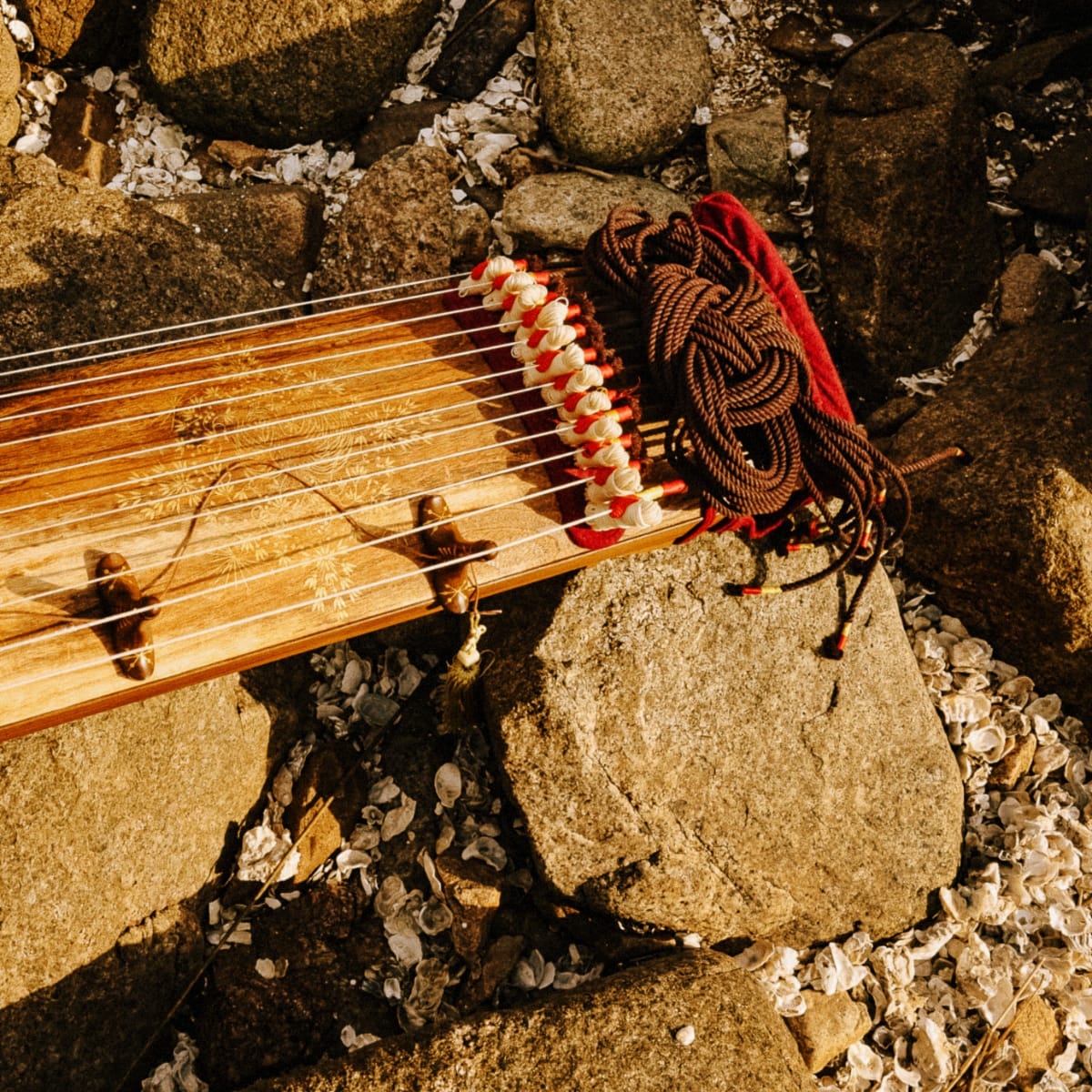
DoYeon: Yes. Mimicking was my teacher. I thought, "Why don't I mimic the trumpet sound? Why don't I mimic some guitar sound? How can those sounds be created in this instrument?" I started by mimicking the sounds of other instruments, and from there I developed new techniques. That's why I have different tools to make those sounds. Like, how can I make this sound more metal? And then I put my chopstick in it. So it always came from curiosity and mimicking.
Jonah: That's a really cool way to learn how to experiment with an instrument. You teach, too, right? How do you teach your students to play?
DoYeon: I've taught the gayageum in improvisation, competition, or Korean traditional theory. When I taught at the New England Conservatory, we talked about the important things—they wanted to learn traditional Korean music, but teaching them a song wasn't really helpful. The understanding of how it's used differs because the relationship between notes and rhythm is very different from Western thinking. So understanding that is first. For example, in Western music, it's based more on pulse, right? It's more vertical, "1, 2, 3, 4." But in Korea, if you play that way, it sounds really cheesy. We're not based on pulse, we're based on—should I say—breathing cycle. Like inhaling/exhaling and holding, so it's stretching. So the concept of the eighth note is way larger. After you make that note, how you send it to the next note is important.
A lot of people think, "Oh, Korean music is chromatic." It is not that or pentatonic at all. There are so many microtones, and the rhythm depends on our own system. So understanding that is what I try to teach students. Hopefully, music can be one of the many ways that help them open their eyes a little bit and build a real relationship with it.
Jonah: It’s funny because I was watching this YouTube video earlier today about this guy who found a gayageum for $75 with half the strings and a lot of the bridges missing. I forgot what they're called, the little bridges . . .
DoYeon: Anjok.
Jonah: Ah, anjok. He 3D-printed a bunch of those and restored the instrument. He talked about the instrument's tuning and how difficult it was from one end to the other. Then he played a recording of himself playing with a bunch of other instruments, but it sounded like he just made a regular guitar song and just slapped the gayageum in there like he wasn't thinking about what the instrument is capable of.
DoYeon: When you hear the gayageum, it uses silk strings. So when you're plucking, it's not the exact note that's coming out. It's a round note that's coming out. I'm still struggling with how to mic the instrument because the mic easily captures the high frequencies, but those frequencies sound like a harp or guitar. The gayageum needs the low frequency. Even understanding that, I still struggle with it. I hope people are more curious about the actual sound of and the depth of this instrument.
Jonah: What I felt when watching you at Big Ears was the depth of the instrument. Your theatrical performance added to that as well, but I think just to see how your hands moved sometimes, spider-like. Sometimes they pluck, sometimes they can do other things. Is the instrument made to use your hands in all these ways?
DoYeon: So, actually, the traditional way is right-hand plucking or flicking. We have techniques with the left hand. If there's an anjok move-over-bridge and left side, and then we're bending it. This part is the cooking part. This is a recent technique.
Jonah: This kind of spider movement?
DoYeon: That one, I think. Even my husband says when I do that, it's like a mouse digging.
Jonah: It makes a great sound when you do that. So you made up techniques with your hands, too?
DoYeon: Yeah. Also, how much I cover the strings to control the vibrations. So I pluck open strings, a little covered, or a bit more, and they all create different tensions.
Jonah: Where does your theatrical performance come from? Your facial expressions and your body movement are with the instrument, but also separate from it. Your stage presence is huge.
DoYeon: Actually, that goes way back. I sometimes play with Tony Malaby, the saxophone player. So before, when I played with a full jazz band, even though I had a lot of mics, I couldn't hear myself. They're so loud, and my sound was all covered up. When Tony plays with just me, he can feel my energy, but with that many instruments, of course, he can't hear me. He kept saying he needed more and more and more. But there's nothing I could do. So I started screaming, "Can you hear me?!" I screamed in Korean. I was so upset. I was like, "Why am I here? Why am I playing with you guys?" I'm screaming. Tony loved it, and the audience loved it. They said, "More!"
After that, people asked me, "Can you sing?" I'm like, "What?" So I tried it. And then I realized I could sustain notes with the bow, but because the strings are so close together, it's hard to get a single clear note. But I can do that with voice, and I can make one clear note. Then, as I was singing the melody, I had a new feeling. I found out what the gayageum couldn't do, but I could do it with my vocals.
Jonah: It sounds like you got that from one of those happy accidents in life.
DoYeon: Yeah. So after that, I was getting more comfortable using my voice. I realized it's a more direct way of sending my message to the audience. I really like the energy of that, so I started using my voice a lot.
Jonah: I felt that in your performance. What inspires your music? Specific musicians, places, people?
DoYeon: Oh, I think it's different every time. But these days, I'm thinking, "What does it mean to be human?" So I'm reading some philosophers and also reading about Buddhism—topics that keep asking about my existence, what it means, and how I can give back.
Jonah: What's something you would say to someone who's trying to learn the gayageum and doesn't want to take the traditional learning route?
DoYeon: That you can't do it. I always tell people that without the basics, you can't go further.
Jonah: So you think it's important to learn the traditional style of the gayageum before experimenting with it?
DoYeon: That's what this instrument was made for. What I'm doing is adding more to that. For example, if you don't have the rhythmic field, then it's going to be a struggle. There's always a root, and then we can go forward. Today, I wish I had studied English more. I wish I had studied Korean history. It's related. Why do we learn this or that? Without it, we can't go further; you lose your engine, and we need this engine. Same as improvisational music.
Sometimes in improvised music, it gets too emotional and can feel random. I think that's like performing your diary. But musically, you should write a novel. People are not coming here to listen to your diary, your personal self. They're here for a novel. I think there's a difference. And if you have a basic understanding, then that's good. You also need a great sense of taste in music. I think that's the basic route that I can share with the audience. Music doesn't need much, but a single note can carry so many meanings. Without that, I feel it could be too empty.
Jonah: What meaning can you see single notes carrying? In what way?
DoYeon: When we hear some jazz, and there are only a few notes, we feel it. It's sooo beautiful. You know, without that engine and without that basic understanding, that can't be delivered. It helps when they have that, plus their life experiences, and of course, their great taste in music. With great musicians, when I hear just one boom, it delivers so much. Like you can say, "Oh, that bluesy one-note really warms our heart." Or some tingling. Of course, there are so many parameters in music, but by having the basics, you'll be able to deliver.
Check out more like this:
 Meredith Hobbs Coons
 Jonah Evans


Comments