


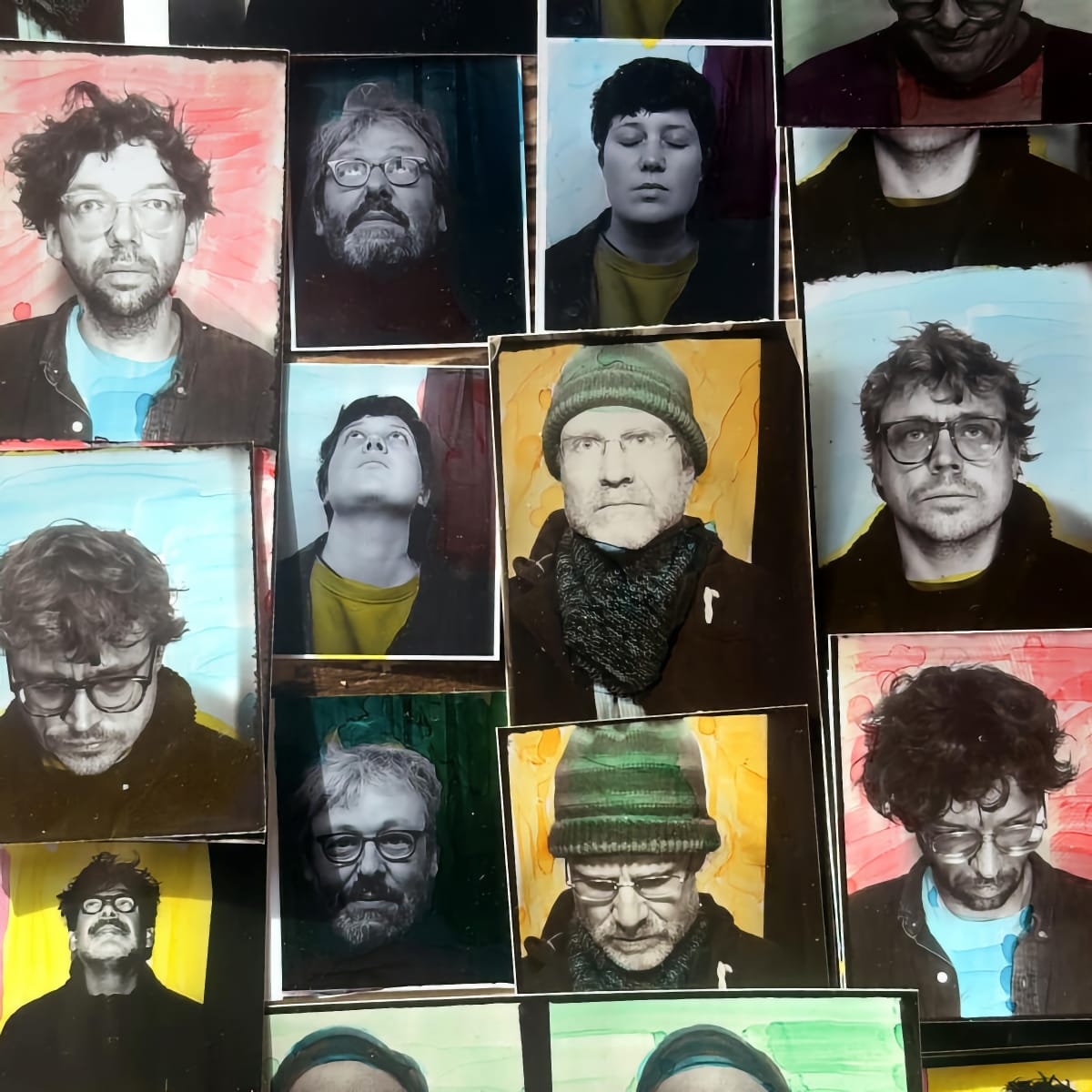
Simply put, it is a joy to bask in the sonic warmth of The Notwist's newest offering, News From Planet Zombie, from the youthful curiosity of its watercolor artwork to the hauntingly lucious production and songwriting that evolve over eleven tracks. An honest observation of the juxtaposition between life's beautiful and dark moments, News From Planet Zombie scratches so many musical itches in its retelling of a classic battle between good and evil.
The record is a mature and well-rounded output from the legendary German band after over thirty years of playing together. Reflecting on their self-titled debut from 1990, which showcases a fuzzy, noisy side of the group, this is a grown-up, mellower response to the same confusion and insecurity in the world. There are moments of folkish, pop-adjacent brilliance that remind me of the breathy beauty of 1990s–2000s Neil Young or John Cale's Paris 1919 (see "Projectors"). There is a melodic-meets-punky undercurrent in the production that is reminiscent of American bands like Cursive or early Turnover ("The Turning," pun not intended, could fit well on 2015's Peripheral Vision). Songs like "Propeller" bring a quirky, joyful flavor to the record; Arthur Russell meets Stereolab in both instrumentation and songwriting.
I spoke with Markus Acher about News From Planet Zombie, takeaways from recording a record in a live-band format, and the joys and challenges of a band sticking together for over thirty years. This conversation has been edited for clarity and length.

Sam Bradley: What are your earliest memories of things that drew you to music?
Markus Acher: You know, as far as I remember, there was always music in our family because our father is a big fan of jazz music. He played in this Dixieland band. Here in Bavaria—I think Europe in general, but Bavaria especially—you have many beer gardens, so there you have a Bavarian brass band or a Dixieland band. He was playing those all the time.
So, this was something we heard a lot and also played together with him. My brother and I started making music on our own quite early, drumming on some packages or playing the guitar with a recorder and something. So, these were the earliest memories.
Sam: You’re based in Munich. Is there anything specific about the musical scene or the community there that you find unique?
Markus: We started in a place called Weilheim, which is like a small town about 40 minutes away by car from Munich. It is this very small town, and nothing was happening. We were lucky, there were many people the same age who were also into this kind of music, more indie and also hardcore punk stuff. So many bands all of a sudden started playing and forming there, and there was a scene in this small town that was great and very influential for us.
Munich is very expensive, very rich, and also a kind of conservative city, like very beautiful and safe, and so many rich people want to live here. It makes it harder to live here as musicians or artists, people like us. What's special about Munich is that the people who stay, they really have to want to make art. It's a much smaller scene than in other cities like Berlin and Hamburg. This scene is good, and I think very connected. There's a lot of networking because people have to help each other. So, you go to each other's concerts, and you know people who are in bands and do art and host exhibitions and stuff. There are lots of really interesting things happening.
I think for us, especially for the new record, this scene helps us to continue doing what we do. We recorded it in a place that's very important to Munich (Import Export), one of the last independent alternative spaces for music. It's also a space for other stuff within the community, a lot of social and political things that happen. We decided to record our new album there because it’s an open space, and we wanted to experience it and show it. We did not want to go into an isolated studio again, but to record in a more open space. So I think that is something very positive about Munich: at a time when the atmosphere is very conservative and difficult, there’s a lot of community, connection, and collaboration among the people, artists, and musicians in this city.
Sam: Would you say the rigidness, that conservatism you mentioned, within Munich has brought a kind of rebellious scene closer together?
Markus: Yes, definitely. Also, because there aren’t many open spaces here. In other cities like Berlin, which is also getting more expensive now, but was much cheaper for a while, there was more space for these kinds of things. So here, Munich is a beautiful city with lots of old houses in the center, but there are no open spaces. People live everywhere in Munich, so you don't have empty factories or houses where you can do something for a music or art community. So, it's difficult to find spaces here.
Sam: I understand the album was recorded as a live band. How did that come about after doing it differently for so many years? Did you run into any challenges doing it this way?
Markus: It was just an intuitive kind of feeling. The last record we did, Vertigo Days, was recorded during COVID. There was a lockdown in Munich most of the time, so my brother Micha, Cico, and I were kind of locked in the studio, and we had to communicate with everyone else over the computer. We also invited international guests via computer, such as someone in Argentina or the US. We invited them to contribute, which was good because we were afraid we might not be able to leave Munich or Germany anymore. There were times when you just didn't know what would happen next. For me personally, that is something of a total nightmare. I like Munich, but only when I know I can leave and go somewhere else at some point.
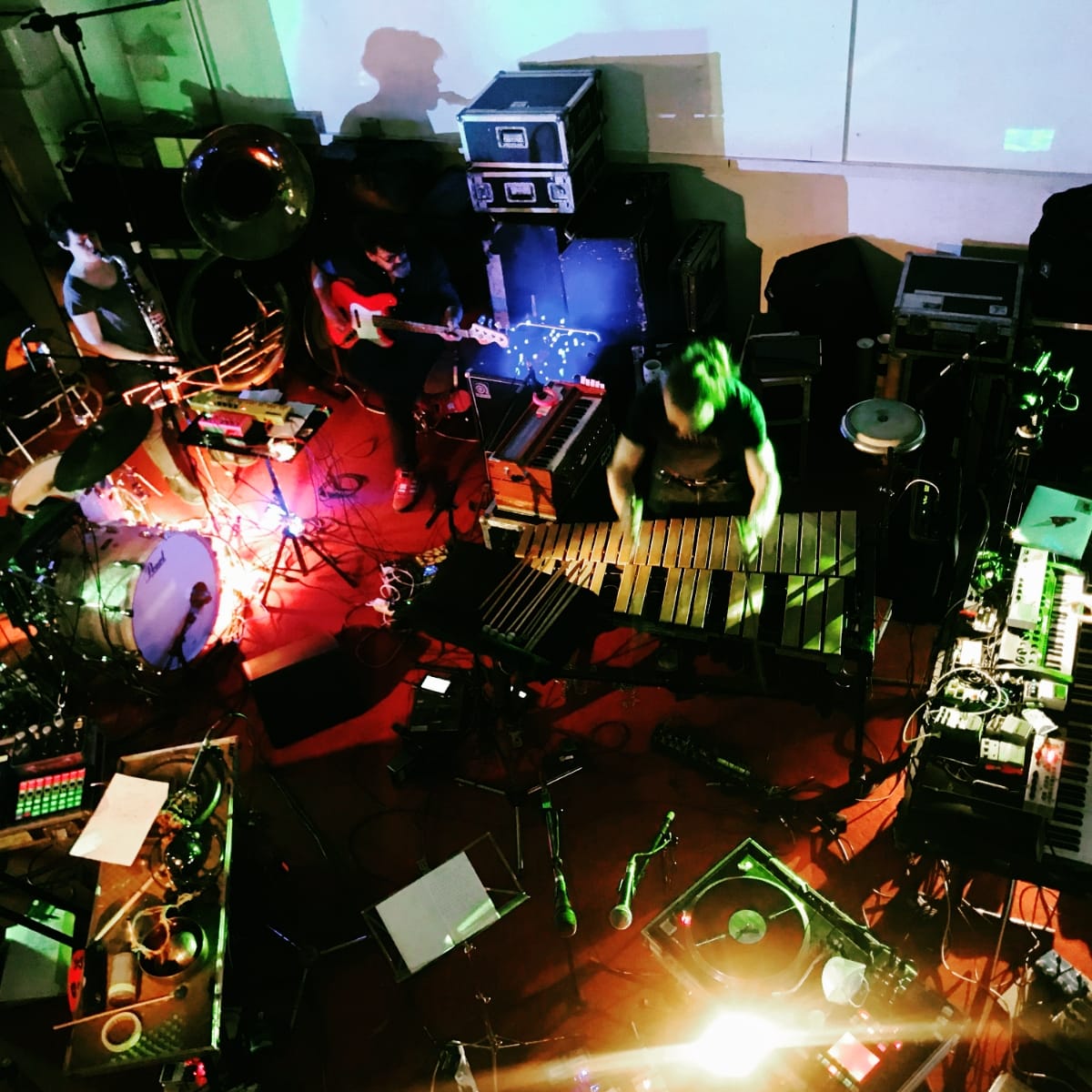
Now, when we started the new album, we started again with Micha, Cico, and me behind the computer. Somehow, we got the feeling that this is not right for the moment; it's so important to communicate and play together. We were done approaching this from a distance. We wanted to go to this place, Import Export, where there are already people coming and visiting all the time. This is like a meeting point for many people we know. And then also, we wanted to record as a whole band. So we thought this time we would try to compose songs, meet with everybody to rehearse for a few days, and then, for one week, record it all together. We were nervous about whether it would work. But it was really good in the end because everybody was focused, and it was a very special situation.
I think if you do it this way, you can't have as many layers and details as you can when you work on the computer. There's less cut-and-paste; everything we played became the record. It felt more emotional; it was very intense to play that way. That's also something I hope you can hear on the record, because everybody was in the moment and not just playing at home on their own track. This was great for us as an experience after so many years in the studio, recording track by track.
Sam: Do you find it easier to overthink and overanalyze when recording by yourself on the computer? I imagine there's a sort of catharsis in this way after recording while separated.
Markus: Yeah, definitely. It felt like the right thing to do. It can be intense and very helpful for the music. But also, I think it’s generally good not to have endless possibilities, you know?
I think being limited is good for creativity, as it focuses on the idea rather than the technique. The songs are the most important things, and not the technique. I think sometimes you hear that people lose themselves in the technique, and then in the end, there's no core or nothing, no real ideas. Sometimes in the studio, when you have many plugins, tracks, and electronic instruments, you have all the possibilities but kind of nothing. So it's better to have just a few, create with what you have, and then see if it's a good song or not.
Sam: Yeah, people always say that limitation breeds creativity. What about your relationship with writing the songs and the story they tell? Is there any sort of linear story going on in your mind?
Markus: I think what I try to express on the album is the two poles I feel my life is between. I think there's a tension. I see, globally, in this city, and in this country, political developments that make me very angry. Sometimes I feel totally powerless; there are maniacs ruling the world. On the other hand, there are many positive things also happening in my life. People are always helping each other, and they can come together and connect. I experienced many positive things coming out of very dark days. I feel there's always hope. That's something I tried to express in the songs and lyrics.
I was fascinated by some older B-movies, like John Carpenter’s, with over-the-top stories and characters who seem comical, but then, after the movie is over, you start to think about it more deeply. Especially in the US, what's happening now kind of feels like a very over-the-top plot. I think you would watch this and think it’s too much, but it's all happening now. Not only in the US, but also here in Europe, there are things happening that you didn’t think were possible anymore, you know, after all the history of the world. You only have to read history books to know how totally stupid everything that's going on at the moment is.
Sam: I think over the past few years, especially, there are a lot of parallels there, and a lot to relate with, no matter where you are in the world.
Markus: Yeah, and I think this is how I try to express it. There are the zombies and monsters, those kinds of characters and things that I think of. For a long time in my life, I thought you had to think positively, and that people were inherently good. But now I see there are some people who are really bad or really stupid. (Laughter)
I just can't understand how people can be so selfish, you know. It’s just so shocking.
Sam: In addition to your songs, the record has two covers. How do those fit in with the rest of the songs; what was the message there? I was so surprised to see that you covered "Red Sun," which I consider an under-appreciated Neil Young song.
Markus: The Neil Young cover we did some time ago for a theatre play. This was written in the play as the main character’s favorite song, so the director asked us if we would like to try a cover version. I'm a huge Neil Young fan too and have listened to so much, but actually, I didn’t remember this song; it wasn’t one I really listened to a lot. We said yes to the theater play; normally, we wouldn't do a Neil Young cover. I wouldn't dare make a new cover version, actually, but we thought it was a good idea for this play. We tried a different arrangement with the brass instruments and discovered how much we really liked it. I thought that, because Neil Young is such a big name, having only one cover version on the record would also be a bit strange.
So this Lovers song ("How The Story Ends") was one I had already covered with another project. It felt good to have it on the album as a kind of counterpoint. Firstly, it's written by a woman. It also feels like indie bands are more in our context somehow. The Neil Young song is more positive, very kind of romantic, a beautiful love song. This Lovers song is more like the end of the relationship trip, where just nothing's left anymore.
Sam: Looking back at the thirty-plus years of The Notwist, what would you say the biggest lesson that you've taken away is?
Markus: Making the music for us after a while became our profession, but in essence is really something that we have to do. It's important for our mental health, somehow, so in those times where we couldn't play live, we felt something was missing as a way of expressing ourselves. And that's why we became musicians in the first place, and it's always stayed with us.
I'm very happy that it's continued for so long, especially with The Notwist. With musicians you play with for a long time, there's this kind of communication that happens without talking.
Sam: From an audience perspective, is there anything you hope someone listening takes away from this record?
Markus: Something I wanted to express was that even if life gets really dark and heavy and horrible things happen, you are not alone. There's always the possibility of tomorrow. I know this is something I experienced. The ability to come together, to work together, to create something together always helps a lot. This is something I hope people get from this album.
Check out more like this:
 Lawrence Peryer
 Sam Bradley


Comments