


Martin Bisi recorded his first real session in January 1981, with Brian Eno, in a Brooklyn loft he had taken with Bill Laswell. Those recordings found their way into Eno's ambient releases, notably On Land. The room was called OAO at the time, for "Operation All Out," a phrase out of William Burroughs's Naked Lunch. Bisi has worked in that same building ever since, and after he and Laswell parted, he kept the space and renamed it BC Studio.
Born in Manhattan in 1961 to Argentinian parents, Bisi grew up with a touring concert pianist for a mother and a father who played tango-style piano at home. He was sent to French school, given lessons, and taken regularly to the Philharmonic and the opera. He rebelled against all of it, developing a disdain for academically accepted music, and by fourteen he was writing graffiti on New York subways under the tag Alive In 75.
The no wave and avant-garde noise bands he saw around 1979 and 1980 took hold, and he moved from mixing live sound into recording. In the decades since, he has made records with Sonic Youth, Swans, John Zorn, Afrika Bambaataa, the Boredoms, Helmet, White Zombie, Foetus, Cop Shoot Cop, Unsane, and the Dresden Dolls. He also notably engineered Herbie Hancock's "Rockit" in 1982, after a run of Friday nights at the Roxy with Laswell's band Material. Bisi began releasing his own records in the late 1980s, starting with Creole Mass, made with Lee Ranaldo and Fred Frith. For years he kept that work at a distance from the sounds passing through his mixing desk. Around 2011, he relented and openly let his influences into his own records.
The self-released Dancing On The Power Lines is the latest of these records. Oliver Rivera Drew plays drums, and Diego Ferri plays bass and baritone guitar; Joan Hacker sings, with lyrics by Nora Almeida, Bisi, and Hacker. The record arrives in BC Studio's forty-fifth year, which is also being marked by a documentary short updating Sound & Chaos, the film that first told the studio's story. "It almost took the system being on its knees for it to be something where artists could flourish," Bisi says of the New York he came up in.
Lawrence Peryer recently hosted Martin Bisi on The Tonearm Podcast. The two talked about the four and a half decades Bisi has worked out of the same building, the pull of genre and the distrust of the post-genre label, the collaborators who shaped the new record, and what it takes to keep making loud music in a neighborhood that is quickly changing.
You can listen to the entire conversation in the embedded audio player below. The transcript has been edited for length, clarity, and flow.
Lawrence Peryer: It feels like it's the same playbook every generation. Look at SoHo or Dumbo; we have neighborhoods that were once affordable for artists, and the artists made them desirable. Then the money came in, and the artists couldn't be there anymore. And we're kind of running out of places for it to happen.
Martin Bisi: Yeah. It just keeps going through that playbook. For instance, a lot of the subsidized artist spaces—there's not enough of them, and there are gatekeepers. We're really in this gatekeeper zone. Luckily, I preceded the current ownership and the gentrification era. I'm in the same building I moved into in 1979, by miracle and dumb luck. I'm in the middle of the block, isolated from the street, so I can get away with sonic murder. The portion I'm in is like a separate building that's surrounded by air, so I can really get away with stuff.
Lawrence: I'm going to assume that going out to Gowanus back in the day for you was driven by necessity, space, cost, and things of that nature.
Martin: So it's kind of funny. I was never a squatter here; we always paid rent. But I think because I paid rent, I was serious and invested in the building. Soon enough, after about a year and a half of being in the building, of shifting from maybe just having rehearsals with bands I knew, we thought, "Oh, actually, maybe we can record something." And then, "Oh, someone met Brian Eno and Brian Eno's interested." But I was always aware of the value of doing your own thing.
We've had a lot of displacement, so I'm really sad about some of the movements in these different genres, whether it's punk, jazz, or whatever. I think there was always a benefit of being near each other. I'm not so into this post-genre thing. I recorded this band I'm super happy with called Genre Is Death, and here I am saying I like genres. But I think genres are akin to social movements.
Genres have their own looks; they have their own uniforms, if you will. They have their own values; they have their own language. Once you share in some of these burgeoning subgenres, once you share spaces with people, you can talk about certain things, the value of this or that, and you're on the same wavelength.
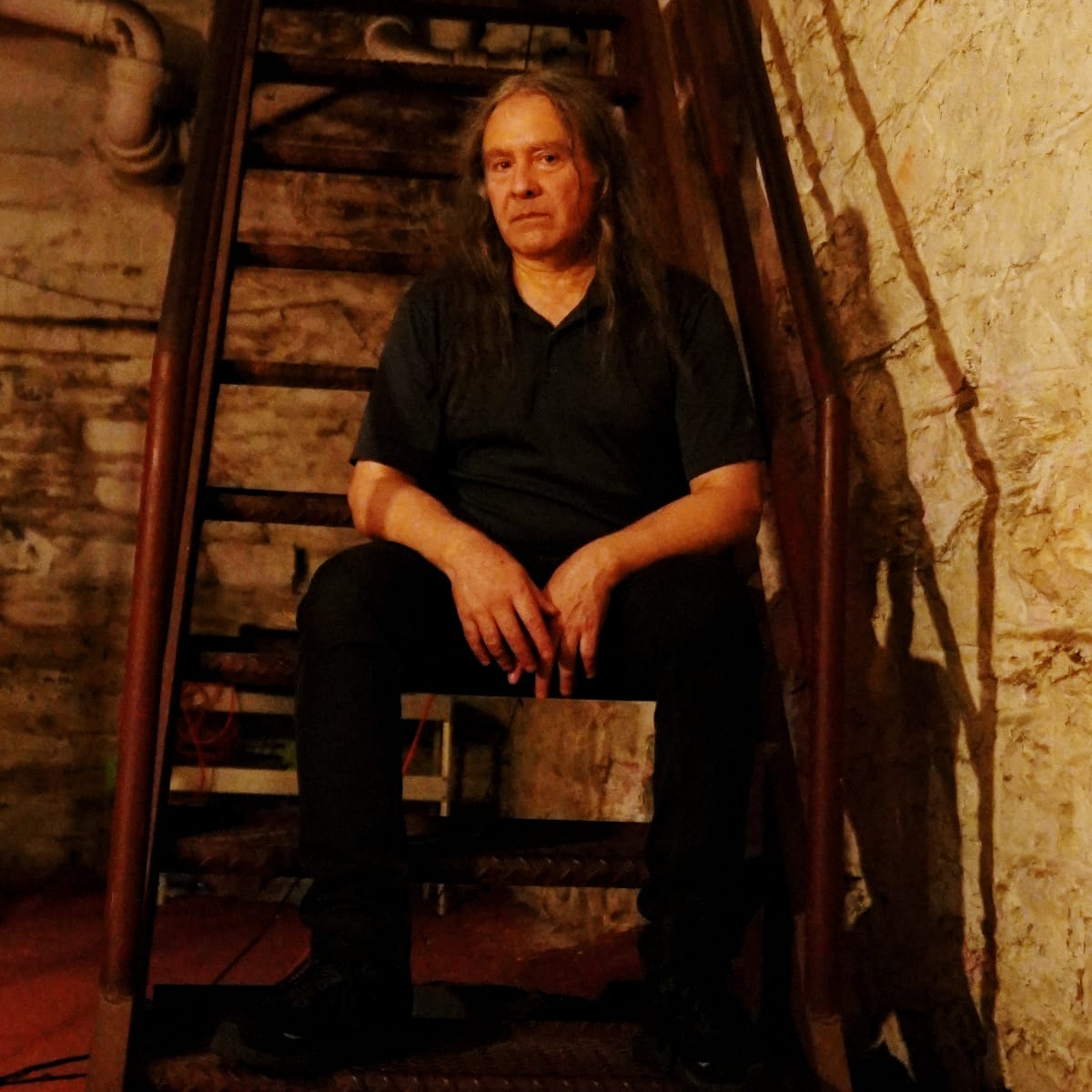
Lawrence: When I think about the era of New York—you mentioned Laswell—you guys all strike me as, if I had to pick a genre, punk-inspired. It was this group of people who came from art schools, the streets, and everything in between, and mashed all those influences together. You guys seem to represent post-genre.
Martin: Well, thanks for that. But it's funny, because I did notice that a lot. One thing that's kind of interesting is me, personally, as a recording engineer—for a while, I actually thought of these things as different lanes. And I didn't think that people would be very interested in the other lane, except musicians.
I loved this place called Max Fish. It was on Ludlow Street on the Lower East Side. One thing that was crazy about that bar was how brightly lit it was. For a bar, you think it's going to be dimly lit so everyone can hide from each other. And it was like walking into a high school cafeteria; you could see everyone who was there. It was all like this big table, so people had to sit communally.
What mattered more at that particular bar was caring about music, whether it was musicians themselves or music advocates, as I sometimes call them, writers and stuff like that. So it was a little bit like the Algonquin Round Table. But it did seem like when you organized a show, you really had to go with goth night or a metal show, or that there had to be an overriding theme.
I'm really surprised there are people in my zone that don't like metal. I even know people who, surprisingly, say they don't like jazz. And then there's, of course, the narcissism of small differences. So I've been in this situation with mods in the Strokes era. I could be a little embarrassed about being kind of goth or something, and they would be like, "Oh, the goths. The goths." And I've literally been in a bar where goth is not cool. I was in a bar with some friends who were kind of gothy, and then some mods walk in, and they go, "Oh god, mods."
In the seventies I used to be embarrassed to tell anyone that I was into prog, because that was just anathema to punk.
Lawrence: Like Johnny Rotten with his I Hate Pink Floyd shirt. (laughter)
Martin: Yeah. And then I actually went to see Pink Floyd at Madison Square Garden. And that was like a secret. I wasn't about to walk into the scene and get asked, "Hey, where'd you come from?" I wasn't about to say that I came from there. But also I'm a recording engineer. I always felt like, as a recording engineer, I really took full form. I always thought it had a little to do with not being very specific about any one of these things.
That's why I looked so strange in the early eighties. I had a headband, used to have Elegua beads, and took to an Argentinian gaucho belt. Anything but looking too specific. So it's a weird mix; like a paradox, really. You need these things to be separate lanes. Nothing happens, nothing fertilizes, unless you get some cross-fertilization.
I remember there was an article that came out in Tape Op magazine that a friend of mine wrote. He said, "Take a look at how this person's credits cross genres." And suddenly I felt like—not to be too careerist—but my whole thing jumped up a little peg, because it was important, and I didn't actually appreciate it being important, and I didn't understand that others would think it was important.
I thought it was just a little open secret amongst people in the East Village, Gowanus, and SoHo. Yeah, I also do jazz sessions, recorded a couple of jazz records, and also, oh yeah, some hardcore comes in, but that doesn't really resemble no wave. But that's not something that felt worth trumpeting. It took someone else trumpeting it: "Hey, take a look at this. Do you realize he was doing hardcore, and that he also recorded Herbie Hancock's 'Rockit?'" I never thought that would be of interest. I just didn't see how that all connected. Maybe we were slowly moving collectively toward more of a post-genre thing, where it actually took someone writing an article to see that. Even if you look at documentaries, it'll usually be about just no wave. But do we talk about how Lydia Lunch also likes jazz?
Lawrence: It's easier to root the narrative when you take out some of those nuances or complexities. And then every once in a while there would be a connection that would reach out into the mainstream, and you'd be like, holy shit, "Rockit."
Martin: Yeah, I agree with you, and I've evolved or whatever, but I try to also remind people about the value.
Metal was much more about excess, and hardcore needed simplicity, to be more about energy. And then it also started becoming less democratic because it became more about a skill set. And then there was prog metal, and then you have a lot of people with music degrees playing metal.
Hip hop and hardcore were ones that really came out of a reservoir of disaffected youth culture in a way that the other genres didn't. The others were people coming to New York to support the arts or whatever, and these other ones were, like, underclass. You had hardcore, which was Long Island working-class. Same with the South Bronx. That gave them their power. It's interesting how the name Sonic Youth is a nod to hardcore, right? You have Reagan Youth, Youth of Today, and Cult of Youth.
Lawrence: It's a very punk name.
Martin: Right. And I think a lot of people felt that, even John Zorn. There was Spy vs. Spy, which is the Ornette Coleman covers record, and in the back it references something like the Tokyo-London-New York hardcore triangle. Him doing Ornette covers with an upright bass, but somehow feeling some affinity to hardcore music. And the same thing with hip hop. That's why Sonic Youth came to me. They told people: "We're going to court a hip-hop producer."
So everyone trying to carve out this niche and self-define, it's a weird mess. And I'm sorry to be part of that mess. These genres emerge from pride in identity in these small communities, sometimes among underclass people. They wanted to stake out their thing. That was the thing with hardcore and hip hop—they tried not to be that influenced. It took years for hip hop to blend with other genres. It started very purist.
Actually, what fascinated me about hip hop was how informed and educated many of those people were about other genres. Specifically jazz. DST, who was the turntablist on "Rockit," was a jazz drummer. You could talk to him about soul and jazz. Does any of that stuff sound like jazz? Nope. But he was aware. He was part of an African American history.
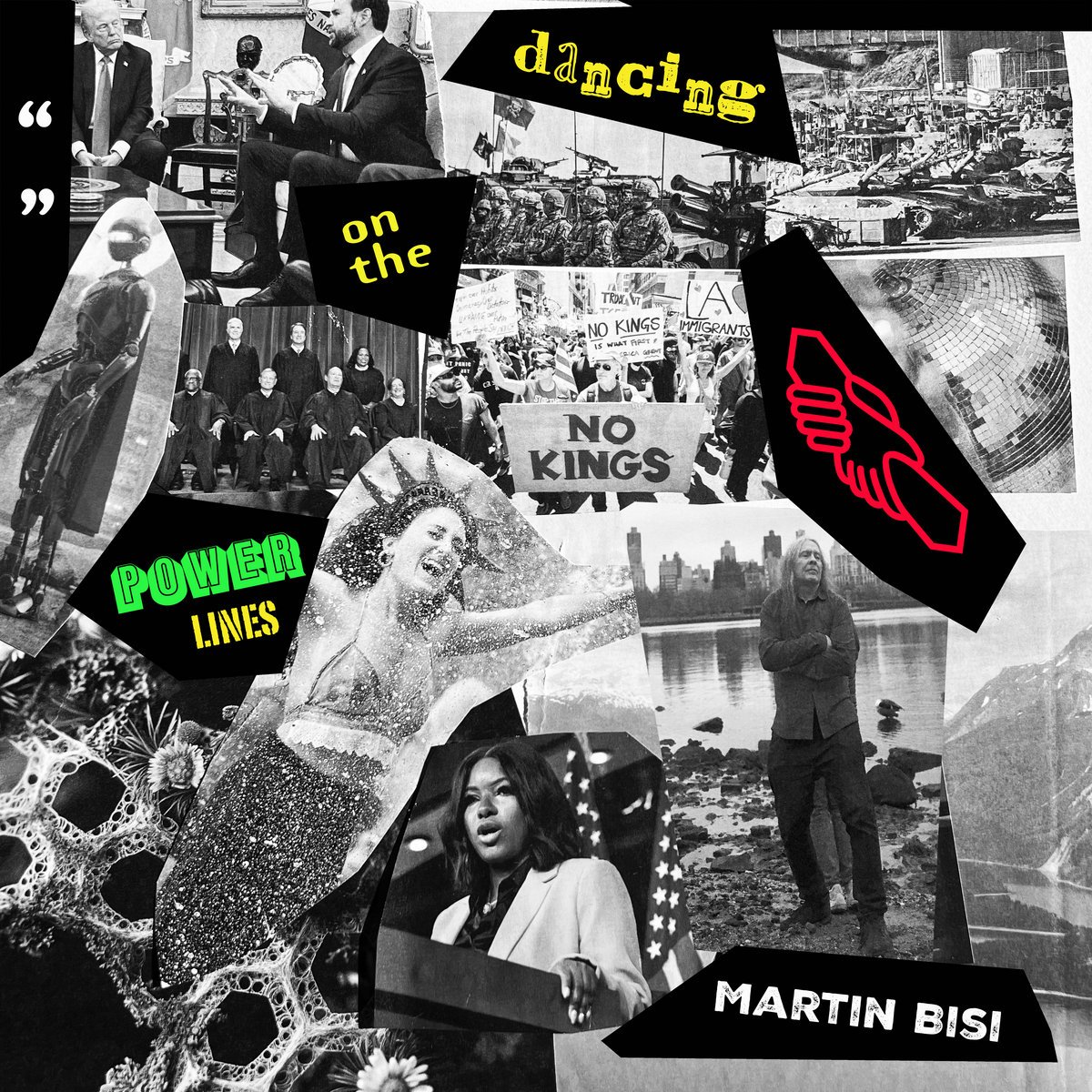
Lawrence: I want to ask you about the vocal delivery on the new record, Dancing On The Power Lines. There seem to be some really specific choices, whether it's the speaking style —almost ranting—the lyrics seem to dictate a need to rant. Can you talk a little bit about the lyrical content of the record, your specific collaborators, and then maybe we could talk about some of the choices of the delivery?
Martin: Yeah. About half the record, the lyrics were written by Nora Almeida. She's a local Gowanus urban activist and performance artist, and we did a lot of street political theater. For instance, one interesting thing we did was Cafe Rezone, where we set up a table out by the Gowanus Canal and had a few people play-acting as rich, aloof diners. I'd be the toxic waiter serving up. Someone in our group wrote out the menu, which was quite brilliant, of toxic entrées and toxic desserts. That was the essence of our collaboration. I didn't really realize she was a poet
Nora had some views from her window, and she could see a woman unpacking in a kitchen. And there was a U-Haul storage building, and Nora could see this from her window. She goes, "Oh, I call her my U-Haul girl." So this sort of twist of finding this beauty in a storage building; I said, "Oh, that almost sounds like it could be a song."
And then she says, "Well, from my window I wrote a song about CubeSmart." CubeSmart being a big, massive building with cubicles for all the new residents of gentrified Gowanus. It's like this monolith. And she goes, "I have this thing called 'CubeSmart Sunset' because that particular CubeSmart really overlooks the canal."
She gave me that poem, so I moved some words around and repeated some. I was like, this is fantastic. It's my view also. And then there was stuff in there talking about the toxicity, the canal, and like the new buildings rise, like toxic people. So even the buildings themselves are part of Gowanus's toxicity. A lot of it became political, because she was writing for me, and then she and I were having these endless conversations about anarchism and about bureaucracy. So all this stuff, she really brought it into this poetry.
"CubeSmart Sunset," that's her title; she wrote the whole thing. Some of the other songs, I just had a title but no words. So, for instance, the one that became "Dancing On The Power Lines" was titled "Sparrow Dive." And then interestingly enough, there's this person that was sort of part of my New York City–based band, Joan Hacker. I thought she was going to do synth, because she's a synth player, and instead she gave me back a bunch of singing, and some of it was really nice and I liked her voice.
So Nora rolled with that—one sparrow, one hawk, a gentle bird and a predatory bird. And then put them on power lines. And that was a double entendre of our lives dancing on the power lines. At that point I was sort of coming to terms with the idea of celebration, because I had never really made very celebratory music—fun and dancing as defiance, kind of sticking it in their face. So that song, I was like, okay: "Dancing On The Power Lines." A slow drumbeat is a heartbeat.
It's interesting how, for stuff that people think of as very prosaic, which is political concerns—in fact, even municipal concerns, flooding, sewage retention tanks—there could be art in that. It's kind of amazing, really. In some of her lyrics or little bits that have anger, just one line: fuck them all.
But there was one thing I did in "Solace for Dollars" that was like a rant that puts me back in my bedroom, surrounded by the failed state, and there being migrants under my window trying to cross the river or something crazy. I was like, "I'm going to do one take, even if I run out of breath, and ramp it up to a frenzy and to anger."
It was interesting how there had to be anger dwelling there. That's a super important emotion to me, because I think that's the most taboo emotion of all, and that's the only place it can really be socially acceptable to put it. I'm telling the bureaucrats, like, fuck them all. But try doing that at a public hearing. They're going to be calling security, and they're going to have a bunch of bruisers there with guns sort of hovering near you.
Lawrence: Disappearing you. (laughter)
Martin: So it's taboo. I'm not very angry emotionally. I don't have an anger management issue. It's an intellectual anger, but I do think it's worth expressing. I do care about expressing the emotions tied to the intellectual concept that brings us the anger.
On some of it, specifically on "Dancing On The Power Lines," I sound kind of cranky. That's kind of on purpose. I didn't want to be too sweet, not too angry, not just talking. I felt like it should have personality, not something that's too concerned with being in tune. So I took on a cranky persona, but it's still me. Imagine me without my coffee, maybe DJing. I kind of felt like a cranky DJ that doesn't have a great voice.
Lawrence: That's so funny.
Martin: I really love recording voice. That puts me a little bit at odds with the John Zorn world, which is more into instrumental music. Which is funny, because I think it's instruments that drew me to music. It's not so much voice. Like Frank Zappa, I liked some of his humor and stuff, but it was really about the players. I like Terry Bozzio on drums, and I like Jimi Hendrix.
In the end, I've actually surprised myself how much I really enjoy working with voice. So, for instance, vocal comping —where you pick pieces from different takes by vocalists—I love that process. That's why, inevitably on this record, there is the occasional thing that might sound like a hook. There are some harmonies, because I like that zone, so I slip them in where I can.
The one thing I did with Iggy Pop was Instinct, a record that was produced by Bill Laswell. Laswell, once he became too big for his britches, too big for Gowanus, would still occasionally come back to BC Studio because he's almost an alchemist. He liked to get some of the dirt, get some of the grit, hoping some toxicity would just sort of sprinkle onto the recording. So he would record something with me. There was Ramones, and then he did that with the Iggy Pop record. So I recorded all the vocals, with a lot of comping.
Iggy had no patience for comping, so he would sing a song three times and would actually name the takes different things. He would write it down. "Okay, I'm writing out 'Juve.'" That was a word he wanted: Juve, as in juvenile. And then there was 'crooner,' and that was some other characterization.
So he would do like three or four takes, then he'd go, "Okay, have fun." So we would have to figure out: do we start juvenile, or do we build with juvenile, or was juvenile just for the choruses? Is crooner just for the bridge?
Lawrence: I was curious about remote recording, especially as an engineer. Do you perceive it as a trade-off to have people record remotely?
Martin: Yeah, it's definitely a trade-off. I generally don't like it. I would much rather say on my new record that everyone was here in the studio recording. With remote mixing, I find both parties settle. That's what I don't like. There's a point where people are trying to explain something to me, and I get kind of in the ballpark, and they'll settle. And then the same happens the other way around.
I do like working on the whole project, from front to end. When people are doing something here in front of me, even though there's not a lot of deliberation, I get it. There's another way of communicating that happens. And I also think about building community.
I went to see Glenn Branca's Symphony No. 13 with 100 guitars at Lincoln Center. And I was like, "Okay, this is really amazing." And there were so many people from bands I recorded. People were like, " Do you remember me? We recorded at your place in 1987." Like endless—dozens, dozens. So many people crossed through BC Studio that there were, of course, some who were actually from the Glenn Branca era. And that was kind of nice.
It occurred to me a little later that it was nice to have been there and accessible to a lot of people. I'm embarrassed at all the people I've forgotten. I think the bands and artists that I am compelled to speak about more, I remember, and I remember the sessions more, but all kinds of stuff is gone. So my apologies to the universe for not remembering everything. (laughter)
Check out more like this:
 Jon Buckland
 Lawrence Peryer


Comments