


Billy Polo is a drummer who arrived at audio engineering through dub. He bought a four-track recorder, built a studio in his parents' basement, and, by his own account, never really left. "I got into recording because I wanted to mix dub," he has said. "In a way, I'm still that kid." Over more than two decades working in reggae and dancehall, he has built a reputation as a producer, mixer, restoration engineer, and archivist, with session credits that include Lee "Scratch" Perry, Eek-A-Mouse, and Ranking Joe, among many others.
Polo currently handles audio restoration, mastering, and catalog management at VP Records. This storied imprint, headquartered in Jamaica, Queens, has served as the central home for Caribbean music in the United States for more than fifty years, with a catalog spanning reggae, dancehall, and soca. The company traces its origins to Kingston, where Vincent and Patricia Chin, whose initials gave the label its name, entered the music business by maintaining jukeboxes at bars around the island. Vincent began selling the displaced records rather than discarding them, and from that foothold came Randy's Records, a landmark retail shop at 17 N. Parade in downtown Kingston that opened in 1958, and then Studio 17, a recording facility frequented by Bob Marley, Peter Tosh, and Gregory Isaacs. The Chins relocated to the United States in the mid-1970s, and the company remains family-run today, with sons Christopher and Randy overseeing a portfolio that includes Greensleeves Records and 17 North Parade, a reissue imprint focused on reggae's foundational catalog.
For years, Polo also ran the Clive Chin 17 North Parade Lost Archives, a collection of nearly 1,000 tape reels covering some of the most consequential material in reggae's recorded history. Working directly with Chin gave Polo access to the catalog and an extended education in the decisions that shaped the music at the source. The work influenced his understanding of his own place in that continuity. "Sometimes I'm leaning maybe ten percent more artist, or ten percent more scientist," he has said, "but it's all a hundred percent archaeology." His own releases under the PPR Musik imprint, including Disinformation Dub and Halfway Dub, draw on that recovered sensibility and carry classic production methods into contemporary work.
Billy Polo recently joined host Lawrence Peryer on The Tonearm Podcast. The pair discussed the technical challenges of translating vintage reggae recordings into digital formats, the balance between artistic judgment and forensic precision in tape restoration, Polo's working relationships with the legendary figures of Jamaican music, and the urgency of preserving specialized knowledge before it disappears.
You can listen to the complete conversation in the audio player embedded below. The transcript has been edited for flow, length, and clarity.
Lawrence: Let's start with some challenging scenarios. How might an audio master drive you to drink?
Billy: With anything, each one of them has its own individual set of circumstances. With reggae stuff, the kick and the snare are usually a lot louder than the rest of the music, because it's big-speaker music. When it comes booming through the sound systems, when you have all that bass getting juiced, it might flood out the vocals, it might flood out the drums. So on these mixes straight off of the tapes—the original mixes—sometimes that doesn't always translate to digital the best way. You've got to finesse things a bit and make sure they sound good digitally. Otherwise, you just get vocals and a kick drum, and you're like, "All right, that's the song, huh?"
Lawrence: Is that because a lot of times the mixing engineers don't know how to prep something for mastering?
Billy: It's actually kind of the opposite. These guys down in Jamaica, the mastering process was cutting to vinyl or cutting your lacquers for your dub plates, or for your record that would go into production.
I have the good fortune of working with Paul Shields. Any questions that I have—like, "How did you guys do it in the seventies? How did you do it in the eighties?"—he's given me more information than I could ever think of. Things I wouldn't even have imagined.
It's nice being around some of the older school guys, the foundation guys who were there. So if something doesn't make sense to me with my modern ears, I can ask him, and he'll be like, "Oh, we just did that because it worked out well," or "We already knew the mix was good, and we'd just send that straight to cut, straight to production." And a lot of times these mixes would get cut in the studio, and then that same night they would be playing on the sound system on an acetate. So who's got time to master something when you just want to get it out to people?
That's kind of the wildest part of some of this. I was talking to him a couple of weeks ago. He was telling me that, with the way the studios were dialed in, the consistency was always there. Like, if you could listen to something that [King] Jammy tracked, or even coming from Channel One, the essential recording was always the same because they were going through their console, and the console was your preamps. It's not like now, where it's like, "Oh, I'm going to use the Quad Eight on the kick, and then the Drawmer on the snare." In their consistency, it was just an elegant simplicity that produced the same great result every time. That was pretty amazing.
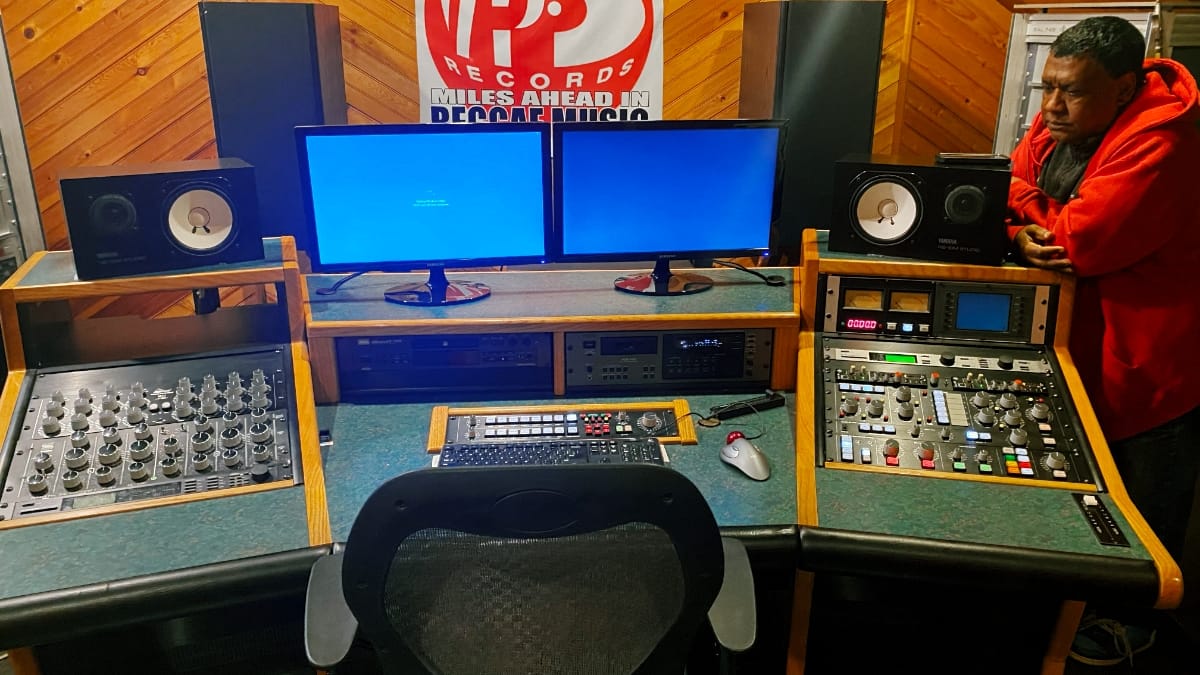
Lawrence: Tell me a little bit about your origin story, both with the music and with audio engineering. Were you already into engineering when reggae became part of your life, or is it the other way around?
Billy: Music was always just part of the family growing up. My oldest brother has been one of the best guitar players I've been around since I got into music. He's ten years older than me, so there was a stretch where, when I was young, he would take me to the studios with him when they would do recordings. You're like a twelve-year-old kid in a recording studio, you see all the dials, it looks like a spaceship—that kind of piqued my interest.
Fast forward to when I was maybe eighteen. I started really getting into reggae music. I used to work at this graphics place, and there was this guy there, this punk rock kid who found out that I was into reggae and gave me this mixtape that a friend of his made. It was not most people's entry into reggae, where they get Legend or something like that. This was deep stuff right off the bat—hearing Augustus Pablo for the first time, the King Tubby stuff. Hearing that and thinking: you can be just as creative as a musician playing a drum part—because I'm a drummer myself—by doing a mix where you express the same creativity as an engineer. Dub got me hooked on it that way.
Lawrence: What's your self-conception broadly? There's the engineering, but then you still create music. Like, if I run into you at a party and say, "What do you do?"—what do you say?
Billy: First and foremost, I'm an artist writing music, producing music. There's nothing I love more than playing drums—absolutely nothing. Next, producing. I love producing—getting in there with artists, exchanging ideas, and bouncing around ideas. I like it when people get passionate about their ideas, because then they'll fight for them, which means they're trying all kinds of different things. I'm a musician who got into engineering and found his niche.
Lawrence: In your archival work, how much of an artist are you allowed to bring to it? If the original people aren't there and you don't have the manual for what they were doing that day—and I'd imagine a lot of tapes come in without session notes—there's art and science, right? Can you pull those apart and talk to me about when you're doing scientific work—restoring, preserving—and when you're doing more interpretive, artistic work?
Billy: On the artistic side, when the A&R team wants to do a release—and I've done this with some of the stuff from Jammy's catalog—they would put out an original mix that was mastered at, say, Townhouse or Trident Studios back in London in the early eighties. Those masters, the low-end information is there, but it's not meant to be cut onto the record. It's meant for the listener or the sound system to turn up the bass and really make the song bloom. But those masters sometimes don't translate to digital as well as you'd like.
In some cases, we have the mix Jammy did that didn't go to Townhouse, the master Jammy had, and the master Townhouse had. The master Jammy did was more bass-heavy and a lot warmer. I usually opt for Jammy's mix for a digital release because it translates to digital much better. That's where the art side of it comes in, as the engineer, that's where you get to apply your ear—my taste thinks this would translate better to digital. Now, if we were doing a physical release, I would go with the Townhouse master, because that was specifically designed for that format.
Sometimes there's a lot of actual noise that gets in the way, or when people transferred these tapes, maybe the left side was out of phase. So that's where the science and the art kind of fold into one. Sometimes I'm leaning maybe ten percent more artist, or ten percent more scientist, but it's all a hundred percent archaeology. (laughter)
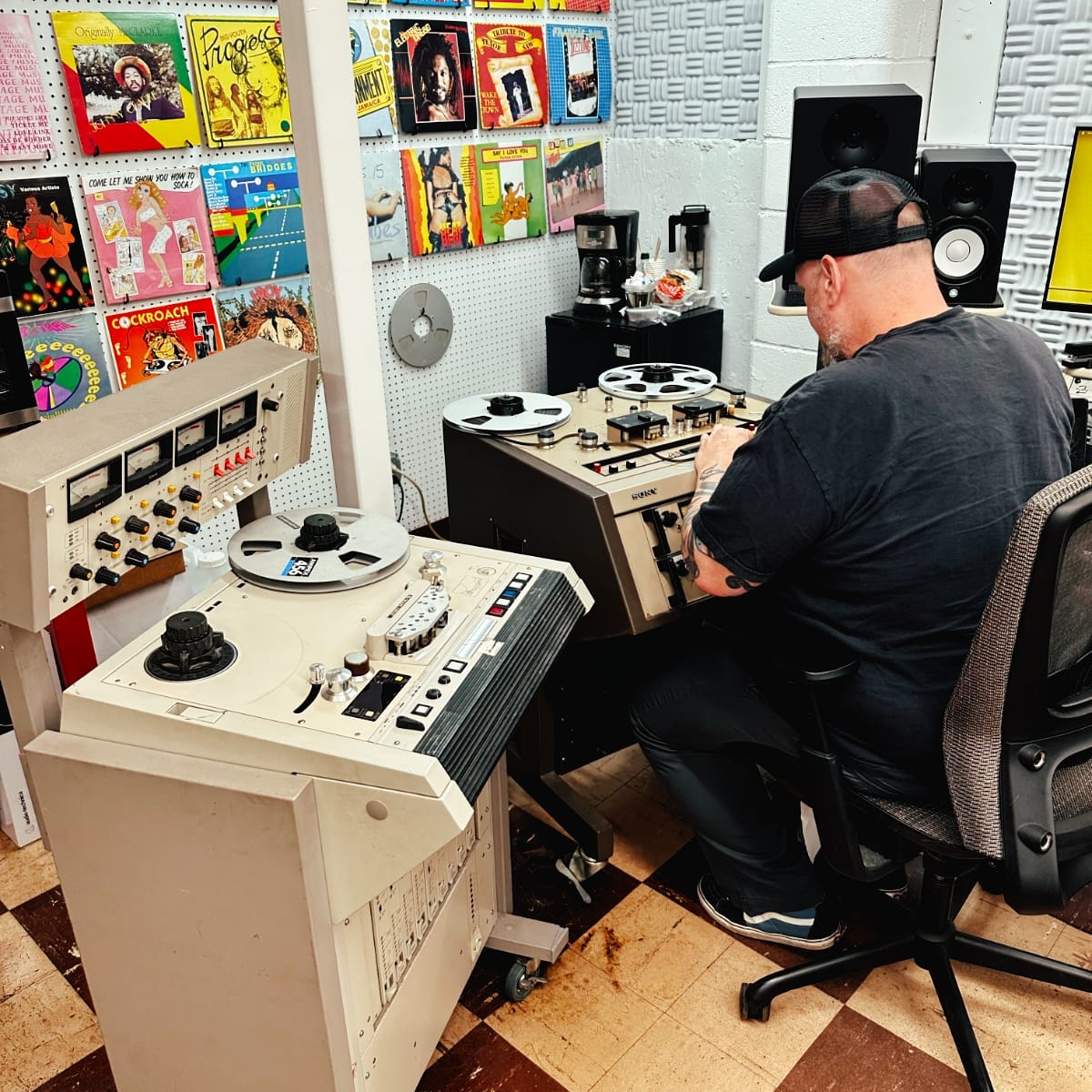
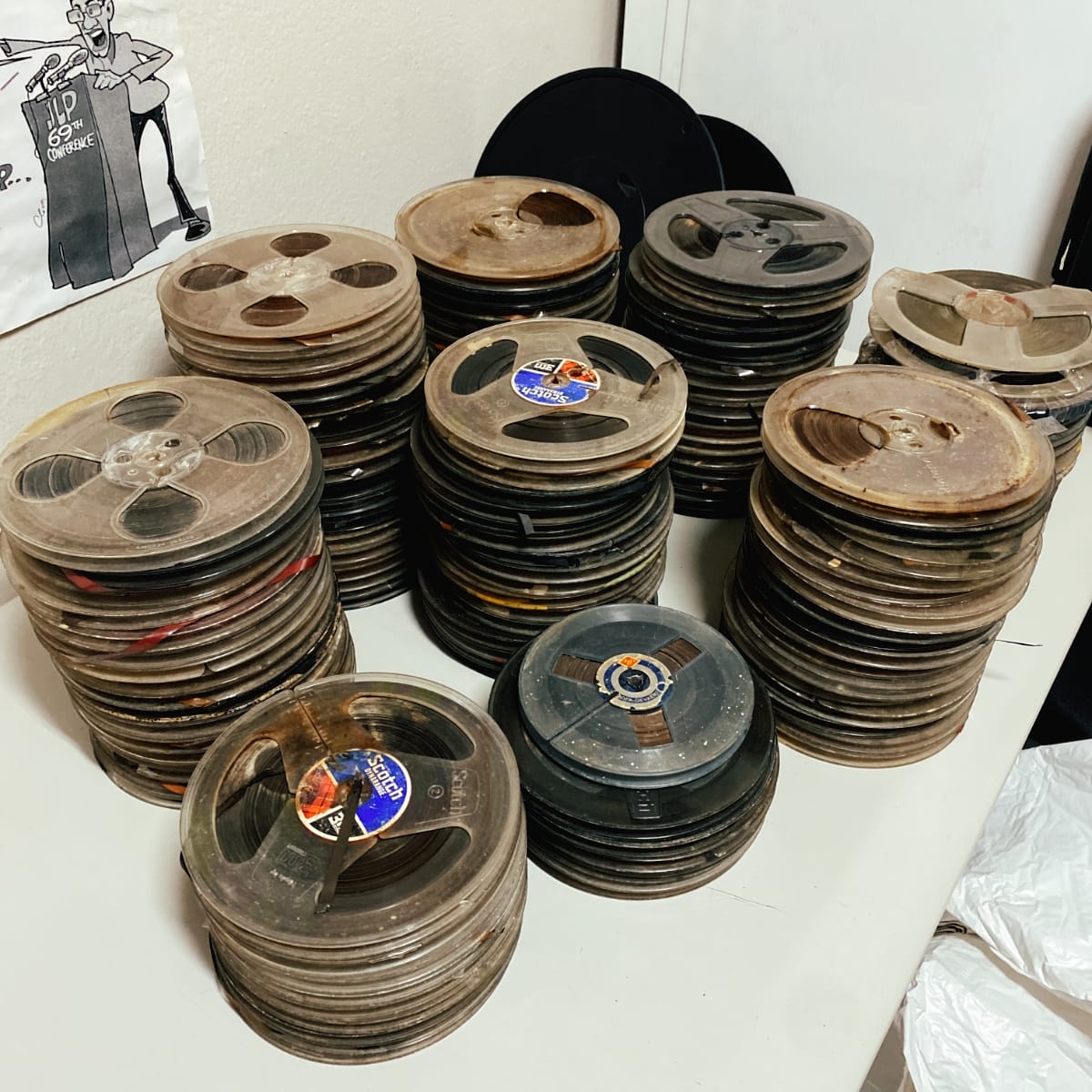
Billy Polo at work and some tapes that need a lot of work.
Lawrence: Can you talk a little bit about the conditions of things? What happens when you open a box?
Billy: There are some things that are just in our archive. You open it up, and there's a handwritten note, or an invoice from 1973 to Robbie Shakespeare from Robbie Lyn, and with the multi-track tapes, there are unique track sheets from Dynamic Studios, or a Byron Lee session, or other things. Sometimes there's nothing there. You bake the tape, you put it on, and you're completely surprised. Other times you bake the tape, and there's nothing on it, but the box is labeled, and you're like, "I was hoping that would at least yield something." And sometimes it's like the end of Raiders of the Lost Ark, where they open up the Ark, and everything comes flying out.
Lawrence: Don't look! (laughter)
Billy: Yeah, exactly. A lot of times, finding old track sheets, finding Linval Thompson's phone number on something—those little things are always interesting. There's also a good percentage of what's written on the box that isn't actually on the tape. You get through the tapes, and there are maybe ten minutes left. As an archivist, you've got to run the whole thing because you never know what's at the end. And all of a sudden, pow—there's something you had no idea existed. Then I bring it to the A&R guys, Carter Van Pelt and Chris O'Brien. These guys are encyclopedic. If they say, "Wow, I don't know what that is," then I totally know we just stumbled upon something.
Lawrence: Does that happen often?
Billy: One of the interesting things is that the reason so many things get lost is that people start to cherry-pick. What's written on the box is not what's on the tape a lot of times. So you have to start from one and work your way down, and when you hit the end, then you know what you have. There are always some gems. There's always that end-of-tape surprise, or the jam that's not mentioned, or the song that on the production master faded out—but on the tape, there's ten more minutes of guitar solos.
So when I started here, I did a revamping and started from one. Now we've got the catalog itemized—not what's written on the box, but what's on the tape. The A&R guys, Chris and Carter, have been loving it because they're like, "This is actually what's on the reel." Because things get swapped, lost, or end up in the wrong place. There are so many auxiliary factors. Next thing you know, you think you're sitting on all this stuff, and then you go listen to the tape, and you're like, "Oh, actually this is all gospel music."
Lawrence: Is your work primarily driven by the needs of A&R, or is there still an archiving and restoration strand that goes on where it's not reactive to a request—you're still just building the vault?
Billy: They do give me a little bit of freedom to conceptualize. If I come across something that I think could be turned into a product, maybe not this quarter or next year, but eventually—go ahead and restore it, go ahead and master it, or at least get it into a condition where if we were going to turn it into a product, it would be ready. I can fire shots for the A&Rs, but I always like to have bullets in the chamber for when they run out. If I know the audio is good, I'll go ahead and finish it, get it ready, alert the A&Rs, and they'll run with it.
And I have clients outside of here as well. I did the composer David Amram—Splendor in the Grass and The Manchurian Candidate, the original soundtracks and scores. He is a phenomenal composer. Some of that work was amazing—recording at Carnegie Hall in 1968 with two microphones. The archaeological side of your brain starts kicking in, and you can kind of hear the setup and visualize yourself there.
And maybe it is a race against time because of the tapes. We're at a point now where, no matter how well your tapes are stored, some of these things are coming up on sixty, seventy years old, and the lifespan is about eighty for these things. That was one of the things I didn't expect to have to learn—the composition of tape and formulas and all of that science-y stuff. Now I know about Agfa and all the rest of it.
Lawrence: Do you like knowing that? Is it interesting?
Billy: It's definitely helpful. I've been putting together a list that I might publish as a manual in ten years or so—it's information that's not really out there. If you're into the archival side, it would be like a service manual for archiving tapes.
I learned a lot from a gentleman who was a tape-rep salesman and had been in the business for about 60 years. I bought a bunch of empty tape boxes from him. I was asking about the boxes, he was asking about tapes, and we just ended up talking for about two hours. He was giving me all this information—"Oh, this tape, and then in this year it switched, and this is how you can tell the difference between an acetate tape and a Mylar-based tape just by holding it up to the light." All these trade secrets, inside info, salesman knowledge—"this is the composition of that, and then they stopped it because it was having shedding problems or it didn't adhere, and then they switched the formulas." Just incredible information you're never going to find in any book.
Lawrence: That seems super valuable.
Billy: Yeah. I do want to do a call with him one day and ask, "Can I record our conversation?" Because that's the thing—a lot of these guys are of advanced age, and when they go, so much of their information goes with them. It's a hit to the industry.
Lawrence: Tell me a little bit about lineage. If we keep looking at the guy behind us and the person in front of us, the pool of people who came before actually gets smaller and smaller. Ultimately, you get back to whoever made the tape machine or knew everything about all the tape machines. How much do you think about your role in that?
Billy: I'm just happy to be a link in the chain—to hold my little part together for the whole thing. Even with David Amram's archive, there's audio I transferred that was turned into records that are part of the history of a composer's life. Contributing to Jamaican history by preserving and archiving this music and having that spill into cultural life and Jamaica in general—yeah, just being a link in the chain is fine with me.
When you first get into these things, you think, "Oh, I came up with this idea, this is my secret, I keep it close." And then, as you keep going and either start to level up or just expand your circle, you find that you get better the more you talk about things and trade information with other engineers. You might exchange some info with another engineer who's doing something similar, and maybe they have an intern right now who could go on to be the next Alan Parsons or George Martin or something like that. Sharing information is huge. It's not worth holding on to anything—because when you go, if you have anything substantial and you haven't shared it, you're kneecapping anybody coming after you. And we all have something to say.
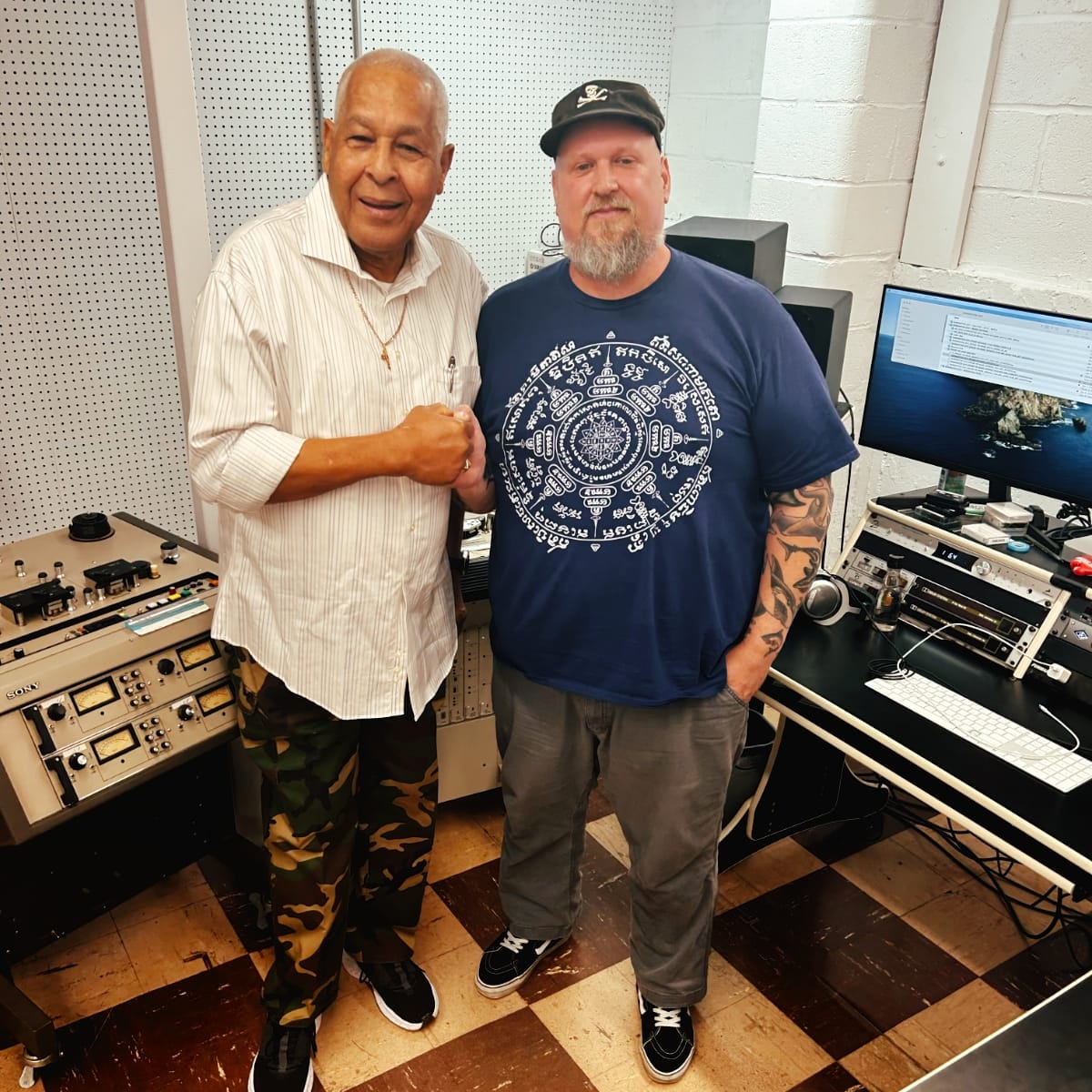
Lawrence: How much opportunity have you had over the years to either professionally work with, or just co-mingle with those who came before you, whether in Jamaican music or the broader engineering community?
Billy: When I started working here, they sent me down to Jamaica a few times to go to Jammy's Studio. I've been learning a lot directly from him—whether it's me calling him to ask something or just being there. Obviously, I worked with Clive Chin—we ran his archive together for about four or five years, which meant being with him every day and having the opportunity to ask him all kinds of questions.
The guys are still around, a lot of them, and they're some of the coolest people you'll ever meet. They have no problem answering questions or sitting down for a chat about most things you'd want to know.
One of the guys I really wish I could have met—though this is way before my time—was Graham Goodall, an engineer at Federal Recording. Back in the days before you could go to the store and buy a Mackie or a Midas, your studio was built from the electrical outlets all the way to the windows. I worked on a lot of his tapes. I remember the earliest one I worked on is from around 1963, and the latest from somewhere in the early seventies—and his formatting, everything, was exactly the same across that whole stretch. You could recognize his work instinctually after a certain point. You could just tell by how it came off. Guys like that—I really wish I could have conversed with him. But then again, everybody would love to meet Jimi Hendrix and talk to him, too. That's the level of my wishlist.
Lawrence: Tell me about Lee "Scratch" Perry. Did you spend time with him?
Billy: I ran a couple of shows. One was at a place on the West Side—my friend Josh Werner was playing bass with him, they put the band together, and they had me come in to run sound and do dub stuff. Doing dub in a live dance situation is a little tricky because you want to stay out of the way of the vocalist, make sure the song comes across, and, a lot of times, I've seen it just turn into mush. So I was definitely not going to experiment on the Lee Perry show. (laughter) My personal exposure to him directly was somewhat limited. But I have worked on a lot of his music—Black Ark-era stuff. I've put my hands on the tapes that he had buried in his yard.
Lawrence: Wow.
Billy: We have some Lee "Scratch" Perry tapes that I have run. When a tape sheds, there's the magnetic side and the adhesive side, and pieces—even in their worst condition—will just fall off. They'll separate, and you'll get these big chunks of tape. I ran Lee Perry tapes where the tape hits the head, and after it hits the head, it turns into glitter particles that go into the air.
The music is magic. It's the only time I've ever heard something come off of tape where I'm thinking, "There's a spirit in the room with us right now. There's something bigger than just a really cool song coming off of the tape." And then you look over at the tape machine, and there's all this sparkly glitter going off into the air, coming off the head. Everybody's just sitting there, not saying a word, totally sucked in. So even beyond the physical, the magic is on those reels to that extent. There have been tapes where I've heard Marley stuff, Tosh stuff—just beautiful, beautiful music—and you get drawn in. But once in a while, these Perry tapes, man. It's like you're in the Black Ark and you just feel differently. The air in the room changes. Whatever kind of juju that is, it's real.
Check out more like this:
 Lawrence Peryer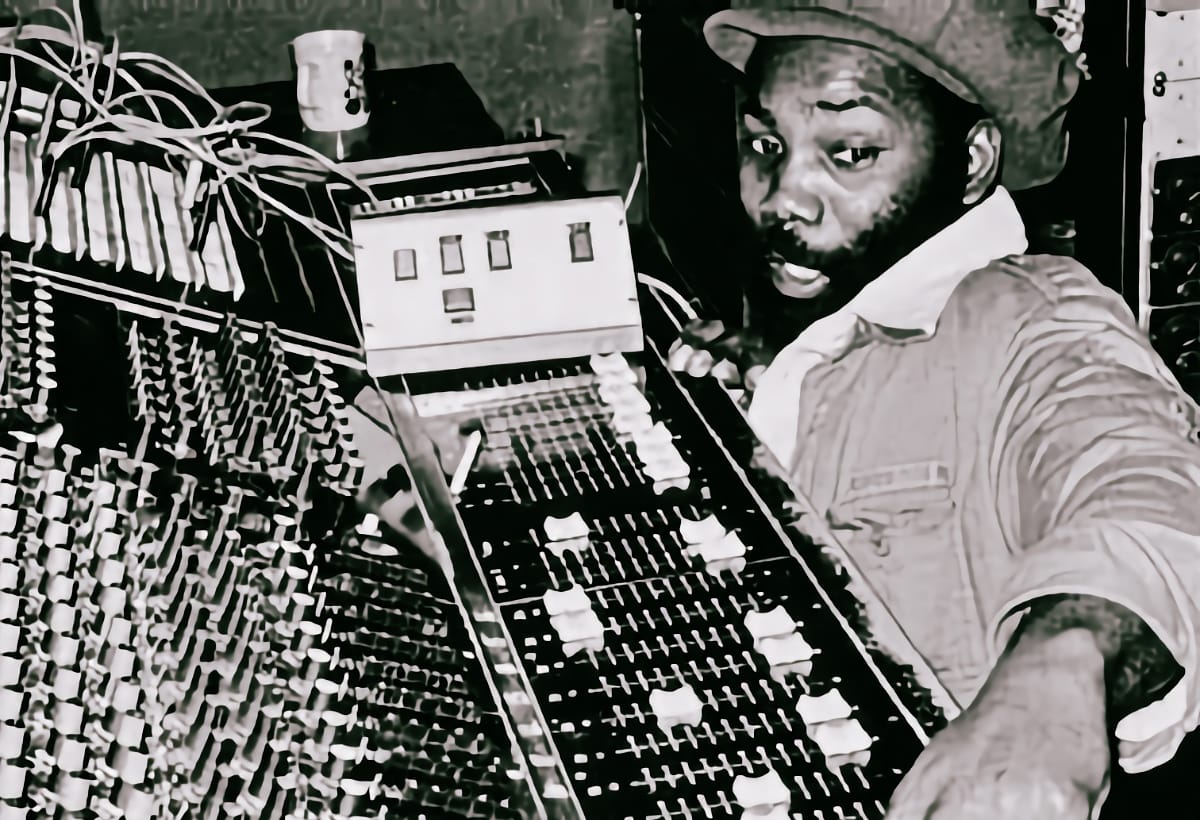
 Lawrence Peryer


Comments