


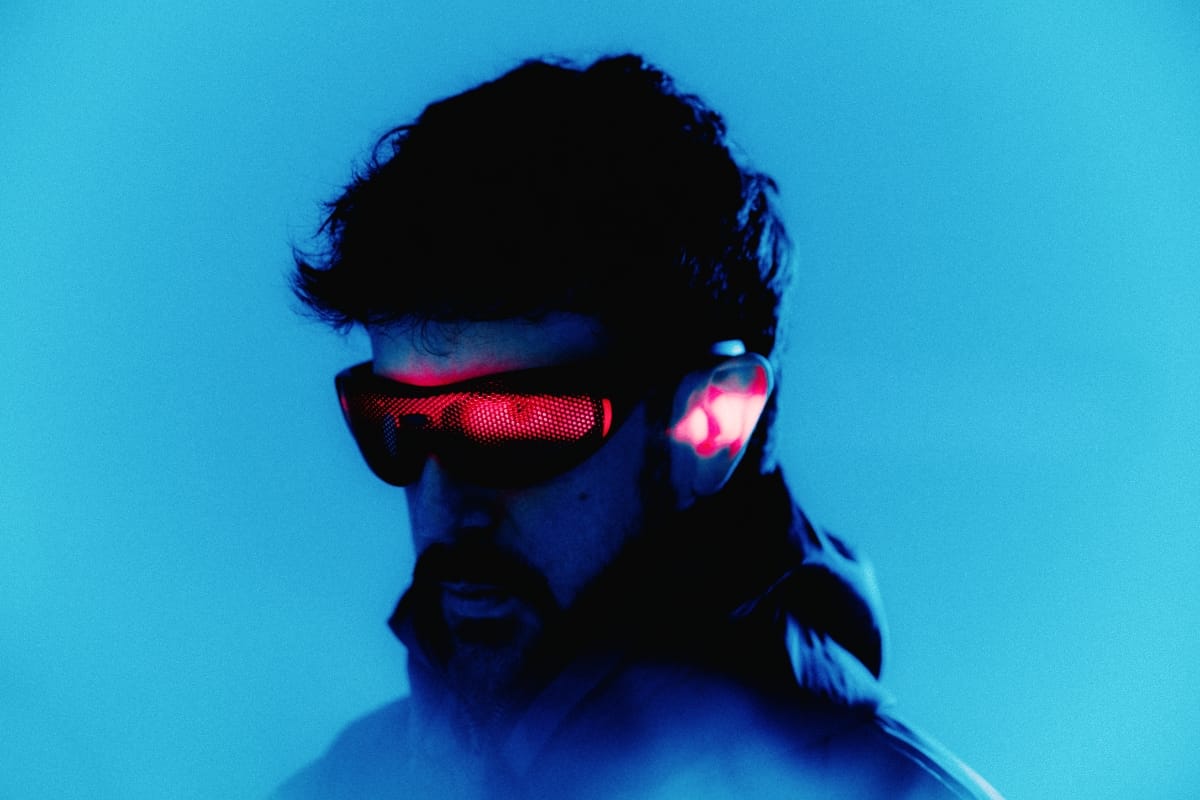
Synthesizer aficionado Dan Leavers records and performs as Danalogue, and is a founding member of The Comet Is Coming and one-half of the duo Soccer96. For years he has been a fixture of Total Refreshment Centre, the East London studio and venue that became a hub for the city's restless jazz and electronic scenes.
Danalogue's work has been supported by Thom Yorke and Mike D of the Beastie Boys, A-listed on BBC 6 Music, and featured in the television series I May Destroy You and Utopia. With Ken Ishii, he co-wrote the score to the virtual-reality game C-Smash VRS. As a producer, Danalogue has made records for Snapped Ankles, Rozi Plain, and Joshua Idehen, and collaborated on albums with Alabaster DePlume and Sarathy Korwar.
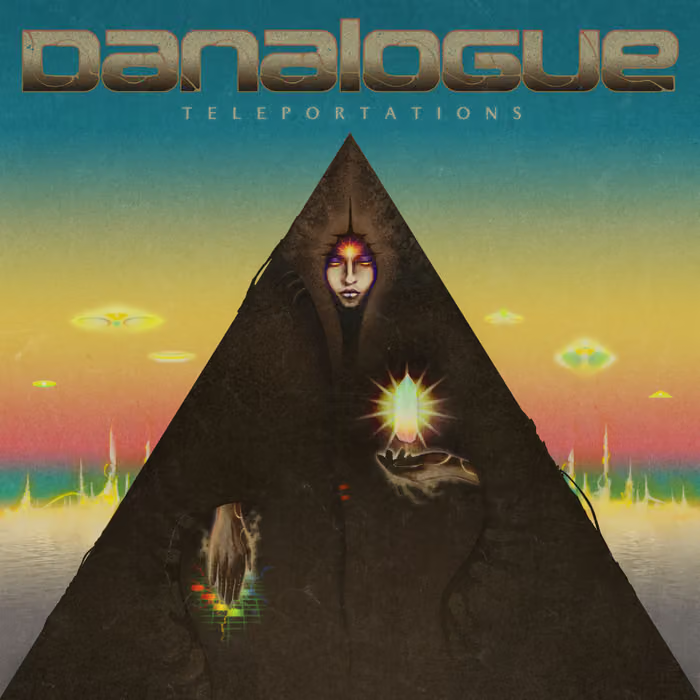
Teleportations, released on Castles in Space, is Danalogue's first solo album. He performed all of it himself, on a largely vintage setup of analog synthesizers and old samplers. Sparked by a chance encounter with the work of the French artist Jean Giraud, better known as Moebius, the record turns grief and personal upheaval into a science-fictional voyage of escape and renewal. It draws on the 1970s German kosmische tradition and its outsider electronic pioneers, and beneath the space-age surfaces runs a conviction that imagination is a form of hope.
Lawrence Peryer recently hosted Danalogue for a lively conversation on The Tonearm Podcast. Danalogue spoke about making a record alone after a career built on collaboration, the long and patient process behind it, the science fiction and vintage machines that shaped Teleportations, and why he still holds to imagination as the first step toward hope.
You can hear the full conversation in the audio player embedded below. The transcript has been edited for length, flow, and clarity.
Lawrence: So much of how I think about your body of work to date, leading up to this project, has really been about either group environments or collaborating—being part of other artists and their contributions. What do you take from those experiences that you can apply here, when it's all you?
Danalogue: It's definitely a hugely different experience. I'm quite an intuitive, natural kind of person, so in the moment, on all the records I've made, it's just felt effortless and easygoing in the relationship with the different artists I work with. I've been blessed to work with some great ones as well, so you can really trust them and what they're going to bring, and you can trust yourself.
One of the things that's been very different working solo is that you don't have any affirmative voices around you. One of the greatest things about collaborating is everyone gassing each other up—as we say in England; I don't know if you say that in the States—but you're supporting each other verbally, you know? "Wow, that was a great riff," or, "Yeah, we should definitely do this, this new section is sick." But when you're on your own, it's almost like you learn how to be that affirmative voice for yourself, which I think is quite a therapeutic process. It's like, "Oh, I have to learn to be my own positive cheerleader."
I'm more like "let's keep going on this a little bit longer, keep tweaking it, I think it can be better," which doesn't come from a negative place. It's more discerning; I want to get the maximum amount of juice out of this that I can. I think Max—Betamax [regular production collaborator]—is often like "this is awesome, I'm down; from the early demo, this is good to go." We've become a little bit left-brain, right-brain, having made so many records together. I just have a method of making albums, and I did that in collaborations, and I thought that method would be great for working solo too. So there are things that have carried through and things that have just had to change naturally.
Lawrence: It's interesting you went to "method," because I was thinking about that as well—how does process change? You have to self-start. It strikes me as a different mode of operating.
Danalogue: Yeah, I totally feel what you're saying. And I find, if I'm meeting someone at the studio, you'd better bloody turn up on time as well. Whereas if you're working on your own, you can be a bit late, you know? There's something about your responsibility to show up for yourself. Again, as much as it's a musical process, I think it's also a therapeutic process. It's like learning that you are enough, and you can look after yourself too, and it's worthy to do.
Ever since about 2007, I came up with this process. Loads of people have done it; I didn't invent it, but I just realized it was best for me. Rather than sitting down with a pen and paper and thinking about theory—"there's an A chord, and I think we should go here"—I much prefer playing long-form for many hours until I get into more of a hypnotic trance, reaching for things a bit more intuitively, taking risks here and there. And sometimes the best bits of music would come after quite a few hours, once you'd really stopped thinking too much.
But with that method, you end up with reams and reams of recordings. It's almost like when people make films: they make loads of takes, loads and loads of footage, and eventually an editor has to get involved, distill it down, and find a narrative, both between the tracks and as an album as a whole. So you almost do the recording first and the writing second. For some reason, that just felt a little bit rebellious, because if you come up with something good, it's so exciting, thinking, "We walked into the studio today, we didn't know we were going to get this." That works great for Comet, and it works great for Soccer, and then I basically did the same as Danalogue solo. I just recorded lots and lots and kept going, and then knitted it into place in post-production, bringing the room together.

Lawrence: I'm curious how you go back and find the good bits. Are you leaving markers along the way, or are you like, "Now I have to go back and listen to seven hours' worth of stuff to find the fifteen minutes I liked"?
Danalogue: I think the key is to leave it for a few months. I remember reading a Charles Bukowski thing—he used to write stuff, then put it in a drawer for six months, lock it, and come back. And when he reads it, it's different; he almost reads it as if it's somebody else. So you can have a bit of a third-person perspective. It's quite good to leave it for a few months on a hard drive somewhere safe, and then switch it back on. Sometimes you've forgotten half the stuff, and you're like, "Whoa, I forgot about that bit, that bit's really cool."
And then I go really fast—I put markers in, and I slice everything up, color-code it, and write very simple, sparing notes on each one. I make some quick decisions, make a very rough mix of everything, and make a bounce. So now you've got a kind of six-disc album, and then you can listen to that on the tube or on trains, when you're traveling around, and try to listen to it like a record. You quickly work out which bits you like the most. And once you make a short list of those, then the real fun starts—then you're going to really start slicing into those, because those tracks might be twenty, thirty minutes long, so there's another editing process. So it's this multi-stage, cooking-down distillation process—like triple-distilled vodka or something.
Lawrence: I would think that gap in time also allows some of the heat of the moment to wear off. You might find something you thought was wonderful, or thought wasn't working, and take some of that emotion out of it, come back to it a bit more objectively.
Danalogue: Totally. And sometimes there might be a little slice of something that was great that you moved past very quickly, and you might want to take that and loop it—like, "Oh, actually that bit was great, let's make that into a tape loop and make it the foundation for a whole other track." And it might be something you thought was going to be the best track, and you work on it and work on it, and then you realize it has to be left on the cutting room floor. A lot of great things have to be destroyed.
Lawrence: I like that line. (laughter)
Danalogue: I have to destroy a lot of lovely things. And some things don't make the record. But there's one track on the record that was the last one I made—a track called "Arrival at Rho Ophiuchi"—and I made it in about a couple of hours. I just felt like there was something missing from the record that I really wanted to do. Most of it's done in that method—like maybe "Moebius Triptych," that was a classic example of the method—but some of them I just did in one sitting as well. I try not to have too many rules when making stuff.
Lawrence: At what point in this project did you have the concept for this arc, this journey the record was going to take?
Danalogue: For this one, I had quite a vision of the sound world right at the beginning, but the overarching narrative—the order of the tracks, and some of the astral projection ideas running through it—came more near the end. Sometimes your process of making the record reveals itself at the end. When you stand back and look at it, you suddenly realize what you've made.
But there was also a really fundamental building block to it. I first started the record probably about ten years ago, in a studio in Paris—it was kind of an amazing story, really. I bumped into a guy on a train in France and had a coffee with him, and he invited me. He'd been promoting The Comet Is Coming in France. We had a little espresso, and he said, "Why don't you come to my synth studio? I've got twenty-one synths—it's called 21 Filters. Come and stay for a week, I'll give you an incredible deal." Which I did.
And that week, I recorded a lot of stuff I didn't like. I was like, "Dammit, this was meant to be the week of making an album." I was making a lot of stuff that didn't feel that good, or didn't feel fresh, or felt like I was trying too hard. But I went on a walk to freshen up, and I went past this French comic book shop—they're really good with their cool comics, the French—and for the first time ever, I saw this book by this guy called Jean Giraud, or Moebius. He's an incredible sci-fi, fantasy illustrator, and he's famous for helping with the art design on some big movies—I think like Alien, the first one, and things like Tron, all those classic eighties sci-fi films.
He has these incredible books, and there was this cover in the comic bookstore—this scene on an alien planet—and I was absolutely blown away by it. I was like, "This album has to be almost like the soundtrack to another civilization on another world." I tried to take a picture of it, but as I took the picture through the glass, my phone ran out of battery, which was quite poetic somehow.
I spent a while trying to find it, just writing keywords on the internet, and I did eventually find it. As soon as I had that, I went back to the studio, and it freed me from an earthly grounding. The narrative started—the seed of it was there—where I realized I wanted to embrace that part of my character, that part of myself that wants to do a bit of world-building outside the current reality, and really embrace that side and not be afraid of it. Lean into it even more.
Stay on top of The Tonearm.
Subscribe for exclusive interviews, cultural tip-offs, and community fun.
And your support keeps our site free of advertising and paywalls.
Lawrence: Are you a science fiction writer who just happens to play music?
Danalogue: That's a good question. Maybe I need to write a book. I did write a little thing, which is on the back cover—or in the inner sleeve—of the record, for "Earth Remembrance Day," the last track. It's basically a story about a future organism that's a little bit connected to Earth—like a twenty-five percent carbon-based life form. Every now and then, every Kepler cycle, they come back to Earth through a kind of astral-projection meditation, just to look at it. But the Earth is now long gone; it's just a burning red husk. And they come to visit Earth in order to remember what not to do—if you are the custodians of a planet that's got access to this beautiful universal web of consciousness.
Lawrence: It feels very reminiscent to me of the mid-century science fiction that inspired a lot of artists in the sixties. I feel we're in that realm now.
Danalogue: Yeah. Time definitely has a funny way of working in cycles. The period you're talking about, I guess you'd have the Cold War, with the constant fear of nuclear apocalypse. And I feel like now we're in a time of great global upheaval and military intervention, and the politics of fear a lot of the time. People often think of science fiction as Star Trek, lots of lights blinking away, and robots, and R2-D2 and Darth Vader—all of that stuff, which is really entertaining and great. But oftentimes, within the veneer of the entertainment side of science fiction, and how marvelous and fun the imagination of it all is, there's always a deeper undertone.
Which is: to imagine a human collective that has managed to mobilize and collaborate across race—normally in sci-fi, like Uhura in Star Trek, who had one of the first interracial kisses on television in the sixties—and outside of that, you get into species cooperation between different aliens and humans all working together, perhaps on some galactic ship. Even that idea, that you could coordinate and collaborate and work together on such a huge project, would require a lot of improvement to how we're doing things now. It would require us not to waste energy on killing each other. To have that kind of hopeful imagination, just as a thought experiment, is beautiful—to keep open what possibilities we might have as a human race down the line, without it being some billionaire trying to go and mine Mars or the moon. There's got to be a more interesting way of looking at exploration.
Lawrence: You're touching on the idea that losing the capacity to imagine is basically losing hope. I'm curious how you think about the role creativity plays in building possible futures.
Danalogue: I've taken it slightly less from the self-help aphorism—though I totally get the connection—and more as a kind of manifestation, almost, which I'm down with. But it comes more from a perspective of: if you accept the world as it is, and that's your whole reality, then you can never change anything. So it comes more from a revolutionary perspective, and also from one where it's always the imaginative people who can start to change things in society.
I think it probably comes from some awful stuff that happens in our country. In England, a few years ago, the government decided it was okay to pump sewage into all of the water. The imagination there is, "We can make loads more money if we don't put up any red tape, and you can just pump." So now, all around the British Isles—which used to have pretty nice little swimming spots—they're all on red alert, filled with pollution and basically toilet stuff. So what I'm talking about is: if you just accept that, like a lot of people, and go, "Well, that's just the way it is, can't change that, it's just the government"—I think what it comes from is being pissed off that if you just accept everything you're given, whatever the narrative is in the news, then life will probably just get incrementally worse. Whereas if you can imagine a better way of doing things, that's the first step to action.
I'd also combine it with a feeling that maybe I imagine less than when I was a kid. When you're a kid, you imagine tons of stuff all the time, little stories and characters. By practicing imagining, or imagining new worlds, I find it refreshing and invigorating, and it gives me a youthful playfulness that I felt I was maybe losing as I crossed the threshold of forty. I just love using music almost as a tool to create these imaginary worlds in my mind.
I just think the end of imagination is the end of hope itself. If you can't imagine something better, then you're stuck with what you've got. And that's a daily process—even if that means looking around my studio and being like, "My God, I can imagine this being a bit tidier."
Lawrence: Another topic I love to talk about is the use and usefulness of self-imposed constraint, such as the limitation of the two-synth setup you use. And yet, in the context of this record, nothing feels small.
Danalogue: Well, on this album I did end up using a few more synths, especially at that studio in Paris. But I've spent the majority of my career playing the SH-09 mono synth and the Juno. Both of those synths can make a hell of a lot of sounds, and that's what first drew me to synthesis. But the self-imposed limitation of only owning a couple means I don't go into choice paralysis, which I really struggle with. It's almost like getting married to one person rather than having hundreds of girlfriends. You get deeper and deeper in love with your partner. I still work out new sounds on my synth—after twenty years, I still go, "Oh my God, I've never done that before, that's incredible," and then I'll write five tunes using that setting.
It feels like my sonic identity, that you could draw a line through, all the way back through The Comet Is Coming, all the way back through Soccer96, back through Flock, back through different records I've done down the years. That's quite satisfying, that I can go back and listen to something from 2012 and be like, "Oh yeah, that's the same keyboard I play today," but I was playing it in a completely different way at the time.
Lawrence: I don't think I fully appreciated that the Paris material actually survived to finished form on this record. You really have been carrying this around for a while.
Danalogue: Yeah, man. I could have released a record just of that Paris session, but to be honest, I'm really glad I didn't. It's kind of become like a best-of. I've been doing it this way because I was touring a lot, and when The Comet Is Coming wasn't touring, I was producing and mixing records. So I had myself a little bit on the back burner, but I also feel like now is the perfect time. So what I did, after The Comet Is Coming finished for a bit, is shut the door and say, "No more jobs." And I refused a couple of records, which is kind of crazy to do when you're self-employed. I actually started meaningful work on this record about two years ago, but I had all of this material from down the years to pull from. It's all come together, really, in the last year or so.
I'd never done a fully solo album, and that felt like an elephant in my room, so to speak. I thought, "It's about time; I've got to see what I can do completely on my own."
Lawrence: One of the tracks I wanted to ask you about was "Far Beyond the Sun." How rooted in reality is that song for you?
Danalogue: It depends on reality. So I think that track came out of an imagination of the afterlife, and how the afterlife is kind of gatekept by monotheistic religion—they tell us what it's going to be: heaven and hell, St. Peter at the pearly gates. Or the reaction to that, the atheist one, would be, "Well, there's nothing, it's just dark, it's just black, it's just boring." I thought about the physical space out there, outer space, with all the stars and planets being a huge physical manifestation of all the souls that have left Earth, flying through space. You go far beyond the sun, far beyond that, through as many galaxies as you want, and you naturally gravitate to the resonant souls, the treasured souls you'd met here on earth.
It's a way of helping with the grieving process, because we all lose people in our lives, don't we? And it's tremendously sad. I just think it's fun to think about meeting them again. Or even meeting people—this gets into more realms of fantasy—but I started to do this meditation practice, connecting to a kind of benevolent alien in the Sirius system. I don't know if you've read Cosmic Trigger by Robert Anton Wilson.
Lawrence: He's one of my thought heroes, and as a young man, he really helped me learn how to think about the world. The idea of "maybe" is very big in my life. I try not to make assumptions or assertions.
Danalogue: Cosmic Trigger, yeah, and the Chapel Perilous. It's like, if you live as if something is true for a month, see how your life changes, whether that means Buddhism or Catholicism or becoming a Jedi or whatever. So I was doing this specific meditation practice, and the lyrics of that song are, you know, "I look far beyond the sun, and I'll see you there." I just think it'd be cool to meet that person. But I don't know. It is reality, and it is not, at the same time.
Lawrence: Not yet, maybe.
Danalogue: We'll see.
Check out more like this:
 Dave Segal
 Lawrence Peryer


Comments