


Diles que no me maten’s fourth record is intertwined with many stars. Escrito en agua [Written in water] is a record meditating on a kind of spirituality, motivations for art-making, and created in response to the work of artists who came before them. This approach of ekphrasis—writing in response to other art—is an important throughline in the record and lends a connectedness, a gravity, a larger scope to the music. The band creates through improvisation, and that searching quality persists on the record, not without moments of arrival, moments choked with feeling, and moments of something like a deeper pigment, where the experience of artists from another time and place illuminates the storytelling of the band’s spare and moving fourth record.
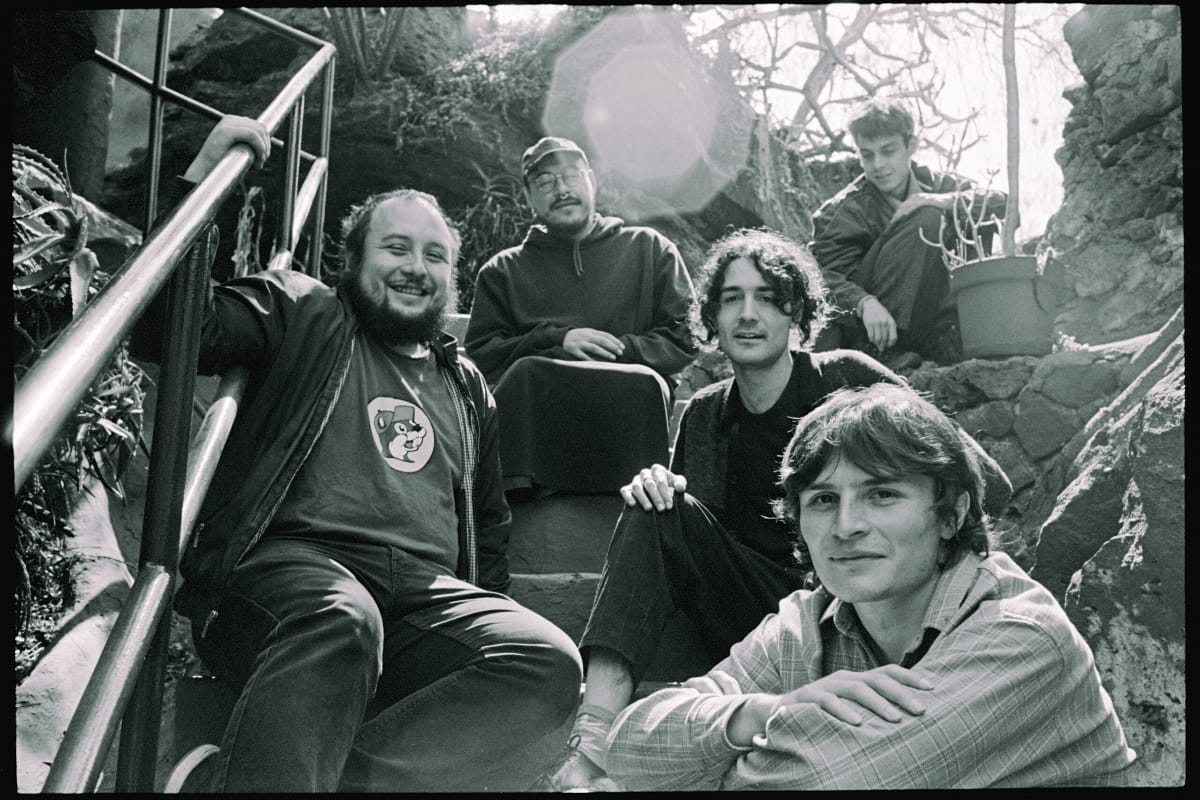
Diles que no me maten was started by two brothers, Raúl and Gerardo Ponce (drums and guitar). The band created this record largely through improvisation, and the singer at its center, Jonás Derbéz, says they’ve grown into new territory with Escrito en agua—that they’ve been able to create more complex landscapes. Through looping soundscapes and unresolved, even crunchy instrumental harmonies, you can hear them listening to one another.
Layering transmissions from other artists has evidently fed the project of Escrito en agua. Derbéz has been at work organizing a festival of experimental music, poetry, and video poetry in Mexico City, the band’s hometown. Now in its third year, Festival Sol Quieto en el CCD is run by Derbéz in collaboration with Cecilia Castro and Daniel F. Álvarez from Polilla Librería, an independent bookstore and publishing house specializing in Latin American authors. The banner on Polilla Librería’s website reads “armas frágiles contra tiempos sórdidos [fragile weapons for sordid times].” The festival brings together tens of independent publishing houses and an intergenerational bill of performers. They just received a larger grant, the PROFEST grant, from the state, to continue expanding the project. It was important to Derbéz that the festival be all-ages, accessible, “a big picture of the art created in this city across generations,” bridging the gap between people making zines, poetry, music, particularly in the wake of the pandemic. When asked how he balances organizing work with his artistic practice, he said:
"I have to ask it of myself constantly. I believe that, in a way, being a cultural manager is a form of art. Art is a way of moving through the world, and if you find a way to make something out of faith, love, and work for the benefit of whoever wants it, that’s being an artist. I wouldn’t be happy being the kind of artist whose only responsibility is to dream and record. I like to write the poems, sew the paper for the books, and then sell them myself. I believe that by doing so, art stays connected to life and can connect more deeply with people."
I was curious to hear about the dailiness of this record, moments of stuckness where other artists became a boon, inciting incidents for more art-making. Derbéz had begun the festival work thinking it could be a job, but it became a passion project. The sentiment that organizing art is inseparable from art-making seems to inform what is at stake in Escrito en agua: making meaning of, but not necessarily making sense of, our connections to one another. There is this insistence that art not be separate from lived reality.
The album is dedicated to Mahmoud Darwish, a Palestinian poet. The band was inspired in particular by his documentary poetics in The Butterfly’s Burden from the vantage point of life in a besieged Palestine. I am used to a certain jadedness in art-making right now, a skepticism of what art can do for us. I see a distancing from, rather than a vulnerable willingness to lean towards, a direct discussion of rising fascism in our artistic expressions. But in Darwish’s writing, and in Derbéz’s singing, there is always a turning back towards reverence, and from that place, righteous anger. There is an affirmation of how precious life is, and a certainty that we are entangled with one another. The form, in this case, writing songs in response to another artist’s work, reaffirms the content. It further demonstrates how one cultivates wonder through the practice of art-making writ large.
Through Fady Joudah’s translation of The Butterfly’s Burden, Darwish writes, [“We Walk on the Bridge”],
“As in writing, the necessary comes
on time, a feminine moon to fill the poem’s
emptiness. Do not leave me completely, and do not
take me completely. Put the right time
in the right place. You are the means and the guide
A real country, not a metaphor, your arms
around me… over there by the holy book
or right there. Who of us said: Language
might preserve the land from the plight
of absence if poetry wins?” (21)
While there is an ambient surreality to Diles que no me maten’s music, a transmutation of elements, of present and past, there is also a question of how we will live each day. How does the art show us something about our city, but connect us back to it in real time as well? How does the music preserve something of its spirit? Derbéz dares to ask, yes, what if poetry wins? He says:
"Well, every musician or writer will understand when I say it isn’t always easy. But we all know why we chose this path. For me, I’m old-school about this. I don’t really like nihilism. I believe in beauty and truth—the truth of love, the beauty of waking up to the world as if you had just been born. I believe the truth of love comes before reality itself. In my life, I found purpose and a place of healing in poems and songs, a commitment that comes before all of life’s puzzles."
Escrito en agua is dedicated to Darwish and also to Tunuwame, the patron of singers and musicians from western Mexican indigenous myth, seen as the morning star. “Estrella tan distante, si te dejo de cantar me desperdiciare,” Jonás sings on the eight-minute track named for the deity, [“Star so distant, if I stop singing to you, I’ll waste myself.”] There is something telling about Tunuwame being understood as the morning star, art being the reason we get up, the most immediate proof of our aliveness.
Derbéz goes on:
I can’t forget
that we come from a place that does not yet exist,
what we have to invent
and that still does not exist
that is soon to arrive
***
No me puedo de olvidar
que venimos de un lugar que todavía no existe,
que tenemos que inventar
y que todavía no existe
que está pronto por llegar
There is a call, a charge the speaker is tasked with. I have to invent the place we come from. The speaker has to find ways to join the wonder of their young self and the place where they are headed. In this philosophical and urgent style, I see flashes of Darwish’s own reflections, his bridging of memory across displacement and occupation. And I see a question being asked through this record: how to honor an original sense of wonder, to carry that forward as a posture for meeting the world now.
There is an unease and a slowness to the music itself. Escrito en agua opens with a song that was meant to sound like a funeral march, pulling on techniques from funerary music from Oaxaca’s Sierra Mixe, “Las noches que dormimos en sillas” [“The Nights We Sleep On Chairs”]. Originally conceived as a goth Duke Ellington number, the forlorn brass pulls the drums forward. You feel each step of the funeral march on the snare. What does it mean to enter an album from a place of grief, of exhaustion? What does one find after loss, if we are to take seriously this context of funeral music? In the last minute of the song, the drums drop out, and there is a brass trill almost like a butterfly floating, something like curiosity, if not quite hope yet.
This is followed by the lead single, “Hiriku,” which pulls lyrics from “Híkuri (Peyote),” an epic poem by José Vicente Anaya. This song is an immediate lift, the momentum of its pattering drums and its leading bassline, and its lyrics sending us forward with the narrative of an explorer. We learn, as the song continues, that the explorer is sitting at home on the couch, but as they close their eyes, they are transported to somewhere they are not, and this becomes the refrain, this dislocation or even yearning. Derbéz says of Anaya’s lines translating to the song, “I felt it was important to put it in a song. Now, when we play it live, we’re a bunch of people singing it together.” This relationship to perspective is one of the album’s great strengths. The band is influenced by krautrock, or kosmische musik, a movement of experimental, psychedelic rock music in the 1960s and 1970s that came out of West Germany, which shed traditional rock song structures in place of extended improvisation.
When asked about structure for the record, Derbéz said:
"There’s a movie called The Battle of Chile by Patricio Guzmán. The director interviews people in the streets about what they think is happening in Chile at that moment. Meanwhile, the cinematographer films their faces for a second and then starts looking for other details that reveal something more about the situation. It might be another person crying in the background, or a luxury ashtray sitting on a table. It’s a second image that makes the world feel bigger."
On this record, larger questions are explored through small details, without definite answers. This is true lyrically, but musically as well. Instrumental parts return, such as the brass part in “Jardín” from “Las noches que dormimos en sillas.” At one point, Andrés (bass) and Jonás were up late trying to figure out “Jardín.” They added the clarinet from “La Rata Modesta” almost as an interruption, before returning to the original song. And there is a parallelism lyrically in “Jardín,” a side-by-side comparison: “It’s a conversation. / It’s a burial. / It’s a conversation. / Air pools.” which casts these different images as like. Air pools, chasms, spaces.
Raúl and Gerardo were thinking a lot about the role of silence on this record. Gerardo spoke of “the spaces that you take in silence and the silence you make after you play.” We spend a lot of this record on revolving instrumentals or extended passages without vocals, not exactly structured, but with enough repetition to give you a sense of familiarity, a feeling of return. There is pensiveness and sparkle to the guitar fraught with reverb on “4 Kilómetros Dentro de un Túnel.” “Perquisidor” culminates in eerie and delicious clashing tones while Derbéz is speaking quickly on top, until he stops, and the looping continues for a full minute.
I’m reminded of Darwish again:
(To a reader:) Don’t trust the poem,
this daughter of absence,
she’s neither speculation
nor intellect,
she’s chasm’s sense (167)
What is the intuition of space? The sentient feeling of space? This is one way to say wind. How does one listen for it?
A dry guitar follows Derbéz’s voice on “Viene el Viento,” [“The Wind is Coming”], a song about aging and death. The first two minutes of the song are mostly just intimate vocals and a jangly strum pattern, and then the song opens to electric guitar, a sliding pad, and whining brass, creating a soundscape. They were calling on the spirit of the Argentinian songwriter Luis Alberto Spinetta of Pescado Rabioso, who wrote of civil unrest and against commercialization. They found melody before lyrics, and the effect is great tension, and the lyrics that came later express how destiny is tired, it wants to burst, something in the admission a balm. “No me” is the penultimate track, and really feels like the peak of the album. The steady rising drone of a guitar in the back, Derbéz’s artful interjections of lyricism, a smooth guitar riff, leading to a greater arrival of feeling. You can hear the band’s process in this song, how they are moving towards one another, and gathering at the height of the song, which isn’t overly declarative or flashy. But it does amount to something like revelation.
Check out more like this:
 Lawrence Peryer
 Bill Kopp


Comments