


It's a rare artist who can make music that defies categorization. Rarer still is the artist who feels comfortable having their music labeled as one style or another. When Evolfo debuted on record with 2017's Last of the Acid Cowboys, critics pinned the group with a garage-soul tag. The music certainly displayed hallmarks of both soul and garage rock, but the label didn't quite seem to describe what the Brooklyn-based seven-man band was really about. As keyboard player Rafferty Swink told me around the time of their debut album's release, "Because there are so many people in the band and we all love so many different kinds of music, it's sometimes hard to narrow it down."
Two more albums and nearly a decade later, that conundrum has yet to be fully resolved. And that's fine with Swink and fellow Evolfo songwriter Matt Gibbs. These days, the band has settled into a degree of comfort being known as a psychedelic group, but even that label doesn't fully capture the essence of Evolfo. For that, one should listen to the music. Of Love—the group's third album—was released in April. The band has just announced a July-August overseas tour with dates in the UK, Germany, and elsewhere on the Continent, including high-profile festival appearances in France and Spain.
Leaving behind their label deal in favor of self-releasing their music, Evolfo is focused on honesty, authenticity, and ethical decisions. In practice, this means listeners won't find Of Love on one of the most popular streaming services. The band's principled decision to boycott Spotify is in line with the musical collective's larger worldview. In our recent conversation, Swink and Gibbs explained the band's mindset that led them to follow a truly independent path, discussed their all-hands-on-deck creative process, and shared some important lessons they've learned along the way.
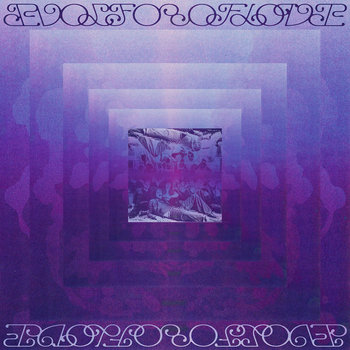
Bill Kopp: The press materials for Of Love manage to name-check a long, long list of styles. In fact, in a single sentence, the band's sound is characterized as having elements of psych, groove, roller-rink disco, soulful prog, drone rock, and even chillwave. I know the band doesn't write its own press kits, but where do you see Evolfo fitting in the musical landscape?
Matt Gibbs: Yeah, genre-wise, it's always hard to nail down. But I think that the definition that suits us a lot of the time is "psychedelic." Because psychedelic can describe a way of experimenting with music in a more expansive sense than a single genre. Yes, psychedelic music does bring to mind specific sounds, but I think for us, psychedelic is an opportunity to experiment, try different things, and be fast and loose with our influences . . . and not get stuck.
Bill: How has the band's musical vision changed since 2017's Last of the Acid Cowboys?
Matt: It's changed a lot; the whole process is very different. It used to be more what you picture with bands: a couple of us—mainly me and Rafferty—bringing songs to the group for them to learn and record. And then through [2021's] Site Out of Mind into Of Love, more and more we adopted a work ethic of improvisation in the studio as a group. I think we've become much more focused on the idea that one of the more interesting things we have to offer is our long history as a band, our connection as a group. Going into the studio can be about putting that foot forward and writing together.
We really embraced that on Of Love, because all of the songs started as group improvisations; every song on the album is cut from improv or jamming. Sometimes they were refined, but it always started with the group. Late-stage capitalism in the 21st century doesn't want that from artists, but it's time to do something different. And group writing focuses on who we are as a group.
Bill: What led to that change toward this more organic, collaborative approach?
Rafferty Swink: I think it was conscious, and it also had to happen over an extended period of time. When you start recording music as a band, a lot of times the mode of operation is: write the song, rehearse the song, go to the studio, cut the record. You start there, and as you go, you start to think, "How can we express who we are in a more all-encompassing, genuine way as a group? How can we accentuate the unique sound that we've developed?"
Through spending a lot of time together, we've experienced both the more traditional ways of recording a record and finding our own space, recording ourselves, getting better at recording ourselves, and building a studio. And it all culminated in this record. But it was a long and not always conscious path through this terrain to get to this place as a seven-person group. During the [Covid-19] lockdown, we spent a lot of time focusing on connecting the hive mind as deeply as possible.
With a lot of the improvisations Matt referenced, the goal in the moment was to be more connected as musicians in a spontaneous way, to prompt ourselves to get outside our box as players and see what would happen. Sometimes it was bad, and sometimes it was really good and made it on the record almost as we played it in the room.

Bill: What was the timeline of the album's creation?
Matt: It began in the heart of the pandemic; I distinctly remember going down to meet the guys, just to play. It took place over a long time, from 2021 to 2024, but we weren't necessarily in that "We're recording now" mode the whole time. It was this experimental process where Rafferty was playing with the studio mics and the mixer; we were setting up and jamming. There's nobody saying, "Ready, set, go: Here's the take."
Rafferty: Also, the release of Site Out of Mind was delayed a little bit because of the pandemic. So we were in this space where we had a record that was done—that we were going to release and promote—but no one really wanted to be playing the set because we didn't know when that release was going to happen.
So we'd just get together and play, and it wasn't until a year or two later that we went back and listened to those recordings. I was just documenting the stuff as we went, experimenting with the room mics, having fun, and messing around. And then, in hindsight, after we had toured in support of Site Out of Mind, we went back and were like, "Wow! There are actually some songs here, some gems that we can develop and write on."
Bill: If there's a unifying aesthetic to the songs on Of Love, it's a kind of dizzying, disorienting crosstalk. It's as if two different things are happening independently of one another. And they somehow fit together, not because they're supposed to, but just because they do. It all feels like the sonic equivalent of being in an altered state. Is that intentional?
Matt: Maybe sometimes. When we did take the basic jams and work on them, we often played with those woozy or echoey sounds that suit the feeling of the song. And often, what suits the song is to do something sort of dissociative-sounding.
Echo really makes you feel like you're far away; sometimes it gives you a kind of bird's-eye perspective. And at least sometimes I write from a perspective that's kind of above the main character; you're watching the story unfold. And I think that's how it feels to be on psychedelics.
But to say it was ever intentional would be inaccurate. At least speaking for myself, I'm shooting more from the gut, letting the feeling guide me rather than establishing a concept and then hitting it hard.
Rafferty: I do like that you get that from it.
Matt: Yeah. I want to support this thing you're saying because it's great.
Stay on top of The Tonearm.
Subscribe for exclusive interviews, cultural tip-offs, and community fun.
And your support keeps our site free of advertising and paywalls.
Bill: Tell me about the thinking behind making a point of not streaming the new album on Spotify.
Matt: It's pretty simple. For me, the scales just tipped; kissing their ass was hurting more and more. I don't want to even care about them. They're a tech company; they're not a music company. They don't give a shit. And the profits they're making, they're turning around and investing in artificial intelligence and items used for war.
It feels good to get away from them. I know I'm using all sorts of other things where the CEOs will take their profits and do things that I don't want as well. But with Spotify, it's like they're out there saying that you're endorsing them by having your music on their app. And I don't want to endorse them.
If I'm forced by the circumstances to use Amazon and Google sometimes—and I hate them, too—that is what it is. I make music; my whole life is music. And I'm not going to let Spotify misrepresent me. I don't want to be part of that anymore.
Rafferty: It just got to a point where they're actively devaluing music and art. And even though a band of our size removing our stuff might not have that large an impact, I think it's important to draw a line in the sand. They're the biggest streaming service; therefore, they are the worst streaming service. I think that streaming in general is bad. If another company like Apple Music or something displaced them, they would probably start doing the same thing, but for right now, Spotify is the biggest target. And it's time to start talking about it more publicly.
Not having our music on Spotify is also a great way to start discourse with people who might not be as aware of how evil a company Spotify really is, and how much they don't give a shit about music. They're actively down with A.I. music; they pad playlists with music that's not made by humans. The list goes on. And at the end of the day, for the sake of music itself, anyone who can do anything should be talking about this.
Like anything, it's not about having the perfect solution. It's about continuing to be critical and to keep asking these questions, and to get the word out so that people who are more casual music consumers have a better understanding. Because the convenience factor is so strong that a lot of people are not even aware of how exploitative it really is.
Bill: Speaking of the business side of music, Evolfo's first two albums were on Royal Potato Family. Of Love is self-released. Tell me about the circumstances and the thinking that led you to go the true indie route.
Matt: I've been talking forever about starting this record label. I'm sort of grassroots with this label, Food of Love, and Royal Potato Family is still in the mix, helping me out. So it wasn't some sort of divide there.
I'm very excited by all of the music around me. And it seems like the universe is telling me that starting a label and pushing this record out is the right move. It even plays into the Spotify thing: I'm going to take a little ownership of what I like about music, and I'm going to build community, events, and releases around quality and good taste. Whether or not it's some universal form of taste, it's my taste.
And that's fine; that's what the label is anyway. I think it's very significant; there's something about it that feels like an incredibly artistic decision. It has nothing to do with business, connections, getting a leg up, or getting discovered. It has everything to do with saying, "I want to push whatever it is about music that I like; I don't want to have it decided by labels and algorithms and things like that." And it's time, I think.
Check out more like this:
 Jonah Evans
 Bill Kopp


Comments