


Born Jochem Paap, Dutch electronic music icon Speedy J released his first record on Plus 8 in 1990, and the three and a half decades since have taken him through enough distinct phases that a lesser CV might belong to several different artists. Seminal electronica LPs on Warp's Artificial Intelligence series and Planet Mu, ambient work on FAX +49-69/450464, a sustained run of club 12-inches across most of the significant techno labels, and a catalog of collaborations—Slag Boom Van Loon with Mike Paradinas (µ-Ziq), Multiples with Surgeon, Metalism with Chris Liebing—that he has recently archived and made accessible on Bandcamp. Through it all, Paap kept moving.
Around 2016, he opened STOOR, an underground studio facility in Rotterdam built around his decades-deep collection of outboard gear. STOOR spawned more of an ongoing research culture than a traditional studio operation, with solo sessions, collaborative sessions, remote live jams broadcast during the pandemic, and records cut directly to acetate on an in-house lathe. STOOR Live extended this further, with Paap orchestrating long-form improvised performances alongside some of the most prominent names in electronic music, all staged as a high-stakes, deliberately unpredictable spectacle. The STOOR platform has been his primary creative outlet for years, and it showed him that the work didn't need to resolve into an album to matter.
This makes Walkman worth paying attention to. This is Paap's first solo LP in over twenty years, and it takes its shape from a specific observation about how people actually listen in the 2020s. He assembled ninety minutes of material from early 2025 STOOR sessions—twenty tracks, sized deliberately to fit two 45-minute cassette sides—and imagined it as a mixtape rather than a conventional album, moving through beat-driven pieces, full-tilt techno workouts, and stretches of immersive ambiance without announcing the transitions. Rather than being nostalgic, the Walkman in the title points to a listening context that Paap considers underused, where the music sits in the foreground rather than the background, inspiring active movement.
I interviewed Speedy J on the cusp of Walkman's release, as well as a multi-country tour of the STOOR live project in the summer, which sees Paap and invited artists perform a totally live electronic jam in the round. I had many questions for this storied artist, and the interview has been edited for length and clarity.
Mykadelica: Walkman takes us back to a time when we recorded DJ sets on cassettes to create mixtapes. What made you want to return to this format and the album?
Speedy J: Well, it used to be the standard way to present music, but then the internet happened. I tried to follow the sense of freedom that digital distribution gave me, and I experimented a bit. An album is a format that has its limitations, right? It's either two sides of vinyl or eighty minutes on a CD. There's a limited time duration.
The routine of playing an album or a CD is pretty much: stick it into the player, hit start to play, and then let it go from start to finish. But we all know that disappeared. It's still great that you can carry your music with you wherever you are—in your car, out on a run, or whatever—with pretty much the entire world's library of music in your pocket. But [we're missing] the ritual that was attached to the old album format or CD format: one curated piece of music, consisting of different tracks, passages, or chapters, in a format that sort of demanded start-to-finish playing.
I think in this time when everybody has a hard job navigating through all the fucking junk and noise that is being fired at you all day from everywhere, it's nice to just go back to the format and see if it works, presenting music like this. It's also an experiment; it's not "Okay, I'm returning, this is the gospel." For this collection of music, for me at least, it makes sense to have it play from start to finish, and it resembles how I listen to music these days, which is usually in transit. I don't sit down next to the fireplace and put a record on; that's not how I listen to music. Usually, there's a way to put in headphones or stick in some earplugs, walk or travel, and use that time, with the lack of distractions, to listen to something uninterrupted. I think it has a place in the landscape we are living in these days; the possibility of being enjoyed from start to finish. I must say, don't get this as an instruction. It is an album format, but you can listen to it however the hell you want.
Mykadelica: I guess what happens with people now is they get a paralysis of choice, don't they? There's so much that you could listen to.
Speedy J: I guess the group of people who have the most trouble with fragmentation is our age group, you know, the fifties and forties. If you grew up in the Internet age, you are skeptical of everything but much more flexible in dealing with things, whether to get attached to them or abandon them. I guess when we choose to do something or choose a certain format or platform, we feel some kind of loyalty to it. But I think younger people feel no loyalty at all.
There's a lot of awareness amongst a lot of people to stick to some kind of digital diet, to be conscious about the choices they make, and to consciously choose things that are definitely totally offline. I have kids (in their 20s), they gather with friends and rent a DVD to watch a movie because it's funny, and at the same time, it's "Eh, look at us, we're renting a DVD," but it's also a choice to share something that is not interrupted all the time or fragmented. And listening parties, like audio bars, are becoming more common these days. So yeah, maybe it's not a crazy idea to present it as an album.
Mykadelica: If I go back to how mix tapes were formed, they were very fluid, I would say, because you would always be recording new stuff over old stuff. You'd get bored with something, then record over it. So is this release a snapshot of you at the time when you did this? If it were a month later, do you imagine there would be different tracks on there?
Speedy J: Yeah, it's absolutely a snapshot. The mixtape is more like a metaphor. I didn't set out to make a mixtape album. While making it, I was just listening to stuff I had on the shelves. Some of it is a few years old, and some of it is from the last year; it's stuff waiting to find its home or final output. It's a massive collection of stuff I was going through, getting to know, and finding a sort of common thread amongst it all. I would listen to it while walking, running, or in transit. From that routine, I developed the final compilation.
It really suited the slow walking pace of getting from A to B. So you turn a corner of a street, and then everything looks slightly different, and then you turn another corner maybe in two minutes, and then you see this thing that you hadn't seen before, and it's a totally different vibe. Then you turn into a park, and everything becomes quiet for about eight minutes. Actually, "Walkman" isn't referring to the machine; it's referring to me, the guy who's actually walking. I'm the Walkman.
Mykadelica: In terms of the material on there, it is so varied. You've got ambient, there's industrial stuff, and some dancefloor-friendly tracks. One of my favorites on there is the second-to-last, "T33Unstable Core." It's also by far the longest track. If there were ever going to be a single, I think it could be that.
Speedy J: It's not really DJ-friendly, is it, the one that's your favorite? (laughs)
Mykadelica: I just love the way the track melts down into that ambiance about halfway through. It's great.
Speedy J: It's like going from the city to a desert, or almost like being in an avalanche and then in some completely quiet place. I like it too. I like the contrast. That's why it's on the album!
Mykadelica: Given that the STOOR project is collaborative, I wonder if you prefer working with others or alone, or if there is a balance between the two?
Speedy J: I would say there's a balance. Working alone in the studio is obviously without an audience. It's not direct, it's not a performance, it's an exploration. So it's working solo. I really like working solo when I really want to dive deep into ideas and figure out technical things. It's like the nerdy side of what I do. I challenge myself in the studio to build or do something I haven't done before. That's where the creativity lies; if you have to solve a problem, that's where the ideas happen. So it's just living with your own mind and coming up with ideas, coming to conclusions, like painting or sculpting.
Playing live with other musicians is the opposite. You're feeding off each other's ideas, energy, and body language. Then, of course, there's an audience that also feeds into it, which is an equally important factor. If you're put on the spot in front of an audience, you have to act in real time.
The way the STOOR project is set up is that I invite four guests, so it's me plus four guests. We meet for the first time in person during the soundcheck before the show, so there are no rehearsals. We haven't played together before, in this particular configuration, anyway. Some people are regulars, but there's always a different band with different dynamics and different personalities. We get all the gear on stage, make sure everything syncs up and works technically, then press start and hope for the best for the next eight hours. The whole thing unfolds in front of people's eyes, as well as for ourselves, so everybody who's joining the jam is as much a spectator to the whole thing as the creator; we are in the same position as the audience. Nobody knows what's going to happen.
There's a very open-minded environment where people can basically throw out an idea, try it out, and if it works, we stick with it for a while until it gets boring or someone tries something else. We are constantly putting ourselves in the service of the group. It doesn't make sense to try to completely dominate or force things. We all feel responsibility to keep it, not to damage it, or not to fuck it up, though sometimes that happens, of course. Not all ideas work. (laughs)
And also made equal with the audience because there's no knowledge of the future, so it's really like an 'in the moment thing'. Where everybody is just, just enjoying the ride and, yeah, it's a great experience. Everyone is totally different; it's really a lot of fun to be involved with everybody in the room, really. I think the audience is a very important factor too, because they're actually part of the decor, they're very close to the musicians. They're all around the stage, so people can almost touch the gear. I like it so close. So the setup is right in the middle of the room.
Mykadelica: You do it in the round, don't you?
Speedy J: Yeah, exactly. The people in the first three or four rows around the stage have a direct line of sight to what's happening. They're very close to the musicians, all around the stage, and can almost touch the gear. Then there's this massive video column hanging above the stage, with images of people. It's video art, but there are also cameras on the stage that can film people's hands and faces, and sometimes the audience. The whole room gets a first-person view, either by being very close or by seeing the real thing from a greater distance, but with close-ups through the video column. It feels almost like some ritual celebration. It wasn't conceived to turn out like this, but it did, and it's a great thing.
Mykadelica: It seems to me like maybe when you came up with the idea, you thought, "What can I do to put the most pressure on myself?" The adrenaline must be incredible.
Speedy J: Actually, it's the opposite. People accept that it is completely live, so nobody puts pressure on you that it has to be perfect, and it isn't; it's never perfect. Nobody goes there expecting a fully produced, shiny, polished show. I think, maybe unintentionally, it's a counter to how a lot of music is presented these days, with amazing, perfect drone shots and everybody's smiling, hands in the air, and 30-second clips of unreal representations of what these things actually are. This is the opposite; it's just human. People gather, shit happens, people fuckup, there are amazing moments where everything starts to click together. It's euphoric, but it's real euphoria; it's not "Oh, let's smile to the camera and put our hands in the air." It's "What the fuck's happening?" So it's real. It exists. And I think that's a valuable thing in today's music landscape.
Mykadelica: Now, I know you're an innovator, you like to look forward, but if you were to look back, what would you say is one of your career highlights so far?
Speedy J: Highlights? That's not how I think about what I do. The reality is, everybody in music has to balance their lives between trying to generate income from it and doing things they are fully behind. I think the highlight is the fact that I'm still doing my stuff without any compromise, after 35 years, that's probably the highlight. I'm not starting to play trends or TikTok techno just because I have to; I chose to be a musician, and I have to pay the bills. I do what I believe in, and so far, I've been lucky that all the ideas have gained enough traction to continue. I find myself very lucky to be in that position, to be honest. I don't think a single highlight can trump that.
Mykadelica: If you think about when you started and where we are now, and the massive changes in technology and what it can do, do you think technology has finally caught up to your ideas as an innovator, or are there still things you would like equipment to do?
Speedy J: You know what it's like with every tool. You can use it the way the maker intended, or just have it in your hands, turn it around a few times, and think, "How can I abuse it?" That's another way to look at tools—not necessarily to see if I can demolish or abuse them in a negative sense, but to see how I can put them to my advantage. So to me, every time there's a new generation of tools, the first thing I try, or most electronic music people, I guess, try is, "What's the range of this instrument? Where are the edges, and how can I break them? At what point does it start to do things that I actually haven't heard before?" And then "Can I make it do things that it wasn't intended for?" From that, ideas start to happen.
I don't think there will ever be the perfect synth or the perfect drum machine or 'music' machine, because it is in the imperfection—it's in the way you approach it, that's where it is. It's not "What does the machine do for you?" It's what you can do with the machine; that's basically what it is.
Check out more like this:
 Bill Kopp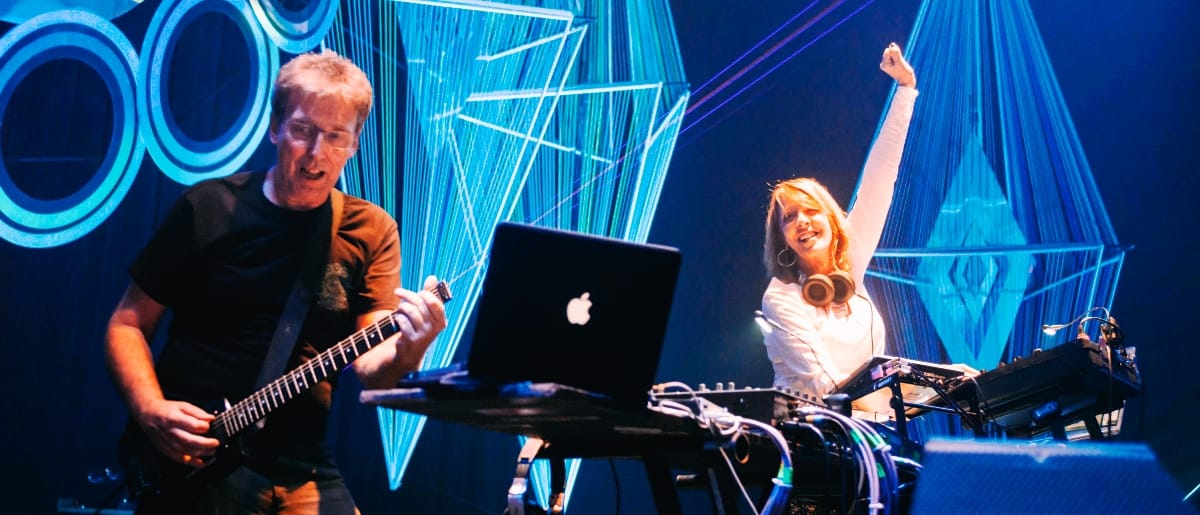
 Mykadelica


Comments