


Maria Schneider has spent more than thirty years building an acclaimed body of work in contemporary American music. With her debut album, Evanescence (1994), she began writing for her 18-member orchestra, tailoring each composition to the specific voices of players she has worked with ever since, many of whom are among the most accomplished improvisers working today. The ensemble has performed at concert halls and festivals worldwide, with commissions from Jazz at Lincoln Center, the Saint Paul Chamber Orchestra, and the American Dance Festival, among others. She holds seven GRAMMY Awards in total, earned across jazz, classical music, and her collaboration with David Bowie. In January 2026, she was awarded the Rolf Schock Prize in Musical Arts, joining previous recipients Wayne Shorter, the Kronos Quartet, György Ligeti, and Kaija Saariaho. The prize citation praised her "unique and innovative artistry" for combining humility, precise form, and deeply personal expression, while also acknowledging her sustained advocacy for musicians' rights.
Long before the streaming era made the economics of music distribution a public argument, Schneider was already trying to instigate one. She testified before the US Congressional Subcommittee on Intellectual Property, participated in Copyright Office roundtables, and wrote extensively on what she saw as the structural failures of platforms like Spotify and YouTube to pay equitably for the recordings they distribute. She also found a practical alternative through ArtistShare, which pioneered direct-to-fan funding and allowed her to finance ambitious, expensive projects without surrendering creative control. Concert in the Garden (2004) was the first recording to win a GRAMMY through Internet-only sales and the first ArtistShare project, eventually inducted into the 2019 National Recording Registry. Her 2020 double album Data Lords, a Pulitzer Prize Finalist and two-time GRAMMY winner, brought both concerns together, parsing the friction between the hyper-connected data economy and the natural spaces that have supplied her with material for decades.
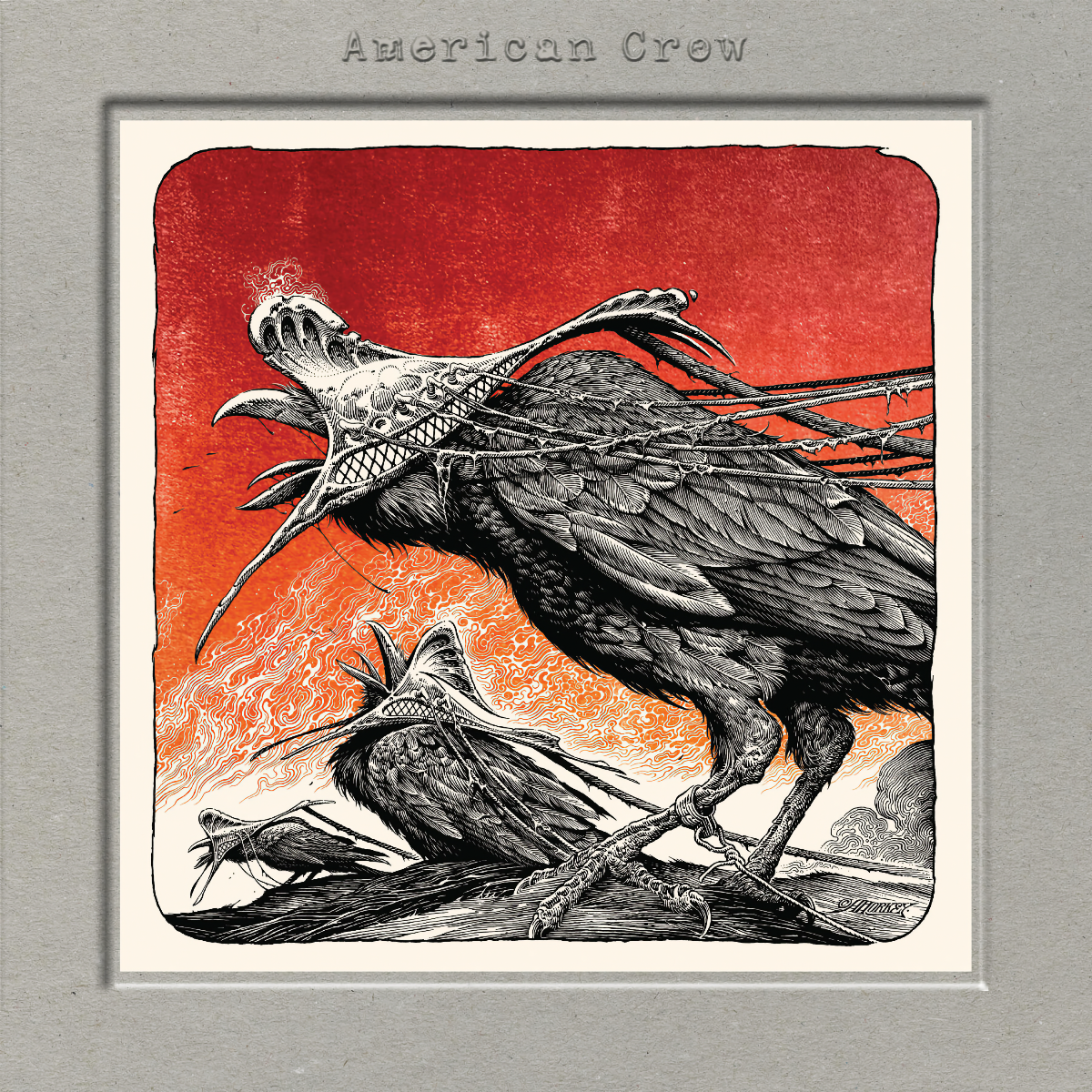
American Crow, also released via ArtistShare, picks up where Data Lords left off. Originally commissioned by Emory University, the title composition addresses what Schneider calls "an impenetrable knot of curated rage" in present public life, where the presence and failure of listening become the central action. The instruction Schneider gave trumpeter Mike Rodriguez defines the piece's governing idea: she didn't want him to listen, but needed him to "sound like he's not listening." The EP also includes a newly recorded version of "A World Lost," reimagined as a guitar feature, along with a field recording of crow vocalizations that leads into an alternate take. The physical package features original art by Aaron Horkey, the painter from Schneider's hometown of Windom, Minnesota, who also contributed to Data Lords. Four/Ten Media produced an accompanying long-form video, "American Crow: A Narrative in Notes and Frames," available free worldwide. When Michelle Mercer, author of Footprints: The Life and Work of Wayne Shorter, attended a Denver performance in 2024, she wrote that it was "a masterpiece offering clarion hope in the babel of a divisive age."
Lawrence Peryer recently had the pleasure of hosting Maria Schneider on The Tonearm Podcast. The pair discussed the relationship between improvisation and deep listening, the origins and resonances of American Crow, Schneider’s collaboration with David Bowie and what it reignited in her writing, and the restorative practice of birding.
You can listen to the entire episode in the audio player below. The transcript has been edited for length, clarity, and flow.
Lawrence: You've been on my bucket list for a couple of years. I took my son to see you the last time you were in Seattle at Town Hall. I've gotten friendly with Donny McCaslin over the years, so we had a chance to talk to him and see the show—it was phenomenal.
Maria: The guys are so amazing. I feel so lucky. There is something special about when it's your own group—when you can hone things, call rehearsals, pick at details, and adjust them. Most composers don't have that. Their music is played by fantastic groups, but they don't have the chance to really develop their work with musicians with whom they have this intimate relationship. We grow old together. Most groups don't have that, and many musicians don't even know to value it—sticking with one group for a long time.
Lawrence: Especially in creative music. Getting everybody to come back together and maintain that consistency of an ensemble is pretty rare and fortunate.
Maria: My music has improvisation, so I work very hard to create pieces that have this connective—you could almost say mathematical—development. It's motivic, built on motifs, so that you try to build in a sense of inevitability. What I love is when people meet the design of my music—where I try to build in the intent of where it needs to arrive: a sense of finality, conclusion, suspense, whatever they are supposed to go to. They are not improvising in a vacuum—they are improvising in the presence of each other. What I'm so addicted to is listening to these musicians, and their level of listening is so astounding. Donny will go somewhere, and Gary Versace will hear it and just, harmonically, go to outer space with him. That kind of support allows them to do miraculous things.
Lawrence: Tell me about what you're saying here about the act of listening. Words come to mind: commitment, requirement, obligation, intention. Can you talk about that—the act of listening versus receiving?
Maria: Over the years, I started to really value the musicians who came into each performance vulnerable, not wanting to repeat themselves—coming in empty and waiting, wanting to hear what somebody else gave them so they could go somewhere new. Not just being like, "I've been working on these diminished patterns, and come hell or high water, I'm going to put them in my solo tonight." There are players who are fun to listen to—more showmen who have certain things that work, and they play them. But my guys are different. They come in wanting to discover something new and not repeat themselves.
I don't generally sit down and say, "I want to write about this subject." Each of our lives is permeated with things we obsess about, worry about, stay awake over, love, adore, and things that repel us. When you sit down to write, if you are present to yourself and all your feelings and just start playing with sounds, what happens to me is that those sounds suddenly illuminate what's been on my mind. It's almost like an Ouija board—the music draws out what I've been thinking about without my actually thinking about it. Data Lords was like that. I was writing this music that was very intense—one piece was "screw Google," the next was about birds or poetry, and then the next was about AI destroying us. I thought, "This is so disparate." But then, all of a sudden, it showed me the struggle I was having to stay connected to myself amid all these things. That's just how I work.
So with American Crow, I've been watching my band—especially in the last few years, since Data Lords. When I see my guys doing that deep listening I was talking about, seeing them on stage, where somebody does something, and you can see the guys in the band smiling: "Wow, this is something that didn't happen before." And I would think: what if our elected leaders could witness the beauty and the miraculous things that can be found when people don't come in with a preformed agenda, but come into a situation really wanting to listen and to find something unexpected?
That's democracy at its best. So when people say jazz is democracy, I wasn't sure what everyone else meant, but all of a sudden it hit me. This is showing us how democracy should work: that we, as a country with very diverse opinions, can listen to each other and not want to win our idea, but to say, maybe if I understood more about you, there could be some balance here, a win-win for both of us.
And then I grew up with crows—I was thinking about crows, hearing them just this morning. Knowing how they live in these wonderful communities and how much they care for each other—if one dies, they practically have funerals. They all get together and mourn. They're protective of each other. They're a lot like we are, but they're also really noisy and argumentative.
I thought about the words "American crow." I wrote one opening phrase—the opening phrase of "American Crow”—, and it felt like Americana, but it felt dark. I said to myself: what if I make a piece about listening, and I call it "American Crow"—like crowing about things, so it's a double meaning? I tried to write something with this intensity, but then it goes back in time to remind us what it was like when we listened.
From that first idea, I had to extract its DNA. (sings) That phrase is throughout the piece. I started developing a harmonic section that felt very much like where I'm from—the Minnesota prairie—and I immediately thought of Mike Rodriguez because he has this warmth in his playing: warm, lyrical, beautiful, but he can also be really intense. That's where the idea for this piece came from. Then it was really challenging to get it to happen. I wanted it to sound like there were crows, so we ended up using solo tone mutes. (laughter) When I work on these pieces, I want them to be intense but also have something fun in them, too. Data Lords is a little bit like that—it's not just brooding darkness. It's dark, but slightly tongue-in-cheek.
Lawrence: You mentioned your upbringing in Minnesota. How much do you trust your memory of this time when we used to listen to each other? How real was that, versus a mythologizing or a longing?
Maria: That's a really good question, because certainly people could come to a consensus. We didn't have twenty-four-hour news where we were only hearing our own story echoed back at us and never hearing the best of the other side. Only hearing the worst of the other side: "they're crazy, they're nuts, they're this, they're that."
It was a different world. We didn't have news curated for each of us individually. I was talking to somebody about Germany during World War II—you know about Goebbels? The People's Radio: they gave radios to people so they could do propaganda in every home. Think about how much deeper the propaganda is now, but it's listening to us, feeding us. It's not a literal radio, but it's our newsfeed. And the algorithms know that the angrier you get, the more you're going to click. So it keeps feeding you what incenses you, what makes you angry. If you look at the cover of American Crow—that's what I call "curated rage." They're curating us to rage at each other. The data lords, to me, are the destroyers of democracy. This isn't about people; this is what we get as a result. That's why I say it's a result of Data Lords.
When I was a kid, everybody listened to Walter Cronkite. My dad was a Democrat who flew Hubert Humphrey around for his early campaigns in state government. My dad married my mom, who was a Republican—she had been an economics major, really into Adam Smith and trickle-down economics, and she became the Republican chairwoman in our town. How often would that happen these days?
Lawrence: I remember more of that from when I was a kid.
Maria: I wouldn't exist if my parents had grown up now, because my dad would have hated my mom, and my mom would have hated my dad. Over the years, my mom became much more liberal, and my dad became much more conservative. So they changed, and it was fluid. Whereas now most couples are in lockstep—they're wearing the helmet, as I have on the crows, with the cord attached digitally or through Bluetooth. They're being fed the same line. I think we were better listeners. I don't remember people saying, "I can't possibly have Thanksgiving dinner with them because of who they voted for." But it's so common now.
Lawrence: When your work is dealing with political concepts—where you're overtly putting that as part of the presentation, talking about it in interviews, writing about it in press material—it's not just a hidden subtext; it's part of the work. When you're doing this in the context of music without words, there's a level of abstraction between your intention and what the audience hears—there's no chorus they can sing along to or anything like that. Can you tell when the message is landing, or does that all go away once you get to performance?
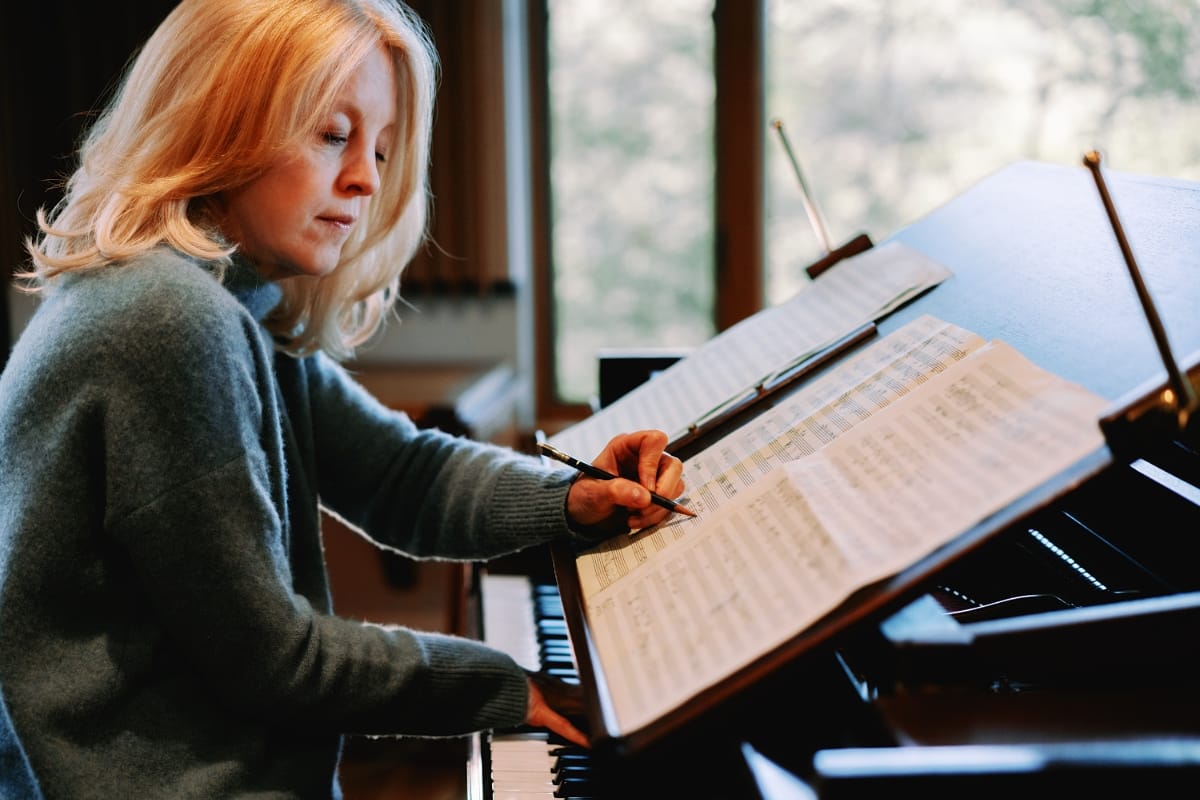
Maria: This is such an interesting subject. How does one make that happen as a composer transmitting experience? The closest explanation I've found came through a book by an artist named Robert Henri. He wrote a book called The Art Spirit, and he says the most important thing in making a painting is that it feels alive. What you're doing as an artist is making something that is a trace of your experience. If you're deeply connected to being in that moment—with yourself, with how you feel—and you create something expressive of it, it's a miraculous thing. It's like teleporting the experience to the audience.
The best example, and the most shocking for me, is when I wrote "Sky Blue." My best friend was dying of cancer. I went home one night, sat down—something I never just do—and found myself in the dark, crying, in this world of love and loss and profound mystery. And "Sky Blue" came out of that.
I played it at the Detroit Jazz Festival. I was signing CDs—there was a line of people—and the last person was a man who knelt down and said, "Seventeen months ago I was diagnosed with prostate cancer and told I had about seventeen months to live. That last encore piece is the first time I've felt at peace in seventeen months."
How does that happen? You can't make that happen. You allow it to happen. You work on your craft, but then you have to be in that moment. When we are constantly connected to this device, constantly on and pinging, it's harder and harder to get to that place.
That's the place I go. With American Crow, I was actually scared to play this piece when I first wrote it. I went to colleges and thought, "Who wants to listen?" Everyone was so raw in 2022, especially on college campuses. I premiered it at Emory, then went to Michigan, which is a very liberal school with a lot of young people, and I thought, "Are they going to react to this?" Kids came up to me, and some were crying. It had such an impact.
When we finish playing that piece, there's that whole section—I call it a Gordian knot of curated rage at the end. (sings) And when that melody comes in, when that thing stops, suddenly I hear people in the audience go, "Oh"—they get it. I don't know how they get it. I can't say I made it happen. I can only say I'm grateful when it happens.
Lawrence: Can you tell me about the relationship between birding and composing?
Maria: Birding is good for me because it brings me back to something I love purely for loving it. Just looking at birds makes you think about migration—it's like looking at the stars, full of wonderment. They activate my heart. I'm not one of those birders who counts birds or races to see as many as possible. I just love it, pure and simple. And that is so good for my composing—to get back into the world of just loving something, because with music you can so easily get into a place of judgment: judging every little thing you did, thinking that's not good, this isn't good, I need to write better, that sucks, I repeated myself. If I go birding, I access that part of myself that's just in love and not judging.
Lawrence: Even hearing you use the phrase "going birding" implies you just traipse out into an area and listen.
Maria: Birding is just—it's funny.
Lawrence: It's like fishing in my mind. I go fishing, and I don't really care if I catch anything. I just want to go fishing. (laughter)
Maria: You go out with binoculars, looking for birds, listening. There's a great app from the Cornell Lab of Ornithology—Merlin.
Lawrence: I just downloaded that! I wake up before dawn, and I always hear the first bird. I grew up on the East Coast, and the first bird in the morning was always a robin. This was not a robin, and it turned out to be a Bewick's wren.
Maria: Oh, nice. Merlin is fantastic. Everyone should have Merlin. Get yourself a decent pair of binoculars and start looking for those birds, observing their behavior, and the colors during migration. Things are going to heat up soon, and you're going to see spectacular birds heading north or arriving to nest where you are.
Lawrence: I wanted to ask you about the lasting impact of your work with Bowie and what you’ve brought forward from it. I'm also curious about that interplay more generally—your collisions with other artists and what you bring back.
Maria: With David, it was interesting. First of all, it was shocking when he came to me out of the blue. How did I get on David Bowie's radar? When he said he wanted to collaborate on a song and sing it with my band, I was just like, really? Why? Really?
When we sat down to start working, he came to hear the band. He really loved Donny. He loved everybody. It was fun watching him listen to the band. He was just smiling wide, loving it. He said he liked my older dark pieces. From my first album, "Wyrgly" and "Dance You Monster To My Soft Song" were his two favorites, and he wanted to write something dark together.
I had been writing mostly pastoral, beautiful things for quite some years. My early work was all minor and brooding, and then came my period of nature and beauty. It was really fun to get into writing something dark with him. That would be the biggest influence David has had in my life, because when I said to him, "What's this piece going to be about?" he said, "I don't know—maybe vampires." And he was smiling, so excited.
He changed the final lyrics for "Sue” right before coming into the studio. He gave me the new lyrics, and I'm reading them, trying to understand, because it looks like the man in the lyrics kills the woman. He looked at me, nodded, and smiled. "He kills her." This is at the peak of the Me Too era. (laughter)
Lawrence: He gets to do that. (laughter)
Maria: It allowed that to enter my musical world. It's like he reignited my older, darker side, but with this new attitude—it can be fun. It doesn't have to be brooding. That was the big impact for me.
Lawrence: I am curious about your receipt of the Rolf Schock Prize. It recognizes both your artistry and your advocacy work—your social work on musicians’ rights—and there aren’t many cases where both are recognized together.
Maria: I did a lot of work in Sweden early on—I have a pretty long relationship with Sweden. They award it to a mathematician, a person in logic and philosophy, and a person in the visual arts, and I have to write a speech that brings those things together.
It is funny—when I teach, I'm really excited about this award and love that it goes to those different disciplines, because a lot of times I talk about mathematicians and math.
Lawrence: You mentioned math at the beginning of our conversation.
Maria: Yes. And I tell a story about a mathematician named Gauss as a child. His way of thinking about a math problem—for me, that is a way to find a similar path to elegant solutions in music. It's like when I was talking about "American Crow"—the first idea I came up with, and extracting the DNA from that idea, making the whole piece come alive through the prism of that idea. That's like finding the most elegant equation that creates a world of possibilities from the simplest distillation.
The same thing happens in philosophy and logic—there's some idea that resonates as true and has a world of implications flowing through the prism of that idea. Certainly, architecture does the same thing in visual form. I use The Art Spirit all the time. So I think it's really fun to receive this award because I feel genuinely connected to those things in my way of thinking about music, much more than arriving at music through listening to music.
But when I saw that they cited the advocacy, I thought: well, anybody can do that. Writing really good music is really hard.
Lawrence: Maybe anybody can, but not everybody does.
Maria: Not many people do, and I did fight the good fight—but I wasn't that successful. I tried to sound the alarm with a lot of people when the streaming music thing happened. You get access to all the music in the world for $9.99 a month or for free—there is no way that will ever work out financially for paying people royalties. 90% of the music gets 1% of the plays. How can opera, jazz, all these things possibly survive that? And I screamed bloody murder about it.
A friend of mine in Norway said, "Well, we're lucky here. Our government gives us money for projects." I said, "Oh, great. How do you feel about your tax dollars subsidizing Spotify and YouTube? Because that's what it's doing." They're paying for the artists' work because there's no viable way for most people to make money from it. I do, because of ArtistShare—I do very well through ArtistShare, paying for very expensive projects. And I tried to show people how to do that, too. But most musicians just want to make music and not think about that stuff. I thought there was a problem that needed to be addressed, and not enough people got on board. It's kind of sad.
Lawrence: I struggle with this topic and, more broadly, with everything we've asked artists to be these days. Every artist needs to be a content creator and a social media marketer, and they have to understand so many things. It seems so unfair to ask even more of them. My favorite artist not making art is a lost minute of art not being made.
Maria: I feel that about my own life to a large extent. We're like plate spinners, with one plate spinning here and here and here—and the last plate we're trying to spin on our nose is actually making music. (laughter)
Lawrence: Is there something you've found that you really can't teach? Something that has to be learned the hard way, or only on the bandstand?
Maria: I think it would be convincing people that less is more.
I'm talking to so many students these days writing pieces that have so many different things together that, as a listener, you're just dizzy. There is no logic, no elegance, no mathematical formula underneath that makes it come alive. They listen to it again and again on their computer—it's being fed back to them, and they've heard it a thousand times. For them, it feels inevitable because they know where it's going. But I try to describe: you're writing something for somebody listening for the first time. You have to take them through time, give them a sense of inevitability, and leave enough surprise so it doesn’t feel handed to them, but rather as if the listener is discovering it.
Check out more like this:
 Lawrence Peryer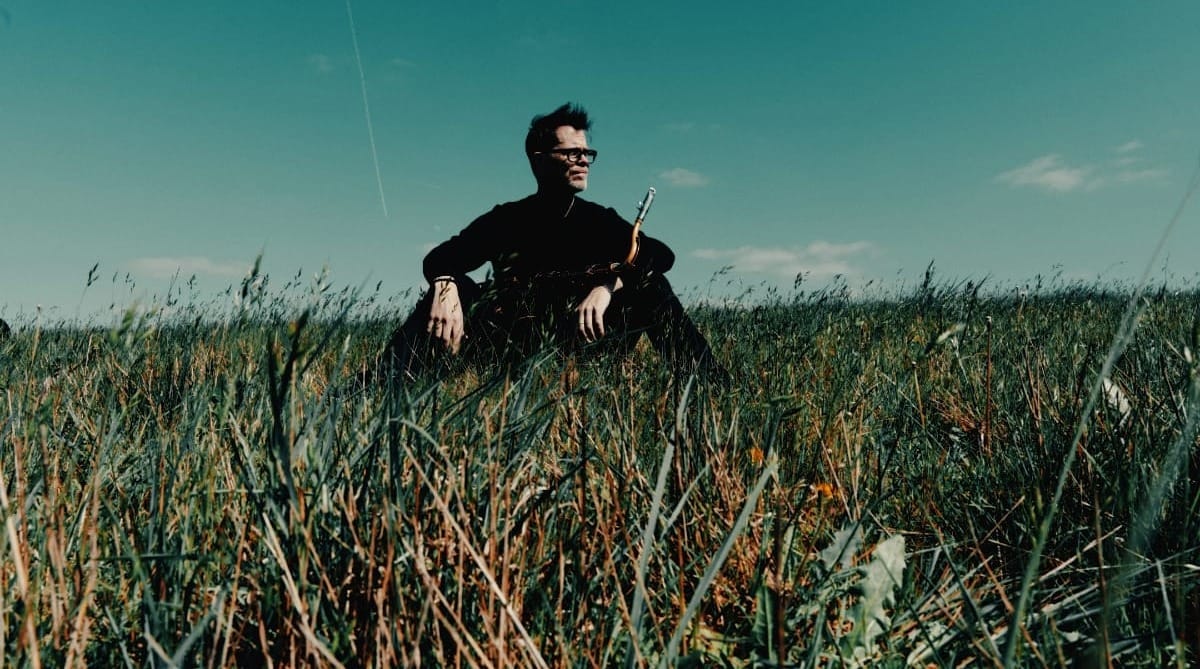
 Lawrence Peryer


Comments