


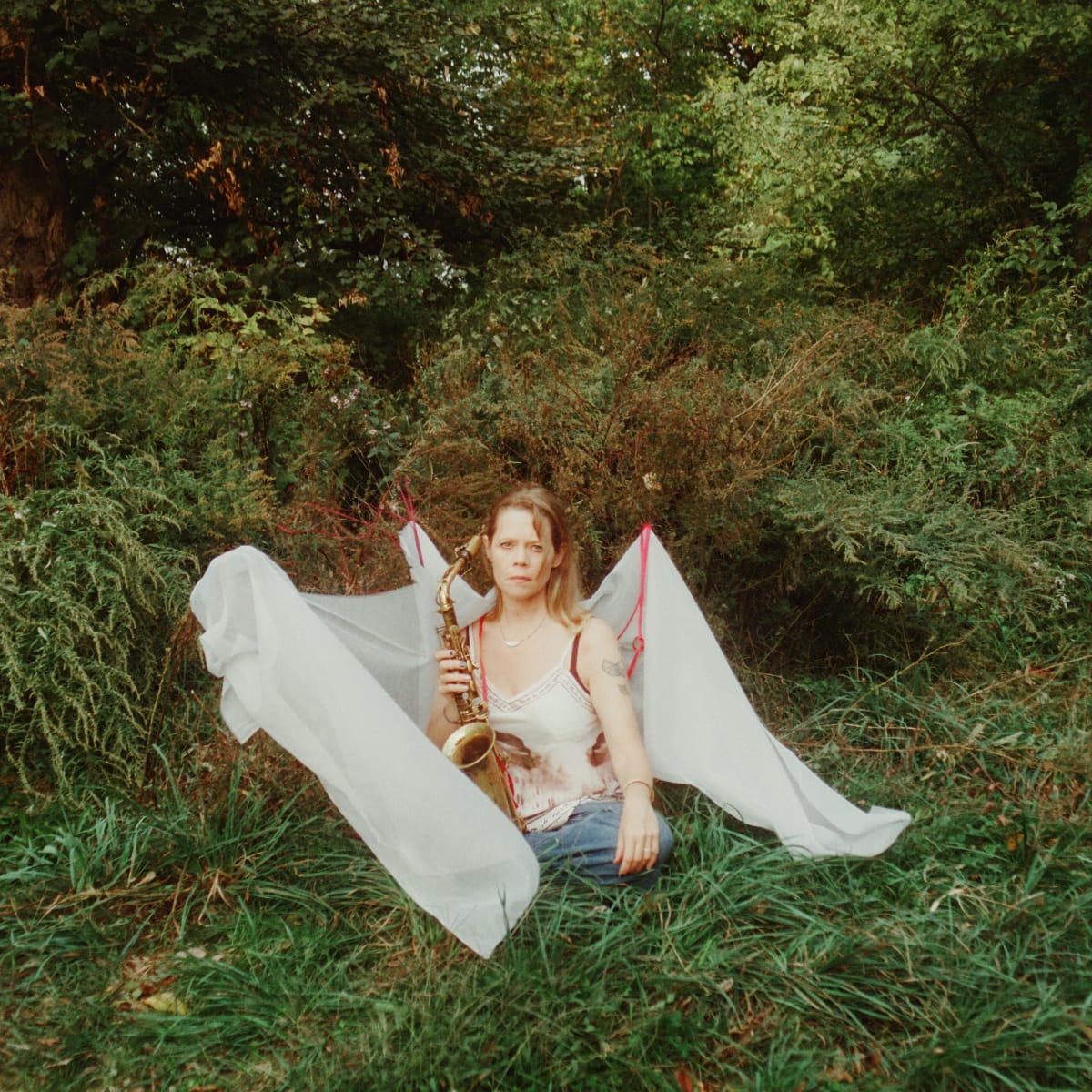
Caroline Davis picked up the saxophone at twelve in Atlanta, drawn to the instrument by gospel and R&B thick with horns. She studied cognitive psychology alongside music and holds a PhD in music cognition from Northwestern University. After teaching at Chicago-area universities, she moved to Brooklyn in 2013 to concentrate on performance and composition. Eventually, DownBeat's critics named her a Rising Star Alto-Saxophonist in 2018, and a Guggenheim Fellowship arrived in 2025. She has released nine albums as a leader, among them the jazz-leaning Portals series, albums from the protest band Alula and the experimental R&B project Maitri, and Davis contributed to Terri Lyne Carrington's New Standards, a collection of jazz compositions by female-identifying composers. Lee Konitz, John Zorn, Nicole Mitchell, and Rajna Swaminathan are among the musicians she has shared a stage with.
Fallows, released on Ropeadope Records, is Davis's debut solo record. She made it alone in a wooden cabin at the Ucross residency in Wyoming, on the lands of the Lakota, Cheyenne, and Crow nations. Her tools were her alto saxophone and the Organelle, a processing and beat-making device. Twelve tracks emerged from the residency, plus field recordings captured from the surrounding terrain. The music moves through delicate melodic passages, extended textural work, fragmented screeches, and rhythmic backdrops, with acoustic preparations added directly to the horn. Davis also developed a private notation in her journals for the venting techniques she was discovering, "creating a language for the venting options I like best." The album title picks up the agricultural meaning of "fallow" as uncultivated ground, echoing a Mary Oliver poem, "Fall Song," and its image of the present moment dissolving underfoot. Three ancestral figures run through the record: the soprano saxophonist Steve Lacy, the pianist Geri Allen, and the Buddhist teacher Thích Nhất Hạnh, whose voice appears on one track via sample.
Davis pursues a parallel life as an advocate, with particular attention to gender equity in jazz and carceral justice. Her community events under the banner "Creative Beyond Incarceration" bring art and activism into the same room, and she has been looking to connect with organizers working on the LandBack initiative. "How do we honor the people who were here before and bring them into the community?" she has asked.
Caroline Davis was recently a guest on The Tonearm Podcast. Joined by host Lawrence Peryer, Davis discussed the genesis of Fallows, the discoveries that emerged from the Ucross residency, the prepared-saxophone techniques she explored there, what creative community means within a solitary process, and the many forms her advocacy takes outside of music.
You can listen to the entire conversation in the audio player below. The transcript has been edited for length, clarity, and flow.
Lawrence Peryer: I would love to start by understanding a little bit about the genesis of Fallows, and by that, I mean the element of Ucross. Did you go into the residency knowing this is what you were going to come out with? Was this your submission, or did you get there and make it up on the fly?
Caroline Davis: In my application, I said I wanted to make a record there. I wanted to take the saxophone and make it not sound like the saxophone. I'm not the biggest fan of listening to saxophone music, which is really funny for me to say as a saxophone player. But a lot of the music I listen to is not played on a saxophone, and the players I adore are at the forefront of that list. Speaking of the record, one person I tried to honor on it is Steve Lacy—he's a person I love and listen to all the time. But I didn't go in knowing this is what would come out of everything.
I looked into the prepared saxophone. You're hearing a lot of experimentation on many fronts—mostly with this electronic processing unit I have, the Organelle. But I also wanted to explore the acoustic processing of the saxophone without any technology. There are hours of me getting leaves from outside and putting them inside the tone holes, and I realized a few times I had messed my saxophone up. I figured I should be a little more careful with the preparations I was doing with these objects I was finding outside. But I was coming up with really interesting sounds. One of my favorites was with an aluminum can. So no, I didn't go in knowing what I’d get at the end, but I knew I wanted to explore and spend more time understanding what the saxophone was capable of.
Lawrence: Tell me about the aluminum can.
Caroline: I got some seltzer from the grocery store and was thinking about what objects could sound nice being dragged across different parts of the saxophone, like the bell. I turned up the microphone as loud as the input would allow and dragged the can on the bell. It produced this really creepy underground sound, like you're in a tunnel and something is scraping against the wall. There's water in the can, so I was messing around with that as well. It took me to a different place. I was in my headphones, really listening, and then I improvised over it. But yeah, it was just a regular can of seltzer.
Lawrence: It wasn't some kind of special seltzer?
Caroline: No. (laughter)
Lawrence: Tell me a little bit about the Organelle—what led you to it, and what's attractive to you about it versus other synthesis devices you could work with?
Caroline: If I weren't as lazy, I think I'd probably delve more heavily into the world of modular synthesis—Eurorack and everything. I look up to so many people around here who devote their lives to that way of making electronic music, because I love the idea of things changing all the time—the idea of irregularity, something that's never the same. With the Organelle, I had seen someone use it to generate sounds at a show—it was a bass player—and I was curious about what it was doing. I asked her about it, did a lot of research, and really loved the idea of having a piece of hardware where you can pull up different patches and process yourself. You can create drum beats, use it as a sampler, and use the patches to create synthesis. It's running on Pure Data, so it's kind of like Max/MSP but a little more open-source. I love the community structure of people sharing this open-source software and this open-source patch-making platform—some things in music can get really insular or individualistic, and this community is just not that.
Lawrence: It's interesting that you emphasize the community aspect of the device, given that my impression from reading some of the materials around the making of the record is of being alone—going to the residency, living in your own space, having time to spend exploring the instrument, and the solitary nature of this record.
Caroline: When I was practicing in that little cabin, I was alone, but there's nature everywhere—the Bighorn Mountains in the distance and a creek. But I didn't feel that alone. At that time, there were twelve other people there who were writing books and poetry and making visual art, and we would come together at dinnertime for a communal dinner. And the nature is pretty special. I would go for runs most days, and there were these groups of cows that would come right up to the fence. I've never really experienced that—how sweet and gentle they seemed to be. And there were birds constantly coming over and sitting in front of the window—turkeys and grouse, geese making all kinds of noise, and deer everywhere every day. But the process of making things felt like I was sitting in a room doing this one thing and trying to get somewhere, and some days were really hard and other days were easier.
Lawrence: Do you find that the other artists there are with you metaphysically—the next morning, while you're working?
Caroline: I'm down with that kind of thought. One enjoyable thing for me as a musician is to be around non-musicians. We're around musicians so much, and I love musicians, but I also really love non-musicians. Being around a filmmaker, for example, talking about another filmmaker I really love, hearing her take on this person we both know. Or I was at a different residency last year at Civitella, in Italy, where I befriended a group of poets. I loved talking to them about poets—hearing their take on who's good and who isn't, going over certain poems together, or they would like this book but not that book. I loved that process of getting to know their world through mine. Then they would ask me about people in music, and you're stepping into their world in certain ways, and you start to understand that we're all kind of the same—we just have different interests and different lanes.
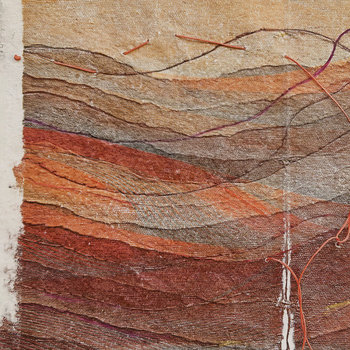
There was a person at Ucross working on a book about the food industry—he had worked at a very well-known fast food place for a time, sort of undercover, and was using a lot of that information in the book. Seeing how dedicated he was to uncovering information about this industry was so inspiring to me. And seeing people's visual art—the studios were right next door to me, so I would go visit. There was a woman making paper from found grass. She would create this pulp, dry it out, and press it into paper. I loved her work so much that she ended up doing the artwork for my record. Her name is Tulu Bayar—she's Turkish —and, witnessing her whole process of making paper and telling stories through her visual art, I was just like, “I have to get you involved in this project."
I read somewhere that Ralph Waldo Emerson, when he got into a flow state where everything was just coming out, would stop and put the paper away so he would come back fresh and excited to go again the next day. What a process, what a way of doing things! I was trying a bit of that, and sometimes it worked, and sometimes it didn't. It's just up and down with the creative process.
Lawrence: It takes a lot of faith to turn the faucet off when it's flowing like that. To me, that's terrifying. If I feel like I'm in the zone, I sort of go past the point of exhaustion.
Caroline: Yeah, absolutely. It's nice to just get it all out. I know a lot of artists who want to get everything out because they're afraid that if they don't get it out now, it won't be there tomorrow.
Lawrence: “Today might be the last day I'm capable of this!" (laughter)
Caroline: That's a real thing. I've definitely written pieces of songs, had to go somewhere, come back, and thought, "What the hell was that?" It takes me a second to get back into the zone of what I was thinking or doing.
I woke up at around three in the morning the other day and wrote something that had come to me. The next day, I looked at it and had no memory of doing it. It was so wild. I've talked to John Zorn about that before, and he said his favorite time to write is also in the middle of the night. You're kind of not yourself, and nobody's awake, so it feels like all the energy of the place is open for you to take.
Lawrence: There's something very special about those hours between one and four or five in the morning.
Caroline: Yes. Where everything feels okay. It's ripe. “Let's go."
Lawrence: Earlier, I don't know how serious you were about not listening to the saxophone. Some people don't listen to much music for fear of being influenced, or don’t listen to artists who play similar instruments because they don’t want to steal licks or anything like that. I'm curious what it's about for you.
Caroline: I think it's always in my face—on my body and in my mouth—so I want to take some time away from it to gain perspective from another world. I'm trying, texturally, to make my sound more like the voice in certain ways, or like a trumpet, or maybe a flute here. How can I make it sound percussive? Can I make this accent sound like the piano? What texture can I live inside?
I spent an earlier part of my life totally immersed in Charlie Parker, or totally immersed in Joe Henderson, Sonny Rollins, and some other people who have been madly influential to me—Lee Konitz, Lester Young. I've spent hours transcribing and trying to learn about them, hearing their sound in my head. I think the process of immersion or imitation is useful sometimes, but it can be a little damaging if you stay in it for too long, because then you never become yourself—you're just always trying to be someone else. There are a lot of people who sound like John Coltrane because he was just such an untouchable and incredibly talented human being. That's another influence of mine. I think there will never be another one like him, ever. So, trying to imitate or copy too much isn’t what I’m interested in.
I'm not listening to a lot of saxophone music right now because I'm just more interested in other textures and how they can manifest themselves on my instrument. I think it's difficult to get a good sound on this instrument. It's an easy instrument to learn—if you're just learning how to put your fingers down and press buttons, very easy—but to get a good sound on it is really tough. Sound is number one for me—sound, time, rhythm, creativity.
Lawrence: I get that from some of the names you mentioned. When I think about someone who clearly spent time on their tone, Joe Henderson would be pretty high on my list. I could listen to him endlessly.
Caroline: Me too. And I can listen to Sam Newsome play saxophone. Anything that Sam is on, I have. I remember learning about him the first time through Litchfield Jazz Camp in Connecticut when I was a kid. He wasn't on the faculty, but the person I met on the faculty was Dave Berkman—he's still around, a wonderful pianist. He had made a record, and Sam was on it. I bought the record and thought, "Oh my God, this is the best saxophone player I've ever heard in my entire life." Then I moved to Brooklyn and played with Sam. He had a band of four soprano saxophone players, and I was in that band with him. He's also doing prepared saxophone—he uses tubes added to the mouthpiece, wind chimes, and balloons. He's just the most creative spirit I've ever met and a huge inspiration to me.
Stay on top of The Tonearm.
Subscribe for classy reportage, culture tips, and crafty surprises.
And your support keeps our site free of advertising and paywalls.
Lawrence: Tell me a little bit about the role of the ancestral figures on the record—Steve Lacy, Geri Allen, et cetera. What did those people give you that made it important to acknowledge them?
Caroline: Two of the people I mentioned I was fortunate enough to meet—Geri Allen and Thich Nhat Hanh. I didn't get to know Thich Nhat Hanh very well. I went to a meditation retreat at a center here in New York, and he was there. He led guided meditations with us, and we did walking meditation, so we didn't have an especially personal connection. But Geri, I worked very closely, and she helped me believe that my voice was something unique. She kept in touch and asked how I was doing regularly, and I would go see her play. The last time I saw her was at the Village Vanguard, right when she was starting her program in New Jersey for young girls in jazz. That was a really special initiative she believed in very strongly, and she asked if I would be interested in participating. But she left us too soon.
The other two people, Steve Lacy and Connie Crothers, are musically speaking at the highest peak for me in their ways of accessing flow. Connie comes from the lineage of Lennie Tristano—she was a student of his—and I met her because Lee Konitz, who was my teacher, mentioned her. I went to see her perform a few times here, saw her out in the community a few times, and never got to study with her, which I was really sad about. She also left us too soon. I listen to her interviews a lot and her music all the time. I also met her collaborator, Richard Tabnik, an alto saxophonist here who's on a lot of her records.
Steve Lacy, who I didn't know personally, is obviously one of the masters of the soprano saxophone, and his solo records in particular—not just the Monk records, but some other solo records, Sands, and others—where he explores different textures on the horn and different ways of playing. His sound is the woodiest you can imagine on the soprano. I just love him so much. Those two figures have been so influential to the way I hear music, because they're just in my head, even though we never met and never played together.
Lawrence: I wonder if you could tell me a little bit about your interest in the work you do alongside the justice system, and how, if at all, it intersects with your artistic pursuits.
Caroline: Most of my interest in advocacy has been in two worlds: gender advocacy and advocacy for incarcerated people.
For gender, I've been working at the New School. I teach a course on gender and jazz with my colleague Sarah Elizabeth Charles. She started the program there, and we've been doing that together for about eight years now. That's been a beautiful community to continue every semester—talking through issues that continue to plague the jazz and improvised music communities regarding gender expression and sexual orientation.
The other side of my advocacy has been through the prison-industrial complex. I have a family member who was previously incarcerated, which is partly how I got involved with advocacy—I started realizing as I was getting older how much the system had affected my family's life. That was not here in the United States, because my family's from Europe, so a different carceral system. But I started contacting people here, namely political prisoners who had been involved in some kind of cause and had been locked up because of it—people in the Black Panther Party, like Angela Davis and Jalil Muntaqim. Both of those people are still living, out of prison. I know Angela was only in prison for a very short time. Jalil was in prison for over forty years, and I befriended him by writing letters. The awareness of freedom fighting and how that can affect your freedom is just a wild set of circumstances I've learned about through contact with both of them.
I also perform with a group working toward freedom for Keith LaMar, a person on death row in Ohio who was wrongfully convicted for a crime he did not commit and has been in solitary confinement for over thirty years. His execution date is set for January 2027. I'm going to visit him on Sunday. I also go semi-regularly to Sing Sing Prison in Ossining with Musicambia, an organization that provides music classes for people inside—not just at Sing Sing, but also at Rikers Island, and at other facilities: Bedford Hills in New York, which is a women's prison, and a facility in South Carolina. They've been expanding their work to other states, which is beautiful. I've really been enjoying those classes and getting to know the guys in there. It's been an amazing experience.
So it's several levels of involvement. I would call myself a prison abolitionist, even though I'm very much woven into the fabric of activities inside prisons. It's a confusing and often cognitively dissonant way of life, because I know that prison abolition isn't possible at this moment. It's going to take a lot to reverse this whole system—we have two million people now who are locked up in immigration detention centers, jails, and prisons.
Lawrence: And now there's a financial motive.
Caroline: Yes. I'm also on the board of a wonderful record label called FREER Records. We put out records by people who are either still in prison or who have recently been released and want recording careers. That's the basis of the label, and the work has been so illuminating—to see people making music and trying to make a better life for themselves, because getting out and then trying to build a life is one of the hardest things a human being can do. Even just getting an ID—I was talking to one of the artists affiliated with Musicambia a couple of months ago, and he was having trouble getting one. He had to track down his mom, with whom he didn't have a great relationship, to have her call a place in Colorado to get his birth certificate reprinted. Meanwhile, he can't work because he doesn't have an ID. The whole thing is completely broken.
I'm just trying to do as much as I can, but sometimes I have to step away a little because advocacy work can completely take over your life. It's there, and I'm doing the best I can, but I'm mostly here making music, practicing, and touring. I've been trying to balance all of that.
Check out more like this:
 Lawrence Peryer
 Lawrence Peryer


Comments