


“I’m really an improviser, from my heart. I like the living music that comes from the moment when you play, and I think it’s very special when you’re in a room, and you hear a person on stage creating some music, creating it in that moment that you’re there, that you’re present. That’s something really special, and you lose that when you write the music down.”
These words come very early in my conversation with Olaf Rupp, and he says them with a quietly impassioned cadence, utterly disarming in his earnestness and wonder. It is a pattern of expression that prevails during our conversation—me asking questions, and Rupp answering, first in a measured and direct manner, then, with an unerringly kind and affable smile, opening more, his speech becoming more technical and painterly at once.
The free-form guitarist has appeared on over 70 records to date, in duo, trio, and larger group formations, as well as in a substantial body of strictly solo work. And though he may not be a household name, even in the constricted spaces of experimental music, chances are that this unostentatiously fearless player just may be your favorite guitarist’s guitarist. Now, with his latest solo undertaking on Bill Orcutt’s revered Palilalia Records, the exuberantly tone-smearing Fuzzy Logic, Rupp’s upright fingerpicking technique has taken a pulsing mass of hot tube-amplifier distortion and carved it into a mesmerizing, torrential landscape of raw beauty and mind-scrambling atonal textures.
Born in 1963 in Saarlouis, Germany, he started playing at 12, in a pristine autodidactic state, unencumbered by formal strictures or rehearsals, or even learning standard chords.
Khagan Aslanov: You have a different trajectory than most experimental guitarists, in the sense that you started playing avant-garde music right from the start.
Olaf Rupp: Yes. But if you listened to what I was playing at 12, it didn’t quite sound like what I do today (chuckles). But yes, I was not learning classical songs; I was just picking up the guitar and playing whatever was on my mind. I was meandering and enjoying how you could try things, and then find something that resembled a song. Then I’d go somewhere else. It was like rafting. When you’re in a boat on a wild stream, you just try out everything. I think that is quite a nice way to learn an instrument.

By the same measure, unlike many of his peers, he bypassed academic learning entirely in his youth, and Rupp doesn’t carry the same disdain so many avant-garde artists do for their scholarly beginnings. He muses that later in life, he would have loved to have had a teacher, someone to help guide him through the pathways that traditional arrangements take, as they veer onto bent and warping courses.
Soon after, at 13, he decided to become a musician and was quickly shocked that what he called “instant music” wasn’t easy to find in live venues. Growing up in the rural isolation of the countryside near the Hunsrück Forest, free improvisation was difficult to come by, and his teenage years also included playing conventional blues, rock, and classical music out of necessity.
Yet, despite these intermittent excursions into traditional genres, he consistently returned to free improvisation, and the technical groundwork he’d laid down for his unique playing style—like holding his guitar in an upright position (reminiscent of Chinese pipa players) to avoid back pain, and more easily execute complex cluster effects, tremolos, and arpeggios—came quickly and naturally.
In 1993, Rupp moved to Berlin and began integrating into the local improvisational scenes. As the decades passed and his body of work expanded, that early instinctual pull that led Rupp down the avant-garde morass only grew, and still, as he speaks of music that roams freely, he does so in a solely reverent tone.
Khagan: I suppose when you conceive ideas, then, you do so in a cognitive way? Do you visualize the music at all? Are there any skeletal compositional components? Or is it purely improvisational?
Olaf: I hardly write music. I have tried several times. But it happens so often that I write down a simple sketch of an idea I come across while I’m practicing, and the next day I read it and ask myself—why did I write this down? It’s just stupid (laughs).
But once I tried to figure out why, I realized it had something to do with the sound. If you play a melody in a certain way with a distorted guitar, the distortion adds other modulated tones in between and creates other sounds. Maybe I felt the need to write something down because of the sound I was producing, not the notes. That’s why I have difficulty writing down pieces, because the sound itself needs a different score. And that’s really not what I want to do. I’m an improviser, from my heart.
You have to be very picky and precise to create a convincing performance when you improvise. And in composed music, very often that’s the part that’s the weakest. You can have rehearsals, but you never get to the point where it’s really committed and independent of the score, where everyone naturally knows what to do in the moment.
Khagan: I think what you said about this music feeling alive is true. A composed piece is obviously something very precise. It can be beautiful, but it also has a certain sterility. Whereas with improvisational music, it is very alive. It feels like an organism when you’re listening to it, especially because you never hear it the same way twice.
Olaf: Exactly. I like both ways, and I think each has pros and cons. The pros of writing are precision and the multiple layers of voices. You can execute these things: parallel voices. You will never improvise parallel voices. We don’t get to a completely telepathic state.
Khagan: You can’t improvise synchronized swimming.
Olaf: Yes, that’s the problem. And very often, when you hear composed pieces that deal with complex sounds and the direction of chaos, they have their own problems; they cannot make it truly chaotic. We can do that very easily in improvisation.
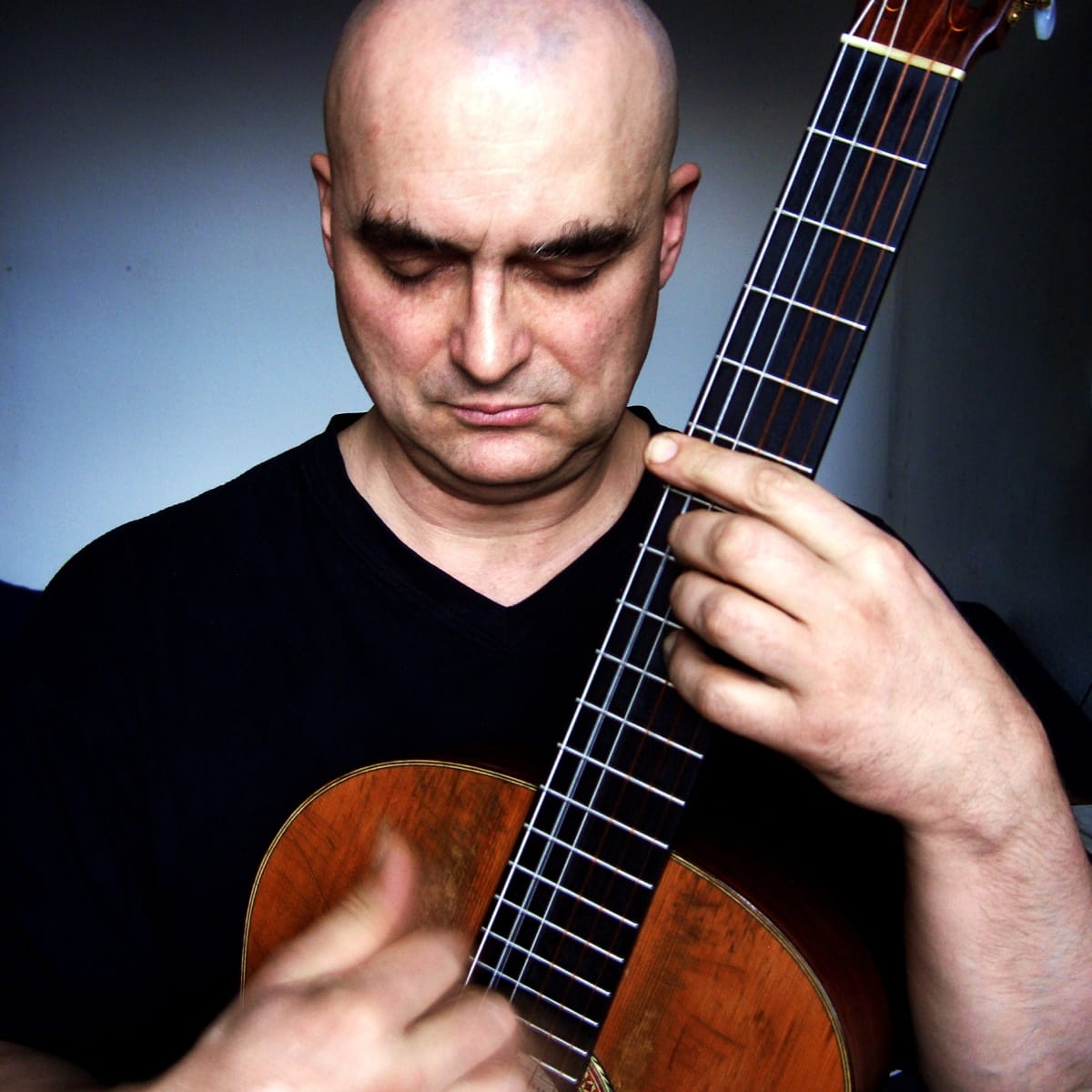
The foundational engineering trick that Rupp pulls off on Fuzzy Logic relies on a very specific mechanical paradox: achieving high-gain, completely saturated “blow-out” overdrive without overwhelming the acoustics of the physical room. To do so, Rupp routed his guitar into a low-wattage amplifier pushed to its absolute threshold. Using a power attenuator between the amplifier output and the speaker, he then captured extreme overtones, self-oscillations, and natural clipping of a tube amp. Tracked at low volumes, these breaking points were subtly augmented, using a custom-manipulated sound-stretcher and a hardware loop pedal.
His actual playing techniques too were something all of his own. Bypassing the usual methods of whipping up electric chaos—such as basic proximity feedback, standard string bending, or sustain pedals—Rupp instead transmuted flamenco fingerpicking, like rapid finger strikes, arpeggios, and picados, onto a hyper-sensitive, high-gain electric fretboard. On some of the album’s pieces, the physical contact points between skin, pick, and wire acted as primary sound sources, inducing a strange bowing effect. On others, Rupp deployed clusters of rapidly changing intervals, creating “rainbow sprays” of ghost notes and interlocked waveforms.
All this overtly technical speak is to say that the amount of innovation and nuance Rupp sank into Fuzzy Logic is something astonishing, especially given the knowledge that this genius exercise in sound art had been sitting on streaming platforms without much attention for years, until Orcutt plucked it out of obscurity and pressed it to vinyl.
Stay on top of The Tonearm.
Subscribe for exclusive interviews, cultural tip-offs, and community fun.
And your support keeps our site free of advertising and paywalls.
Khagan: When you’re using these resonant overtones and divided strings, and you split a string’s resonance to generate those whistling harmonic sounds, it’s not a precise calculation, is it? You’re leaning into the instability of the amp? Or do you have an idea in mind of what sort of overtones you’re going to get?
Olaf: I think it’s in the middle. I’m a person who really enjoys practicing. I like to spend hours with my guitar just playing. Others think it’s boring, but I like it a lot. So it’s not that I know precisely every flageolet on the guitar. But the more you do it, the more you find it. Somewhere between perfection and just stumbling between the notes.
I’m talking about flageolets here, but if you talk about these resonant sounds that Hans Reichel developed, those are almost completely unpredictable. I think they would be really hard to make totally precise. And it’s not necessary at all.
Khagan: On the album, you produce these massive blown-out, overdriven tones at low volumes. It’s a really strange effect and a very singular moment. I’d never really listened to a solo improvisational guitar album that sounded quite like it.
Olaf: It’s a thing you have to get used to. When I started with this, of course, I went to the extremes at first. There’s a limit to how soft you can go with a distorted amplifier. It’s not a technical limit, but an aesthetic one.
It’s a habit of listening, really. A trumpet has a different sound if it’s played very loudly; it has this shattering, kind of distorted sound. Sometimes, sound engineers or even neighbors come and complain about how distorted the sound is. But I’m playing it at the volume of a kitchen radio. It’s not loud. And it’s not the volume. It’s the sound. It’s very interesting because you have to retrain your brain a little bit. For me, this is a fascinating thing, because the separation of volume and sound creates so many opportunities to find.
Khagan: So when and how did Bill Orcutt come into your timeline?
Olaf: I found out about Bill Orcutt when I was surfing the internet, actually. I stumbled onto him and thought—wow, this sounds cool. It’s a different way of guitar solo improvisation. And it was a way that I feel very akin to, just from the sound.
In Germany, improvisation is very much associated with jazz. And this has the consequence of different guitars and a different attitude to distortion. These may be just small details. But a few of these details in a chain end up with a totally different sound. And then I don’t feel at home.
And when I heard clips of Orcutt playing solo, I thought, wow, I want to remember this. But I’m not in a situation to make plans for international collaborations or anything. It’s a bit desperate here in Germany. So I would never have thought to call him. And then he called me.
He emailed me and said he’d found my album on Bandcamp, and asked if I would like to release it. I wrote back and said that it would be amazing, but the album is a bit long. And he said, well, so we’ll do a double LP. It was all very smooth, the whole procedure. And then he was on tour in Germany, and we met here in Berlin, when he was playing with his trio. That’s when we spoke in the real world for the first time.
The mention of Hans Reichel is perhaps a very specific one for Rupp. A pioneering German avant-guitarist, luthier, and typographer, Reichel didn’t just play guitars, but interrogated their very anatomy. He was known for building his own instruments, often from scratch, fretless microtonal creations, and is perhaps best known for engineering the daxophone, a friction idiophone that produces almost human-like groaning sounds via a bowed, custom-shaped wooden tongue coupled to a contact microphone.
Though bound by their tireless pursuit of singular creativities and abject denial of rigidity, the two musicians represent different polarities of the free improvisation world. Where Reichel carved his own unique space through the avant-garde, refusing to adjust to standard forms, whether sonic or physical, Rupp has disassembled the guitar from the inside out, coaxing endless new variations of noise out of its established frameworks.
Khagan: I wanted to mention your 2020 album NOBEACH, where you do the tribute to Hans Reichel. I really love the dissident gesture of using a standard, completely unmodified guitar to pay tribute to someone who strictly built their own.
Olaf: It’s a strange thing, I suppose, and I don’t really understand it myself, but I don’t even go to different tunings. I’m terribly conservative in that way. But I would love to play the guitars of Hans Reichel. He should be in Germany, somewhere.
I still remember the first time I saw him play in Berlin. I couldn’t imagine how these sounds were created. I knew the records, and I thought, “Well, okay, it’s a synthesizer.” But no, it wasn’t. And then, when you see him with this crazy instrument, you can somehow relate to how the sounds are created. The funny thing is, I also hear in his music how he just continues to play all these traditional licks, but they get filtered through this guitar, and what comes out is something totally new.
I was so fascinated by Reichel’s playing in the ’90s. It seemed impossible to do this. And then I found out a few ways, but it’s a very humble version, of course. Just a few sounds. For anything beyond that, you would have to build a little bit more. At least you would need to build a capo that doesn’t push down the strings, but just touches them in certain places.
Khagan: On that note, if you had to graft a guitar together—body, neck, pickups—what guitar would best suit your needs?
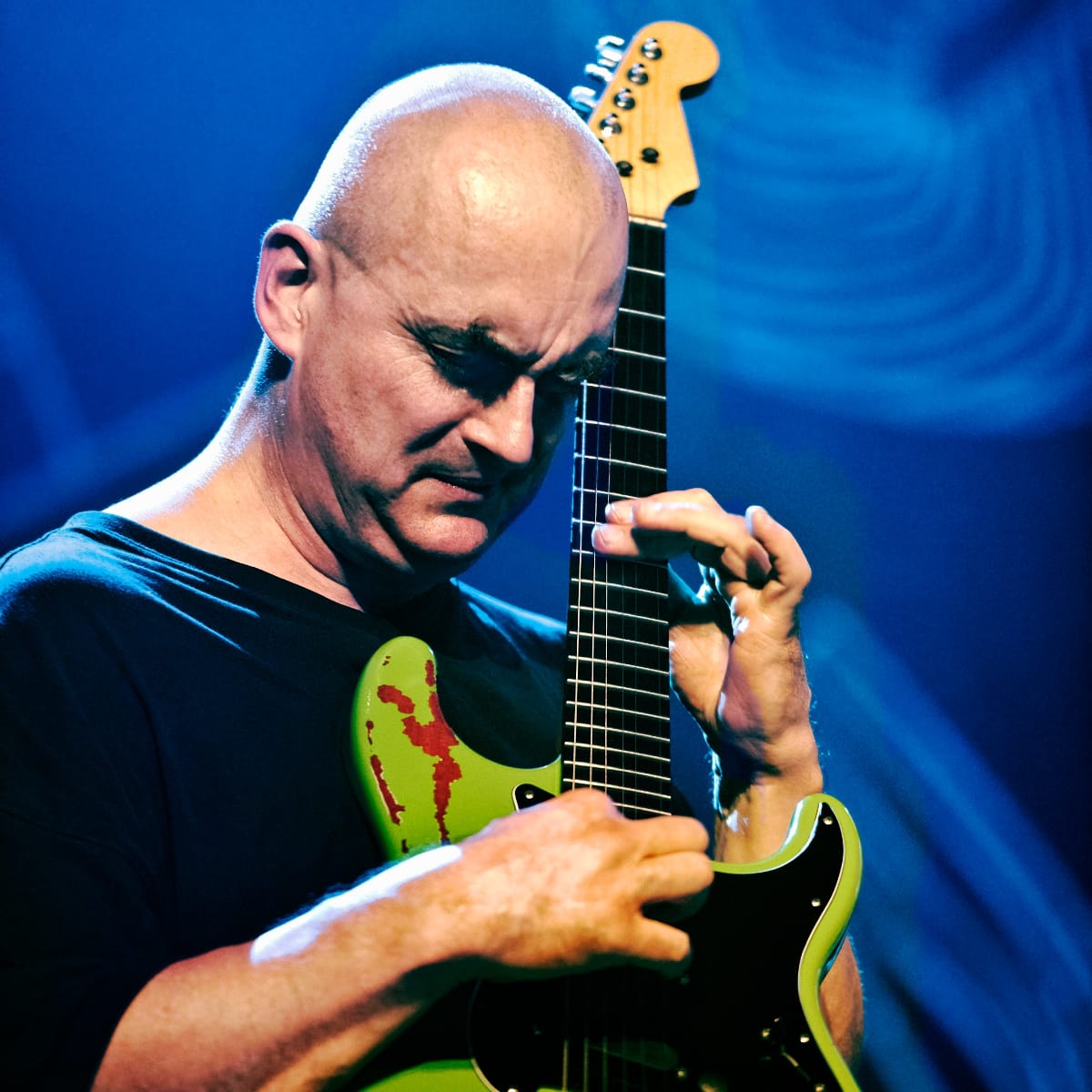
Olaf: Well, my guitar (laughs and points to the bright green Stratocaster hanging on the wall behind him). I’m fine with that one.
I would just like new pickups. There are the new Kinman pickups. I think many guitar players have a problem with the intermediate, third, and fifth sounds. The bridge and the mid-pickup together. If I have to use humbucker pickups, it’s often not possible to play this kind of music in a duo with a cello, for example. You get this (mimics a sustained wailing sound). Humbucker pickups always have a problem when you combine them to create this kind of intermediate sound. But that’s about it.
I’m happy my green guitar has no vibrato, because I do terrible things with vibrato. It’s really terrible. Every time I try, it’s way too much. I mean, if you listen to what Jeff Beck did with the vibrato, you know it’s better to just not have it (laughs).
For me, the two main problems have always been to make the electric guitar softer and the acoustic guitar louder. The first problem is solved with attenuators. And with the acoustic, I can always amplify it, I guess.
Khagan: Well, on SKYHOOK, for example, you bring a nylon-stringed instrument into a room of reeds and a contrabass. Somehow, you avoid stepping on frequencies, which is surprising in that combination.
Olaf: Yes, it’s a very special thing in that trio. You’re always hopping around each other, trying to create places for the others in this fast-fluctuating music. I use this wonderful amplifier, and it’s far too heavy for me. It weighs 25 kilos. When I travel by train, it’s on the edge of manageable, but it is a bit stupid to carry this big amplifier for gigs with an acoustic bass and a loud clarinet.
It’s not just a technical problem, but a musical one. Even in classical music, the acoustic guitar is a solo instrument. There aren’t many combinations where it actually works. And while I enjoy playing solo shows with it, I always want to play with other instruments to get to a place where the level problem would be solved.
As our conversation winds in and out of technical aspects, and the nature of being a niche artist within the larger music industry, Rupp’s unassuming nature holds strong. In the end, he leaves me with parting words that mirror his music, something that is as mechanically complex as it is viscerally emotionally beatific:
“I remember when I was 16, as I was fiddling with equalizers and amplification, I had this cheap Barcus-Berry pickup, the first piezo one; it was so terrible. And a Dynacord tube amplifier, a self-made speaker cabinet. It all sounded like trash (laughs). I tried and tried to get it right. And when you listen to recordings from the time, it wasn’t just me. You hear all these great players struggle with the gear.
But we all did it to play together, in groups. It’s such an important part of improvisation, this communication. You slaughter the sound for the greater good!”
Check out more like this:
 Steven Garnett
 khagan aslanov


Comments