


Here is a short and highly nerdy breakdown of the two instruments that converge on On Bats, the excellent new album by noise-guitar maestro Bill Nace and multi-instrumentalist and virtuosic improviser David Watson:
Watson's Highland bagpipes are a perpetually stubborn monument to fixed pressure and Just Intonation. They possess no volume control, lack all dynamic variation, and hold a very rigid harmonic structure. Because their reeds require meeting just a minimal threshold of pneumatic pressure to be engaged, they either blast at full volume or produce no sound at all. They cannot crescendo, and changing to another key signature is physically impossible without stopping and restructuring the entire instrument.
Similarly, Nace's taishōgoto is averse to major fluctuation. The Japanese wooden instrument uses an automated metal fretting system attached to keys that, in their function, more closely resemble those of a typewriter. As soon as you deploy a key, a metal rod falls onto a fret, and a fixed pitch is produced. Unlike other, more elastic and adaptive string instruments, it cannot play varied chords, drift between notes, or pull off smooth glissandos. Instead, what you get is a monolithic drone.
All this is to say that there is something extravagantly grueling about On Bats. Like all great drone records, it is by no means easy listening, but it possesses a singular magnificence, and the throbbing sonic landscape it carves into the listener is nothing short of hypnotic. In the absence of variating keys or chord progressions, what Nace and Watson end up doing is mounting a dense mechanized wall of texture and timbre—unyielding, irresolute, and somehow, staggeringly beautiful.
Even conceiving of trying something like this is an extraordinary challenge to put in front of oneself to start with. How much soulfulness and artfulness the two manage to draw out of all this stricture only speaks to their prowess. Despite the fixed palette that On Bats sets up for itself, within its relentless abrasion and parallel play lie dizzying matrices of micro-change, and the more you allow this album to envelop you, the more it becomes something profoundly revelatory and disorienting.
As I sit down to speak with the two architects of this claustrophobic tonal stasis, On Bats is about to be released by Amish Records, and the duo is slated for their first shows together since the concert that yielded On Bats. There is palpable excitement within Nace and Watson to speak about their collaboration, their feelings about the nature of non-compositional music, how they navigate their instruments, and their upcoming shows, where they get to stretch these beastly improvised pieces to their maximal capacity.
Khagan Aslanov: You wrote this material back in 2023, but it's largely improvised. Did the motifs and cues you left for each other change at all from recording to playing it now?
Bill Nace: No. The material is all improvised. Our previous shows felt like more isolated events. Lately, we've been actually playing more together.
David Watson: We did a show at an event that I organized, and occasionally, as a little present for myself, I'd invite someone that I wanted to play with. This was one of those occasions. We were on a great double bill. I presumed Bill would be on the guitar. That's not what I got. Best laid plans, as they say. To me, it's really mysterious that this duo works so well. Perhaps it's the person playing it.
Bill: The one difference for me is that during the recording of that early show, I played the five-string taishōgoto, which is all in E. Now, I play the two-string, which is G. It has more sustain and resonance because it's hollow. That would be the one change. But the album itself is mostly the five-string. It's probably imperceptible to most anyone, but there is a difference between the record itself and what we're doing live now.
David: I'll ask you a question, Bill. The two-string—is it limiting or focused?
Bill: The five-string is more limiting. It's just a solid piece. It makes no sound unless you're playing it. It's not like a guitar, where you can hit it and just let it sustain. The two-string is hollow; it's not supposed to be amplified. So there is more to play with there. But it is still limiting. Which I like. I feel like I can get in there a little more, with David.
Khagan: David, to my knowledge, bagpipe notes fall outside the equal-tempered system. How do you then reconcile that sort of modality with a fixed pitch, when your two instruments collide in this way?
David: My answer is I don't know. (laughs) A couple of notes go outside the equal-tempered system, but only a couple. And just like Bill, what I'm working with is very finite. My background is also as a guitar player, and for me, the guitar is an incredibly flexible instrument. And bagpipes are not. The essential equation is that we have some key notes, or is that what you would call them, Bill?
Bill: Yeah! I think, because of his breathing, David's notes bend a little. The five-string felt more like a piano, but on the two-string, I could bend a little as well.
David: If you hit these notes over and over again, that repetition at that volume, the notes appear to be bending, but they're not really.
Bill: Yeah, the other stuff starts appearing.
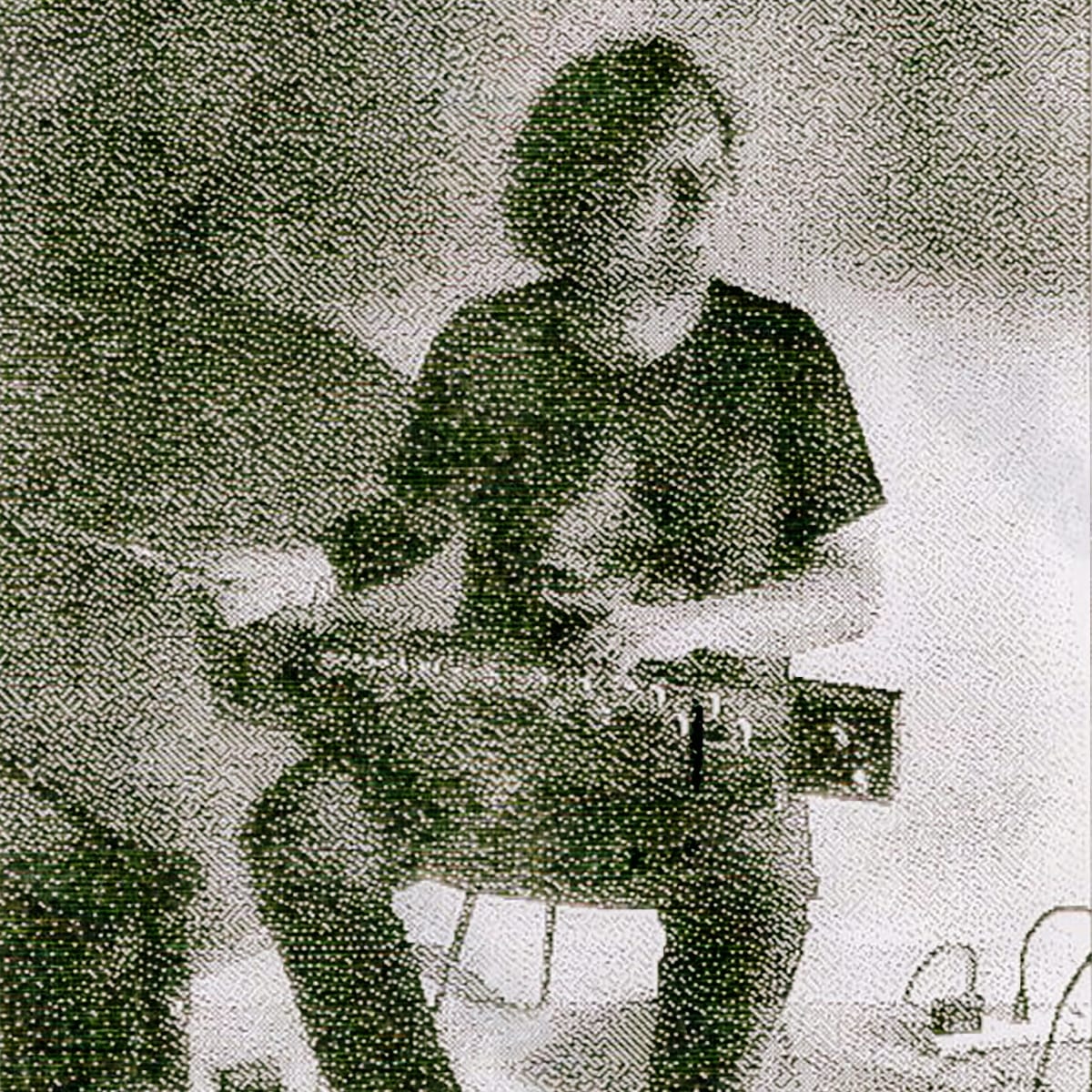
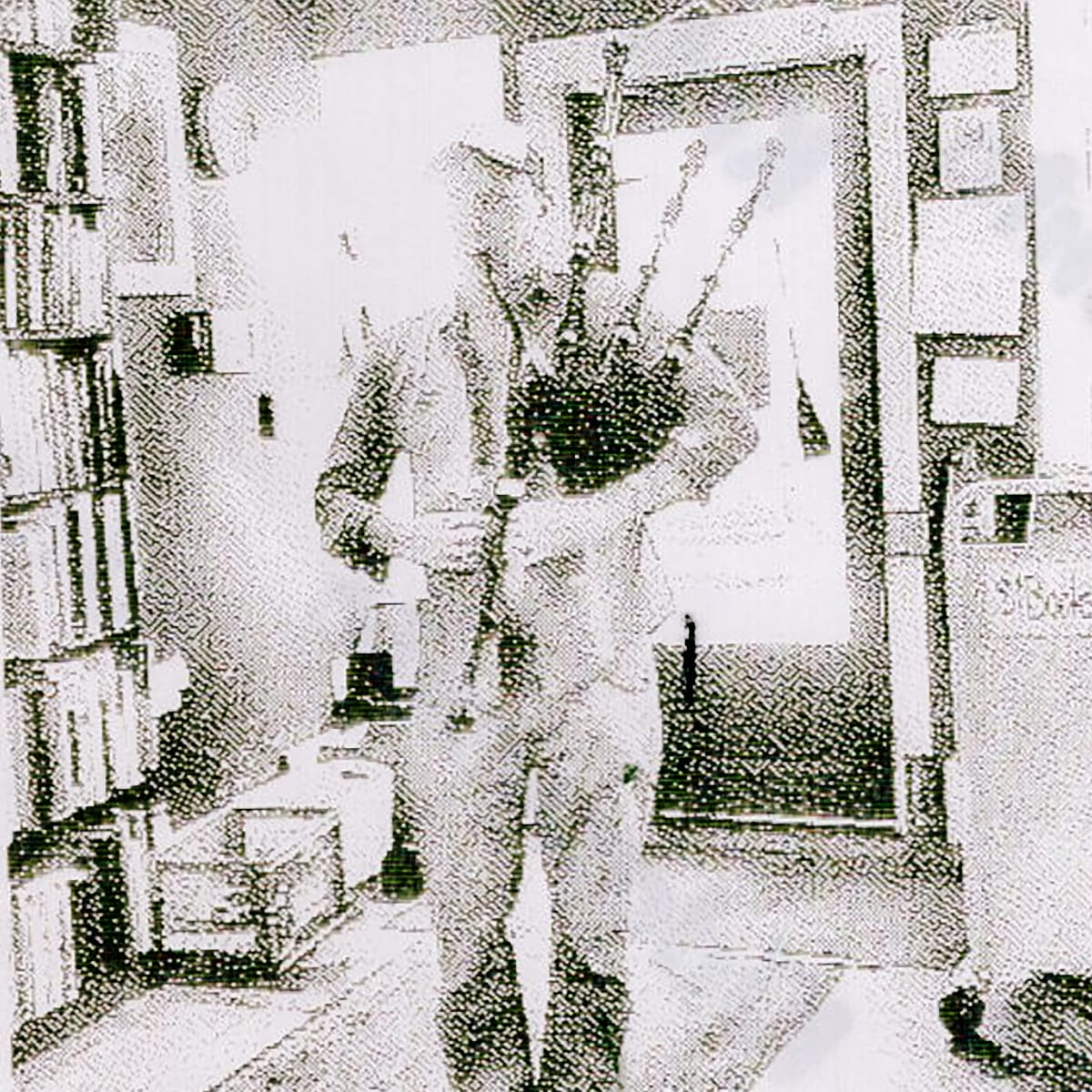
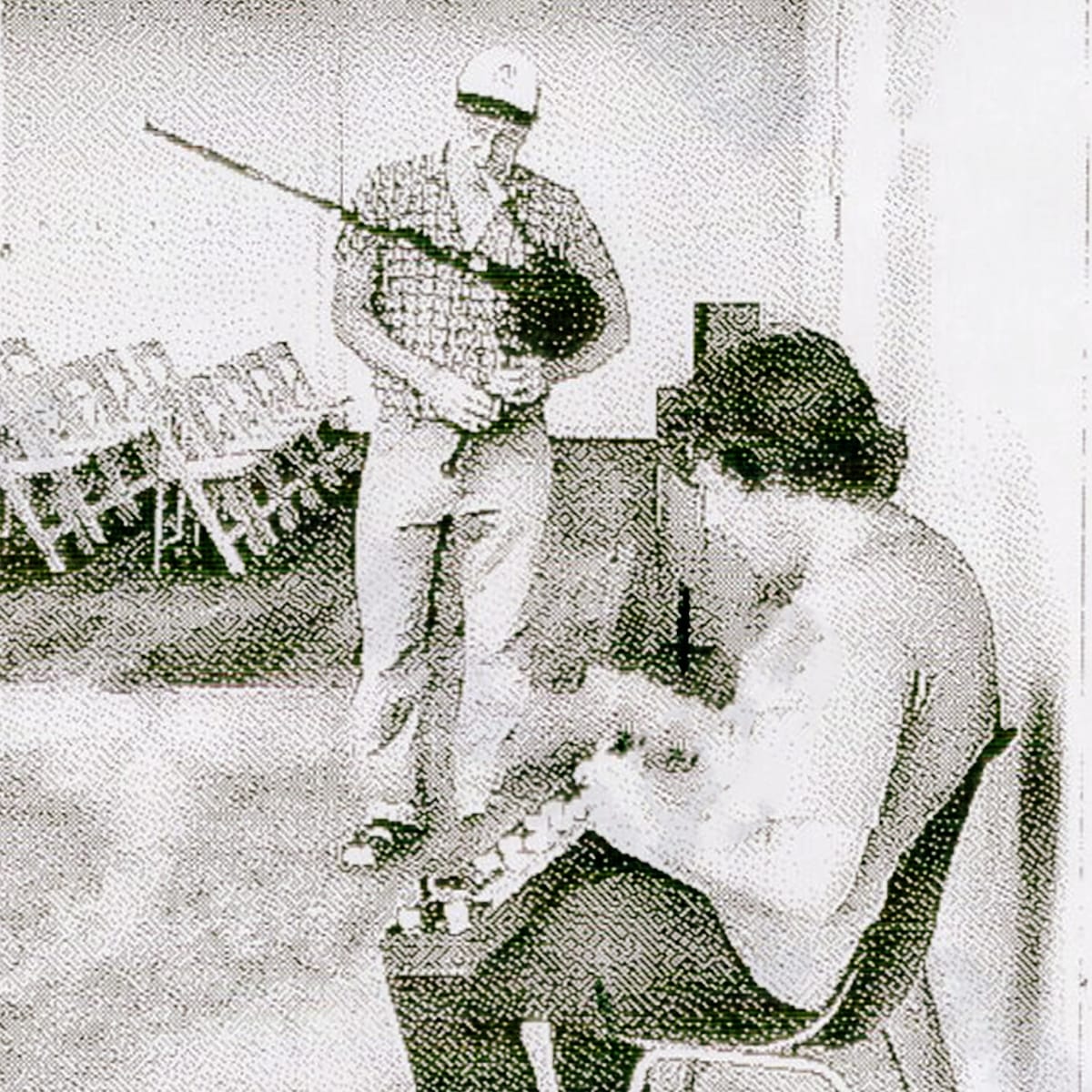
Bill Nace and David Watson
Khagan: That is part of what I love about this record. There are all these inferences of shifts when there actually aren't any. Or maybe there are. It's very difficult to discern this. You spend a lot of time lingering in the same frequency range.
Bill: When I listened to the test pressing, my ear couldn't tell the difference between me and David, which I love.
Khagan: And Bill, those machine-like, percussive noises of the taishōgoto. How much of that is the instrument itself, and how much of it is the mic'ing?
Bill: I don't want to speak for Ian [Douglas-Moore], but I think we just put an SM57 on the amp. We didn't get too crazy with the recording. It's a hollow piece of wood with two strings. There is no distortion, just overdrive. You're not meant to push it like that, so when you do, all these things start to happen.
David: It was a large, nice room. The instruments sounded great in the room. The recording part was quite simple. But it was afternoon in July or August. Sweaty as hell. In the end, I was lying on the floor, saying "No more! No more!" and Bill was just powering away. (laughs)
Bill: That's where the last track came from.
Khagan: You're talking about "The Oracle," the twenty-minute bonus track. I was going to ask about that. It's a great piece. But it’s such a stupid length. It’s just a tad too long to fit on a side.
Bill: I know! I love that track, but it just didn’t make any sense to press it like that (laughs).
Khagan: Maybe someday you can release it as a single-sided record with an etched B-side.
David: Bill isn't going to say it, so I will. It was the very end of the day, and I was exhausted. And I told Bill that I was just going to hold a drone, and he could do what he wanted. It was what I could do physically, which is still not for nothing at 23 minutes. But Bill, I just think you built it out so perfectly, without making a misstep for the entire length. It's just amazing.
Khagan: It’s also a great avant-garde flourish to have this gargantuan bonus track that’s almost as long as the entire album.
Bill: What you said is now stuck in my head. My friend just did a single-sided record with a gorgeous etching on the B-side. I’ve never really thought of doing that. But that one was so nice. I’ll have to think about this now.
There is something deeply felt within both Nace and Watson that these two people, who have cut their teeth and carved their living in the deepest, dingiest recesses of noise and spontaneous composition, exist someplace equidistant between willful detachment and absolute exaltation. They speak practically about the limits of their instruments, the intermittent frustration of audiences who perceive improvisational music as something that's always feral. Perhaps somewhat predictably, they seem unconcerned with genres and whether a particular artist comes by their avant-garde stripes in earnest or out of a lack of technical ability. But when they delve into the nature of music itself, all of these cerebral affectations leave them. With eyes alight, they talk about sound itself as something that edges on the manna of the gods.
Khagan: Tell us about the practical rigors of touring something like this. What playing this music does to the body, to the mind.
Bill: To me, it's really pleasant. It's what I want to hear. There is openness there to just see what can happen. There is obviously an unspoken limitation within it, due to the instruments. And there is a moment there, like with our gig in New Haven, when the show ends with an abrupt silence. And people come up to you afterward and say they were zoning out and wanted to hear it for another half hour. That's also what's been interesting: with these instruments, my perception of time is changing in a way it doesn't with the guitar.
David: It is improvising, but of a sort, because it consists of a pretty set bunch of elements. So it's a different kind of improvising than most of the stuff I've done. It's more ecstatic, more trance-like. When we stop, and there's a silence, that's part of our composition. I've been practicing a lot this week, and sometimes, I kind of despair and just think that this instrument is just so awful to improvise with, so inflexible. Just to amplify it, there are four sound sources to start with.
It's also funny to me because when people speak about improvising, they speak about being open to everything. But there are so many assumptions about what kind of speed you're going, all these things. And when I turn up with my instrument, they're kind of all out the window.
To me, one gig that really struck me was Thurston Moore and Lee Ranaldo as a duo at CBGB's, probably mid-'90s. From my point of view, as a downtown improviser, they were so slow. It took me a couple of days to realize that slow might be okay. That it might even be good. They were so slow and really loud. It challenged my fundamental notions of improv.
Khagan: How about titling the record and naming the pieces? Was that something purely arbitrary?
David: I think I sent Bill a few phrases, and he just chopped them up.
Bill: Anthony Braxton kind of cracked the code on naming improvised pieces. I understand the need for it, but naming pieces is my least favorite aspect. It feels like a put-on. But I get it. And our subconscious is ahead of us in some ways. So it's interesting sometimes to go back and see retrospective logic attached to the titles, to the music.
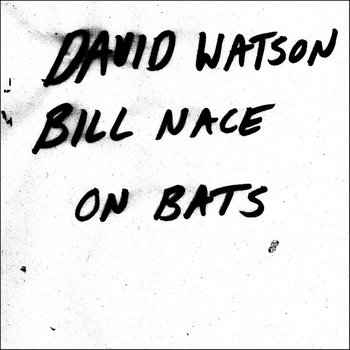
David: I hate naming things, and I hate calling them all 'Untitled.' I know I'm supposed to lend someone a connection to a piece, but I don't always know how. Sometimes, emotionally, a piece can feel like someone else did it. That's why I think Bill did a great job with the cover, with its minimalism. It's a little more info than Richard Hamilton's The White Album, but . . . (laughter)
As our conversation winds around the nature of experimentalism and where subversion begins to give way to simulacra or pretense, Nace and Watson bring up one of the genre's most polarizing albums.
Bill: We talked a lot about Metal Machine Music as a touchstone for this. Obviously, this sounds nothing like that, and there aren't a lot of dynamics happening with us. We're improvising, but we're also mirroring each other a lot, and from within those two elements interlocking, a third element comes out. I'd love to add guitar and other instruments to this someday, but I love the density we can achieve with just the two instruments in this specific setup.
David: Metal Machine Music, conceptually, was something I had in my mind, something I was trying to go for.
Khagan: I get having that album as a reference point. But I do think your record is dynamic. This wall you build feels oddly pliant. I'd say that in some ways, it's less rigid than Metal Machine Music.
Bill: That's great, because it's honestly such a drag when you hit something you actually have in mind when you start making a record.
David: Especially because Lou Reed already hit it, you know.
Khagan: Well, let's dig into Metal Machine Music then. Was that record a pivotal moment for you when it was released, or did you walk to it backward?
Bill: I'd heard other noise albums before it. But I love that record. You always hear in a certain context; that it's synonymous with being a 'fuck you' to his label. But I think it's a very beautiful record. It doesn't feel like a toss-off. There's a lot of construction and melodic sense in it. A beautiful record.
David: For me, I heard it when I was 15 or 16, in New Zealand. And then the record was taken out of circulation, so it became very hard to hear. Just a few people had a copy. It became an icon—something that's talked about and causes change, but no one has actually heard it.
Bill: I miss that time when you heard about something, and didn't know what it sounded like, or even what the band looked like, and had to fill that in yourself. I think we're definitely missing that as listeners now.
Khagan: I don't think there are words to describe what is happening right now with the over-glut and over-exposure of music.
Bill: And it all ends up in the same toilet. It doesn't matter how it's made, its ethics, its reasons. It all ends up in the same pipe.
Check out more like this:
 Jon Buckland
 khagan aslanov


Comments