


Note: This interview was conducted with Nava Dunkelman acting as Japanese interpreter for Masayo Koketsu.
There's a point, about two-thirds of the way into "Hatsurai," the opening track from Nava Dunkelman and Masayo Koketsu's Veins of Rain, when the convulsive crescendo they build briefly attenuates, giving way to an eerily pensive silence. The snapping pause is tantalizingly short, and just a few seconds later, the two players dive back in and continue unspooling their salvo of attack and decay, sudden transients and overblown multiphonics, launched at dissonant intervals.
So it goes on Veins of Rain, the first (but hopefully not last) convergence of Masayo Koketsu, a Tokyo-based alto saxophonist and improviser, and Nava Dunkelman, an NY-transplant percussionist. Together, the pair weaves an enthralling repository of sound, packed with textural density, microtonal inflections, sustained resonance, and an awe-inspiring range of extended technique. In other words, everything a great improviser might find in their arsenal is unearthed and deployed in this stormily elegiac record.
But what Veins of Rain represents, before anything else, is a lesson in the fundamentals of friction—the drifting and crashing warmth of Koketsu's reed clashing against the cold snap of the drum, and the resulting tension.
And yet, for all the abrasive and suspended textures on display here, Dunkelman and Koketsu's dialogue also feels profoundly spiritual, a curative communion in discordant tones. Whatever sensory projection of what veins of rain may be, whichever inference the listener may inhabit, the record fulfills it all at every turn—it is both violent and meditative, blindingly bright and crepuscular, dense by turns, and then vaporous as gauze. But the ingenious naturalism contained within is never in question.
It might seem odd, given how complete Veins of Rain sounds as an enclosed world, to realize that its recording sessions were shared with another project, made on the same days. Poiēsis, cut by the same duo alongside Tim Berne on alto sax, is an entirely different beast—a denser, much more feral undertaking. Berne, a long-established figure, is known as both a virtuosic player and bandleader and a strong advocate of the DIY stream of improvisational art. Though the two albums share a core of creators, their divergent energies make it difficult to imagine (and all the more admirable) how someone can riff up the unhinged, instinctual music that makes up Poiēsis in the morning, and then so seamlessly return to Veins' nuanced exercises in tonal ambiance in the afternoon.
khagan: You made both Veins of Rain and Poiēsis during one recording session. What initially brought you two together?
Nava Dunkelman: I've known Kevin [Reilly] from Relative Pitch for a long time. He was helping Masayo meet and play with some musicians, because he knew she was coming to New York. So basically, he introduced us to each other.
khagan: The two albums are nothing alike. How did it feel switching between their moods and dynamics throughout the day?
Masayo Koketsu: We heard that Tim [Berne] would appear as a guest, but not that we would be recording an entire album. It was a total surprise! There was almost no time to think, and we just had to get into it, and in a way, this was a very ‘improvised’ moment for me in a real way.
Nava: I think it was a spontaneous idea that Kevin had. Masayo and I started with a warm-up recording session and recorded one track. Soon after, Tim came in, and we recorded another track together. I liked how Tim brought an energy completely different from Masayo's and with a different mood and colors. Because we sounded good together, Kevin wanted us to keep going, so I think Tim was also surprised that we got to record the full album.
Masayo: It was the first time meeting him and feeling his sound, so it almost felt like I'd wandered into a forest and stumbled upon him. It was like entering an unknown space.
Nava: I had a chance to listen to some of Tim's work, but I hadn't spent time with him. This was also my first time meeting and playing with him as well. It's rare for me to have a situation where I have two saxophone players come together like that. As I said earlier, Tim brings a very different energy and color, so the two albums naturally give very different impressions. I don't know if you felt it when you listened?
khagan: I did. Poiēsis is a very charged, high-energy album. And Veins of Rain has all this patient negative space.
Masayo: Yes. And the sessions went quite fast with Tim. The energy was just to get in there, play, have fun, and see what comes out of it.
Nava: Unlike Veins of Rain, we never really spoke about a particular way we were going to shape that album.
❋-❋-❋-❋-❋-❋-❋-❋
It almost feels like a tokenistic disservice to say that none of this sounds like two people who have just met and played for the first time, or that the language Dunkelman and Koketsu find and fall into almost seems predetermined in its harmonious coupling. What they achieve here is a perfectly contained moment, a shuddering silo of sound.
khagan: Masayo's playing is so spiritual, flowing, and utterly spontaneous here, like hearing someone's respiration. Nava, what is it like adjusting to something like that as a percussionist?
Nava: I felt quite natural playing with Masayo. When I improvise, the process is both physical and emotional. My percussion setup has a wide range, so I get to be very dynamic and expressive, and I think Masayo also has a language similar to mine, but with a saxophone. For improvisation, simply spending time together can often be more impactful than only playing together. Because I got to hang out with Masayo beforehand, I felt even more comfortable when we got into the studio, as if we were just continuing a conversation, now not with our words but through our instruments. What you're saying about breathing is right. Even when we were playing in separate rooms, we still found each other as if we were co-existing in the same space.
khagan: Can you pinpoint a specific point when you began drifting away from standard notation into improvisation?
Masayo: In Tokyo, musicians who do improvisation tend to be more interesting (laughs). At first, I was in the mainstream jazz world, but I gradually became more interested in improvisation. I feel that mainstream jazz musicians are often strongly influenced by particular figures. There's a sense of lineage, and perhaps a value placed on specific vocabularies or traditions. On the other hand, improvisers seem to focus more on delving into their own inner world. I find myself drawn more to that approach, so I naturally connect with those people. I had many opportunities to perform with wonderful experienced improvisers in Japan, and before I knew it, I became more immersed in the world of improvisation.
Nava: I was born and raised in Tokyo, and lived there until I was 18. My mother is a musician, composer, and performer, and I grew up listening to and eventually performing her music. She's Indonesian, so her work was deeply influenced by Indonesian and Japanese music, along with some Jewish musical elements from my father's side, since he's Jewish American. I was surrounded by all of that culturally and musically.
When I was in Japan, I didn't do improvisation at all as I do now. I took drum lessons and played in a marching band, so I had a mostly classical background. But when I performed with my mother, I played percussion and gamelan instruments, and she would often ask me to create my own parts or simply listen and accompany her. I think that's where I first started to feel comfortable playing without a score.
After I came to the US, I continued studying standards at first. At one point, I saw a video of Fred Frith and William Winant (who later became my mentor) playing free improvisation, and it made me curious about that world. That was one of the reasons I decided to transfer to Mills College. I was already familiar with Mills because my sister had studied there, and I found myself especially drawn to improvisation. It's funny to say, but I remember feeling this sudden ‘click.’ When I took improvisation classes there, it felt very natural to play from nothing, and I remember enjoying the feeling of creating music organically, being in the moment, and that felt special. That's how I started doing free improvisation, but looking back, playing with my mother was probably the true beginning.
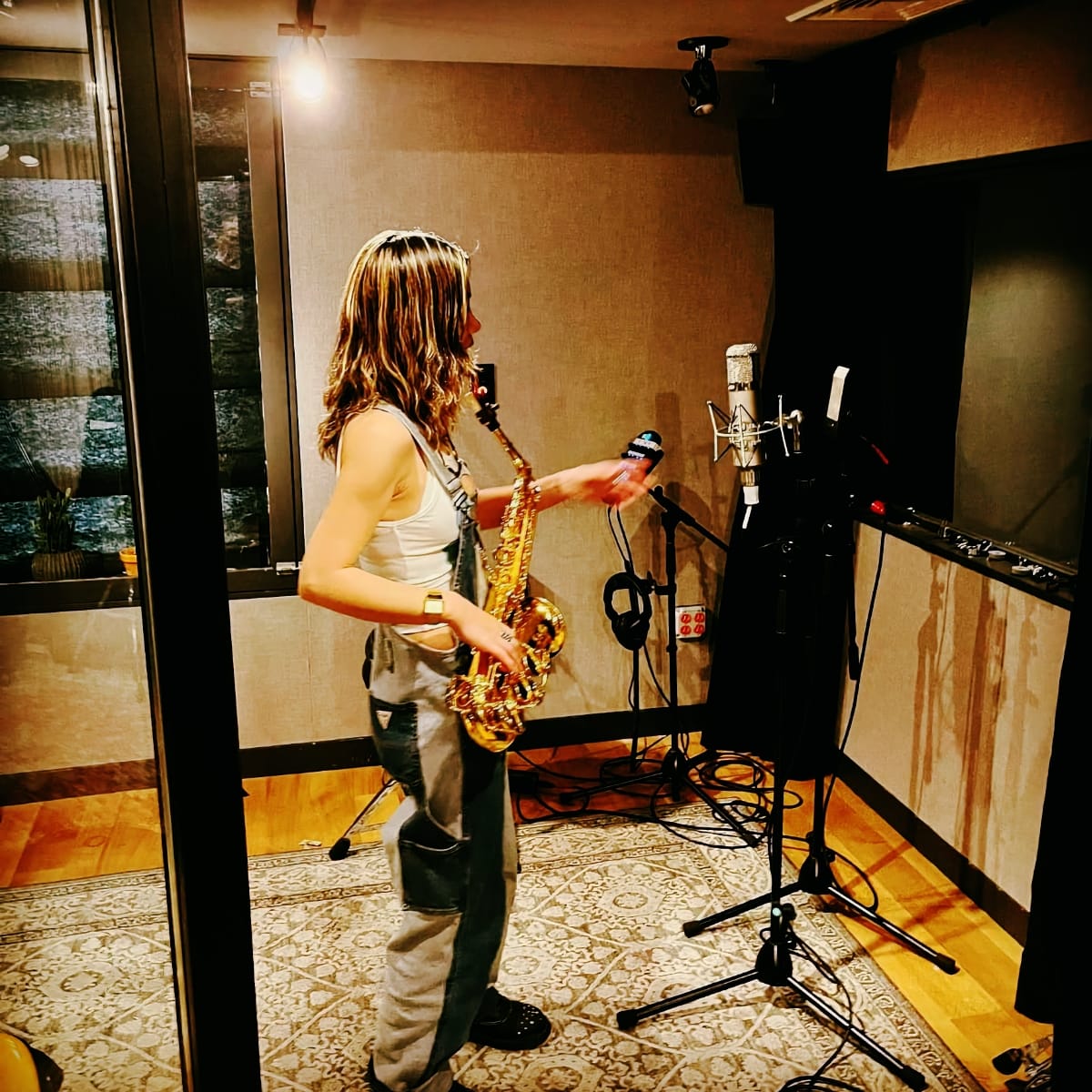
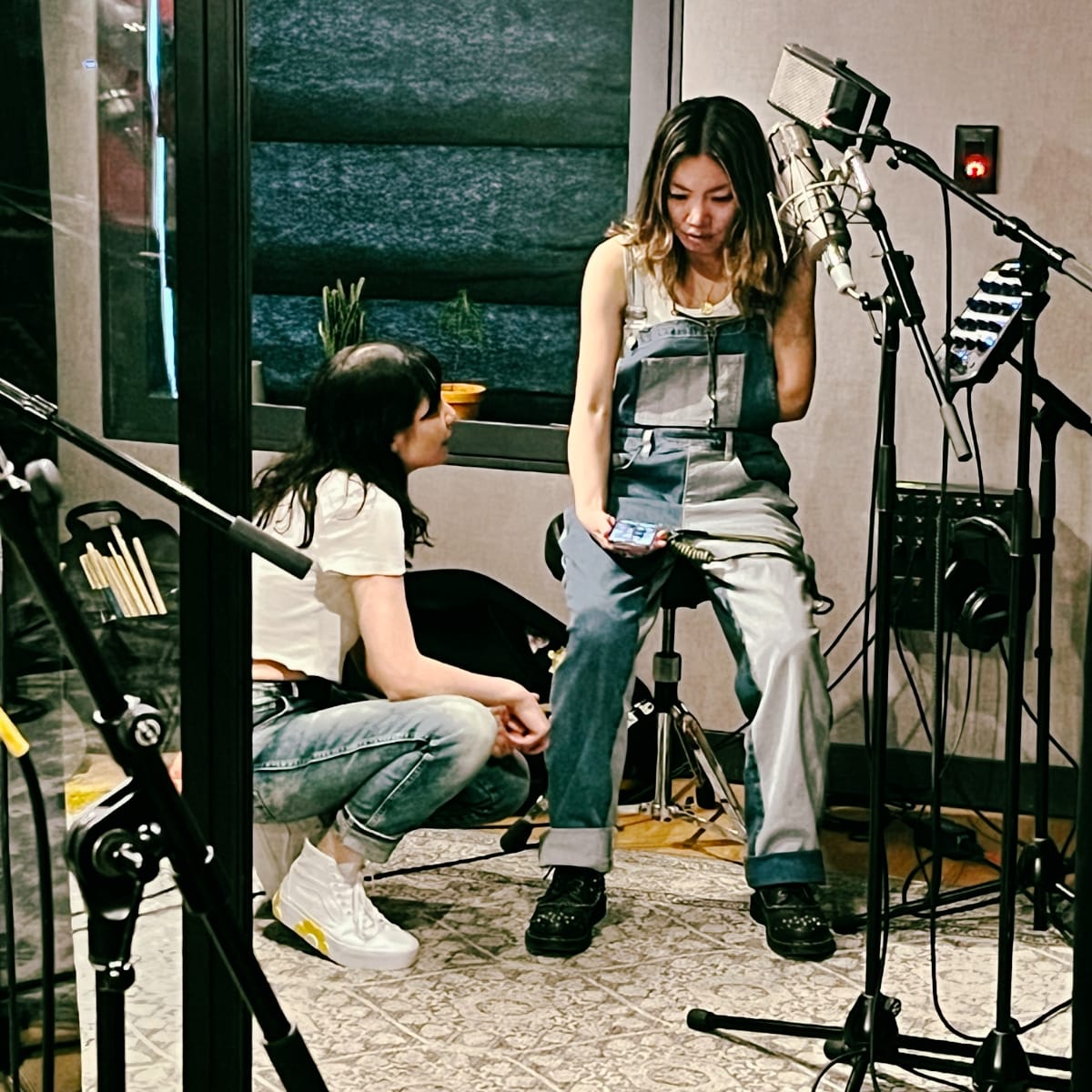
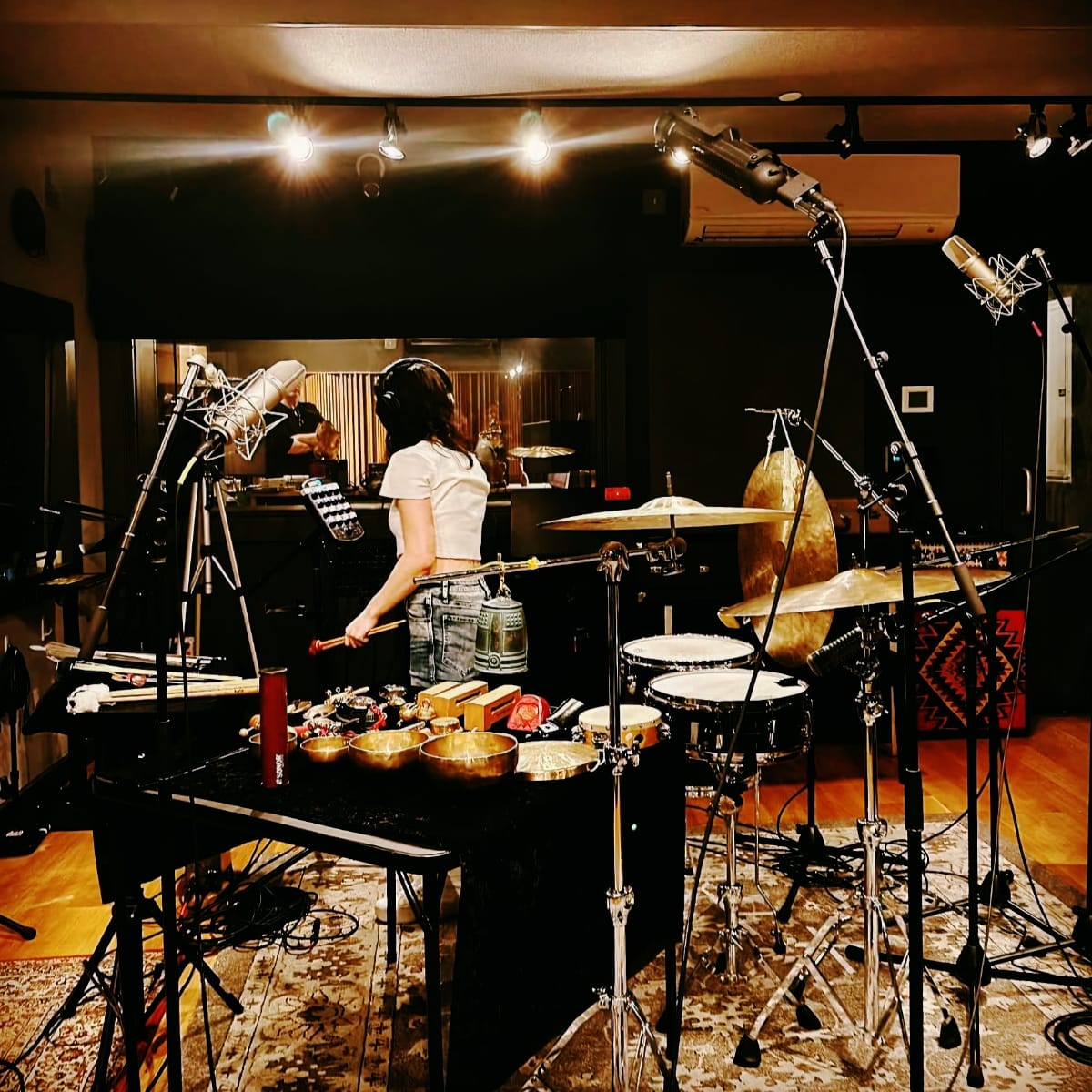
Masayo Koketsu and Nava Dunkelman during the Veins of Rain sessions.
❋-❋-❋-❋-❋-❋-❋-❋
There's a unified dogma coursing between them, in that they both seem completely comfortable letting things happen as they do, adjusting to the tides and carrying on. There's little in either Koketsu or Dunkelman to indicate a propensity for sentimentalism or a tendency to over-structure their lives or fixate on the past.
I ask Koketsu about her memoir, Into the Depths of Sound, which chronicles the ups and downs of her personal and musical life. But she answers the question casually and curtly, without showing much interest in retreading old ground. The same goes when I ask Dunkelman about gender inequity in Japan's music industry (they both point out that such imbalances are far less prevalent in avant-garde circles; even though these exist, they prefer not to dwell on that aspect). None of it appears to be detachment or a lack of resolve. Rather, the pair just seems focused on the present and what may lie ahead.
This reaches a perfectly irresolute conclusion when I ask them to name some peers they would love to play with in the future. Without conferring, the two respond in an identical fashion: that it all depends on the setting, mood, instruments, and people. Rather than who they want to play with, it's more about how they relate to sound, so they don't think much about particular people. Whatever opportunity comes, they will be happy to seize it.
In a way, it all conflates into what makes them both such vital talents in free-form art. Devoid of attaching themselves to specific scenes or modes, they leave themselves open to all paths their art might take. To their listeners, it's an enticing promise of what's to come.
For now, Veins of Rain is what remains, fearless and remarkable, a near-perfect object of what it represents—two people, untethered from form or expectation, coaxing abject beauty out of so much entropy.
Check out more like this:
 Lawrence Peryer
 khagan aslanov


Comments