


"This will go down as a black day in the history of mankind."
— Leo Szilard, physicist, after assisting Enrico Fermi in the world's first sustainable nuclear chain reaction, with uranium, Chicago, December 2, 1942
"If the radiance of a thousand suns were to burst at once into the sky, that would be like the splendor of the mighty one ... Now I am become Death, the shatterer of worlds."
— Physicist J. Robert Oppenheimer, quoting the Bhagavad Gita, on the first detonation of a nuclear bomb, near Alamogordo, New Mexico, July 16, 1945
"Radio-Activity, is in the air, for you and me..."
— Ralf Hütter, Florian Schneider, and Emil Schult, 1975
"Consists mostly of bleeps," snapped the Village Voice's Robert Christgau, who didn't even bother properly reviewing Radio-Activity, Kraftwerk's fifth album (now available for its 50th anniversary on picture disk and/or Blu-ray). "Like most concept albums, it's loaded with dead spots," saideth Ed Ward at Rolling Stone.
And those fellows have their slots in rockcrit firmament, way above your friendly scribe on this byline. Having gone 15 rounds (so far) with this thing, though, I aver it emphatically does not consist mostly of bleeps. It consists of bleeps (petitie)—but also beeps, gleeps, boops, bloops, booms, bumps, bonks, blather, and begettings—their first all-electronic album, bidding bye-bye to rock and roll's most pivotal instrument the guitar, not to mention any keyboard minus a power cord (no relation to power chord but none of that either); and to Florian Schneider's once-beloved flute, which furnished the softest, slickest spots on the breakthrough album Autobahn. They sought only electronic conversation now; even a fair amount of the vocals (in English and German) come off synthetic and/or processed. The human voice, after all, runs fleshy and frail. A weak link.
As to Ward's jab at concept albums, I'm left wondering if he liked concept albums at all, and I'm left conceding that most concept albums (which I love) feature a few tracks to brace the ideas and/or move the plot. No plot here because no rock opera (the concept-album subset), but okay, “Geiger Counter” starts clicking to jump-start a beat for the title cut; “Uranium” gives us decay-as-rebirth (uranium-into-radioactive-ray), eventually leading to "Ohm Sweet Ohm." Acceptance.
And this record's ultimately about acceptance, which comes hard, often painful—since we have to think at least in passing, about what occasioned the pain, how the fuck we got here in the first place. They make it look/sound easy, but then seasoned wizards often make their tricks look easy. Kraftwerk want everything to run smooth, immaculate, but they apply decay-as-rebirth to the "Uranium" poisoning our landscape, then conflate that with signal-as-birth, the spread of radio waves, giving information. Teaching us, hopefully, to shoulder the poison.
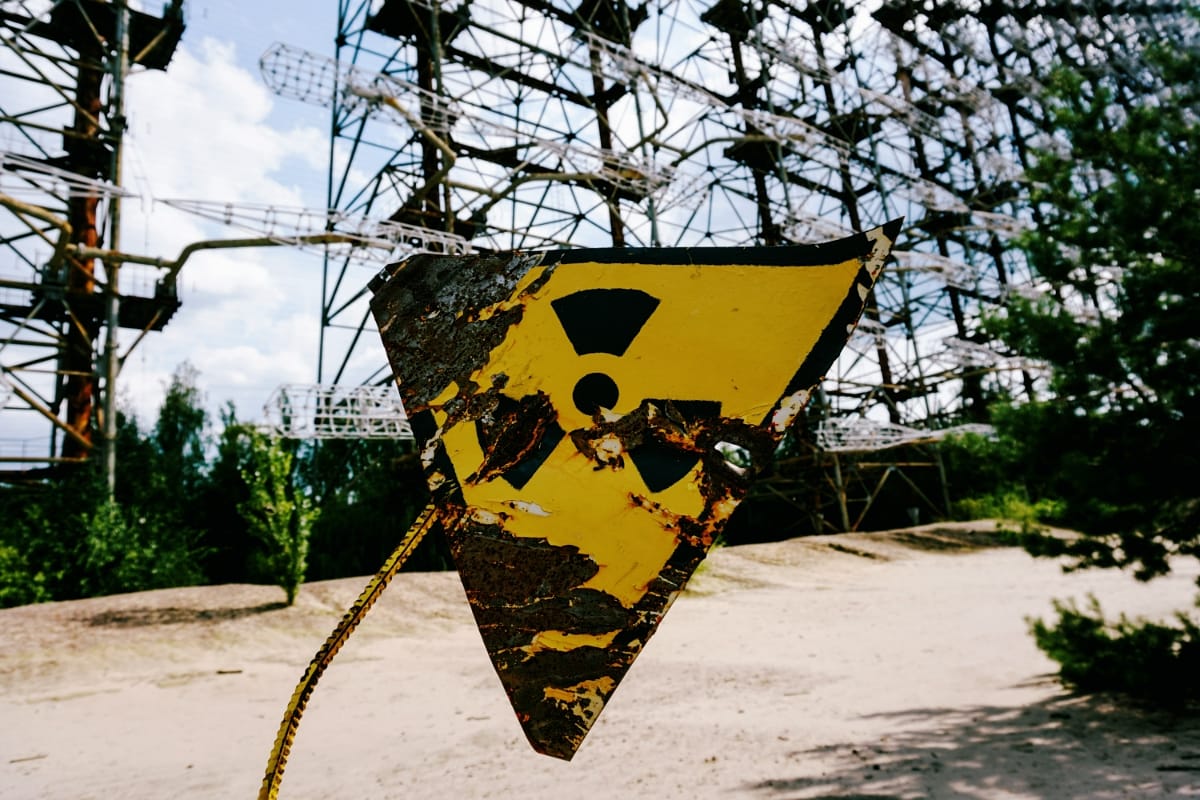
March 22, 1975, Athens, Alabama: A fire burns for seven hours and damages more than 1,600 control cables for three nuclear reactors at Browns Ferry nuclear plant, disabling core cooling systems.
November 5, 1975 (and January 4, 1976), Brownville, Nebraska: Hydrogen gas explosions damage the Cooper Nuclear Facility's auxiliary building.
November 10, 1975: Radio-Activity released in the United States
December 7, 1975, Greifswald, East Germany: A near-core meltdown at Greifswald Nuclear Power Plant: Three out of six cooling water pumps were switched off for a failed test. A fourth pump broke down due to a loss of electric power, and control of the reactor was lost. Ten fuel elements were slightly damaged before recovery.
These things may not have been on Kraftwerk's kollektiv mind, but they were in the air. We, the collective societal we, keep thinking we can get nuclear fission right, tight, and clean. We keep disappointing ourselves. The breeder reactor, generating more fissile material than you put in at the beginning, beckoned, and sometimes still beckons. In the summer of 1995, a superintelligent teen named David Hahn tried to build one in a shed on the edge of his mother's property in Michigan. He got scared, pulled back on his project, but ended up with government agents in hazmat suits pulling down the shed.
Hahn was never sure how much radiation he'd picked up. He refused to be examined at Michigan's Enrico Fermi Nuclear Generating Station—the same station which went through a partial meltdown back in 1966, regaled in that chilling book We Almost Lost Detroit. Hahn never lost interest in radioactivity and never seemed to care what lurked in his body or his bones. He died of a drug overdose, ruled accidental, in September 2016, about a month before his fortieth birthday.
Perfection, of course, is Kraftwerk's game, and they can capture it within certain parameters. Everything about Radio-Activity is on purpose; hardly for them the heat-of-the-moment passion of most rock. And every block builds on the one before. "News" gives us announcements in German about the inevitability of more reactors. Then "The Voice of Energy" takes over, a distorted voice of the Big Generator speaking for itself. I make everything possible, says the voice (in German again). It concludes with (English translation) "I am your servant and lord at the same time/Therefore guard me well . . ." Not quite the World Control computer proclaiming its dominance at the end of Colossus: The Forbin Project, but the same tone, same imperative.
And who's to say that the machines don't have the right idea? World Control, aka Colossus, growled that humanity was its own worst enemy and the only sensible thing for human survival was to take humans out of the decision loop. AI's the buzzword to our bones these days, of course, and we're starting to wonder, not so much if humans can perfect themselves, but if the machines can perfect themselves. Hey, I'm afraid, too—if those intelligences decide all we're good for is dog food, or mulch, then off we march to the knacker's knives.
And Kraftwerk, being human after all, drop a few human hints. "Discovered by Madame Curie" rhymes with "Radio-Activity," but any nuclear student knows Marie Curie got buried in a lead-lined casket, because that's how lit up she was from her bones outward. (Her papers and possessions still give off the cancerous glow, and will for about another 15,000 years.) "Radio Stars" isn't about those rockers on your dial that all got killed by video; it reaches out (again, English translation) "From the distance of the universe, sparks, radio stars, pulsars, and quasars." With radioactivity and radio the gifts that keep on giving, maybe—in the name of perfection—look to the immaculate stars, where for the length of a piece, an album side or two, we're unburdened of imperfection. Or striving. Or acceptance. Or love.
Check out more like this:
 Lawrence Peryer
 Bill Kopp


Comments