


Bioacoustics is "the scientific study, recording, and analysis of animal sounds." Some practitioners, like Lisa Ann Schonberg, extend these practices to flora as well as fauna. Schonberg is a "composer, percussionist, and ecological sound artist" from the U.S. based in Brooklyn. She has a background in both ecology and music, and her current artistic practice involves "developing music compositions that interact with insect sound in real time." Schonberg's work is an interesting combination of 'natural' sounds and phenomena with musical practice, including sonification, synthesis, and improvisation. Schonberg's work often focuses on documenting the sounds and interactions of ants.
Springtails/Snails/Crematogaster is a sound work that consists of two movements, one sourced from recordings "at a root ball busy with springtails and a Crematogaster ant nest in terra firme forest at Amazon-FACE" and another recorded "in a window planter at biologist Flávia Santana's house in the Acariquara neighborhood of Manaus, Brazil, featuring the sounds of snails."
Typically, in her artistic practice, Schonberg will both record the sounds of insects and reamplify the recordings through "anthropogenic materials and plant and soil substrates." This recording of source and re-recording of sound, reamplified through organic materials, is a notable practice in ecological sound art. The listener hears both the source sound and its reverberation in the materials surrounding the source. This is a unique way of "hearing place"—listening to the direct sounds of insects moving as well as their resonance in proximity to them. This approaches an internal perception of nature, a hyperfocus on small interactions of insects with their environment, the soundscape of soils.
This recording/re-recording approach is then used as material for composition, the source of mediated listening for installations, etc. Mimetically, this amplifies the sense of the hyperreal, giving listeners a heightened perception of natural phenomena they can't normally perceive without the mediation of microphones, amplifiers, and speakers.
The recorded performances of Springtails/Snails/Crematogaster layer these bioacoustic sounds with the performances of improvising percussionists, soaked in a long reverb. Schonberg "[combines] these two systems for their featuring of non-insect invertebrates, and for how they might work together in sequence for an improvisation-based arrangement in performance." Schonberg asks the question: "How [might] live performers respond to this sound in improvised percussion performance?" The result approaches a harmony of interaction between the non-human and human, movement that stimulates movement.
Schonberg gives background for the piece Tachi on her Vimeo page and in her doctoral dissertation:
Tachi features the sounds of ants heard through the plant on which they live—an acoustic architecture through which they communicate. Tachi was composed in real-time by mapping interactions between the sounds of Pseudomyrmex ants' locomotion and stridulation on the plant with which they have an obligate relationship, Tachi, and the sounds of the surrounding environment. Tachi has been presented as a video and in an arrangement for live performance with percussion and spatial sound.
The audio of the work (with video and standalone) comprises four types of sounds—recordings of the ants and tachi reamplified through the plant, above-ground recordings of the air around the ants and tachi, a synthesizer, and recorded percussion. The percussion comes in and out, and the pitched, sustained, melodic synth also plays intermittently. The percussion mostly consists of membranophones (drums).
The field recordings fade in and out, being panned differently each time they enter (hence the reference to "spatial sound" in the work description). The recordings of the ants and tachi are winding, scratching, frictive, very dry, and rhythmic thumping like driving over a bumpy wooden bridge, quickly pulsating. Some of these recordings are treated with delay and/or reverb, changing their color to blend with the more untreated recordings. Halfway through the work, the air recordings appear, adding a different context and the sounds of more species—cicadas, flying insects—as well as the soundscape of the environment around the plants.
The video version of Tachi combines pixelated, fragmented, and color-manipulated smartphone footage of the ants moving on top of the tachi plant. This is an abstraction of the photographic and phonographic eco-material filtered and composed through the imagination of the artist.
Schonberg makes this species interaction and the surrounding area audible through multiple juxtaposed recording equipment and techniques. This is an example of micro-mimesis in sound, as in using a macro lens on a camera or a microscope to capture images that are too small to normally perceive. This "zoomed-in" sonic perspective creates a mimetic surreal, simulating what it would be like if humans had more sensitive powers of perception. In combination with editing techniques, spatialization, signal processing, and the addition of musical instruments, Schonberg uses the material to compose a work that simulates an altered reality that sonifies the interaction between humans and the environment.
I spoke with Schonberg from her studio on Governors Island, New York, in May 2026. This interview has been lightly edited and condensed for clarity.
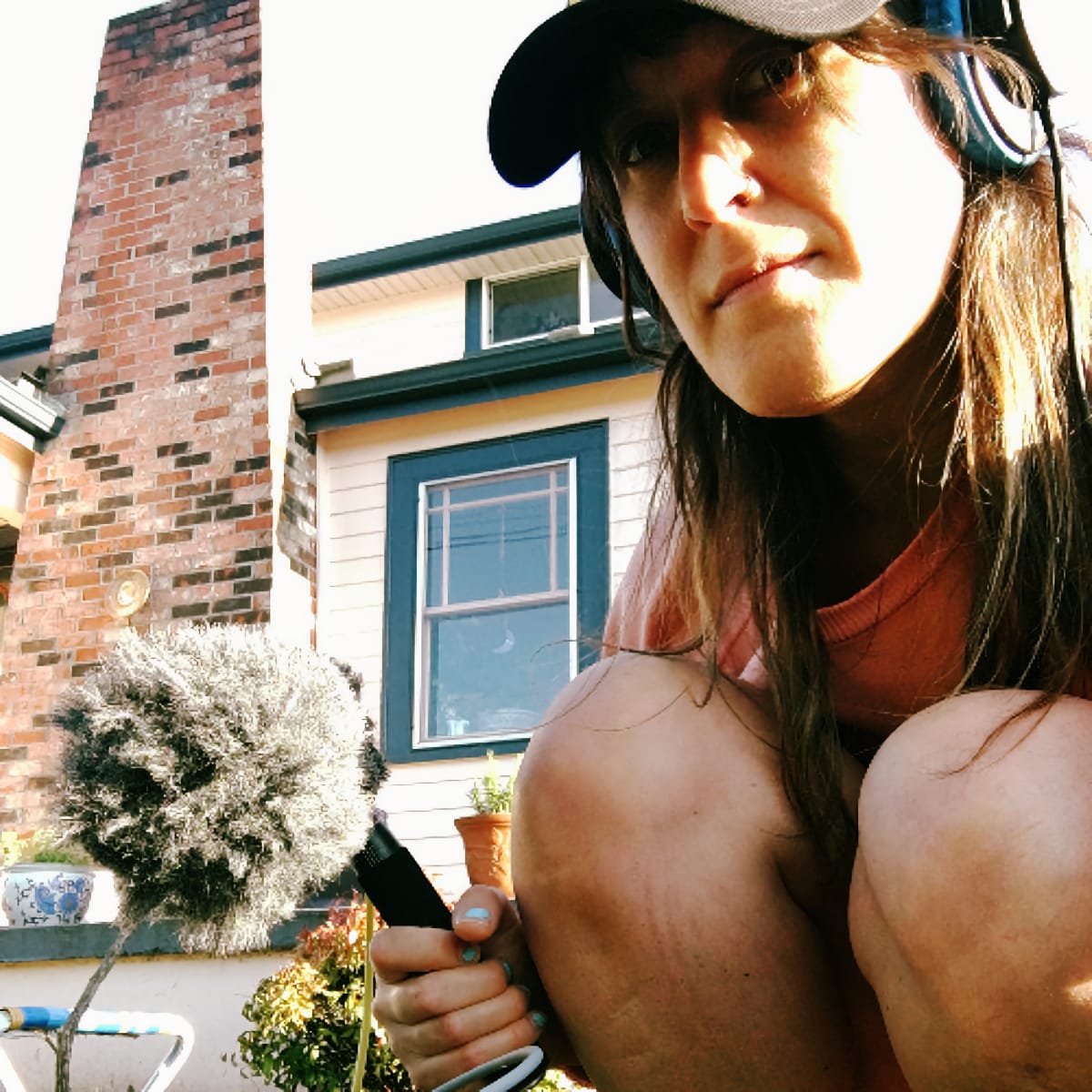
Chaz: I first became interested in your work when I met you and heard your work at the World Forum for Acoustic Ecology conference in 2023 at the Atlantic Center for the Arts, where I produced the concert programs as an engineer. Since I've been writing this book on the representation of reality in art (mimesis), I've been thinking about which artists to analyze and include, and I've been drawn to your work. Can you tell me about your compositional process for Springtails/Snails/Crematogaster and Tachi?
Lisa: Yeah, it really varies. So both of those pieces were done on one of the two main trips I took during my doctoral research in Brazil. They were both on trips with myrmecologists, who are people who study ants.
Chaz: Do you self-describe as a myrmecologist?
Lisa: It depends. If I'm in a room full of musicians, I'm a myrmecologist. If I'm in a room full of myrmecologists, I'm a musician or a professional drummer. If I'm around a bunch of professional drummers, they're like, "She's a weird sound artist." But yeah, I know a lot about myrmecology. I always say I have a background in myrmecology and entomology, and that I draw on it in my work. I'm always shifting what I call myself, but yes, I do study myrmecology.
I was with myrmecologists on those two field expeditions for several days each trip. There were two different, really amazing research sites. In those pieces, my compositional process was driven by what the researchers were doing, as I was essentially going along with them. They would point to places that were significant because they were much more familiar with them, and to species relationships they were studying or curious about.
And so that was a compositional process in and of itself. I would set up what I call a 'compositional system' at the site where I found something interesting going on.
Chaz: For your compositional system, is this the kind of tech that you're talking about?
Lisa: Yeah, basically. The compositional process is driven by the environment in these pieces. I set up the pathways and the variables—it's a set of microphones, playback devices that are in the soil or on the vibratory substrates, software on my laptop, and modulation. What ends up being made is anywhere between 8 and 16 tracks of raw compositional material, recorded in real time into Ableton Live on my computer. It's a generative process of compositional material that I then listen back to and find areas that I like.
One rule I have is that I can't mix time, I can't shift time. I can change the volume, process things further, choose which tracks are in or out, loop things, or shift them with mixing. But I can't overlap or distort the time. I'm really interested in keeping those true to themselves. It's important to me in my process that these parallel soundscapes all happen at once.
Chaz: Simultaneity?
Lisa: Yeah, and so I try to preserve that. If an ambulance passes in the city and then the ant calls, and they didn't happen at the same time, then they're not going to be in the composition at the same time.
Chaz: That makes perfect sense in terms of the mimesis of it, the representation of reality, because if you're synchronizing everything, then your composition is showcasing one moment, one specific time recording in a specific place with specific equipment chained together.
Lisa: Yeah, and the different equipment captures different aspects of it; there might be slight differences. I'm using a Jez Riley French C-series contact mic. It's excellent for recording vibroacoustic signals through plants and on soil surfaces. I'm also using a geophone.
Chaz: I'm not familiar with that. Tell me about it!
Lisa: It's a field recording mic that's adapted from a seismology tool. It's a much more accessible and affordable mic than most seismology tools would be, and it's also less sensitive, but it adapts some of those concepts and captures only the low end.
I have two channels going to an amp that's playing back the sound in the soil substrate and then the Jez Riley French microphone, taking that reamplified sound back. So I'm reamplifying and rerecording the sounds through the soil substrate.
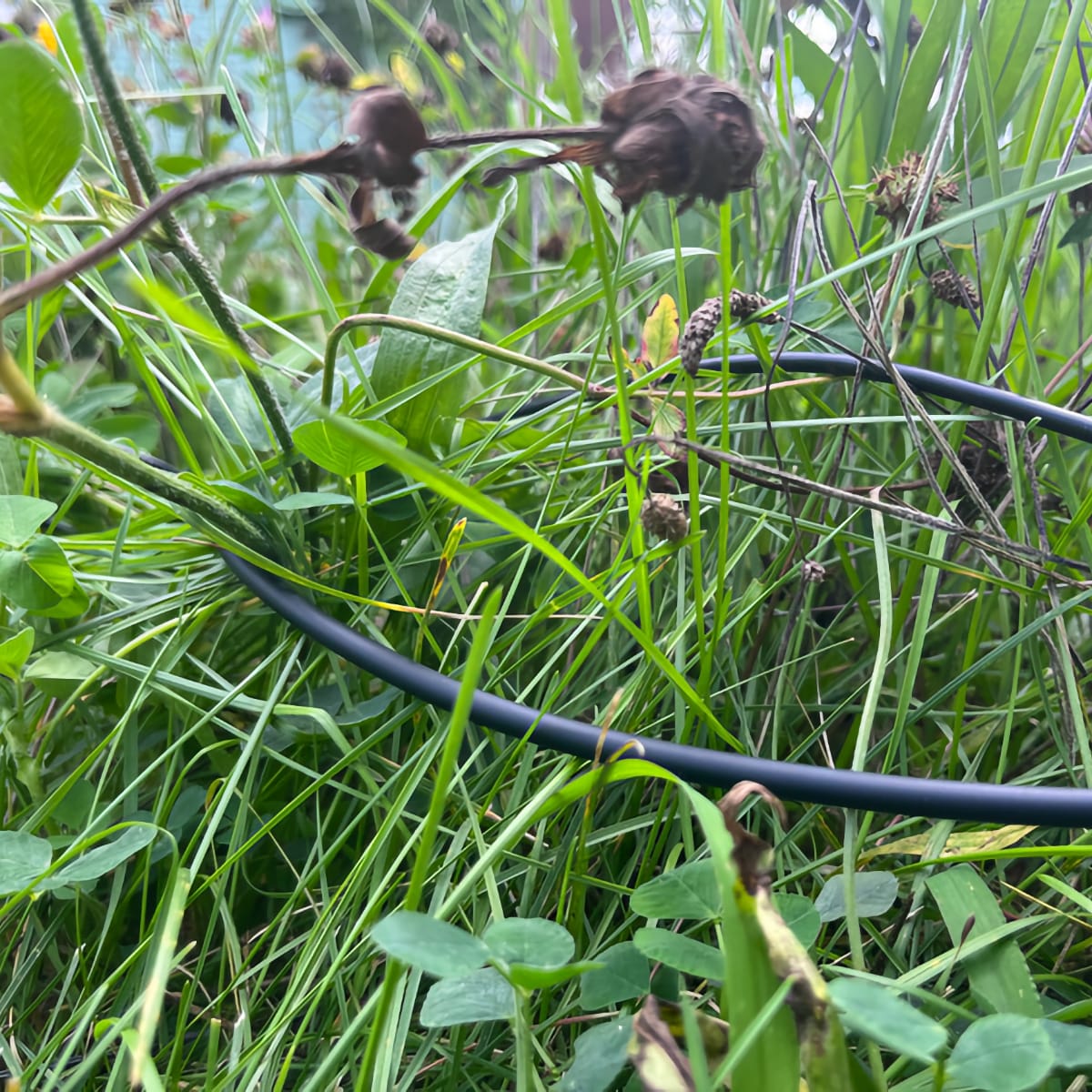
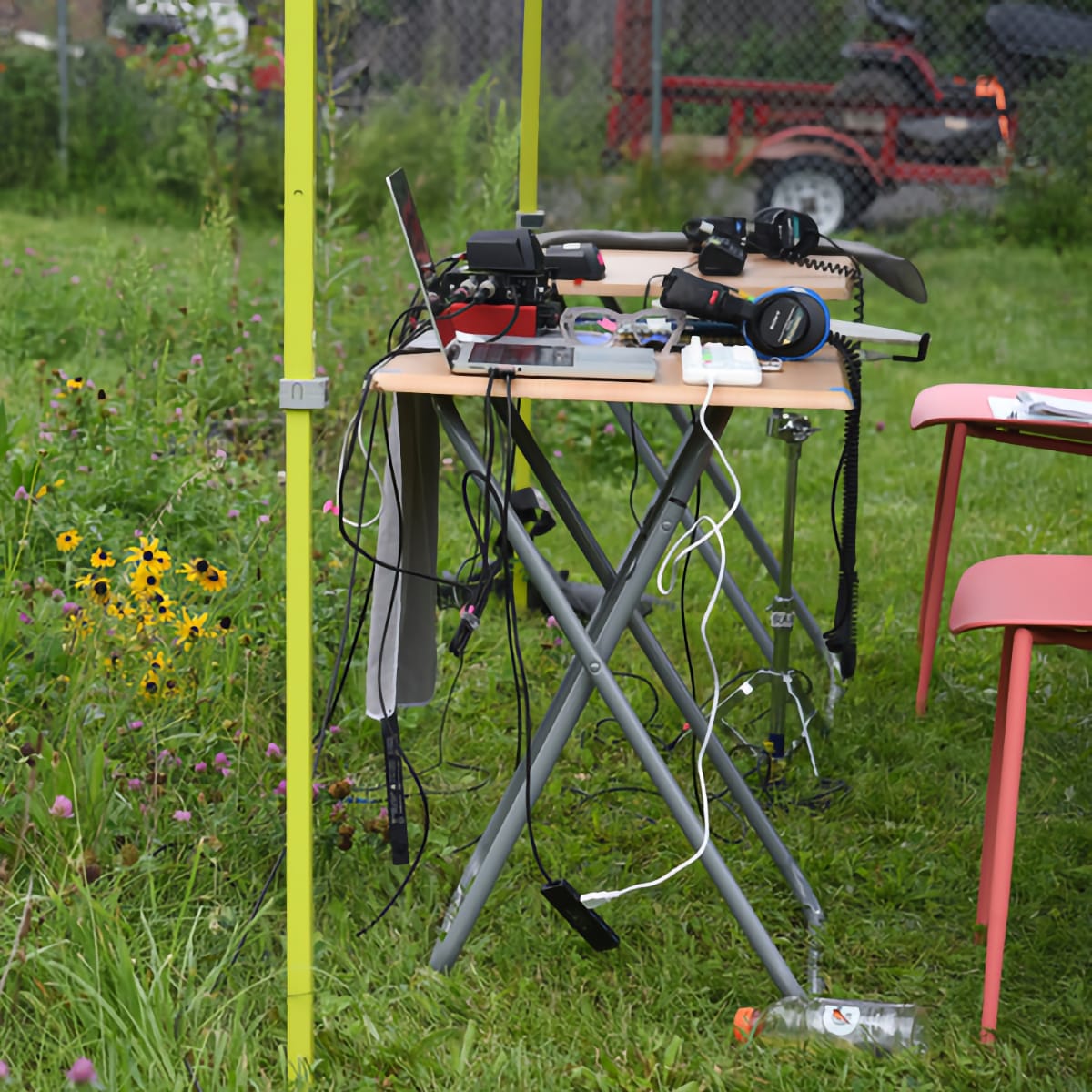
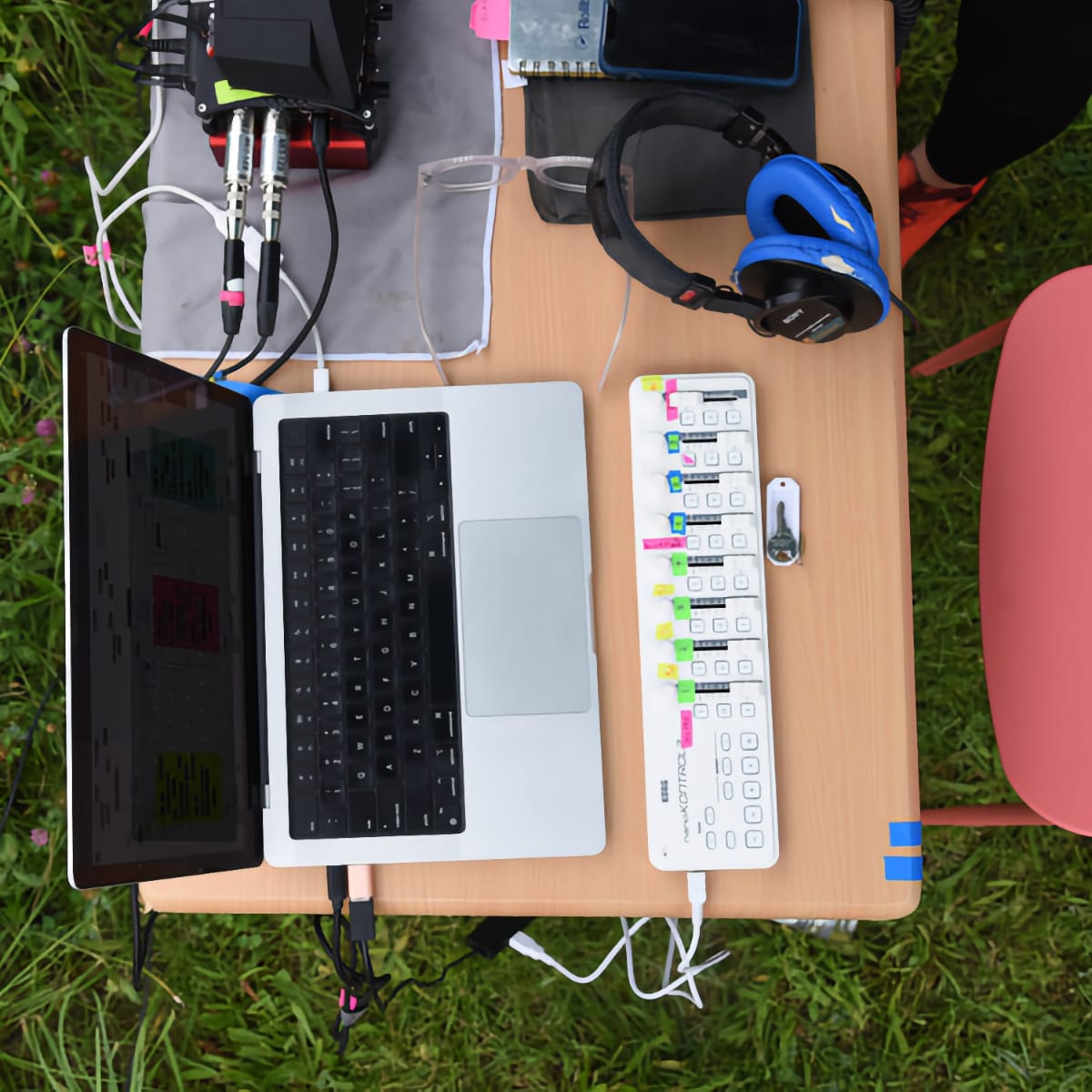
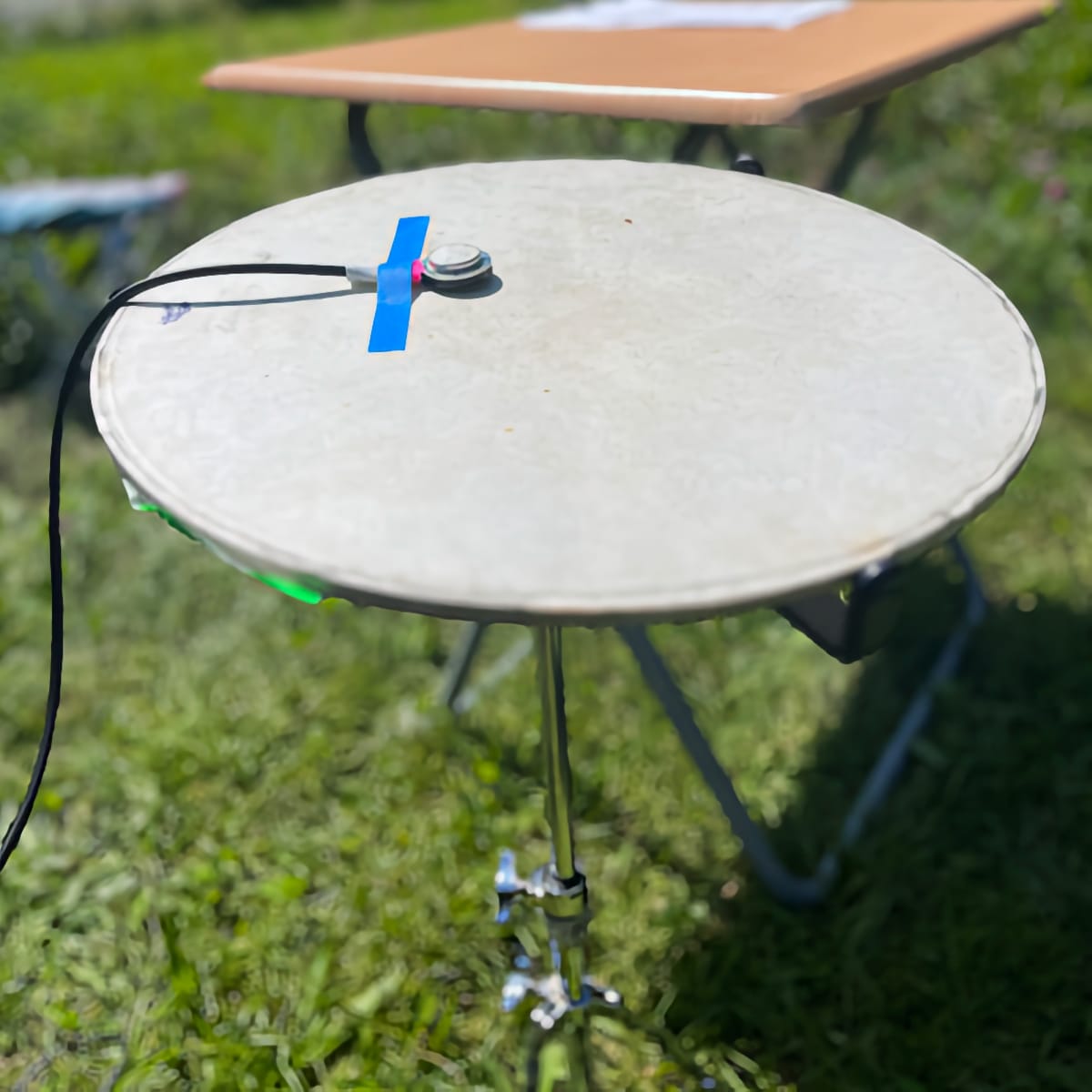
Photographs from The Insects are Present, "a performance-installation that engages with insects and their sound to compose music."
Chaz: I'm really interested in that part of your process. Can you talk me through how you started doing that or where you got the idea? And what does it do for you whenever you amplify the sound of a thing through the physical environment that it's in?
Lisa: That started with a residency I did in 2020 or 2021 at Pioneer Works in Brooklyn. I had many insect recordings, and I played them with transducers back through different drums, percussion, and cymbals, then recorded them back through the drums. So I was experimenting with how these sounds might sound through these percussion instruments, reamping them through the actual drums. And then I thought, "What if I do that in the soil?"
Chaz: Which just anybody would do, right? Oh, clearly I should do the same thing with soil!
Lisa: This is a few lines of thought that came together. There are a lot of birders who use playback with birds. There's a lot of controversy around it because it does affect the birds' behavior, but they'll play the bird signal back to the birds. I was never trying to get a reaction from the insects. What I try to do is actually play the signal away from any visible nests so that I'm just getting the substrate. I know that there are organisms living in the substrate, microbes and small things I can't see, but I'm not going to play it back right in the middle of the ant nest. So I play it away from it, like if you're reamplifying in the studio, but in this case the amplifier is soil or a plant.
I'm interested in that because it reemphasizes the substrate's material filter once again. When you're doing that, it captures the sound of the environment. So it's a little bit like [Alvin Lucier's] "I'm Sitting in a Room" in that it's a feedback—layering environment on environment and substrate on substrate, emphasizing that conceptually and sonically.
But how I ended up doing it, I was working in 2020–2021 with a woman named Allie Wist, who is in the doctoral program that I graduated from. We became curious about mushrooms and fungi together, and how to work with sounds. She works with scent and sound, and we were trying to record the effect of vibrations moving through fungal bodies.
So we started playing sound through fungal bodies in an installation and recording it back. We did a workshop where we invited people to make messages and play them through the soil near the mushrooms, as if sending messages to the mushrooms. Then I started doing more iterations of that in many forms, like collecting messages and replaying the insect sound itself back through the environment. In a way, it's a gestural attempt to communicate with these species, but I'm not going to make any claims to having them react. I don't know enough about it and can't sense their reaction. But sending signals into their realm, pointing out the fact that our sound and our vibration do end up in these spaces, and they feel it and react to it. I've developed that process since then with the replaying of sound, with percussion, with human messages, and with the insect and environmental sound itself.
Chaz: That's fascinating. One of the big things I'm researching right now is landscape pieces, and your work is unique in that regard. They are landscapes, but micro-landscapes that capture reality in a super-focused, physical way and let us hear things we can't normally hear and artistically interpret them simultaneously.
Lisa: A big influence on me developing this is also one of my mentors and committee members, David Dunn. A huge thing in his practice is environmental playback, for the most part, through airborne sound. I studied his work before and during my doctoral work, and had amazing conversations with him, and just wanted to develop a kind of practice that stemmed from his.
This idea of environmental playback, recording the environment, processing it, sending it back, and then having it as an ongoing loop of feedback in the environment, and being made by it again. He's a big influence on me.
Chaz: Do you want us to hear the specific being that you're capturing, like an ant, for example, or a specific plant? Or are you interested in us hearing the place they inhabit? How are you thinking about that in terms of ecology?
Lisa: I want them to be heard, to an extent. I'm also really excited about what the system might do, and then they're being heard through all these processing filters, both the environment itself and also the stuff I put into the system and MAX, so in the end, there is both the environment being heard (with the airborne mic picking up the airborne sound), and then you do hear the ants running. You hear a little stridulation, but more of the locomotion, which is the dominant sound.
It was amazing. When I first heard it, I was like, "Holy shit! That's ants running," and I've captured locomotion of many different ants and different substrates, and I'm obsessed. So I do want you to hear the insects, and I do have a choice in the tracks, be it 8 or 16—which ones? I get to choose how much of each track gets heard—the raw stuff, the stuff that gets filtered and reamplified. Exact or pure representation isn't important to me because I don't think it's possible for us to know what an ant actually sounds like. It's all subjective. So it's not that I want you to hear exactly that sound, but I want you to hear this version of the sound.
I've never been one to try to be pure. It helps that I come from a very DIY background. So it's never using the fanciest equipment (although my equipment's gotten way more refined). I have limited factors, but I also don't really want a 'pure' representation anyway, because it's not always true and can often misrepresent what's going on.

Chaz: On the question of representation, if you're not going for a neutral or pure representation of reality or these specific species, do you have thoughts on how you're representing things in space and time?
Lisa: I try to preserve the time aspect, though I give myself a lot of freedom within it. If I like a slice, then I'm going to loop it. But all those things being looped happened at the same time. Most of these works are presented to an audience that is far away from the place they were recorded and may never be in that space. I'm not interested in transporting you to the Amazon forest or anything like that.
Chaz: Which is very typical . . .
Lisa: But I am interested in being like, "Holy shit, there are ants in the Amazon that move like this on plants. Isn't that amazing?" This is probably happening here, too, but maybe in a less crazy way because in the Amazon everything's extra bizarre. But it happens everywhere, and there are insects moving on plants here, too.
It's also important for me to present the work where it was made. In soundscape composition, the sound has to refer back to the place; otherwise, it would just be using sound as an instrument. And then this more musique concrète kind of thing, sampling. I'm more in the realm of soundscape composition than I am in musique concrète, but I'm not striving for a pure representation of place. I want to share what exists, listen to it, and say: this exists, this is beautiful, and all these things are happening at the same time. There are these multi-layered existences. Not only does this exist, but it points to the fact that these insects have a realm of communication, and they have these relations with each other through sound.
Because I've done spatial work, my goal is to allow the sound to be heard as you would in an orchestra or in a percussion ensemble. For example, there's music where there's a lot of toms being played, and I don't want them to sound like a muddy layering of toms. When my bandmate and I would be mixing albums, we'd struggle with this because we were mixing in stereo and we didn't have the space to do what we do in live performance to untangle things and be precise with using space to differentiate sound. So when I do spatial sound work, I can tease things apart, and I'm doing that so you can hear the sounds more than you can feel like you're in an ant nest, if that makes sense.
There's a lot of work that's like, "It's immersive! It's like you're going to be in an ant nest!" but that's not really what I'm trying to do. And there's this scale thing. These sounds that are so small are being made so big, and I think that's important, to reconsider scales that we're so used to.
Check out more like this:
 Carolyn Zaldivar Snow
 Chaz Underriner


Comments