


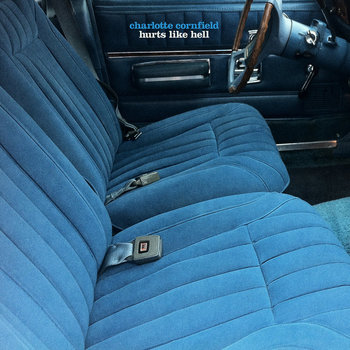
Charlotte Cornfield sure knows the ins and outs of music scenes. That becomes clear within the first few songs on her latest album, Hurts Like Hell. Throughout, we find lyrics referencing underattended shows in crappy bars, scrappy compensation, and unique hierarchies that emerge as members of these scenes reach levels of success that can prove isolating, even as they get to ride the wave of their achievements after years of hustle.
At the heart of Cornfield's storytelling is a musician's desire to connect at all costs: whatever the pay, wherever the gig, however many people ever get to hear the music, whether the songs in question even get the chance to progress beyond existing as mere 'files' a songwriter yearns to share with their audience. Cornfield speaks, as well, to the relationships that can be built between people in musical spheres through these experiences that few others understand—as well as to the little things that take on greater significance in these circles, like one's favorite Neil Young album.
If a person gets especially lucky, as Cornfield has been, these connections then beget deeper ones, as two people who meet in a scene can bring a child into the world together and form a family. Then, listeners are treated to the magic that comes from a mind sharpened for lyrical and emotional precision, translating the transformative experience of new parenthood into song, which Cornfield does to grand effect on the ominous yet womblike "Bloody and Alive."
As a person well steeped in my own local music scene, who has also been lucky enough to merge lives with a fellow songwriter to form a family, I was struck by the accuracy with which Cornfield captured this reality, and was eager to talk with her about it all—which we did, through virtual channels, just before we resumed our respective duties to our work and children for the rest of the afternoon.
Meredith Hobbs Coons: On your song "Long Game," you say, "We were all listening to Neil Young/ you said your favorite record was Zuma." It's a great character detail. What do you think someone's favorite Neil Young album says about them?
Charlotte Cornfield: It gives me a sense of where their emotional and musical landscape lies. I think somebody who would pick Harvest or Live at Massey Hall or After the Gold Rush is maybe an appreciator of calm, of beauty, of a wide range of emotions, whereas the Tonight's the Night, Rust Never Sleeps, Zuma camp has a more frenetic energy—a little more angst in there, a little more rock.
Meredith: You've thought about this, and that's clear, because you don't throw a detail like that into a song nonchalantly. Everything matters.
Charlotte: I've been thinking about Neil Young a lot. I mean, I name-dropped him on this record. I also got a chance to play Massey Hall in Toronto for his 80th birthday—he wasn't there, but he sent in a video from his ranch. Growing up as a songwriter in Canada, there's this Canadian pride that people have about him, and I've had so many conversations, with dudes in particular, who were like, "I like Zuma, and On the Beach, but you have to listen to this recording . . ." I had fun with that line because Zuma is a great record and one of my favorites, but I was sort of poking fun at the thing where people think their choice is the coolest of all.
Meredith: Yeah, they try to be unique. "I'm not going to say Harvest, I'm going to say Zuma! Do you even know that album?"
Charlotte: We all know Harvest is a perfect album. There's just nothing bad about it, except for maybe "A Man Needs A Maid." (laughter)
Meredith: There are so many great music scene details on Hurts Like Hell. The titular character of the "Lost Leader" is so recognizable to people who have been in music scenes and known the musicians who have risen above them. Also, on "Long Game," you reference the experience of "playing to 10 friends in the crowd/ two drink tickets down." It all feels so familiar. Tell me about your creative community coming up as a songwriter, and about some of the experiences that influenced what you referenced on this album.
Charlotte: I started young, playing shows in high school. Then I moved to Montreal for university, and that's when I started performing under my own name and doing my thing, specifically in the Mile End music scene, which, when I moved there, included Wolf Parade, Arcade Fire, and Bell Orchestre, with everybody living in the same neighborhood. Pop Montreal Festival was a big part of that scene, too—an incredible festival that I also name-dropped on this record in the song "Long Game." That music scene was the first one to lift me up and give me the confidence to play music professionally.
When I started, I was playing at any bar for any amount of money, any night. There was no strategy to it. I'd be playing with my friend Steve; we wouldn't have enough money for cabs, so we'd be carrying, like, a Twin Reverb five blocks down the street, drunk. Absolute shenanigans and a lot of fun. I think there was a lot of that. No one's there, you get paid in drink tickets, but we made friendships for life and learned so much in a short period of time. I was technically in Montreal to go to university, which I did, but I feel like so much of my learning happened at gigs and out in the scene.
Then I moved to New York for a couple of years, which was a total eye-opener: incredibly inspiring things happening, hanging out at Pete's Candy Store (which, again, is mentioned on this record), and places like Rockwood Music Hall, spots where there was a big songwriter scene at the time. I've been back in Toronto for 11 years now, I ran a venue here for a while, and I feel so buoyed and inspired by its music scene. I've been mentored by a lot of people, too. Broken Social Scene took me under their wing about 10 years ago, and their belief in me and in what I was doing gave me the confidence to keep doing it. I'm really grateful to them.
Meredith: Feist, formerly of Broken Social Scene, makes an appearance on this album as well.
Charlotte: Yeah, which is so cool. We've always had mutual people, but I finally met her in the last couple of years, and it meant so much to have her be part of this record. I'm a fan of hers for life. I'm really honored.
Meredith: How did running a venue influence writing this album? Listening to it feels very immersive, like being enveloped in a scene and a lifestyle.
Charlotte: Yeah. I went to see Cat Power the other night for The Greatest's 20th anniversary tour, and her song "Lived in Bars" makes me think of living, not in a bar, but in a venue. My life was so inside music and live performance and the scene, so a lot of this record comes from that place of having had my formative, coming-of-age experiences happen within the setting of live shows, which is sort of where the "Lost Leader" character comes from. It has been the backdrop of my life, and I had a lot of fun writing about it on this record. I felt like I was writing from being on the other side of something, not that suddenly, everything is easier, but it's different. The more experience I have in life, the less angst there is, and the more I can reflect back on things and go, "That was really intense. I do want to write about that." In some ways, I'm still processing it, but I really am grateful for all of those experiences and what they've given me creatively, in life, and in the friendships and love that have come out of them.
Meredith: Tell me about your collaborative team on this album in particular.
Charlotte: Phil Weinrobe produced this record, and he's someone I've been a fan of for a really long time. I loved the work that he did with Adrianne Lenker, but he also facilitated this thing called 'Song a Day' during the pandemic. It seemed like everyone, from peers and friends of mine to Beck to Jenny Lewis, was doing it. It was a creative practice-and-accountability thing, and I thought, "What a cool idea."
So, as a creative individual and catalyst for creative energy, I thought Phil would be a really awesome person to work with. He reached out to me, and we just started chatting. Right away, he said, "I think we have to put a band together for this record, and have them not hear a note of the music until we go in on day one." He suggested a couple of people, and I suggested a couple of people, and it all ended up being folks who he had worked with before: El Kemper from Palehound; Bridget Kearney from Lake Street Dive, who I've known for many years, and Adam Brisbin, and Shawn Mullins, and then Núria Graham and Daniel Pencer joined us in the studio for a few tunes. Then we had Feist, Buck Meek, Christian Lee Hutson, and Maia Friedman sing vocals afterward, which was really special. I felt so supported in the studio. In the past, I've gone in feeling anxious about new relationships with folks I'm working with, but Phil has this way of disarming everyone with kindness, generosity, and fun. We would all have lunch together, have a blast, and put our phones away for the day. It was primarily a joyful experience, which I think really set the tone for the album.
Stay on top of The Tonearm.
Subscribe for exclusive interviews, cultural tip-offs, and community fun.
And your support keeps our site free of advertising and paywalls.
Meredith: Tell me about your collaborative team when it comes to parenting.
Charlotte: My partner, Nelson, is my co-parent. We got together about five years before our daughter was born, and now family life is this new, beautiful phase. He's incredible and so supportive, and has made it very possible for me to keep doing musical things. I feel like we're teamworking parenting in a way that feels great. My family is all in the Toronto area—both of my parents, my brother, and my in-laws—so it has also been really beautiful to watch them come together over the last couple of years and to feel so supported by the community in continuing to make music. I feel really grateful for that.
Meredith: I love hearing that. I'm also a parent, and as somebody who has birthed a couple of people, "Bloody and Alive" is a song that really hits for me. It's such an ominous description. What did you want to convey there?
Charlotte: I was thinking about the feeling of having gone through the intensity of childbirth, then holding my daughter for the first time, and feeling like it didn't matter if I was covered in blood or had just experienced a bunch of pain. This experience felt so profound that it overtook everything. I was thinking of the massiveness of that moment, of that turning point in life, where we met our kid for the first time, and everything else fell away.
Meredith: It definitely functions on both of those levels: of this sense of survivorship, of having made it through, but also that boost of energy, that rush of oxytocin following that process. And that song is interesting, because you're really adhering to 'show, don't tell,' and the lyrics and production give it more of a spooky quality than a person might expect.
Charlotte: It was interesting to watch that come together. Phil asked me to play that song in the studio, and I played it, and then he was instantly like, "Okay, everybody, it's a drone." We did it once, and I felt like the drone was a little too intense, so we brought it down. Then I thought about it, and it kind of sounds like the muffle a baby might hear as they're in the womb/entering the world. I like the textural eeriness of that moment because, in some ways, it does feel eerie, alien, and weird. And emotionally intense. It was cool to be playing with people who are confident improvisers. It felt like there was a ton of heart behind their playing.
Meredith: And what a song to end an album on, too! It's compelling because there's this romantic journey; there are these characters coming in and out of frame; then you end on an ambiguous, ominous note.
Charlotte: I was conscious that I didn't want to just have it be a parenting record, so it felt like that was a natural place to end the album. Like now we've reflected on all these things, and then comes the turning point, unknown, new person/new territory kind of thing.
Meredith: Do you think that you would want to write a parenting record? I know it's difficult terrain, because there are a lot of ways to mess it up.
Charlotte: I really loved Laura Marling's latest record [Patterns in Repeat], which speaks to her experience as a new parent. I'm sure that that will seep into my writing, as it's such a big part of my life now, but I'm also still fascinated by all the different forms of human relationships. I don't know exactly what happens next, no plans.
Meredith: Yeah, I go back and forth on that myself with the songs that I've written—do I make this a collection, or do I spread them out?
Charlotte: It's a tough one, because not everybody is a parent—and not everyone has to be everything that is mentioned in the songs—but now that I am one, it's like, "Oh, yeah. It is a totally different experience from someone who hasn't had this experience."
Meredith: And there is that question of, it wouldn't be for everyone, but would it be worth it to make something that could be so meaningful for the people that it does reach?
Charlotte: That's a really good point. I really have loved how Bill Callahan has written about his journey as a parent. It seems like it has happened in a really natural way for him. It's not the overarching thesis of what he's writing, but it's part of it.
Meredith: Your lyrics are very concrete and paint vivid scenes. What songwriters inspire you most, and how do they inspire you?
Charlotte: Well, Bill Callahan. I love his visual writing and storytelling, his ability to let go of his ego in writing. The stuff that he's done recently has been inspiring. My big influence is Joni Mitchell. She's an absolutely incredible writer, and her songs have been a throughline of my life. She's the touchstone, the apex artist. Lucinda Williams is also a really incredible visual writer. "Fruits of My Labor" is a song that comes to mind: "Baby, see how I've been living/ velvet curtains on the windows, too," listing a bunch of fruit, then, "driving a Mercury out west"—all of these things happening in the same song, but you hear what it's about. These visuals paint the whole picture. Bob Dylan, too. I can't not say his name. I was listening to Desire and Infidels a lot when I was writing these songs. Those are both really cool storytelling records. Some of the stories in those songs pull me in and are really fascinating.
Meredith: As a writer, you're definitely in that storytelling lineage. The way that you use dialogue on this album really reminded me of Joni Mitchell.
Charlotte: She does that so well. I was just thinking of the line in "The Last Time I Saw Richard," "all romantics meet the same fate someday." It's loose, and it feels natural to her.
Meredith: Yeah, almost off-the-cuff. What does the lyric "I want to share the files with you" mean to you? It's perhaps the hookiest line in any of your songs on this album, yet it feels like it has a deeper layer to it.
Charlotte: My friend Adam Finchler is who inspired this song. He and I were together for a while after the scenario played out. He's a co-writer on the song because he was the one who was saying, "I want to share the files with you." To me, it suggests an openness to connection, and it's this modern love way of conveying it, because that's the reality. We do live in the digital age. And, instead of rejecting it in song and film, I like it when it's embraced in a way that sees the whole picture, sees the good and the bad, and accepts it as reality. Hearing somebody in 2012 sing, "I want to share files with you," means "I want to connect; I want to throw down with you."
Meredith: Because "files" doesn't suggest that it's a finished product, so there's an intimacy with it.
Charlotte: It's like sharing something before it's done, like a kind of will you read my manuscript?
Check out more like this:
 Sam Bradley
 Meredith Hobbs Coons


Comments