


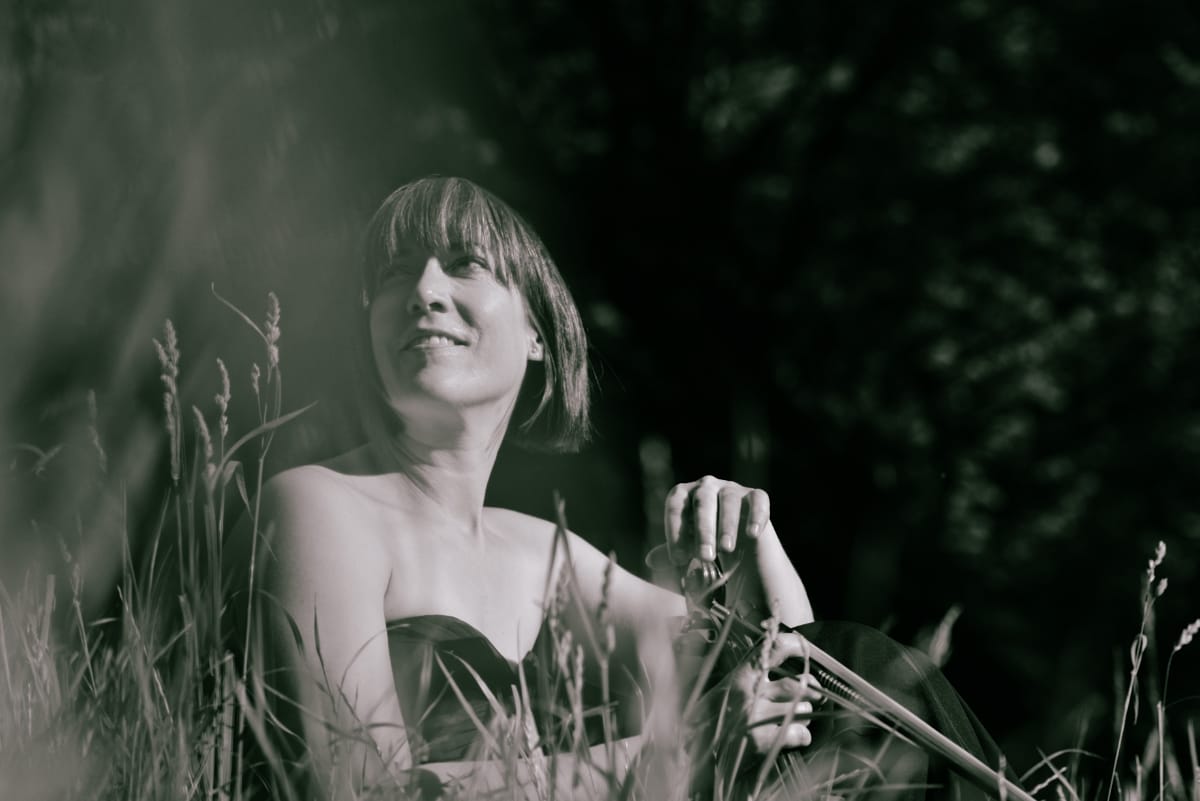
Meredith Bates has built one of the more patient and purposeful careers in Canadian experimental music over the past two decades. A violinist, violist, and composer now based on Salt Spring Island, British Columbia, she arrived at her solo practice through years of ensemble work, most notably with Pugs and Crows, the JUNO and Western Canadian Music Award-winning group, as well as Gentle Party and Like the Mind, the transnational sextet of female improvisers she founded. Bates is also committed as an organizer: in 2019, she founded the Improvised Arts Society, a Vancouver nonprofit that supports interdisciplinary work by womxn, BIPOC, and LGBTQ2+ artists through the Listen, Listen Festival and the West Coast String Summit.
Her debut double album, If Not Now (Phonometrograph, 2020), married birdsong, urban hum, coastal wind, and water into two long-form compositions. Musicworks called it "completely enthralling from start to finish," and it earned a Polaris Prize long-list nomination. Tesseract (2023) runs over two hours across six pieces, examining gradations between texture and tone, cohesion and dissolution, and dissonance and euphony. The Vancouver Sun described it as "haunting and completely addictive," Bandcamp Daily named it among the year's best experimental music, and it received a JUNO nomination for Best Instrumental Album of the Year.
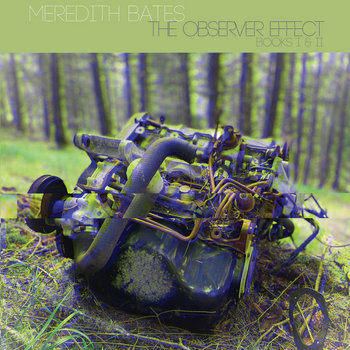
The Observer Effect, released last March on Phonometrograph, organizes its roughly 140 minutes into two "Books" of "Incantations." The title draws on a principle in quantum mechanics that holds that observation alters what is being observed. For Bates, that idea extends well beyond physics. She frames the album as being about "witnessing and being witnessed" and the consequences that flow from that exchange—quantum, emotional, and political at once. The work asks what happens to coherence, both personal and social, when it is measured, interpreted, or silenced by power and by the persistent fact of being seen. Her decision to call the compositions "Incantations" is pointed; intuitive power has long been cast as witchcraft and pushed to the edges of patriarchal culture, and Bates is explicit about reclaiming that framing and placing feminine intuition at the center of the album's inquiry. The album was composed and recorded live at Afterlife Studios in Vancouver over two days in April 2024, and her collaborators included Scott Morgan (loscil) on electronics, Chris Gestrin on synthesizer, and Curtis Andrews on percussion. In her own words, this music is "of a time, an era, a place."
Lawrence Peryer recently hosted Meredith Bates on The Tonearm Podcast. The two discussed The Observer Effect as a conceptual and personal statement, the dynamics of improvisation and intention, the role of field recordings and acoustic ecology in Bates's work, and the relationship between gender, politics, and music.
You can listen to the entire conversation in the audio player below. The transcript has been edited for length, clarity, and flow.
Lawrence Peryer: I had quite an emotional experience listening to your record, The Observer Effect. There were a couple of tracks in particular that I just found myself sort of welling up inside. I was swept up. The third incantation of Book I, the love song, and the opening piece from Book II both just grabbed me and woke me up. It was quite an experience.
Meredith Bates: Oh, that's cool to hear.
Lawrence: I worked very hard not to try to understand that, you know what I mean? Like, I don't want to know what was happening there. I feel like it ruins the fun, ruins the experience.
Meredith: Yeah. It is probably different on a second listen. Maybe it could be, but yeah. That's really interesting.
Lawrence: My understanding is that there were little or no edits or overdubs in this work. And given the scale of some of the pieces, what's happening to you when you're inside that sort of creation bubble?
Meredith: Well, the process was: I had the studio for a few days to create my little stations and zones. My intention with this was very different from when I recorded Tesseract and If Not Now, where I was intentionally going in with the idea that there wouldn't be too many edits later on. So to compose—kind of like instant-compose—these forms: to have an arc built in that I didn't plan for, because it's improvised. But that was the objective—in a way, to have a beginning, middle, and end, like a long story. I would create these little sound worlds, and you never know what will come out first. And then we just kind of followed these threads—we, as in myself, or if loscil [Scott Morgan, electronics] was there, or Chris [Gestrin, synthesizer], or Curtis [Andrews, percussion]—would follow them together.
Lawrence: How do you differentiate, if we could think of it as a spectrum between the intuitive at one end, maybe, and the intellectual at the other? You're working, you're moving around—are you deciding, or is the work saying, "Go over there now"?
Meredith: I don't have a romantic idea about the music coming to me, channeling, or any of that stuff. But it's coming from somewhere, and my whole goal when I'm doing these improvisations is to shut off my thinking brain and get into this sort of flow state. So if it's not coming from some other plane of existence, then I guess it's coming from me. But what feels good to me is that it's coming from intuition. It's being guided by a lot of practice and a lot of twiddling knobs before going into that. I know exactly what every single knob, button, and dial on my pedal does. In the moment, I'm not going, "Oh, I should increase the delay speed by this much"—I'm sort of flowing with all of these instruments that are available to me.
Lawrence: When I was reading through some of the material and listening to the music, I came across something you said about witnessing and being witnessed. I'm curious about that notion just as a standalone—what that means to you—but I'm also curious about how something that conceptual makes its way into the sound or into the finished work. Does it have to do with intention? Are you going back after the fact and realizing that that element's there, or is it aspirational?
Meredith: Maybe all of the above? (laughter) I came up with the concept after the compositions were complete. I think the one part I knew I wanted to tap into was a sense of human connection, and a sensitive connection with nature and those beings around us. I live among a lot of big trees now. British Columbia is pretty amazing for its big trees, winds, birds, and orcas in the water. So we have a lot of communication going on, and I think there's a set of folks who tune in to it, are aware of it on some level, and use it to different degrees. I'm a beginning practitioner of being in tune with the universe.
The other big-picture part of it that came in after the fact was: I really love reading about quantum physics. I don't claim to understand any of the math or the nitty-gritty stuff, but I like the philosophical aspect of looking for new truths. I was listening to a contemporary physicist, and he was talking about this idea of new truths being discovered on the fringe, in the innovation, in that sphere.
Novel ideas occur when we're just throwing things at the wall and seeing what sticks. When you're opening your eyes up and trying to be in tune with something—I think it's that act of observation, when you're looking for something, but you're not sure what you're looking for—it changes as you hone in on it. That's the witnessing. And maybe the being witnessed is more about society, women's role in it, and people in general. We are so quick to judge and label, and sometimes in doing that, you change what—in your expectations of what a person is—that person changes, or vice versa.
Lawrence: So that's the observer effect.
Meredith: In a nutshell. I mean, without even talking about physics. But there's that diagram on the inside of the album—a common visual that goes along with the physics understanding of the observer effect. Particles changing.
Lawrence: It's very hard, especially if you're interested in any kind of esoteric practice, not to see the obvious correlations between the principles being discussed in these different paths. Quantum physics is, to me, almost just the modern rationalist trying to make some reconciliation with what mystics have known for millennia. They just can't help but break out of the Western framework. It's like there's almost a degree of shame about some of the things they have to reckon with—the uncertainty or the high strangeness that other paths, whether it's a First Nations path or an Eastern path, or even Western mysticism, just take as a matter of course. Those are not strange, scary, or even taboo concepts.
Meredith: Yeah, it's natural. Exactly.
Lawrence: You use the word "incantation" in this work. It's a specific and evocative word. Can you tell me a little bit about what it means in the context of this work, and how that relates to the intuitive, the feminine power, and the practices we're talking about?
Meredith: There are two things with the Incantations and the Books. First of all, there's a shout-out to John Zorn, who has had a lot of impact on my music. So that's a little if-you-know-you-know sort of nudge. And then the witchcraft stuff has to do with a curiosity that I have and a feeling, or a hunch, that that's the way forward.
We talk a lot about matriarchal power, but the guys have held the power for so long. Maybe it's time to follow a different path, or work together. And there's an intuitiveness that I see in a lot of my female friends or feminized friends—something keeps happening. I think it happens to everybody, but just depending on how in tune you are with observing and sensing, there's this cohesion: we are one, but also sometimes when you're paddling in the same direction, things happen where it feels like they're outside of your power, but your lives keep lining up somehow. You think about somebody, and suddenly they call you on the phone. You're having a conversation about a friend you haven't spoken to in years, and suddenly they pop up in your feed. There are ways that the universe kind of shows you that you're paddling in the right direction because the molecules seem to be lining up somehow in the bigger picture. That's what I was meaning about cohesion and bringing in the witchy powers—that there's another way of being in the world where you're sensing into things a little bit more and perhaps also listening a little bit more, which is something we try to practice in improvised music.
Lawrence: Then, how does the incantation framing shape the making of the music itself? When you started a piece, were these incantations, or did you have prompts?
Meredith: No prompts. To be totally honest, other than one piece, I arbitrarily took the names of spells and applied them to the pieces. The only piece I knew what it was ahead of time was the love song.
I had no intention when I composed these pieces. They were completely free. The idea was that they were long-form and that I created little sound worlds. Beyond that, there was no prompt or preconceived notion. I think everything I just described about why witchcraft played a part applies to the compositions as well—the process—because it's really about intuiting, listening, sensing into different spaces, the unseen, getting into a flow state. I don't want to say 'spiritual,' because that's not it—it's creative. But my point was to tap into some unseen things, feel what that felt like, and make music out of that space.
Lawrence: I love the inclusion of the found sounds, the field recordings. Those things seem to be important in this work. And I'm curious about that intersection of space or place and emotion as compositional inputs—the room as well as British Columbia, or as broadly or as narrowly as you feel it's relevant.
Meredith: It's super relevant. The bigger part of that question is where I'm at now. I have moved from Vancouver to Salt Spring Island over the last two years, so that's a change. But this was all recorded before that move, other than the two overdubs. But I've been transitioning as a person of water influences to a person of air influences. I don't know how much this matters to you, but—
Lawrence: This is some of the most important stuff! (laughter)
Meredith: I think so! Something really important happened at a concert a couple of years ago. I played at The Chan Centre with a really wonderful artist. It was a deep experience, the performance, and I went for a little walk in the gardens and the forest right before playing. When I rounded the corner back into the parking lot, this huge gust of wind rattled all the dried leaves up top in the maple. It was just this split second, and it hadn't happened any other time. Something grabbed me in that moment and made me turn around and laugh at this tree a little bit, or with this tree.
Something shifted in me. I felt that the wind was carrying a lot more meaning, and it's been that way up here on Salt Spring Island. We live on a mountain, and there's a lot of powerful wind. We're kind of in the treetops, and there are also a lot of birds and a valley between us and the next mountain. There are thermals that the turkey vultures and ravens ride on, and I just feel that the wind is carrying a lot more meaning lately.
The found sounds I used—I used to use a lot more processed rain and wave sounds, and now I feel like I'm using more native bird sounds. A little bit more of the wind influence. I've got some raven wings that come in and out.
Stay on top of The Tonearm.
Subscribe for exclusive interviews, cultural tip-offs, and community fun.
And your support keeps our site free of advertising and paywalls.
Lawrence: Tell me a little bit about your collaborators on this record. What went into choosing them, and what went into choosing to have collaborators at all, when clearly you have the sonic toolkit and capability to create this entire work on your own?
Meredith: Well, I can to a certain extent, but I can't get that low, low bass. So that was part of it—bringing in a couple of people that I knew could fill a certain sonic space that I couldn't quite access yet. I really like Scott Morgan (loscil). I like him as a human and have always enjoyed the brief encounters I've had with him. It was interesting because he was presenting it as: "Well, I don't improvise, I don't do this, I don't do that. What are you looking for?" Wanting to put all these parameters in and prepare, which I totally respect. Obviously, any time I collaborate with someone, I want them to feel good, safe, and excited, and for it to be easy in a way. I have no expectations and just want to go in there and see what happens. So that might not feel safe for everybody.
We did those two long-form tracks that you hear with loscil. There's some clunkiness in the middle where we're switching from one atmosphere to another, but that's part of the music to me—having that feeling of us going through the process of leaving one space and discovering another is kind of magical. And then Curtis—I wanted percussion. I wanted to have this drum build. It was inspired by Nadah El Shazly, a Montreal-based Egyptian artist I really like—one of her tracks has this incredible drum build, and that was the inspiration for it. And then Chris just played a bass line that I sang and did the synthesis. He is my partner in life, love, and the universe, so it seemed fitting that he be part of this long-term relationship analysis I did. (laughter)
Lawrence: The more you talk about that track, the more it makes sense that it landed for me the way it did, because of the people and the relationship and the intent, the thematic notion behind it. I'm really taken.
Meredith: That's interesting, because you always wonder: does improvised music—or any music, really?—translate the power that we're feeling in the room through all these electronics and into a recorded setting? So I'm happy that it has some of the intended impact.
Lawrence: You talked about the percussion piece and Curtis's importance there. I love the use of the field recording and the way it sort of absorbs, it takes over. Is there a theme or a narrative, or is it just, "I like the way it sounds"?
Meredith: I've been a bit obsessed with the tattoo and marching bands—the snare drum brigades. There's something about the connotation of those drums, the war, the marching drums.
Lawrence: I mean, a lot of drumming is martial, right? It was used to scare the other side, to sound big, to issue a warning.
Meredith: Yeah, exactly. And then we tie it into what Curtis does, which is a spiritual ceremony and ritual—dance and bringing community together. He's juxtaposing those two different kinds of intention behind the drumming and the chaos of what's going on in the world. We were talking about place and time earlier, and there's definitely something there that felt kind of true or visceral. It's definitely supposed to bring certain ideas to your mind.
Lawrence: That dovetails very neatly into something else I wanted to ask you about: the relationship between political intent and a listening experience that is essentially nonverbal. How do you not lose the signal of the intent through that?
Meredith: I don't think you can really separate art and politics. I think it's more than you can't separate art and values, or art and ideology, or art and feeling and opinion, especially improvised music. It's a commentary or a reaction or a feeling that comes out intuitively, instinctively, or instantly about exactly what's happening in you and outside of you in that moment. It doesn't have to be super deep. It's a reaction to what's going on in that moment, which encompasses all those things. So I don't think you can really separate art from anything.
I'm not hyper political, but I don't support war in any way, and I think what's happening around the world right now is wrong. So I suppose when I make some of the music that is nonverbally communicating what's going on for me in that moment, that enters in. The inclusion of nature sounds is intentional, bringing those voices into the room and giving them space and agency. And the same is true of the drumming and the invocation of wartime sounds—there's an unspoken message in that.
"Love is political"—I believe that's a Shostakovich quote. It's kind of part and parcel for me.
Lawrence: How does that resonate for you? That's interesting, especially in the context of your exploration, your plumbing of a long-term relationship through your art.
Meredith: The way it resonates right now, in this moment, it brings up this idea of strategy—like we're all strategizing all the time. Even when I turn off my thinking brain and try to enter this flow state, my body is subconsciously strategizing how to keep me alive in that moment, how to interpret the sounds that are coming in and going out. It's all happening, even if I'm not judging it as it happens.
Check out more like this:
 Lawrence Peryer
 Lawrence Peryer


Comments