


Survived by a handful of 78rpm shellac discs and not-quite ten pieces formally published during his lifetime, Agustín Barrios-Mangoré is one of the most quietly influential guitarists and composers of the early twentieth century, with one of the era’s most quietly suspicious deaths. A stranger-than-fiction demise is one of the most compelling aspects of unearthing new music for me, but it remains true that his years spent living and shaping the now resplendent history of classical guitar music were perhaps the most interesting and important part of his legacy.
Some of the earliest classical guitar recordings were delivered by Agustín, a man of many lost, misplaced, and later stolen compositions that circulated as handwritten manuscripts once distributed haphazardly to friends and students. As a result, much of Agustín's legacy was reconstructed decades later through archival research and a devotional commitment to presenting it as the vital influence he remains to this day.
Born in 1885 in San Juan Bautista de las Misiones, Paraguay, Agustín came of age in a country still living in the aftermath of the War of the Triple Alliance. Agustín entered the world fifteen years after the conflict ended, when Paraguay was still piecing itself back together in the wake of near-devastation. That atmosphere of rupture and reconstruction would later echo through Agustín's work, shaping his relationship to nationalism, heritage, and the Guaraní identity that became such a charged part of his artistic profile and persona.
Raised in a family immersed in music and literature, Agustín's early life was marked by an expansive intellectual and creative curiosity. He spoke both Spanish and his mother tongue, Guaraní, and read English, French, and German, a multilingual fluency that hints at the breadth of his education and the global outlook that would later thread through his work. By the tender age of fifteen, he had relocated to Asunción to attend the Colegio Nacional, where his gifts extended well beyond music, moving with ease through literature, journalism, and mathematics alongside his growing devotion to the guitar.
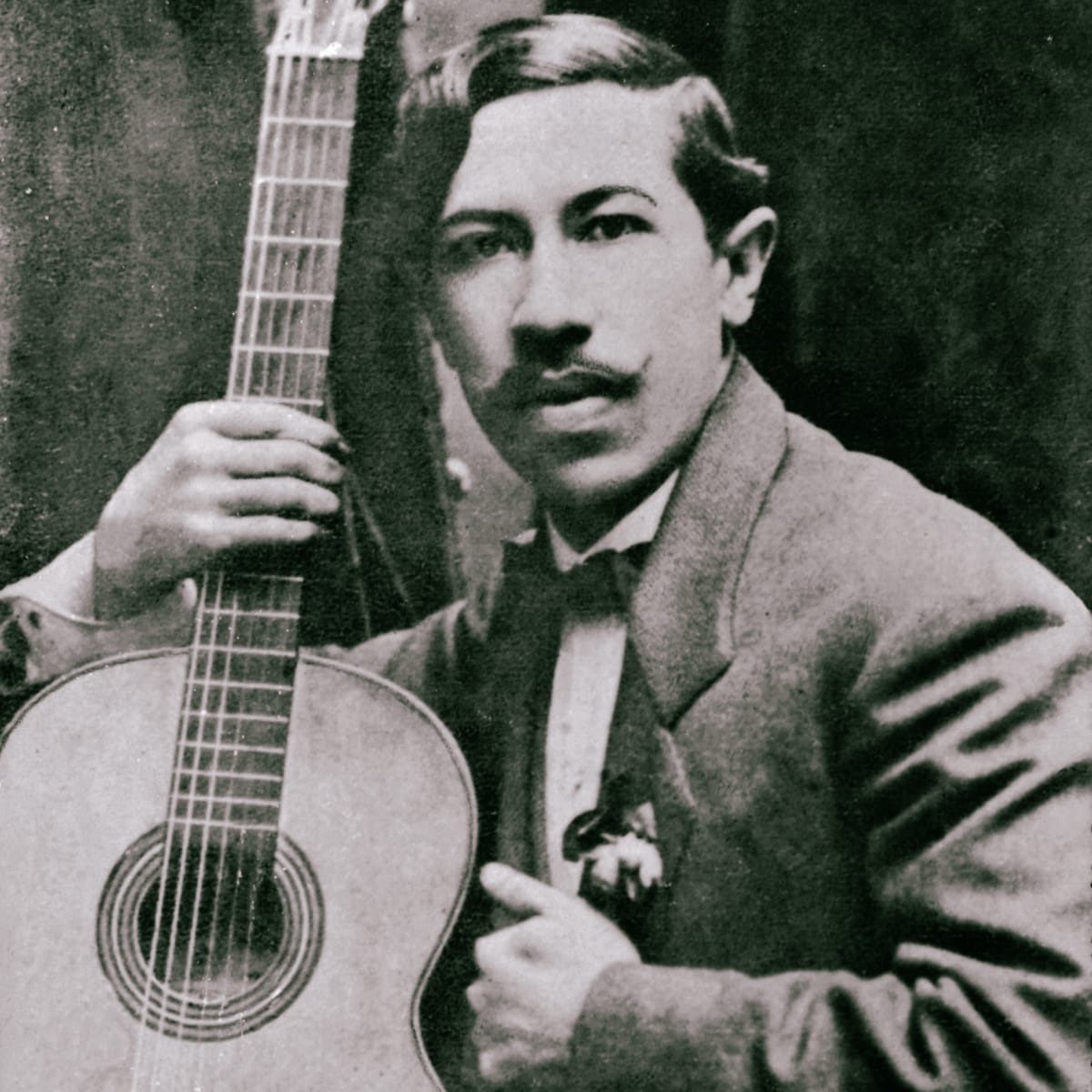
It was in Asunción that Agustín came under the mentorship of Gustavo Sosa Escalada, an instrumental figure in Paraguay's classical guitar tradition. Sosa Escalada recognized his talent early, offering both technical training and an entry point into the European guitar canon, including foundational composers such as Fernando Sor, Dionisio Aguado, and Francisco Tárrega, which would go on to shape the compositional breadth of his later work. In many ways, this became the hinge between Agustín's local cultural ancestry and the global virtuosity that would come to define him.
Yet Agustín's education was never solely shaped by the European canon. Running alongside it was a deep exposure to Paraguayan folk traditions, particularly the polca paraguaya and the vals, whose rhythms and tonal sensibilities remained embedded in his musical language. It is this interplay between local tradition and formal classical structure that gives so much of his work its particular texture and emotional depth.
By the time Agustín arrived in Buenos Aires in 1910, his world had already begun to widen beyond Paraguay, but the move marked a decisive shift in both the scale and ambition of his practice. Buenos Aires, then a rapidly expanding cultural center, offered access not only to larger audiences but to the kinds of instruments, networks, and performance spaces that could nurture a guitarist of his growing reputation. It was here that Agustín began to move more fully into the role of the traveling virtuoso—a nomadic, prolific, and increasingly revered musician traveling across South and Central America.
Over the course of his lifetime, he would compose more than 100 original works and arrange around 200 pieces by other composers, building a catalog that remains foundational to the classical guitar repertoire. Agustín was also among the earliest classical guitarists to be commercially recorded, with recordings dating back to 1909–10. These gramophone records remain some of the earliest surviving documents of the classical guitar as a recorded instrument, preserving not only his compositions but also the extraordinary dexterity of his playing.
His reputation as a performer was formidable. An eyewitness account from Caracas in 1932 went so far as to describe him as "superior to Segovia," a comparison that continues to shadow discussions of his place within the classical canon.
By the early 1930s, Agustín had begun to shift the way he presented himself to the world. Around 1932, he adopted the stage identity "Nitsuga Mangoré," a carefully constructed persona that remains one of the most intriguing aspects of his legacy. "Nitsuga"—"Agustín" spelled backward—immediately signals a process of reinvention, while "Mangoré" references a legendary Guaraní chief, anchoring the name within a specifically Paraguayan and Indigenous lineage.
This transformation was not merely nominal. Agustín began performing in Guaraní ceremonial dress, appearing on stage in an elaborate costume that visually repositioned him in the eyes of his audiences. Concert publicity of the time described him as "the Paganini of the guitar from the jungles of Paraguay," a phrase that speaks to both the virtuosity of his playing and the highly charged politics of image-making surrounding his public persona.
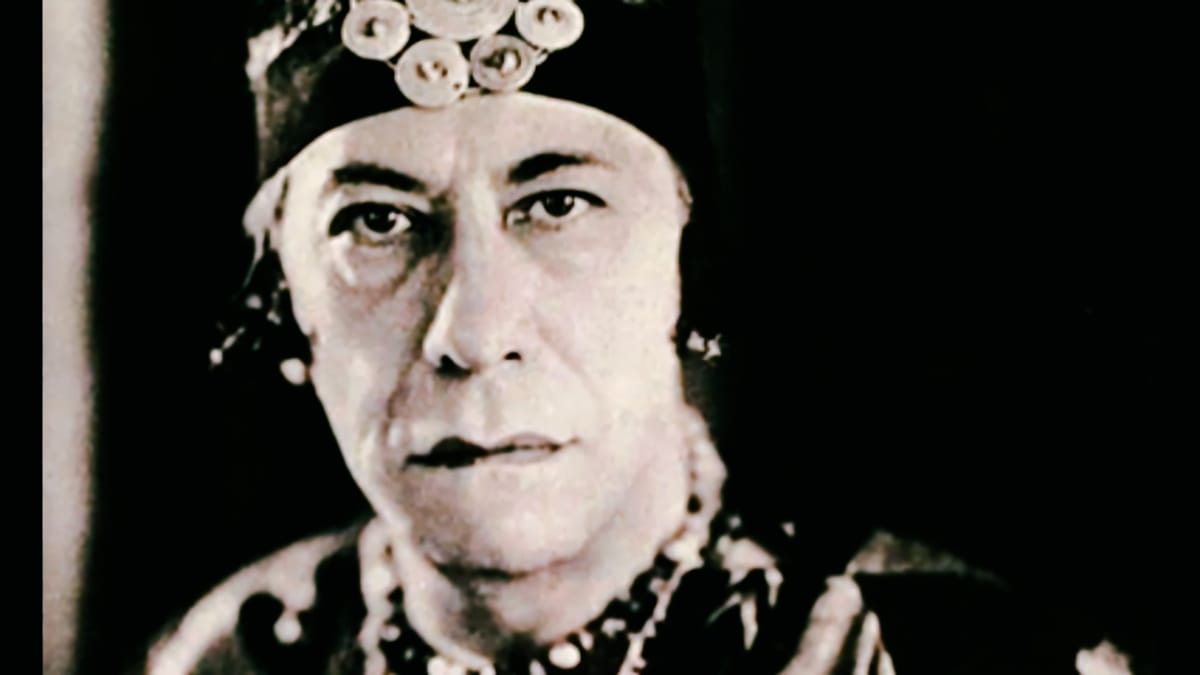
The creation of Mangoré has been interpreted in multiple, sometimes competing ways. For some, it reads as an expression of cultural pride, an intentional reclamation of Guaraní heritage, and a refusal to separate his artistry from the national and Indigenous contexts from which he emerged. For others, it sits more uneasily within the rise of Paraguayan nationalism, functioning as a symbolic performance of nationhood at a moment when the country was still actively shaping its post-war identity.
There is, too, a more ambivalent reading: that Mangoré also operated as a form of strategic self-mythologizing, a way of translating his identity into something legible and marketable, for international audiences. In this sense, the persona moves between pride, performance, and exoticization, holding all three tensions at once.
If the mythology surrounding Agustín has helped sustain his afterlife, it is ultimately the music that keeps him in circulation. His compositions are often understood to fall into three broad categories: folkloric, imitative, and religious, though the boundaries between them are rarely fixed.
The folkloric works are perhaps the clearest expression of his rootedness in Paraguay and wider Latin American musical traditions. Pieces such as "Danza Paraguaya" carry the rhythmic and melodic sensibilities of regional forms, drawing on the polca paraguaya and vals traditions that shaped his early listening. Running alongside this are the imitative works, compositions that move through Baroque and Romantic European traditions. There is a structural clarity and harmonic richness that place him within a classical continuum, yet never entirely inside it as he folds Latin American rhythms into European forms with remarkable fluency. Then there are the religious works, often among his most emotionally resonant compositions. "Una Limosna por el Amor de Dios" remains one of the most celebrated tremolo pieces in the classical guitar repertoire; devotional, suspended, and almost spectral in tone.
Among his key works, "La Catedral" (1921) is widely regarded as his masterpiece. Inspired by the atmosphere of a cathedral interior, the piece moves between solemnity and technical brilliance, combining Bach-like structural influence with an almost cinematic sense of space. "Julia Florida," written in Costa Rica, offers something more lyrical—a floating barcarolle of extraordinary tenderness. Meanwhile, "Un Sueño en la Floresta" stands as one of his most demanding tremolo works, technically virtuosic yet dreamlike in its movement.
What makes Agustín endure is the way these worlds coexist. His music continually blends European classical structures with Latin American rhythmic sensibilities, creating something that feels both formally rigorous and emotionally expansive. Cuban composer Leo Brouwer described his work as Romantic-era composition infused with Latin American influences, while John Williams famously called it "more poetic" than that of many of his contemporaries. Poetic feels right. Agustín's music rarely sits still; it lingers, shimmers, and returns.
No discussion of Agustín's place within classical guitar history can avoid the long shadow of Andrés Segovia. The two met in Buenos Aires in 1921, at a moment when both men were emerging as formidable figures within the instrument's evolving modern repertoire. According to later accounts, Agustín visited Segovia and played several of his own compositions, among them "La Catedral". Segovia reportedly praised the work, later describing it as a "magnificent concert piece" that would sit comfortably in any virtuoso's repertoire. And yet, despite this admiration, Segovia never performed the piece publicly.
Why remains one of the most enduring questions in Agustín scholarship. One explanation, drawn from Segovia's own recollections, is that the promised score simply never arrived before his departure from Buenos Aires. Later testimony has gone further, with some accounts suggesting that Segovia actively discouraged students from playing Agustín's work, contributing to his relative absence from the European classical canon for decades. Whether anecdotal or not, the omission speaks to a broader structural bias within twentieth-century classical music circles, where Latin American composers were often marginalized in favor of a more tightly policed European lineage. In this sense, Agustín's exclusion was never simply personal but reflected the politics of canon formation itself.
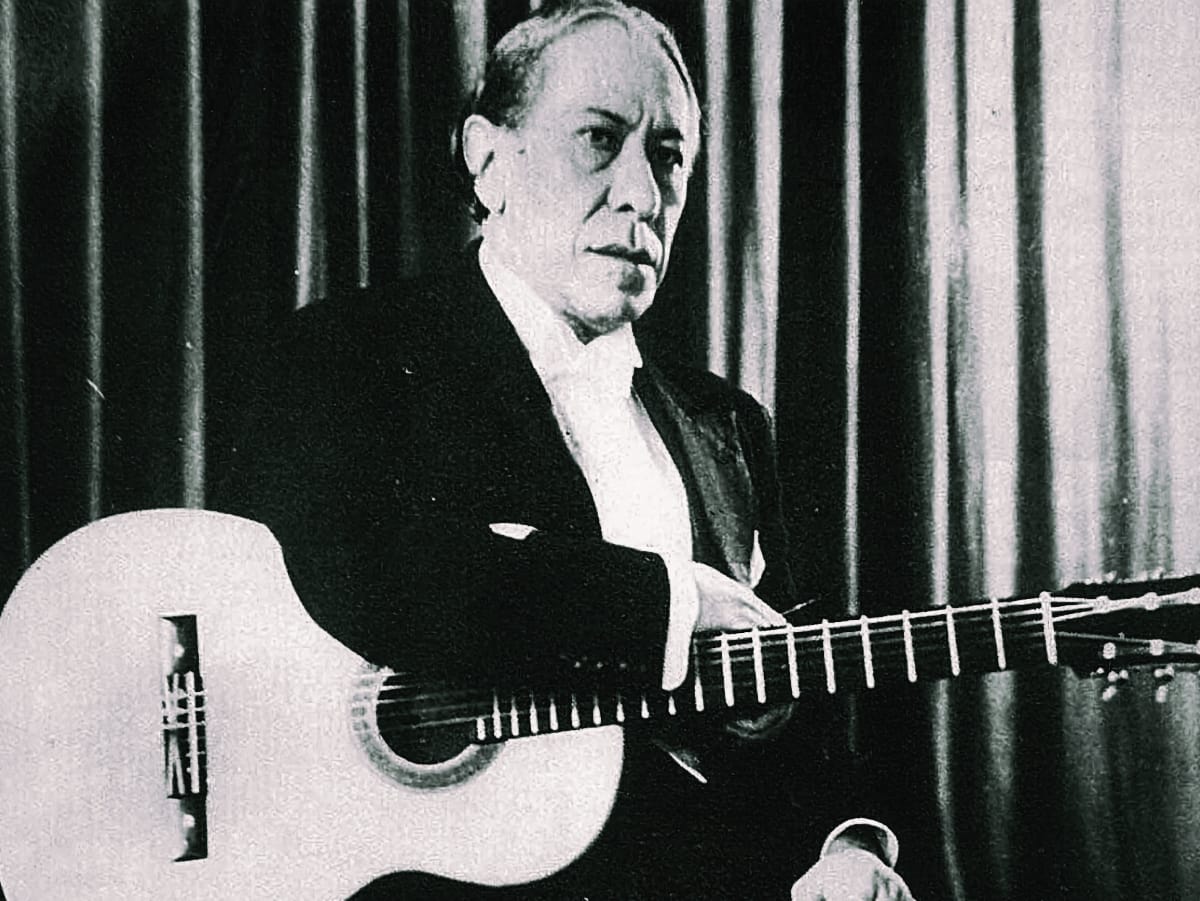
In the later years of his life, Agustín's travels finally began to settle. After extensive touring across Latin America and Europe, he moved to El Salvador in 1939, accepting an invitation from President Maximiliano Hernández Martínez to take up a post at the National Conservatory of Music and Declamation Rafael Olmedo in San Salvador. It marked a significant shift in his career: after decades as a roaming virtuoso, Agustín entered a more rooted phase as teacher, composer, and mentor, formally passing on his techniques to a select group of Salvadoran students who would later become known as the "Mangoreanos."
He would never leave that country. On 7 August 1944, at the age of fifty-nine, Agustín died in San Salvador. The official cause was recorded as a heart attack, though, in keeping with the strange and unsettled nature of his place in music, later speculation has complicated this narrative. Some biographical accounts and later forensic interpretations have raised the possibility of poisoning, pointing toward the presence of chemicals within the household and the increasingly fraught personal circumstances surrounding his final days.
Part of this intrigue centers on Pasquale Cosarelli, an Italian coffee plantation owner who reportedly had an ongoing relationship with Agustín’s wife, Gloria, and later married her after Agustín’s death. Whether this falls into the realm of substantiated history or the mythology that so often gathers around cultural figures is difficult to determine, but the rumor's persistence speaks to the strange afterlife of Agustín's story.
More materially consequential was what followed in the immediate hours after his death. Accounts suggest that students removed handwritten scores and scrapbooks from his home, further fracturing an already dispersed archive. In many ways, these events helped shape the fragmentary survival of his work, a legacy built as much from loss and reconstruction as from preservation.
Today, Agustín occupies a place far beyond that of rediscovered composer; in Paraguay, he is regarded as a national cultural figure, a symbol of artistic innovation and cultural inheritance whose legacy continues to move across generations. What was once a fragmentary archive, pieced together through recordings, manuscripts, and scholarly devotion, now forms a central part of the country's musical identity.
Since the 2000s, the Agustín revival has taken on renewed energy through festivals, concerts, archival projects, and new recordings, both within Paraguay and internationally. Guitar competitions, commemorative performances, and specialist festivals have continued to reinforce his position as a historical figure and a living presence within contemporary performance culture. His works remain central to the modern classical guitar repertoire, regularly programmed by conservatoires, concert guitarists, and students alike, from "La Catedral" to "Una Limosna por el Amor de Dios."
What feels especially significant is the way Agustín's work continues to move beyond the strict boundaries of classical interpretation. Contemporary musicians across genres have returned to his compositions, reimagining them through new sonic languages. One notable example is Paraguayan rock guitarist Rolando Chaparro's album Bohemio, which reinterprets Agustín's work through a different generational and stylistic lens, demonstrating the elasticity of his musical language.
This continued circulation is perhaps the clearest sign of Agustín's endurance. His music is more than a recovered archive or a canonical repertoire, as it continues to be reread, replayed, and reimagined, carrying forward the same sense of movement and transformation that marked his life and death.
Check out more like this:
 Lawrence Peryer
 Elsa Monteith


Comments