


Very early in our conversation about his new Western Vinyl release, Bleeding Past the Edges, Christopher Tignor made me a strange, abstract promise: “I’m going to be very boring at your party.”
It is true, it turns out, but only if you draw tempting, obvious, and ultimately misguided conclusions about his music. Tignor plays acoustic violin and percussion while the software systems he designs process their audio in real time. Though I have been wrong many times about the basic operations here—as you will soon discover—I think these observations of his work, its logistics, its basic configurations, are factually true. And I agree with Tignor that the assumptions that go along for the ride, when his musical means are so described, would most certainly land him in the wrong room. Maybe he was imagining an Interactive Electronics Party, which, thankfully, is not a thing. He might not even make it to the punch bowl.
I prepared for this conversation with Tignor by taking stock of what I know about his music and about the broader context in which I first came to know it. Decades ago, he and I were in the same doctoral program in music composition at Princeton University. A month after I was admitted, most likely via clerical error, the sight of the device I’d been using to make songs, a mixer/digital recorder hybrid (Two simultaneous effects! A 12GB hard drive!), almost convinced me not to go. Princeton is a place where you go to make serious academic electronic music, one of the Two Towers of the Columbia-Princeton approach that, in the second half of the 20th century, came to define a music-making ethos and ecosystem.
Tignor did not make me feel better about my decision, upon my reluctant and not-glorious arrival to campus in the fall of 2006. Not out of any personal friction; Christopher is a joy to talk to and to spend time with, even though he once convinced me that I should really reimburse him, with grant money, for the cummerbunds he pretended to have bought for a “concept piece about making and serving mimosas” in which I would have to participate. Friend-stuff wasn’t the problem.
The problem was my egoic freakout that Tignor was, even at that time, so deeply comfortable “under the hood,” as our mentor Paul Lansky would often say, which only underscored my operating premise that real electronic music is synonymous with writing code. Tignor had the ability to program, on a deep level, via elaborate text-based syntax, musical behaviors that a computer could execute, that might then feed back into the sonic environment, against which he might then play. In this paradigm, I intuited, the performer performs, the computer listens, instantaneously processes, and then returns some sound, to which the performer responds, and around and around they go, entangled.
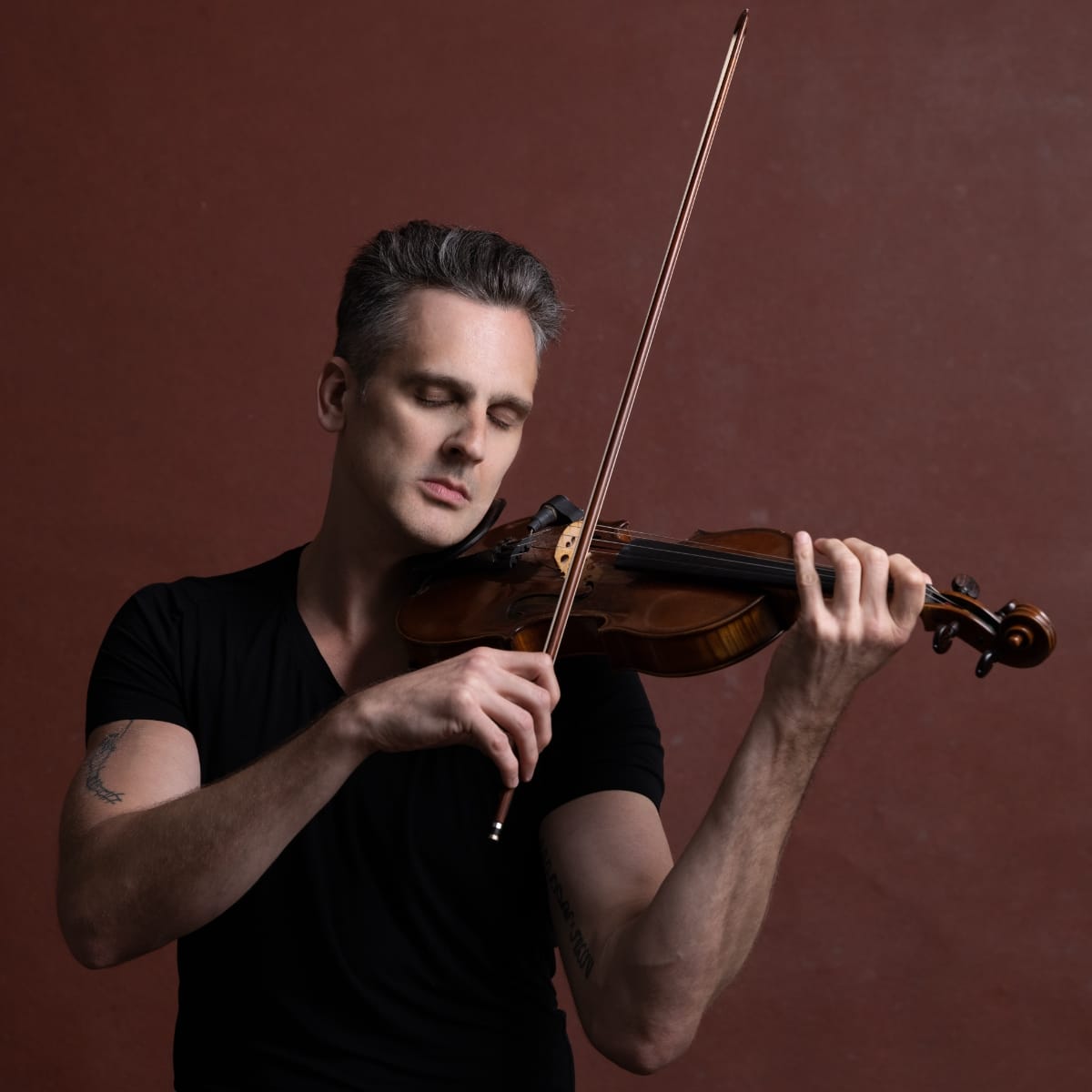
This was the basic framing I brought into our conversation about Bleeding Past the Edges. I presumed I was speaking with and then writing about a human working under the hood to unleash a field of complex behaviors, then standing in the middle of those energetic vectors and fighting his way through. Teetering on the brink. Co-creating with an intelligence he has designed, a bandmate with its own affordances, ideas, and flights of fancy. A chaos-engine brought into the room, on purpose, to make consequential every engagement to which it is attuned, for which it knows to listen. Tignor builds an active danger, provokes it, and then somehow survives its asymmetric response, its overpowered return volley.
Except none of this is true. I cannot overstate the depth of error revealed to me over the course of my conversation with Chris, nor can I overstate my enthusiasm at the result, which is that I got to hear his glorious record with two distinctly different, even antagonistic, minds. I came away with a lot of words to share about these modes of listening, and about how we inherit and invoke them, knowingly and not. But the main event here, the most important conclusion to have drawn, is that this music, in its unabashed beauty, massive scale, and unflinching expressivity, reveals all of my rhetorical framing to be as inadequate as it is sincere. I believe that the measure of a record is how resistant it is to being anything other than a record; my favorite writing about music continually points to the insufficiency of that writing itself. At the same time, such writing commits, wholeheartedly, to the project of using language—which is something you can know, at least a little—to say that someone else’s music—which is something you cannot know, at all—knocked you out, and how.
I try to teach this way of hearing and writing about music, advising that students run their idiosyncratic and subjective experience of the work alongside the historical and cultural context that swirls around it, one that continually reconstitutes itself and transforms. Peter Elbow’s 'believing game' helps, which I invoke without revealing that it was devised specifically for a teacherless class. 'No arguing' is among his generative premises, but rather than create an uneventful, insincere peace, Elbow’s rule actually asks for something quite radical: to use believing the creator as a method. It is hardly a final position but rather a rung on the ladder. If we take the claim (or the story, or the poem, or the song) as though it were incontestably true, or beautiful, or true and beautiful, then our job is not to say what is working or not inside the created thing. Instead, we work to drag into the light the difference between who we would need to be to adore the thing and who we actually are. The work and its context have to ride together if we assume that the work works, that it adequately speaks out to its situation, of which we—or whom the work asks us to be—are a part.
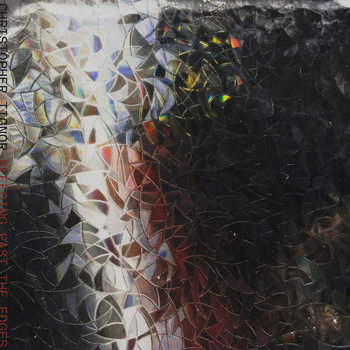
It was not difficult to listen to Bleeding Past the Edges in this way. The context that comes with believing in it is identical to my own sense of what music ought to do and on whose behalf it ought to do it. It’s perfectly plausible, per my strange subjective position, to rig up some gear to a laptop, stand inside the wires, and play your way through whatever happens, sometimes to nearly one dozen people. What I brought to that first encounter with Tignor’s new record was a not-insignificant number of hours spent trying to do this and listening to other people try to do it.
A first point of friction is that, to me, the album does not sound like music that uses, or needs to use, that rationale or cultural currency. One comes in fully prepared to grade on the curve, attuned to a specific kind of resonant filter, timbral evolution, granular cloud, or whatever.
But then an arresting, human-scale melody, at once exalted and world-weary, takes flight. The entire technological apparatus amasses behind it, orchestral power funneled out of a single body. One gets the sense of a small being playing itself into gianthood, that a quotidian human concern can actually be blown up to massive, saturating scale without ambition obliterating the devoted attunement at the center of the storm. What is actually true to a single human soul on some unremarkable Wednesday at two in the afternoon goes widest-screen in sonic signature, but the iterating into all-systems-go bakes every single breath, bow retake, and ritual silence into the accumulation. Lyrical moments become ensemble-lush. A gathering inhalation stops the whole orchestra in its tracks, holds it at attention. Silence is arresting. Literally silent. A vacuum. Not a rest.
It turns out that Bleeding Past the Edges sounds unlike paradigmatic interactive electronics with live performance because it is not, at all, paradigmatic interactive electronics with live performance. After opening our interview with a question predicated on my very inside-baseball take on his album and how it surely would have been made, Christopher said something completely unexpected.
To start, he likened it to music made via a system of notation you might invoke in a traditional score to represent, say, a scordatura, or prepared piano, or any “more traditional thing that we understand.” Rather than claim some tech-augmented evolution or abandonment of this system, Christopher says, by his account, “there's really not any fundamental difference” between the traditional approach and his own. He grants that it is maybe “more extreme, because maybe I've built my own instrument, I've put the frets in different places, drilled them onto the fret board, but I'm creating an instrument specific to the composition in the same way that there's been lots of music for instruments specific to the composition.” The lineage here is less Paul Lansky bringing punch cards to Bell Labs and hoping for the best, and more any composer, ever, who has put pen to staff paper and then handed the staff paper off to a human being who knows an instrument.
Bleeding Past the Edges, then, is composed music for an instrument that happens to include a computer. Play a particular pitch on the violin, and the computer returns, say, dyads from the parent scale that Tignor specifically told it to return. He writes music that takes that entire category of behavior as normative for the instrument. Technology is not deployed as an agent of chaos, or as a mischievous but well-meaning interlocutor. It just makes sure that when he plays an A on the violin, he also gets the F below and the A below that. Every time. Given that hypothetical behavior, and many others similarly conceived, Tignor knows what he will hear when he plays his instrument, like anyone else who has ever played an instrument they know how to play. And given that situation, Christopher wrote and then recorded some music. Precisely. Reproducibly in a room. So he will take it on tour, because, in the end, and in his own words: “my real instrument is the full-range sound system.”
It felt good to flush all that out. But even after revising the priorities I inherited from academic electronic music and its discourses, and updating the frame to fairly account for Tignor’s sense of his own work—composed music for an essentially acoustic instrument, however modified—there was still a remainder, gnawing. Something that frame-dissolves failed to capture. Toward the end of our conversation, Tignor quoted Wilco/Jeff Tweedy as the definitive articulation of what he aims to do: “I am trying to break your heart.” In that sense, framings that talk about music at all will fail because they can, at absolute best, only say what devastating music is like. It is the kind of thing that makes you think in circles and leave a written trace of the failed attempt. Institutions and genres aim to explain and then to codify that process, but at best, they actually take this effort for what it is: a shorthand invented to remind you of that time you went out to meet the thing and asked the only relevant question: How detailed is the topography of your broken heart? In music, maybe in all art, we always get two-for-one: every awful map of human want carries with it the ecstatic joy of knowing someone made it, that someone thought to make anything at all, and then to share it, in opposition to every plausible rationale, mounting in numbers all the time, not to. This is a detailed map. Worth following down the funnel, as far as you are willing to go.
Check out more like this:
 Lawrence Peryer
 Andrea Mazzariello


Comments