


1988 for me was lopsided and nearly capsized. Tail between my legs, I'd returned to Florida with various professional and personal plans discarded (by me or for me). I was a warehouse worker by day and shared dinner with my parents in the evenings. I was toned yet bummed. Two live rock and roll shows that year mattered to me: Dinosaur Jr. touring Bug and Sonic Youth touring Daydream Nation. Regarding the latter, I sustained hearing loss. Regarding the former, B.A.L.L. [featuring Kramer on bass] opened for Sonic Youth. After the potent opening set, Thurston introduced SY, stating, "We're Blondie, and we're from New York City." Things began to make sense.
Some other 1988 highlights:
- February 5: In the first prime time wrestling match in 30 years, Andre the Giant beats Hulk Hogan.
- March 16: The largest ever chemical weapons attack hits the Kurdish town of Halabja by Iraqi forces, killing 5,000 civilians.
- July 8: Stevie Wonder announces he will run for mayor of Detroit in 1992.
- October 26: Donald Trump bills Mike Tyson $2,000,000 for four months' advisory service.
- December 21: One of the most shocking events on this 1988 timeline—Pan Am Flight 103 is downed over the town of Lockerbie, Scotland by a terrorist bomb, killing 270 people. Libya takes responsibility.
And it makes me wonder to this day if the static will ever be quelled. Then along comes They Came Like Swallows, the debut record of Bonner Kramer and Thurston Moore. As I type, a tornado watch is in effect. The recording is somber, elegant, and contained. The songs, instrumentals save for a Joy Division cover, are a response to news headlines, yea even the tumultuous 20th century, and what's to come. Wars and rumors of wars haven't abated since time was recorded. There's nothing new under the big black sun except, without question, how one chooses to react. Here, the two reactors use guitars, voices, and organ and piano as 'sonic activism.' Imagine SY's "Providence" across an entire album. It's easy if you try.
Via email, we conversed.
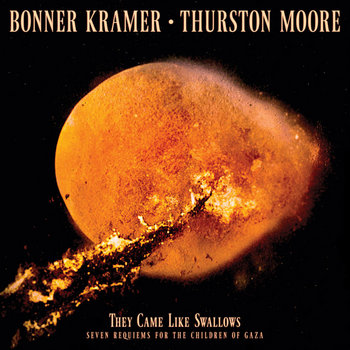
Steven Garnett: Am I correct that the album title was lifted from the William Maxwell semi-autobiographical text concerning WWI and the Spanish Flu?
Thurston Moore: Kramer was definitely inspired by the Maxwell tome, I believe. I myself have not read the book, but it's in my to-read docket that's for sure. I immediately responded to the evocation of the title after Kramer suggested it, as it definitely fit the 'mood' of the music, regardless of the title's origin. It rang as poetry, and poetry is literature set free.
Bonner Kramer: Yes, the title is indeed borrowed from Maxwell's astonishing little novella, but we must acknowledge that HE lifted it from Yeats and his poem "Coole Park, 1929." And if the title echoes Maxwell's text, his war- and pandemic-era highlights from 100 years ago seem especially fitting given the past six years of international turmoil and its sorry wake.
Garnett: Was this recorded in advance of determining its sonic intentions? Will 2020 and forward ever be memory-holed?
Thurston: We were not thinking or mulling about the state of current affairs and global derangements whilst in creative mode. Though, as we began to prepare for the release, we felt (as obviously the rest of the humanitarian demographic of Earth did) inundated with the reports of terror which right-wing governments were sanctioning, specifically the genocide perpetrated towards Palestine, and the images of innocents murdered. As per 'memory-holed'—I am not familiar with that term! Sounds like the worst aspect of bondage and discipline ever.
Kramer: Yes, we did not choose the subtitle before creating the LP.
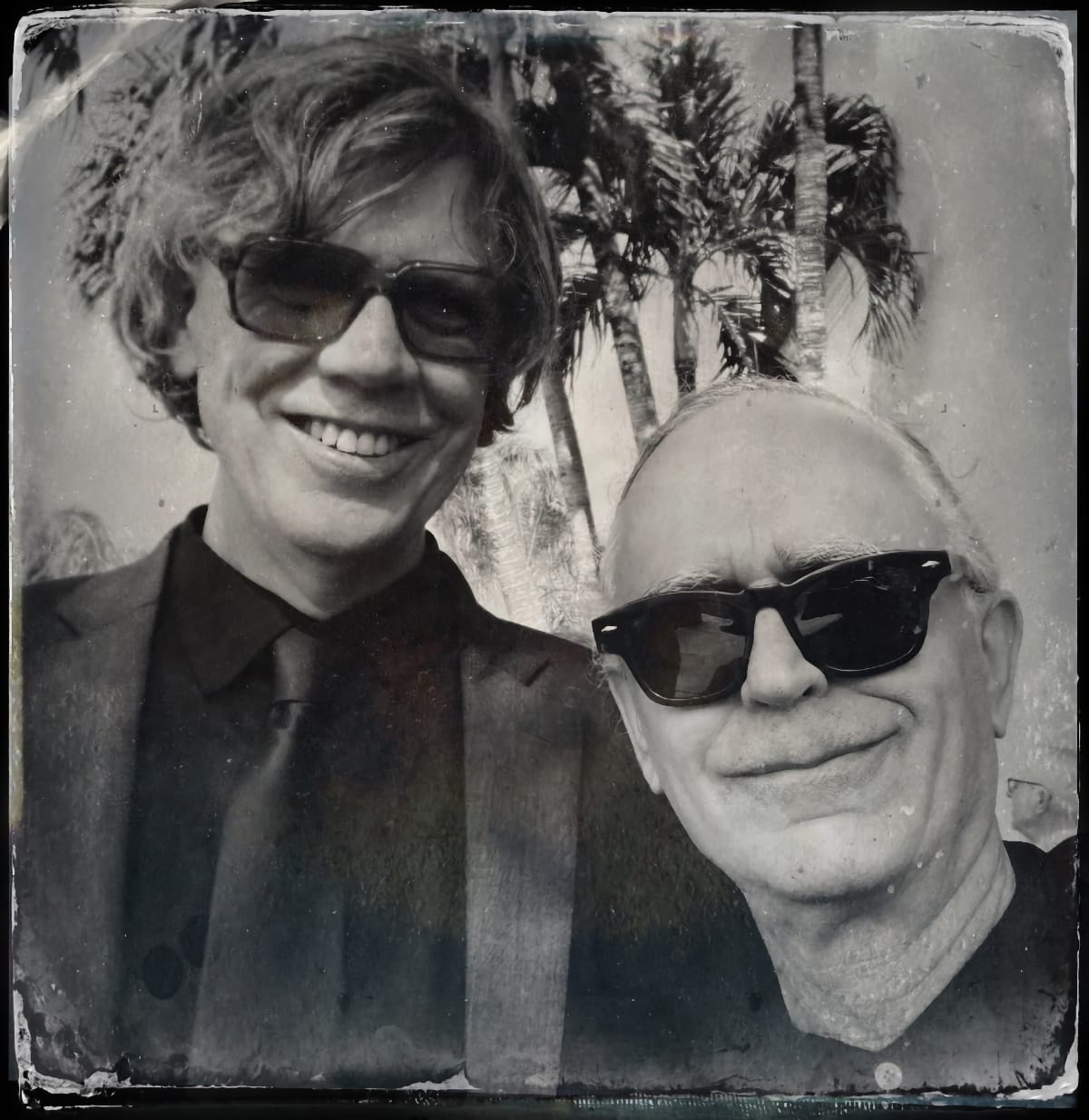
Garnett: Thurston framed the recording process with South Florida imagery (lizards!). I can relate. Kramer, I know you lived in S. Florida for some time.
Kramer: Indeed, I did. 19 years in the tropics. I loved it until my final few years there, when Miami's Russian mob took over my condo board.
Garnett: Tell me more about your creative/musical intersections before this recording, be it 40 years ago or more recently.
Thurston: In a way, it's always a creative connection even when Kramer is cooking up some Sunday morning pancakes made from blue grains. When Kramer was running Noise New York studio in lower Manhattan in the 1980s, I would find myself up there with all kinds of lit up souls from Maureen Tucker to Daniel Johnson—usually in a very relaxed, anything is permitted, atmosphere.
Garnett: And now you're on the Silver Current label, which has recently brought together some dream lineups/bands with Orcutt Shelley Miller (and David Yow on the Beefheart cover), and now you two. Please elaborate.
Kramer: I knew that Silver Current was the right home for the LP. Dean Wareham had been singing [label head honcho] Ethan [Miller]'s praises since the first Galaxie 500 archival release he did, and the manufacturing quality of the SC vinyl was superb. It was a no-brainer for me. We didn't offer the LP to anyone else. We're grateful to have a partner like Ethan in our corner.
Thurston: Silver Current proved to be a fantastic label for some archival Sonic Youth action, which Steve Shelley facilitated via Ethan at the label, so when Kramer mentioned it as an option, I was GUNG HO.
Stay on top of The Tonearm.
Subscribe for exclusive interviews, cultural tip-offs, and community fun.
And your support keeps our site free of advertising and paywalls.
Garnett: Please elaborate on the engineering, instrumentation, and the mechanics of it all. Though I appreciate the Joy Division cover, instrumental music has mostly held my attention the past two to three years. I've gone back to Clifford Brown, ancient church choral works I cannot fully decipher, and Eno's ambient works across decades, for example. I am not alone in the backward glance, per other music writers and my dearest friends. We are also listening to new music in unspoken agreement or awareness of sonic solemnity, which isn't necessarily passive. I've seen the phrase "quiet resistance" used often. There's obviously something in the water for musicians, too. Your thoughts?
Thurston: I remember Glenn Branca being asked about composing entirely instrumental music, and he said (and I paraphrase), "I'll leave singing up to the poets," which is fair enough. I find I also have a preference, at least in the last decade or so, for purely instrumental music. Of course, the voice is an instrument, but when words come into play, it becomes narrative, even if it's surreal. I feel I'm not so interested in words in music so much these days. After Dylan, Lou Reed, Patti Smith, Tom Verlaine, Richard Hell, Ian Curtis, Joni Mitchell—I feel like new concepts of lyricism are not so forthcoming lately, though I do hear some good writing now and then in song-craft. As it is, I've fallen into the sensual grave of harsh noise.
Kramer: Speaking for myself, I'm now in a place wherein I seem to have evolved past words/lyrics. The audio evocation of a place, or rather, a LANDSCAPE, has bewitched me. Everything seems to be going away, distancing itself from me, and it's that departing landscape that holds my attention now, almost to the exclusion of all else. I think it's possible that (like Robert Bresson, or Tarkovsky, or LaMonte Young) I'm finally in search of the Transcendental, and it seems to me that while protest is still an unspoken factor in my so-called 'process', the only valid FORM of protest is Beauty. That's all I'm concerned with now: that ever-elusive destination. I'm driving toward something painfully beautiful. A place in which Peace and the current realities of our lives can—even if but briefly—coexist.
Garnett: Like the Squanderers' latest record, I found myself both contemplative and stoked when listening to Swallows. Kramer mentioned the process was like jazz in that you (the music makers) don't think about it, you just do it. Is it really that simple?
Thurston: "Simple" is really an aesthetic take. Morton Feldman famously said to Cage, "Now that it's so simple, we've got a lot of work to do." Or something along those lines. That to me is such an exciting statement and incredibly inspiring; I completely relate to it as a musician.
Kramer: After over 40 years, it does at times seem to have become that simple. For me, I mean. I just show up and get to work. No compulsions, no 'goals' (other than to have a fruitful collaborative experience in which the resulting work may be something that will stand the so-called 'test of time' and be listened to more than once). This may seem to contradict my previous statements in response to your previous question, but it's important to understand that the act of making music can exist on multiple levels, like 3D chess. Listen to Coltrane, or the miraculous piano recordings of Bill Evans. It's like they have ten brains, all of them concentrically spinning at once. The trick is to let all those processes dance together in real time; to take a step or two back and let the ballet unfold.
Garnett: Your press package includes the terms "miraculous," "acolyte," "soul music," and "solemn inner grace," so I must ask why religious language, if not because it's unconscious knowledge that the making of art and its power to comfort and heal comes from a benevolent creator desirous that we love one another?
Thurston: I was a little Catholic boy, and at some point I became enamored by the writing of St. Teresa of Ávila (Interior Castle) and St. John the Divine. I recall an English class where we read Pearl S. Buck, and the teacher related to us that Pearl only had the Bible to read as a child and learned to write by that. These things always charmed me. But I'm hardly monotheistic these days. More Pop Buddhist cosmicology-minded, I think. God exists in every breath.
Kramer: Sorry, but I'm just an old Atheist.
Garnett: I hope you’ll consider Florida when next you have occasion to perform, together or in other formations. How does that sound to you? What might that look like?
Thurston: Get us a gig on Cocoa Beach!!
Kramer: I'd love it, so long as I also get to revisit my beloved and sorely-missed Florida Keys afterward. We will certainly make another LP or two together, but there are currently no plans to tour in support of this one. That said, if we are offered any opportunities to perform that work for both of us, our ears are open. And after our duo performance at Big Ears [last March], there's no doubt in my mind—if we DID tour, there would not be a band. It would be a duo. In fact, the only people I can think of who'd help us make a great trio are all dead: Alice Coltrane, Roland Kirk, Arthur Russell. You know what I mean.
Thurston: I'm waiting to hear back from John Paul Jones whether the Led Zeppelin tour jet can be made available. Hang tight.
Check out more like this:
 George Grella
 Steven Garnett


Comments