


Ben Wendel's 2023 record All One was an orchestra of himself: layered woodwinds (saxophone and bassoon stacked in multiples) with a different soloist on each track. Made during lockdown, it earned a Grammy nomination for Best Contemporary Instrumental Album. BaRcoDe, his fourth for Edition Records, carries that idea outward, surrounding him with four of the most inventive mallet players working today.
Wendel grew up in Los Angeles and trained at the Eastman School of Music before co-founding Kneebody, the jazz-fusion group whose two-decade catalog has included collaborations with vocalist Theo Bleckmann and Daedelus. His sideman credits include Tigran Hamasyan, Bill Frisell, and, yes, Prince. As a composer, he holds an ASCAP Jazz Composer Award and multiple Chamber Music America New Works Grants. Wendel’s 2015 project The Seasons was a Tchaikovsky-inspired music video series with Joshua Redman, Julian Lage, and Ambrose Akinmusire among its monthly contributors, and the New York Times named it one of the year's best. Understory, released in 2024 from a Village Vanguard engagement, preceded BaRcoDe by just over a year.
BaRcoDe originated with a commission from the Jazz Gallery, where the group sussed out its sound across two multi-night residencies in 2023 and 2025. Wendel assembled the lineup with care: Joel Ross, a Blue Note recording artist whose acclaimed albums include KingMaker and The Parable of the Poet; Simon Moullier, whose customized quarter-tone vibraphone and use of effects have drawn praise from Quincy Jones and Herbie Hancock; Patricia Brennan, known for her extended-technique explorations and work with Mary Halvorson and John Zorn; and Venezuelan-born Juan Diego Villalobos, who draws on Afro-Caribbean traditions and experimental electronics. Wendel sits at the center, and in his words, the music "lives in its own little universe." The six tracks, five original compositions and a rearrangement of Antônio Carlos Jobim's "Olha Maria," were laid down at the Bunker Studios in Brooklyn in January 2025. The title is Brennan's invention.
Ben Wendel joined host Lawrence Peryer for the 300th episode of The Tonearm Podcast. Among many other topics, the two discussed the genesis of BaRcoDe, Wendel’s openness to contemporary classical and percussion aesthetics, and what it means to perform at the Village Vanguard.
You can listen to the entire conversation on the audio player below. The transcript has been edited for length, clarity, and flow.
Lawrence Peryer: Can you tell me about the genesis of BaRcoDe's unusual configuration of so many mallet players alongside you? I've been curious since I first encountered the record whether you were motivated by the sonic possibilities or had certain soundscapes in your head that required this particular instrumentation.
Ben Wendel: I would say it's a combination of things. I received a writing commission from the Jazz Gallery in New York. The great thing about that organization is that there are really no strings attached to what you can create. Personally, I always love trying new things—things that are a little outside of my comfort zone.
The first thing that prompted the idea was noticing a significant emergence of a new generation of mallet players. That instrument, let's say, maybe hasn't been at the forefront as much over the past decades, but more recently, there are just absolutely incredible players coming up. There are also influences—I went to the Eastman School of Music, and some of my closest friends were in a percussion ensemble that eventually became a group called Sō Percussion, which comes right out of that new-music, classical minimalism, percussionist aesthetic. There was a time I was asked to produce a series of concerts in Munich, and I actually set up a collaboration between my band Kneebody and Sō Percussion.
What I was excited about was not just the instrumentation and wanting to explore that, but the very rare opportunity to put together four master improvisers on these instruments. You see plenty of examples of new-music percussion quartets in the classical field, but it's very rare to see all of these great improvisers come together in a band. I was excited to see what would happen if I wrote music that reflects my writing and that aesthetic, but then put it in their hands and put myself in the middle of it. That's how it all came together.
Lawrence: For those four individuals in particular, what previous relationships, if any, did you have with them? Or was it more about selecting them purely for their musicality?
Ben: I was very intentional about the people I chose. I had worked and recorded with Joel Ross quite a bit, as well as with Simon Moullier. I remember going to Joel first, telling him my idea, and asking if we could talk through all the great players on the scene and what each of them brings to the table. After that conversation, I had a list of maybe fourteen or fifteen names. As I checked out more and more players, I was essentially looking to assemble the Avengers of mallet players.
I didn't want players who were aesthetically redundant. I was looking for players who each brought their own voice, instrumentation, and approach. Then, with Joel's help, I would think about a particular person and ask: do you think personality-wise they would be a good fit, in terms of being a true ensemble, a real team effort? And slowly that emerged. Patricia Brennan, I had never worked with before, and neither had I worked with Juan Diego Villalobos.
But between the four of them, I suddenly had this really wide palette to work from. Simon, with his one-of-a-kind trademark vibraphone and use of effects pedals, Patricia, with her extended techniques and use of effects pedals, and Juan Diego, with his deep knowledge of folkloric percussion from Venezuela—between the four of them, I could see the possibilities.
Lawrence: And all of that material was written specifically for those voices?
Ben: I wrote all of that music, including the arrangement of the [Antônio Carlos] Jobim piece, for that ensemble and that specific group. And the writing definitely reflects that—the written parts, the forms, the percussive elements are all a nod to that ensemble.
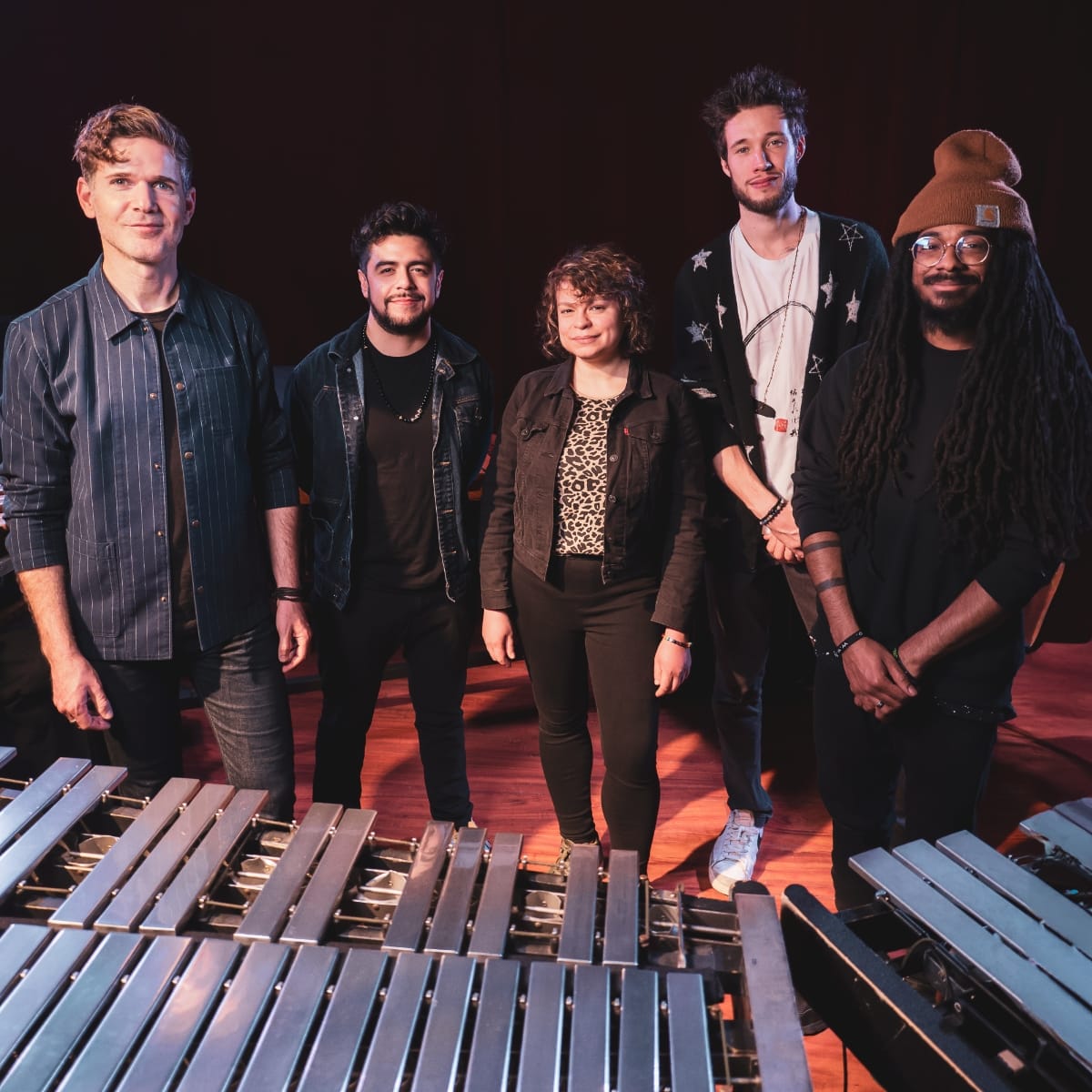
Lawrence: Tell me about the title BaRcoDe and especially the visual logic of the capitalization. Is there something you're suggesting there, or are you just playing with words?
Ben: Well, I have to credit Patricia with coming up with that name and the capitalization. It kind of reminds me of a quote from a Rick Rubin book where he says sometimes the artist doesn't know why they did something until it's done. So when she presented that suggested name, instinctively, we all said, "Oh, that's perfect." It just felt right.
Upon further reflection, though, one could actually point to some meaning. The most obvious thing is that these mallet instruments are made of bars. What this ensemble is doing, I think, is creating a new kind of language through this instrumentation—because they're improvisers, it's a sort of code being created. And I think even the capitalization’s quirkiness is a nod to the project’s own quirkiness. All of that made sense later, but initially, we just thought it was a really cool name and a cool way to write it.
Lawrence: The Jobim piece, “Olha Maria”, is interesting for multiple reasons—the length, the fact that it's the only piece that isn't your composition. Can you talk about the thinking behind including it?
Ben: First and foremost, especially with a group like this, I like the idea of including one piece that's an arrangement, just to give the listener a reference point. I thought this was a really different kind of group, and if I show what this group can do through a song the listener might already know, maybe it sheds a different kind of light. That piece is also one of my all-time favorite compositions, and I've always been looking for a reason to include it on an album. Even the original version has a lot of arpeggiation, so it was really well suited to an ensemble like this.
In that arrangement, I did write some additional material—there's a solo form that doesn't exist in the original, and the intros are a little different. I molded it to my needs in terms of length. We did a version where the solos were half as long, but ultimately, when we got to the end of recording the longer version, it just felt better. It felt like: let's just live in this space for a long time, let's just be in this meditative world.
Lawrence: That's such a sign of a sturdy composition—that its melody and its construct can withstand that kind of adaptation. You can put it in these different contexts, and it still holds its identity, but it can be translated.
Ben: Yeah, it translates. And a piece like that, the harmonic movement is very much in the spirit of Bach. There's a sturdiness to it, in the same way that Bach's writing continues to work and live on across many different instruments. Jobim has that too. The structural core of his compositions is just right there.
Lawrence: And that sonic environment is really a kind of luxury afforded by those particular players, because of the use of effects and extended technique. You have so many opportunities to explore sound.
Ben: Yeah, absolutely. Between those four players and what they're playing, and then obviously I'm using effects too—there's a lot there. As I discovered while doing this project and being in the middle of it during the concerts, there’s something highly hypnotic and trance-like about the effect of those instruments. It kind of reminds me—it's a bit of a stretch—but if you've ever been to any kind of ceremony that has singing bowls, sound baths, gongs. It kind of has the impact of that, but also just the impact of percussion, which can really do that too. So it lives somewhere right in between, and it has a hypnotic effect. I wanted to lean into that.
Lawrence: How were you configured on stage at the Jazz Gallery? Because what you're describing sounds like you really had the opportunity to live in that soundscape.
Ben: Yeah, it was heaven. That's exactly what it was—this massive semicircle with a five-octave marimba, three vibraphones, a balafon, percussion, and I was dead center, bathed in it. And for everyone who was there, the live impact of that ensemble is really something. People who attended the concerts commented on that quite a bit.

Lawrence: I'm curious about your experience as a player in Los Angeles. It's always struck me as such a pragmatic, working-musician scene, given the entertainment industry and the sheer confluence of musical cultures. Has that impacted how you think about orthodoxy in jazz or in creative music?
Ben: I was raised in LA and came up in that scene. I've lived in New York for about fifteen years now, so I've had a real hybrid experience. I would say my professional path and all the different things I've done, not just in the jazz world but outside of it, are more just a reflection of me. I'm a huge fan of experiencing great music and learning through any genre, and I'm very open to collaboration. I always have been.
LA and New York really represent different things. A lot of the skills I developed growing up in LA served me well: studio work, playing in tune, playing multiple woodwinds, and sight-reading well. But the randomness of life also had an influence.
When I was fourteen, I became friends with a guy named Terrace Martin, who was going to Santa Monica High School with me. He started taking me down to Leimert Park in the Crenshaw District, where there's a club called The World Stage, which Billy Higgins ran for many years. Terrace ended up becoming a really prominent hip-hop producer—he produced Kendrick Lamar and worked with Snoop Dogg—and it's because of Terrace that I got to work with Snoop Dogg and things like that. The circumstances of life exposed me to some amazing things that really set my path.
As Duke Ellington said, there are two types of music: good music and bad music. I've never really shied away from dipping into different worlds if I think the music is compelling.
Lawrence: I speak with many artists from classical or conservatory backgrounds who have to be very intentional about maintaining their open-mindedness toward improvisation. A recurring theme in those conversations is that it has evolved generationally—it's not as closed as it was twenty years ago. Were you at all put off by mindsets at the conservatory, or was Eastman not oriented that way?
Ben: Well, I arrived at a lucky moment. When Eastman started its bachelor’s degree in jazz, it brought in two CalArts graduates: the trumpeter Ralph Alessi and the pianist Michael Cain. Eastman at that time was an old, awesome, conservative institution committed to giving you a rigorous education—when you left, you would be a consummate musician. And then Ralph and Mike brought this completely different West Coast, Charlie Haden open-mindedness—this questioning of everything. What does it mean to be an artist? How do you find your path? At that time, they were really challenging neoconservatism in the music, and for the people who went to school during that period, myself included, it was a thought-provoking time.
I was exposed to both sides and benefited from both. But ultimately, where I've landed is a combination of who I am and how I've reacted to the things that have come into my life. At Eastman, I was presented with a lot of things to think about in terms of individuality versus tradition—acknowledging that we are on a continuum, that I cannot musically exist without what has come before me, but then asking: what does that actually mean, and how do we find our own place within it? I ultimately don't think I'll ever have the answer to that. And I would question anyone who says they do, because I think it's an ongoing process.
Lawrence: The answers are dead ends.
Ben: To your point, I certainly have seen the barrier between classical musicians and improvising musicians become much more porous, and that's been lovely to see. There are so many great new-music ensembles that have emerged in the last couple of decades that really point to that—just an absolute openness to improvisation, and a comfort with playing outside of genre in ways that just weren't traditionally done before.
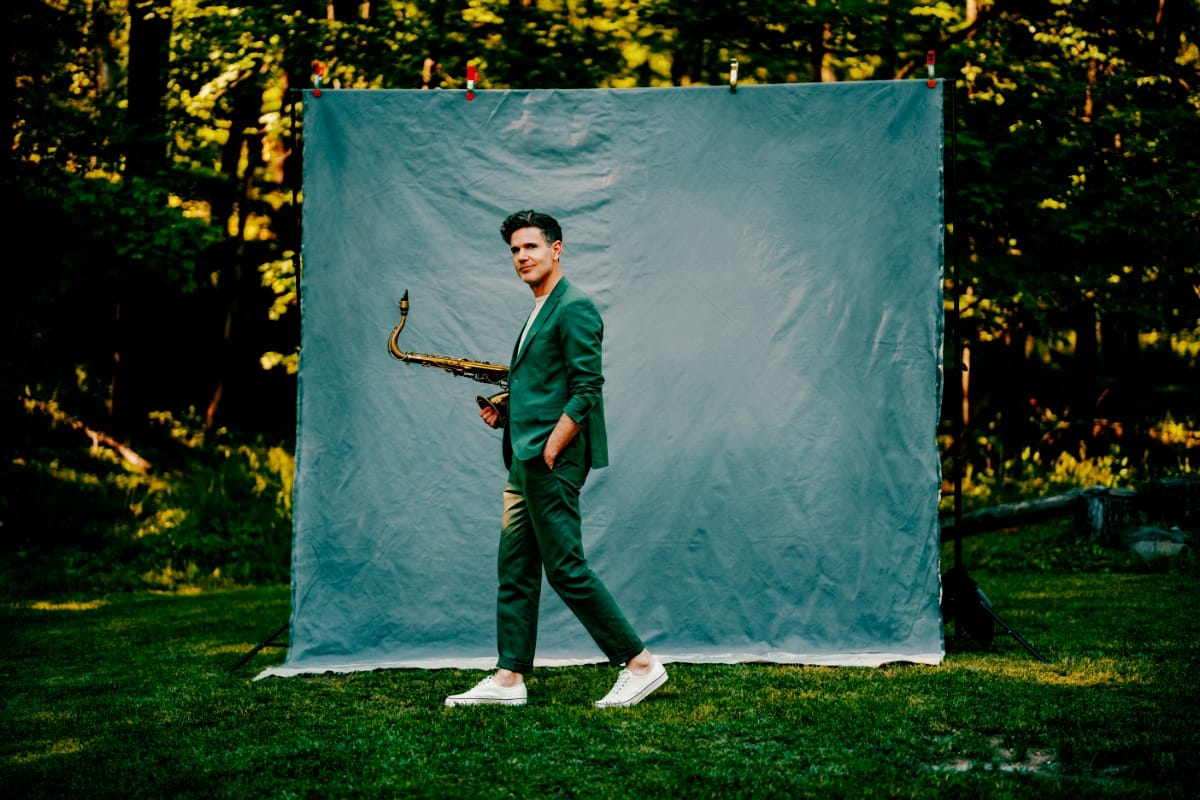
Lawrence: I wanted to ask you about the Village Vanguard. Whenever an artist has performed or recorded there, I try to spend a few minutes on it—the room, the history, the weight of being a saxophone player on that stage. I'd love to hear what the Vanguard means to you.
Ben: The experience has been such a positive one. First, there's the honor of being invited to lead a band there. I’ve played there many times now and recorded an album there. I remember the first time I led my band there; Lorraine Gordon was still around. There's Lorraine's table, always the same one, and there she was.
I was walking to the stage, scared, but something amazing happened that really reminded me of the times I got to play with Billy Higgins. I got on stage and suddenly felt like all of the spirits in that room, and all of the music that had been played there, were this lifting, supportive energy. It was like, "Do it, man. Be yourself, express yourself, lean in."
The emotion I finally felt on that stage wasn't fear—it was something else entirely. And Billy Higgins had that too. When you played with him, he conveyed the message of this music through his playing in a way that, if I was having a bad day or feeling down, the moment we started playing and I was living within his beat, I suddenly felt joy, community, and collaboration.
The Vanguard is an open version of that. You get on that stage, and you suddenly feel this amazing mixture of gratitude and powerful history, but support too—all the ghosts in there, all the spirits in there, are friendly. That's my experience with that club, and it has remained that way.
Lawrence: Is it true that when you're booked to play there, you generally know very, very far in advance? And how do you think about it, knowing it's looming?
Ben: They book one to two years out, because it's such a special opportunity to play six nights. I try something different each time: a different band, a special guest, something new. For example, I'm going to be playing there in July, and I'll be playing with a lot of musicians I've worked with before, people I have a long history with. I had the opportunity to bring in a guest, and John Patitucci will play bass that week. We've been talking about doing something together for a really long time, so I thought this was the perfect time.
Lawrence: When something like All One receiving a Grammy nomination happens, do you have any sense, as the creator, of what made that record connect?
Ben: I don't think so. Maurice Ravel's most famous piece is Boléro. He wrote Boléro as an orchestral warmup piece. Did he think that would be his most beloved work? Definitely not. The artist makes the art, is proud of every single thing they do, and tries to make it as clear an expression as possible of what they're hoping for—and then how the world takes it and reacts is completely out of their hands. Once you release it into the wild, all expectations are gone. I loved getting the nomination, and it's wonderful to receive that recognition. But why did it happen for that one and not another—your guess is as good as mine.
Lawrence: Something else I wanted to ask about is the relationship with Edition Records. There's something about this record that feels very Edition to me: on one listen, it's accessible—it's not shallow. You can spend time with it and find the challenge and the substance in it. That seems to be a hallmark of what they do.
Ben: I would say that the consistency in terms of who I've worked with and what I've done is really about finding people with like-minded philosophies. Dave Stapleton, who owns Edition, is a great musician in his own right, and what you're experiencing is his taste and aesthetic—his openness and the things he loves that form that catalog. He gravitates toward people who look at music in a way that's not overly segmented. He picks people who are open, who try new things with each album, and keep exploring. So the catalog has a sound to it. I definitely fit that mold, and that's why we've had a really nice run of albums. This would be number four, actually.
Lawrence: Does BaRcoDe point toward any specific direction for you? I'm more interested in your approach to projects—do you work linearly, or do you have several concepts at different points on parallel paths?
Ben: I always have two or three ideas ahead of me that I'd love to pursue at some point, so there's always something coming down the pipeline. And for me, it's still largely about whether something is genuinely different. I'm still in the process of expanding the discography, rather than things that feel more like: “you did a quartet album, here’s another quartet album.” So it's linear in that sense—I can see the things I'd like to do ahead of me. And pulling it off is more about capacity and having the time amid an active career.
Lawrence: . . . and who else is available.
Ben: Yeah, all of those things. I kind of know what the next thing is, and logistically it's going to be a beast. Who knows when that thing will be done, but hopefully it won't take too long.
Check out more like this:
 Lawrence Peryer
 Lawrence Peryer


Comments