


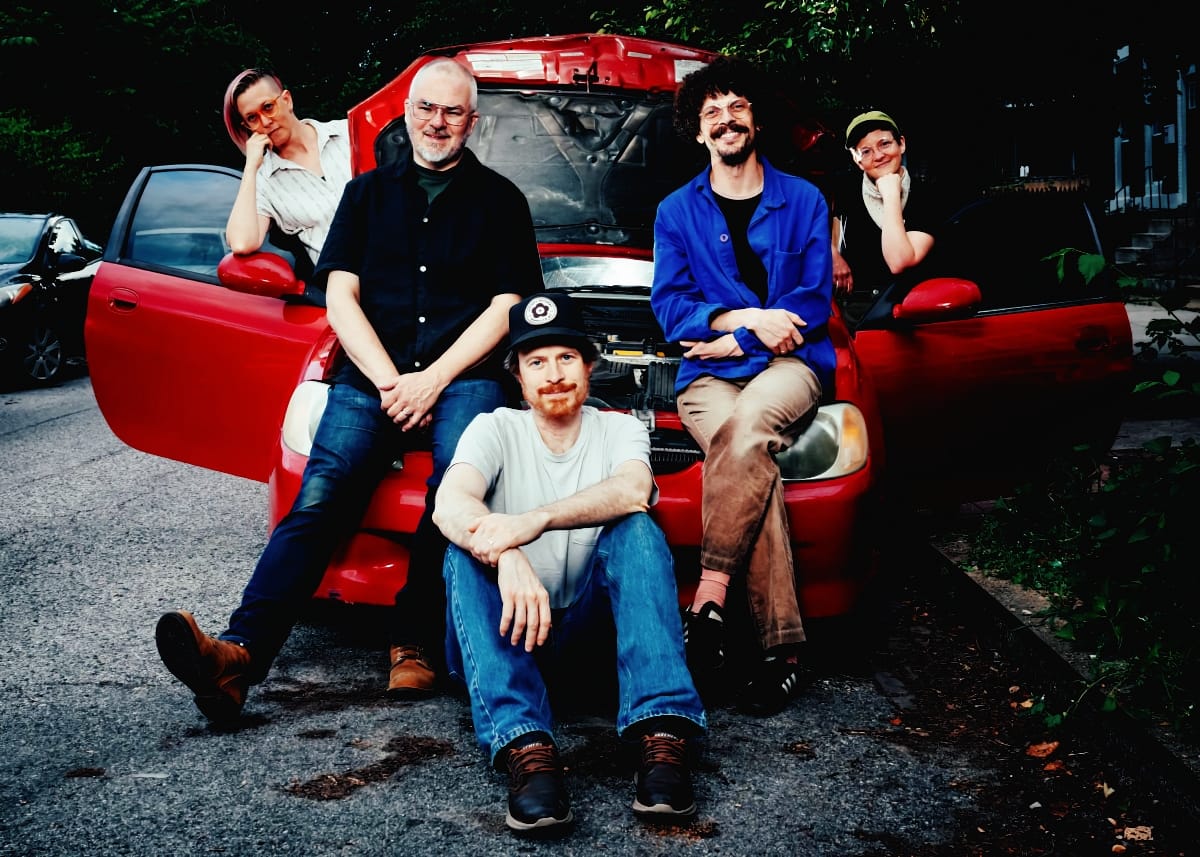
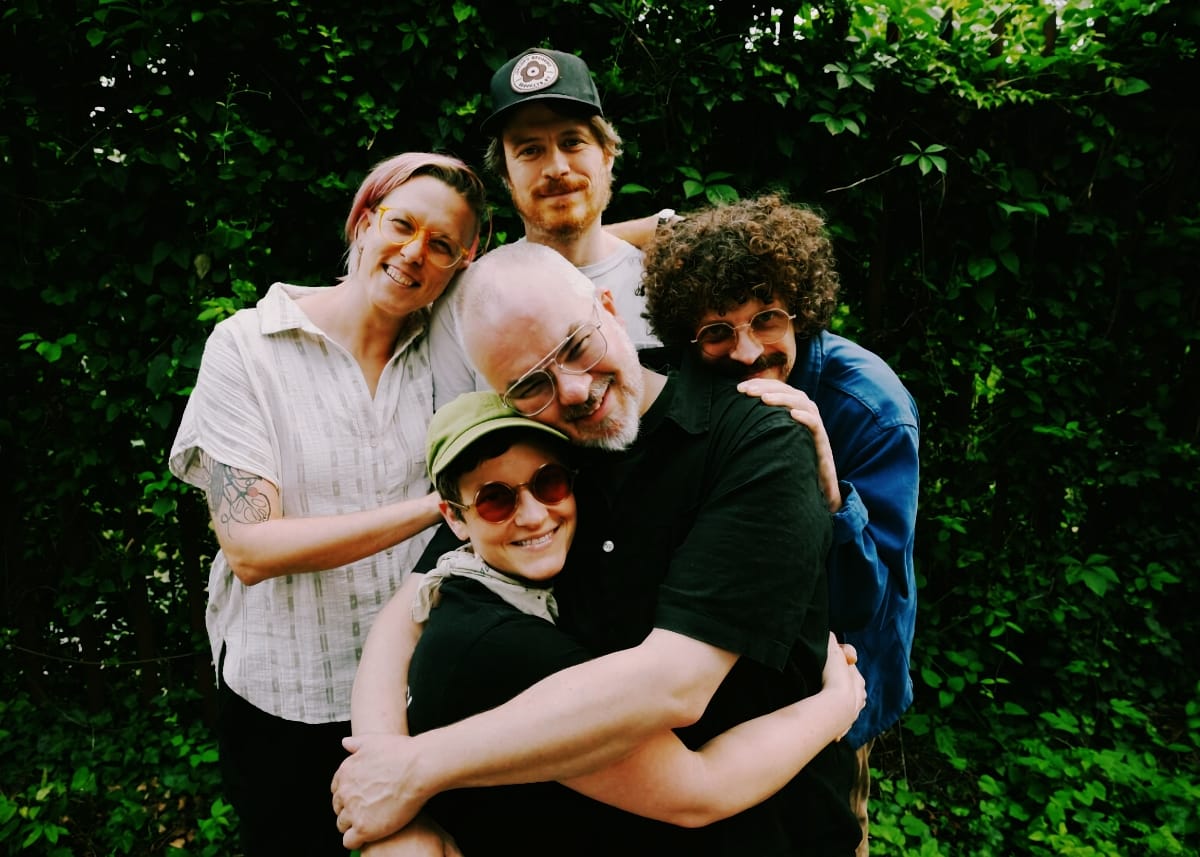
Saxophonist Christian Best and percussionist Jen Kirby previously played together in Smoke Bellow, a Baltimore-based combo self-described as "post-punk, disco, and modern minimalist." The two envisioned a new project while working on the band's final album, Structurally Sound (2024). This vision came to fruition when they connected with three other musicians—saxophonist Rose Hammer Burt, bassist Marc Miller, and keyboardist Steve Strohmeier—to form the experimental instrumental group Crying Laughing.
Like the minimalist composers Crying Laughing are inspired by, their debut Talking has compositions you’ll want to revisit. The first time you listen to a track like “Bass Alarm,” for example, you’ll likely be swept up in Kirby’s unique rattling snare beat, but the next time, you might be more focused on Miller’s same unending bass tone, which gives the tune—yes—the sound of an alarm clock. Still, the most enticing element for listeners is often percussion, exemplified in “When They Come to Town You Must Exile.” Here, Kirby plays melodic cowbells, and Best adds a hypnotic groove of other auxiliary percussion. Meanwhile, Burt’s saxophone soars over the mix, weaving an intricate web over an avant-garde backing.
Yet, Crying Laughing’s music never becomes too complex. Instead, the band’s songs are accessible, while still providing the more challenging landscape some listeners crave. Though the band is hard to classify—is it jazz, neoclassical, rock? Who knows?—the important part is it’s undeniably listenable and enjoyable, no matter who you are.
I wanted to hear how the group created this appealing balance, as well as how Christian Best and Jen Kirby brought their vision into reality. On a video call, we covered a lot of ground, from the band’s construction to why simplicity is important, and even why you might not want to quit your day job as an artist.
The transcript has been edited for length, flow, and clarity.
Bill Cooper: How did you learn to play your instruments?
Christian Best: I started playing saxophone five years ago in Smoke Bellow, when I was rethinking how to make a record. I was just so sick of playing the guitar, which happens quite often. I wanted a new instrument to play where I didn’t know what I was doing. That way, I could have this beginner’s mind about what I could do with it.
Jen Kirby: I grew up in a musical family, so I had some musical education as a young person in a basic sense. Then, I lived at a show space for a long time. There, I booked shows, went to a lot of them, and saw a lot of bands. So, I’ve been in the music world forever.
But in 2010 or 2011, a couple of friends of mine approached me and said, “We’re starting this band. We think you should be the drummer.” Which was funny, because I had not played drums, and they were both pretty good drummers. I just said, “I’ll try.” I was in that band for five or six years. That’s how I learned to play the drums—just playing in a room with these people, trying to make something that sounded and felt good.
Then, Christian asked me to play in Smoke Bellow. The band had just come out with a record and wanted to tour, but their drummer was busy. Christian asked if I could play drums instead. I said the same thing: “I’ll try.” I got some noise-canceling headphones, and our friend who recorded the record gave me the isolated drum tracks. I didn’t play those parts, but I adapted them to how I could play them and what made sense for me. Having to sit down and learn someone else’s parts made me a lot better at my instrument.
Bill: How else did Smoke Bellow prepare you both for Crying Laughing?
Christian: Smoke Bellow was a collaboration between my ex-partner and me. Some of the influences we explored in [Crying Laughing] were also in Smoke Bellow. However, they weren’t as prominent because there wasn’t as much space for them. When that band ended, it was a secret gift, because we could focus more on those influences.
Bill: So, you had a vision of what you wanted this project to be?
Christian: Yeah, definitely, and it’s been fleshed out by the people who very kindly offered to play with us.
Jen: It’s taken on a life of its own.
Bill: How did you determine who would fit in with this concept for this band?
Jen: Baltimore has a tight-knit music scene, and we’ve both lived here for years at this point—upwards of twenty for me, and fifteen or something for you?
Christian: Yeah.
Jen: We’re all in our forties. You have a sense by this point of who’s into what and who plays in what way. When we first started playing, it was just the two of us, seeing what felt good to play and figuring out where we were after the last band. It was more instinctual or intuitive, instead of being mapped out.
We’re lucky everyone we asked said yes. That’s the vibe of this town too—people are down to try stuff out. You don’t have to say you’re looking for a full-time member with certain requirements. You just say, “Do you want to play?” People always want to play, because nobody has aspirations beyond just playing music.
Bill: So, it sounds like it was pretty organic?
Jen: Yeah. When the four of us were playing [before Marc joined], it was clear that we needed bass in the sound.
Bill: The sound is so unique: two saxophone lead lines, the drum lines you’re doing; are there specific influences where you thought, “I want to sound more like that?”
Christian: Percussion-wise, I was thinking about Moondog. It’s melodic, but it’s also percussive. Not a lot of music is like that, so I thought it was interesting to explore. Philip Glass and Steve Reich are inspiring too with their endless music. The common thread is using simple ideas that are limitless in how you can use them. When we got together as a band in a room, the music took on its own identity.
Jen: Everyone plays in their idiosyncratic way. Certain members of the group are like chameleons. They’re intuitive in knowing what they should do.
Christian: It’s all the members who aren’t here right now [for this interview].
Jen: We joke about it, but it’s also true—we are the dunces of the group, because we’re both self-taught. We play the way we do, because it’s how we’ve figured it out. The other three are much more skilled musicians.
Still, Marc [Miller] plays in an idiosyncratic way too. He approaches the bass like a guitar player, or like someone who plays with bass players. Steve [Strohmeier] can play anything on any instrument. He’s like a savant, but he’s also very trained and has put a lot of work into it. Rose [Hammer Burt] is also highly trained, but also a total freak, which is a cool combo. She plays in a brass band—an actual brass band—but she’s also spent a lot of time in the experimental music realm.
Baltimore is a smaller town, so there’s a lot more crossover between people doing different types of things. Everyone’s not super siloed. There was a big experimental music scene here in the early 2000s, and it was a destination for that in the country. I think that had a big influence on our music.
Bill: One of the quotes I had from you, Christian, was: “Compositionally we aim to not encroach on each instrument’s space. All of us contribute to the overall rhythm and melody of each piece, trading roles and interweaving with each other.” Is there anything else you do as a group to communicate effectively and provide a space for each other as musicians?
Christian: An established band personality helps remove your ego. I’ve been in bands when I was younger where I would think, “What am I saying on the guitar, and how does that reflect upon me?” I still can get stuck in this self-conscious state. Thankfully, Jen is very good at keeping me in check. She always keeps me focusing on the fun, because what’s the point if it’s not? Additionally, it’s about the band and the song.
Jen: The writing is democratic and collaborative. We don’t have one songwriter. It’s zero-stress, zero-drama, and nobody has any personal ego about it. That has a huge influence on the music’s vibe and our ability to write new stuff. We have nearly another album’s worth of material. I think that’s why we’ve come as far as we’ve come in this short period of time.
Christian: Everyone also understands they can pass on anything anytime.
Bill: How did you create this album’s compositions? You said it’s a democratic process. What does that look like?
Christian: All kinds of ways, and I think that’s important too. Being creative is tricking yourself into never becoming too comfortable. The second you do become too comfortable, it sounds like shit. We write in a bunch of different ways—it’s never the same way twice. Sometimes, one member brings in a clear idea of what they want to achieve.
Jen: Sometimes, it’s a conceptual thing, like a prompt. For example, trying to make swelling waves. Other times, we’ll just play, go back and listen to it, and try to pull things out that worked. Then we’ll write something around that, make a structure, or write additional parts to fit it.
Occasionally, Christian will have a little demo that he made. We’ll all listen to it, approximate it, and then that takes on a life of its own and becomes a song. Or sometimes, someone will have a phrase—it really depends on the situation.
Christian: Which I think is crucial, because otherwise you get stuck.
Jen: We all have our own refined concept of what we think is good, and we hold ourselves to a high standard. We don’t want to bore people, and we never want to play too long. We do a lot of editing when we’re writing. Often, the criticism we get after we play is that the songs aren’t long enough, which I take as a good thing. That means we didn’t play them for too long.
We also don’t want to bore ourselves. Especially for me, as someone who does feel technically limited on my instrument, I’m always hoping to be better and push myself outside the ways I’ve already figured out to play. So, I’m not putting myself in a box, and I’m also trying to serve the music.
Bill: How much of Talking was set, and how much was improvised?
Christian: It’s a mix. It was mostly set, but there are certain sections of flourish we’re all allowed to do. There’s one song called “When They Come to Town You Must Exile.” Rose improvises that differently every time.
Jen: It’s basically a Rose solo showcase song.
Christian: That one’s like our celebration of Rose, because she’s so good. Her part is loose, but ours are not. We cue each other a lot. The biggest way we change parts is when we look at each other and one of us moves the saxophone deliberately, or Marc moves the neck of his bass deliberately, and we’ll go to the next bar.
Jen: That’s common. We do a lot of cueing.
Bill: It sounds like different people are cueing too. It’s not specifically one person. No one is leading everything.
Jen: There’s explicitly no band leader. It’s nice, because we’ve all been in bands that had band leaders. It’s nice not to have it and not need it, because then people step up when they need to.
Sometimes in this band you have to be able to do something simple. Sometimes, it’s almost uncomfortably simple, and you feel a little embarrassed. The whole first half of “Inner Life”—I couldn’t believe what I was playing. You feel guilty you’re doing so little, and everyone else is doing so much.
Christian: If you’re not careful, especially in the digital age, you become a maximalist. You have to permit yourself to keep it sparse and spare and simple. That’s such a huge part of joy in music. If there’s a song with twenty parts and everyone’s playing, there’s no room for you. It’s alienating. Which again comes back to Moondog. It’s such sparse, simple music that you can project whatever you want onto it, which is why you can listen to it over and over again.
Bill: So how do you create that simplicity and make those decisions?
Christian: I’ve made those mistakes before. We’re all older musicians. I’ve filled a record too much, and when I listen back to it now, I’m like, there’s no room in this. If ten mid parts take up that frequency range, you can’t hear any of them. I had a revelation about this a couple of years ago—I want to be deliberate about a band’s makeup and never stack too many frequencies on top of each other.
Jen: We all enjoy listening to each other play. Whenever you have a moment when you can stop playing, and everyone else is—that person is always like, damn, when they’re listening to everybody else. We all have a mutual admiration for each other, so that’s another thing that keeps us wanting to keep the space. You want to hear everything in a strictly pleasure sense.
Christian: I’m always trying to play as little as possible, honestly. My dream role in a band is to stand on stage and listen to the band. I could just be holding a cowbell on a stick or something and never play it. That would be my ideal role for this band—to just get to listen.
Bill: What makes you say that? I’ve never heard a musician say that before.
Christian: Because you listen differently. You listen with an involvement you don’t have as an audience member.
Jen: Like you have a responsibility, but, for now, you’re just watching.
Christian: Absolutely. It’s the best place to be.
Stay on top of The Tonearm.
Subscribe for exclusive interviews, cultural tip-offs, and community fun.
And your support keeps our site free of advertising and paywalls.
Bill: We have a lot of musicians who read this site. Any advice you would offer to anyone who’s either just starting out or trying to make it as a professional musician?
Jen: Don’t do it if it’s not fun. Why do it? We’ve both done it when it hasn’t been fun. And just get a day job and do it on the side.
Christian: But also, it’s okay to be a musician and have a day job. In fact, I think it makes you more of an artist. It informs you. When I first moved here to Baltimore, I did have a day job, but I was working within the music scene, in restaurants and stuff, so I didn’t have exposure to the city at large. And now I do. It’s nourishing to be part of the place you live and a community that isn’t just musicians, but instead, all kinds of people.
So, I think it’s important to keep your interests broad. We have a narrow view of what being a musician is—of what being an artist is. I’ve known so many incredible artists who also work as nurses, dog walkers, or janitors. We have to understand that most of the most enjoyable, interesting, or unique art in our societies doesn’t necessarily come from those with easy marketability or easy sales.
Basically, I’m saying give up and get a day job, but keep playing your instrument.
Bill: Or at the very least, music doesn’t have to be your only focus in your entire life.
Jen: I wouldn’t even refer to myself as a musician. I play music, but it’s not my identity. I respect people who are maniacally focused on something. Cool things can come out of that, but I have always been against trying to make your living from the thing you love doing, because it burns you out.
Christian: Some of the most miserable people I’ve ever met in my life have been successful professional musicians.
Bill: It sounds like they lost the magic for why they did it in the first place.
Christian: Yeah, absolutely. It became their job. That means they have to sell and make money, and that colors your art. You’ve already lost if you’re thinking of it like that.
Check out more like this:
 George Grella
 Bill Cooper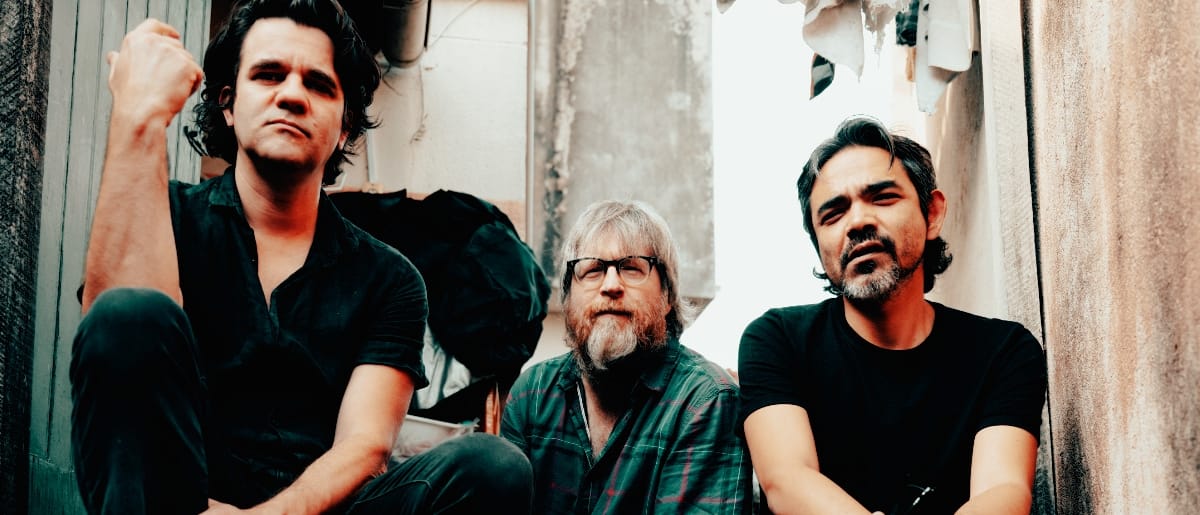


Comments